
Torsion Box, Racking & Hull Twisting
Why a 45° oblique wave twists an open-deck container ship, how the torsion box girder resists it, and why tankers need no such stiffening.
Key Principles at a Glance 6 points
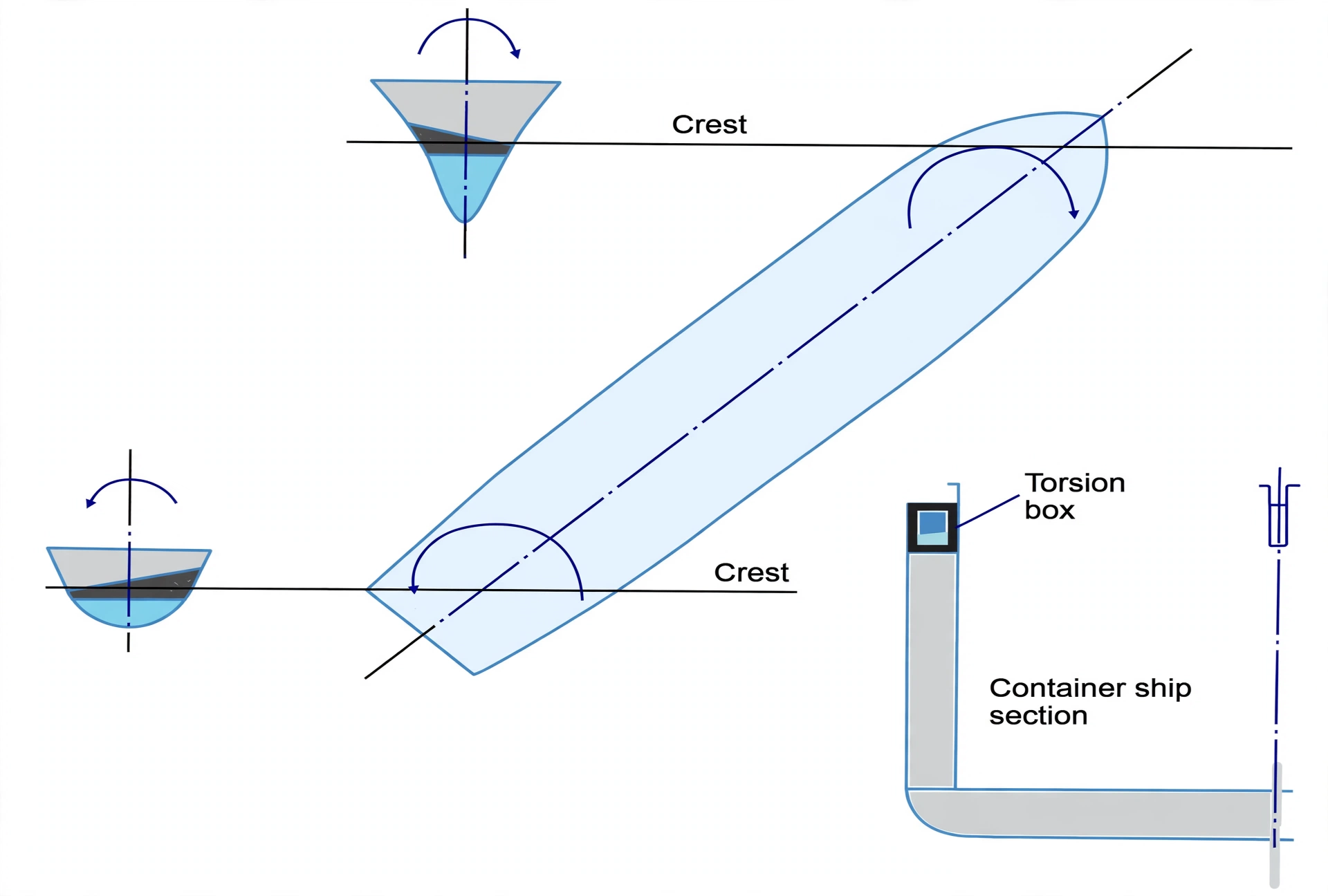
- Torsion occurs when a body is subject to a twisting moment (torque); a ship heading obliquely at about 45° to a wave experiences righting moments of opposite direction at its ends, twisting the hull.
- The torsion box is a heavy box girder structure including the upper deck, provided at the topsides of large container ships to accommodate torsional stresses.
- The torsion box runs from the collision bulkhead to the after peak bulkhead on both the port and starboard sides.
- The torsion box prevents torsional bending caused by the dynamic movement of waves and also helps avoid the racking effect caused by shear stress on the vessel.
- Racking is the transverse distortion of the hull when rolling, similar to the collapse of a picture frame; it is resisted mainly by transverse bulkheads, with beam knees and tank side brackets assisting.
- Oil tankers have many transverse bulkheads and a continuous uppermost deck with no large hatch opening, so they require no torsion box; bulk carriers have small hatch openings and sufficient deck stiffening to counteract the twisting moment.
1. Hull Torsion: The Oblique Wave & Open-Deck Problem
Torsion occurs when a body is subject to a twisting moment, commonly referred to as torque; the body is then said to be in torsion.
The Oblique Wave Condition:
A ship heading obliquely (about 45°) to a wave will be subjected to righting moments of opposite direction at its ends, twisting the hull and putting it in torsion. In simple terms, one end of the ship is supported by a wave crest while the other end is in a trough, and because the wave approaches diagonally, the two ends are forced to rotate in opposite senses about the ship's longitudinal axis.
Why Only Some Ships Care:
- In most ships these torsional moments and stresses are negligible.
- In ships with extremely wide and long deck openings they are significant, because the deck cannot act as a continuous top flange.
- A particular example is the larger container ship, where at the topsides a heavy torsion box girder structure including the upper deck is provided to accommodate the torsional stresses.
Surveyors frequently ask torsion box questions specifically for container ships because that is where the structure is fitted. Remember the two-word answer for its purpose: torsion and racking.
Orbit the open-deck ship and switch modes to watch the hull twist in an oblique sea, isolate the torsion box girder and its closed cell, see the picture-frame racking resisted by transverse bulkheads, and compare why oil tankers and bulk carriers need no box.
2. The Torsion Box Girder: Location & Construction
The torsion box is a heavy box girder structure including the upper deck, fitted at the topsides of ships with large deck openings (principally container ships) to accommodate torsional stresses.
Location:
Runs from the collision bulkhead to the aft peak bulkhead on both the PORT and STARBOARD sides. Running the full length of the cargo region and continuing into the wing structure ties the two sides of the ship together, closing the top of the hull like a tube.
What the Torsion Box Prevents:
- Torsional bending: Caused by the torsional moment on the ship arising from the dynamic movement of waves.
- Racking effect: Helps avoid the racking caused by shear stress on the vessel.
Construction Principles:
- Closed box form: The upper deck, side shell, and internal longitudinal bulkheads/plating form a closed cell whose large enclosed area gives very high torsional stiffness.
- Continuous top flange: Unlike the open cargo hatch region, the box restores a continuous upper flange on each side, so torsional shear flows can be carried around a closed loop.
- Tied to transverse structure: It works together with transverse bulkheads, web frames, and hatch coaming side structures.
3. Racking Effect & Resistance by Transverse Bulkheads
What is Racking?
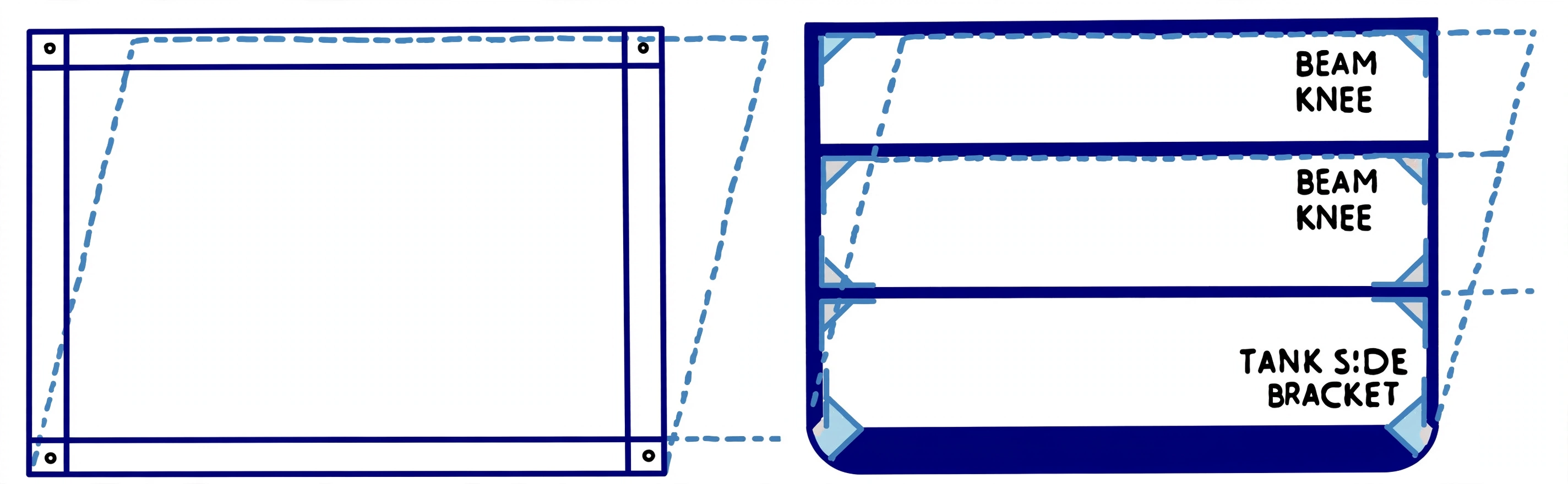
When a ship is rolling, the deck tends to move laterally relative to the bottom structure, and the shell on one side tends to move vertically relative to the other side. This type of deformation is referred to as racking.
Put another way: when a ship rolls there is a tendency for the ship to distort transversely in a similar way to that in which a picture frame may collapse. This is known as racking.
How Racking is Resisted:
- Beam knees at the deck-to-side connection.
- Tank side bracket connections.
- Transverse bulkheads — these have the greatest effect.
Transverse bulkheads primarily resist such transverse deformation, the side frames' contribution being insignificant provided the transverse bulkheads are at their usual regular spacings. This is the key sentence surveyors are listening for.
4. Why Oil Tankers & Bulk Carriers Need No Torsion Box
Surveyors often follow the torsion box question with: "Why does an oil tanker not have a torsion box?" The answer lies in how the deck structure and internal subdivision of these ship types already resist twist.
Oil Tankers:
- An oil tanker has many transverse bulkheads which act as main stiffening members for both racking and twisting.
- Along with these, it has an uppermost continuous deck which does not have a large opening (hatch), compared to a dry cargo ship.
- So an oil tanker does not have additional stiffening such as a torsion box, because the continuous deck and frequent transverse bulkheads already provide the necessary resistance.
Bulk Carriers:
- Bulk carriers have small hatch openings.
- They have sufficient deck space or deck stiffening members which are sufficient to counteract the twisting moment.
Comparison Summary:
| Ship Type | Deck Opening | Torsion Box? | Reason |
|---|---|---|---|
| Container Ship | Very wide & long | Yes | Large opening destroys continuous top flange; high torsional stress |
| Oil Tanker | None (continuous deck) | No | Many transverse B/H + continuous uppermost deck resist twist |
| Bulk Carrier | Small hatches | No | Sufficient deck space/stiffening counteracts the twisting moment |