
Ship Classification, Surveys and Drydocking
Who certifies the structure and what they do to it at intervals — the classification societies, the cycle of periodic surveys, and the drydock where the worst of it happens.
Key Principles at a Glance 8 points
- A classification society is a non-governmental body that sets and maintains technical standards for the construction and operation of ships, and most flag states delegate survey and certification to one.
- Class is assigned through a defined process of plan approval, survey during construction and survey on completion, and it is maintained by the survey programme that follows.
- Class can be suspended, withdrawn or restored, and the difference matters: a ship trading without class is uninsurable and largely unemployable.
- Statutory survey is carried out for the flag state under the conventions; classification survey is carried out for the society under its rules. Both happen, and they are not the same thing.
- The periodic cycle runs annual, intermediate, bottom, boiler, tailshaft and renewal or special survey, and the Harmonized System fixes the intervals and the certificate.
- The Enhanced Survey Programme applies to tankers and bulk carriers because their structure ages by corrosion in ways a general survey misses.
- Substantial corrosion is judged against the original scantling, and once wastage passes the allowable margin the plating is renewed rather than monitored.
- The drydock work is planned from the docking plan and the shell expansion, and the critical period is the interval when the ship is partly waterborne and partly on the blocks.
16.1 Classification
Who certifies the structure, and what they do to it at intervals. Part 15 built the ship under the surveyor's eye; this part is the authority that surveyor represents — and the programme of surveys that never ends for as long as the ship trades.
16.1.1 Introduction to classification
International law requires every merchant ship to be registered in a country — its flag state. Registration is like a person receiving a passport: the ship is bound to the law of, and sails under the flag of, the country of registration. The flag state exercises regulatory control — regular inspection, certification of equipment and crew, safety and pollution documents — and most flag states give the authority for these inspections and documents to a classification society.
A classification society is a non-governmental organisation that establishes and maintains technical standards for the construction and operation of ships and offshore structures.
16.1.2 Why a ship is usually classed
To be registered, an ocean-going ship must be certified of a particular type and size and maintained to minimum standards. Class is a requirement of most insurance companies and shippers using the vessel.
Classification is a special certification confirming the ship complies with the society's requirements — on the understanding she is loaded, operated and maintained properly by competent, qualified crew. A vessel either meets the Rules or does not: she is either in or out of class.
16.1.3 What classification societies do
Their purpose is classification and statutory services — assistance to the maritime industry and regulators on safety and pollution prevention, from accumulated maritime knowledge and technology. The objective is verifying the structural strength and integrity of the hull and appendages, and the reliability and function of propulsion, steering, power generation and other essential-service systems — through their own Rules and through verifying compliance with international and national statutory regulations on behalf of flag administrations.
The concept rests on three elements, for newbuildings and ships in service alike:
- Setting standards (classification Rules).
- Verification of compliance (approval of specifications and drawings, surveys and testing).
- Documenting compliance (survey reports, classification certificates).
Societies grant notations indicating compliance, shown on the certificate and in the published Register of Ships — the character symbols such as +100A1 assigned at classification.
16.1.4 What classification societies ensure
Compliance with the standards — the rules — by four means:
- Design to a recognised standard (safety and reliability of propulsion and steering).
- Construction to a recognised standard (structural strength of all essential hull parts and appendages).
- Operation and maintenance through her life to a recognised standard.
- Regular survey to confirm she stays up to standard.
16.1.5 Certificate of classification
Classification confirms the ship complies with the society's published standards — and the certificate is an attestation only of that compliance. It does not imply:
- Warranty of safety,
- Fitness for purpose, or
- Seaworthiness of the ship.
16.1.6 The societies, and IACS
The International Association of Classification Societies counts 13 member societies:
| Society | Country |
|---|---|
| ABS — American Bureau of Shipping | USA |
| BV — Bureau Veritas | France |
| CCS — China Classification Society | China |
| CRS — Croatian Register of Shipping | Croatia |
| DNV — Det Norske Veritas | Norway |
| GL — Germanischer Lloyd | Germany |
| IRS — Indian Register of Shipping | India |
| KR — Korean Register | Korea |
| LR — Lloyd's Register of Shipping | UK |
| NK — Nippon Kaiji Kyokai | Japan |
| PRS — Polish Register of Shipping | Poland |
| RINA — Registro Italiano Navale | Italy |
| RS — Russian Maritime Register of Shipping | Russia |
IACS — the International Association of Classification Societies — is the chartered body representing them, dedicated to safe ships and clean seas through technical support, compliance verification and research. More than 90% of the world's cargo-carrying tonnage is covered by the thirteen members' design, construction and compliance Rules, and the Association holds consultative status at IMO.
16.1.7 Why enrolling a ship is called classification
In the 18th century an attempt was made to classify each ship's condition on an annual basis — and the societies formed around that practice:
- Hull condition was classified A, E, I, O or U, by excellence of construction and perceived continuing soundness.
- Equipment was G, M or B: good, middling or bad.
That method is gone. Today the vessel meets the Rules or does not — in or out of class, with nothing in between.
16.1.8 The process of classification — seven steps
- The builder submits design plans; class verifies compliance with its Rules and approves.
- A class surveyor attends during construction, verifying the vessel is built to the approved plans and Rules.
- Surveyors attend the production facilities supplying key components — steel, engines, generators, castings — verifying conformity with the Rules.
- Surveyors attend sea trials and other trials before delivery, verifying conformance.
- On satisfactory completion, a certificate of class (hull and machinery) is issued and kept onboard.
- Particulars are entered in the class register with character symbols assigned (e.g. +100A1).
- In service, the owner submits the vessel to the specified programme of periodical class surveys for continuation of class.
16.1.9 How the class is maintained — and what affects it
In service the owner submits the vessel to the survey programme — class renewal (special survey), intermediate survey, annual survey, and bottom/docking surveys, plus tail shaft, boiler and machinery surveys. Between surveys the owner must keep maintenance satisfactory.
The owner's standing duties:
- Carry out regular surveys of hull, machinery and equipment.
- Carry out necessary repairs under class surveyors' supervision.
The class is affected when:
- Significant defects appear in structures, or in systems and equipment under the Rules.
- Damage is sustained through heavy weather, malfunction or human error.
Owner and operator must inform class of defects or damage without delay.
16.1.10 Suspension, restoration and withdrawal
Suspended by society decision when:
- The ship is not operated in compliance with the Rules.
- She proceeds to sea with less freeboard than assigned.
- The owner fails to request a survey after detecting class-affecting defects or damage.
- Repairs, alterations or conversions affecting class are done without a surveyor in attendance.
Automatically suspended when:
- The renewal/special survey is not completed by its due date (or granted time), unless society surveyors are in attendance to finish before trading resumes.
- Annual or intermediate surveys are not completed within their windows.
Suspension lasts until the due surveys and any further survey the society deems fit are completed. Withdrawn when: the owner requests it; suspension exceeds six months; she is a constructive total loss with no declared repair intent; she is reported lost; or she will not trade further.
Conditions of class. Recommendation and condition of class are different IACS-society terms for the same thing: requirements imposed by the society, non-compliance with which by the due date affects class status. In the orals' form: a condition of class is issued where the hull or machinery has issues and temporary measures have been done — the surveyor checks them and issues the condition so the ship may sail one voyage or some stated period. Unremoved by that date, the class certificate goes invalid and the ship counts unseaworthy.
Interim certificate. Where damage cannot be permanently repaired at once, the society may accept a temporary repair and issue an interim certificate stating the limitation — retained in class until next port, or until next dry-docking. Without the full recommended repairs thereafter, she is taken out of class. Interim certificates are also issued after satisfactory survey until full-term certificates arrive.
16.1.11 Statutory against classification survey
To keep the ship in class, the owner surveys hull, machinery and equipment regularly and repairs under class supervision.
| Statutory survey | Classification survey | |
|---|---|---|
| By | The Administration | The classification surveyor |
| Under | National and international rules — safety, seaworthiness, pollution | Class requirements — structural and mechanical fitness for the intended voyage |
| Effect | Certificate essential to trade; without it the ship can be detained | Visual examination: overall examination of Rule items, detailed sampling checks, witnessing of tests, measurements and trials |
| Examples | Tonnage; load line (5-year); safety construction (5-year); safety equipment (2-year); safety radio (1-year); MARPOL IOPP and IAPP (5-year) | As per the Rules programme |
Two distinctions within that table:
- A statutory survey inspects against a set standard or law — it is not measuring for a client — and its certificate is what lets the ship trade.
- Class cannot attend unless the owner requests it — or unless port state control has detained the ship. Societies issue statutory certificates only where the administration has delegated that authority to them.
16.1.12 Condition of assignment — where it belongs
Condition of assignment is the load line concept: the protections and closures of openings on which the assigned freeboard is conditional. It is treated in full in Part 14 §14.2.7.
16.2 Periodic and non-periodic survey
16.2.1 Periodical survey and the life-cycle of a ship
The society that verified the design and construction verifies the ship periodically after delivery: to remain in class she must undergo surveys confirming maintenance to class standards and Rule conformance.
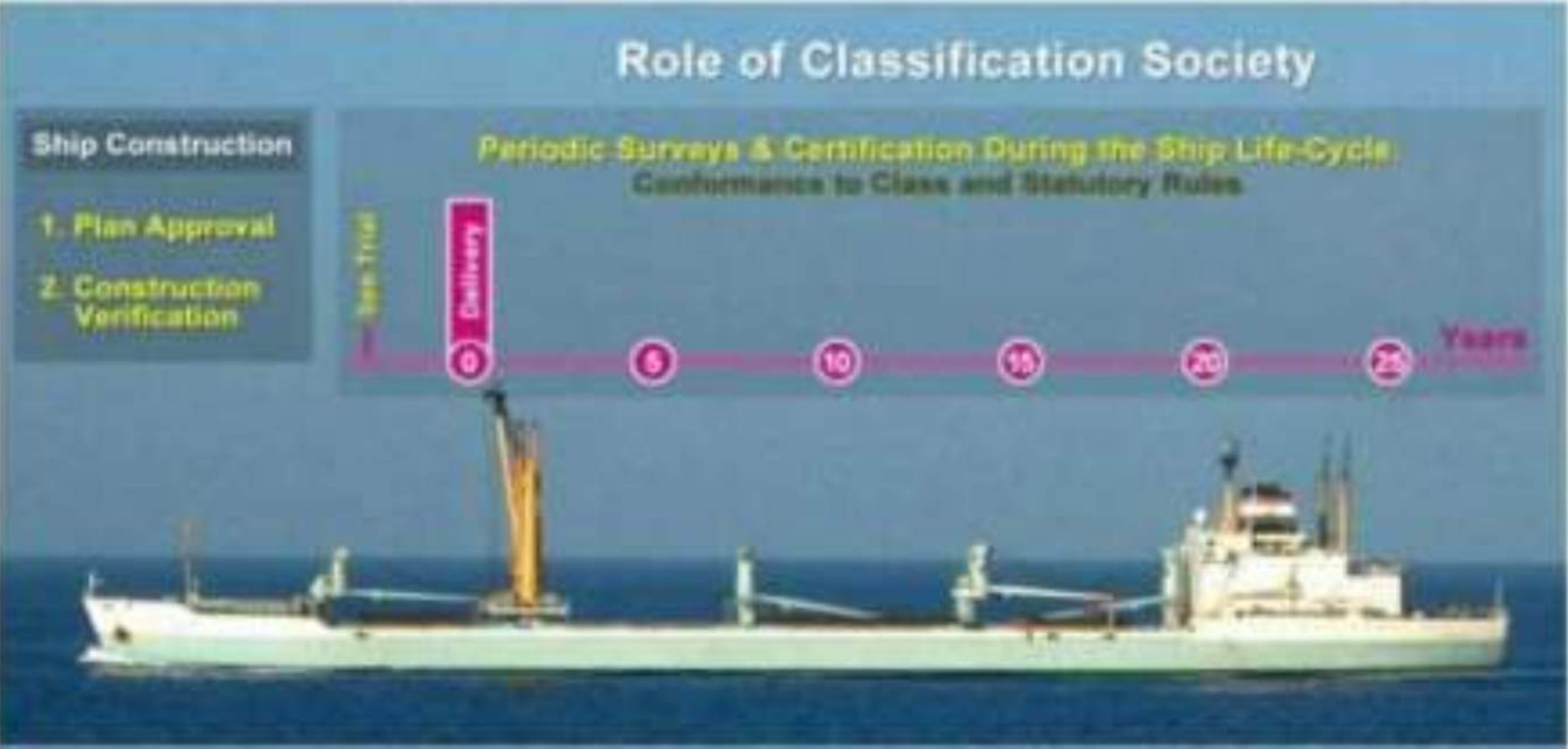
Each classed vessel follows a five-year cycle: annual surveys, an intermediate survey, and a class renewal (special) survey every 5 years.
16.2.2 The six periodic surveys — annual, intermediate, bottom
Six periodic surveys make up the programme:
Annual. Every steel ship is surveyed about yearly, where practicable concurrently with statutory annual or load line surveys. The surveyor examines all closing appliances under the freeboard-assignment conditions, the freeboard marks, auxiliary steering gear, watertight doors and bulkhead penetrations, and verifies structural fire protection. General condition is assessed; anchors and cables inspected where possible; dry bulk carriers get a forward and an after hold inspected. Window: ±3 months of the anniversary date.
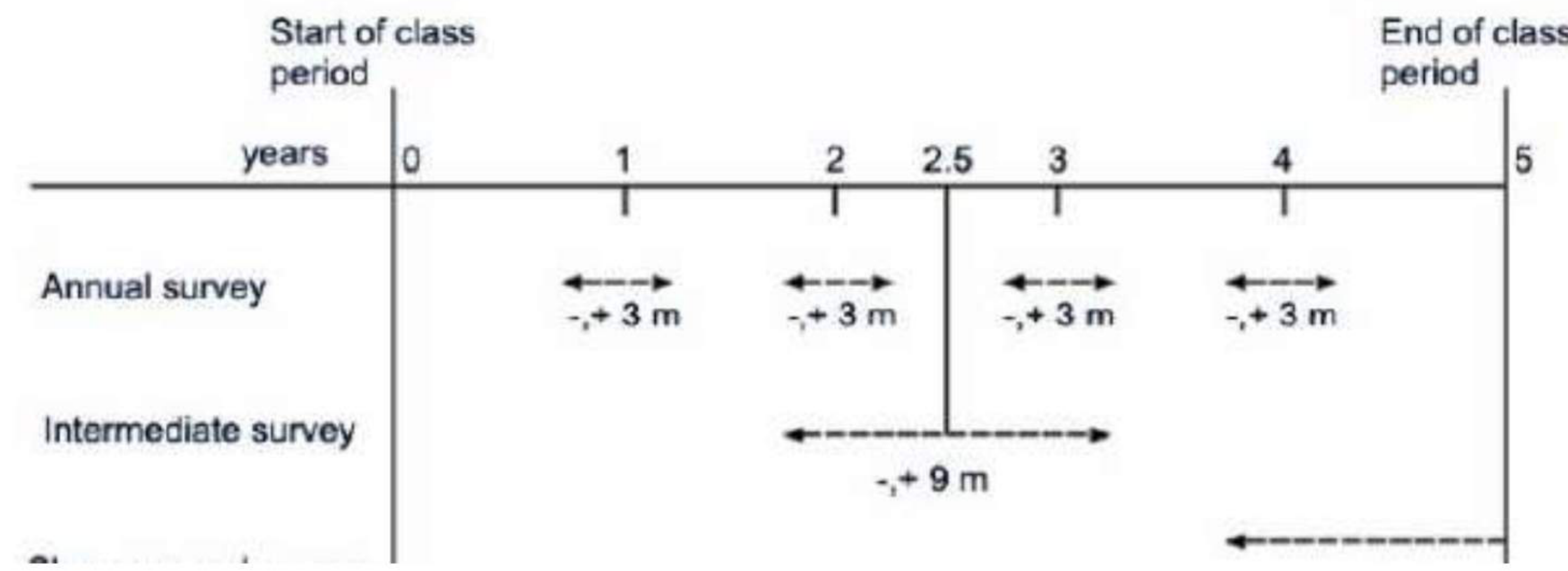
Intermediate. Taken instead of the second or third annual survey after building or special survey. Over and above the annual requirements, attention goes to cargo holds in vessels over 15 years of age and to the operating systems of tankers, chemical carriers and liquefied gas carriers.
Bottom/docking. Examination of the outside of the hull and related items, twice in the certificate's five years with no more than 36 months between surveys.
The anniversary date is the day and month in the class certificate corresponding to its expiry; annual, intermediate and renewal certificates each carry their own.
16.2.3 Boiler, tailshaft and renewal surveys
Boiler. Boilers and thermal oil heaters surveyed twice in every five years. Steam boilers, superheaters and economisers examined internally and externally — drained and suitably prepared for examination of the water-steam side and the fire side.
Tailshaft. Survey of propeller shafts, tube shafts and other propulsion systems. On modern ships with keyless propellers and oil-lubricated stern tubes, with regular lubricating-oil analysis, the interval is 5 years.
Renewal (special). Assesses whether structural integrity still conforms to the Rules — structure, machinery and equipment inspected for Rule compliance, with the owners declaring modifications relevant to class requirements.
16.2.4 Non-periodical surveys
Carried out for example:
- Updating classification documents — change of owner, name or flag.
- Damage or suspected damage, repair or renewal work, alterations or conversion, postponement of surveys or of recommendations/conditions of class.
16.2.5 Harmonized System of Survey and Certification
The IMO harmonized system of survey and certification, covering the international shipping regulations, entered into force on 3 February 2000 — covering survey and certification under MARPOL, SOLAS, Load Line and the like.
Before it, survey dates and intervals under different conventions did not coincide, and a ship could come off one survey only to enter yard for another. The harmonized system ends that:
- One-year standard interval between surveys — initial, annual, intermediate, periodical and renewal as appropriate.
- Five years maximum validity for all cargo-ship certificates.
- Extension limited to three months to complete a voyage (one month on short voyages).
16.2.6 Port State inspection
Port State Control is the inspection of foreign ships in national ports by PSC officers, verifying the competency of master and officers and the condition of ship and equipment against SOLAS, MARPOL, STCW and the like, with manning and operation in compliance with international law.
Its objectives:
- Eradicate sub-standard ships.
- Identify and detain ships that are a threat to life at sea.
- Identify and detain ships that are a threat to the marine environment.
16.2.7 IGC and IBC explained
IGC Code — the International Code for the Construction and Equipment of Ships Carrying Liquefied Gases in Bulk. Mandatory for all new ships under SOLAS amendments; compliance is proved by an International Certificate of Fitness for the Carriage of Liquefied Gases in Bulk kept onboard. The purpose is an international standard for the safe bulk sea transport of liquefied gases and certain other substances.
IBC Code — the International Code for the Construction and Equipment of Ships Carrying Dangerous Chemicals in Bulk. The international standard for safe bulk carriage of dangerous and noxious liquid chemicals, prescribing design and construction standards and equipment with regard to the products — with standards for three ship types (Type 1, 2 and 3) by hazard level of the chemical cargo.
16.2.8 Special survey and the ESP Code
The Enhanced Survey Programme applies to bulk carriers and oil tankers, mandatory under SOLAS Chapter XI-1, Regulation 2. On 30 November 2011 a new resolution — the ESP Code — arrived, in force 1 January 2014. It came because many bulk carriers were lost at sea during the 1990s, showing the survey measures then in force were not sufficient.
Close-up inspection during renewal is aimed by three things:
- Hull-related deficiencies at PSC inspection and non-conformities at SMS audits.
- Damage history — frequent damage to one area, on the ship or her sisters, directs attention there.
- Critical and suspect areas — areas with substantial corrosion at the previous survey become suspect areas.
16.2.9 Substantial corrosion
- T = original thickness
- Ta = minimum allowed thickness
- Td = maximum allowed thickness reduction
Corrosion is substantial where assessment of the pattern shows wastage in excess of 75% of the allowable corrosion, but within limits.
16.2.10 Survey against audit against inspection
| What it is | |
|---|---|
| Inspection | A check of the physical condition of an item — a lifeboat, an extinguisher — carried out physically |
| Audit | Looks at past activities: faults, operations, system operation, documentation. Not very thorough |
| Survey | Looks to future activity — so the equipment keeps functioning. Physical status (a machinery fit to run before the survey clears). More thorough |
16.2.11 Preparation for a safety construction survey
| Item | Inspect |
|---|---|
| Structure | Structural strength; peak and machinery bulkheads; stern tubes; watertight bulkheads, decks and inner bottoms; watertight decks |
| Machinery | Main machinery, means of manoeuvring and going astern |
| Systems | Ventilation in machinery spaces; noise protection; boilers and other pressure vessels |
| Electrical | Installations, main power source and switchboard, lighting |
16.2.12 Safety Construction against Safety Equipment certificates
| Safety Construction Certificate | Safety Equipment Certificate | |
|---|---|---|
| Issued to | Every cargo ship of 500 GRT and over, by the flag state government | Every cargo ship of 500 GRT and above, by the flag state government |
| Validity | 5 years, surveys at specified intervals | 2 years, annual inspection ±3 months |
| Covers (SOLAS 1974) | Ship structure incl. structural fire protection; external bottom examination; electrical installation; steering gear; pressure vessels and fittings; main and auxiliary machinery | Fire-fighting appliances (FFA); life-saving appliances (LSA); navigation equipment — by inspection and demonstration |
16.3 Drydocking
16.3.1 Types of dry dock
Graving dry dock. Built on land near coastal waters: a rectangular solid concrete construction with blocks, walls and gates. The vessel is shifted inside and rested on the blocks; the gate closes and the water is removed.
Floating dry dock. A U-structure, first used in salvage — carrying damaged ships unable to reach a coastal dock — now used by many regular small and mid-size seagoing vessels, with several U-docks joinable for a large vessel. The ship comes alongside the channel, the dock partly submerges, the ship slides inside; steel framing like a seagoing vessel's, with side and bottom ballast tanks to raise and lower the dock. Operated in sheltered harbours without wave or tidal action.
16.3.2 Requirements for dry dock
The three from Part 3 §3.7, restated as the docking triad:
- Adequate initial GM — touching the blocks raises G and reduces GM; the initial margin must compensate.
- Vessel upright — no list when touching, or contact off the centreline can tip her.
- Small or moderate trim aft — stern and bow ground in tandem rather than together, reducing hull and keel load.
16.3.3 Regulation for dry dock
Under SOLAS Chapter I, Regulation 10: a minimum of two inspections of the outside of the ship's bottom in any 5-year period, with no more than 36 months between any two. The inspection may be in dry dock or underwater, at the classification society's decision on the vessel's condition.
16.3.4 Dry dock critical period
The critical period runs from when the stern touches the blocks to when the entire weight is borne by the blocks — the vessel sitting completely. Continuous monitoring throughout: critical means carrying the potential for disaster.
Precautions:
- Adequate initial GM — it starts reducing the moment the stern touches.
- Minimum required trim — shortening the critical period cuts the sudden hull and keel load on the blocks.
16.3.5 Dry dock preparation as second engineer
- Repair and maintenance list; drydock handbook; duties assigned; staff grouped over yard gangs.
- Spares checked, repair items ready.
- Previous dry dock reports studied, clearances noted.
- Engine room tank top and bilges cleaned.
- Sewage, dirty oil and bilge tanks prepared.
- Bilge lines flushed before docking.
- Oil-water separator element renewed, system proved.
- Tankers: cargo tanks cleaned and gas-freed.
- Minimum bunkers (fuel, fresh water) and ballast.
- Heavy weights secured.
- Tanks and cofferdams sounded and recorded.
- Fire and safety measures discussed beforehand.
- Firefighting equipment checked and ready.
- Emergency lighting and generator tested before entry.
- Escape routes clearly marked — with E/R work under second engineer supervision.
16.3.6 Plans for dry dock — docking plan and shell expansion
Docking plan. A detailed plan view from the bottom: all bottom openings including main sea suction boxes at the machinery area underside, individual drain plug holes (one per tank, two in large ships' tanks), and the recommended block lines with block pitch. Three rows of blocks normally support bulkers, tankers and container ships; finer cargo forms get breast shores marked. For normal docking only — after heavy collision or bottom damage an amended plan is made from the shipyard diver's photographs of the afloat bottom, with alternate supports where the original blocks cannot bear.
Shell expansion. A two-dimensional drawing of the three-dimensional hull surface: shell plates butt-welded, vertical joints as butts, horizontal as seams. Bottom-to-bilge strakes run thickest over 40% of the length amidships where bending stress peaks, thinner at the ends apart from the pounding region's extra.
The capacity plan is not treated in the material.
16.3.7 Checks in the sea chest during dry dock
- Inspect corrosion and condition of sea chest plating.
- Check the grating.
- Inspect the MGPS (marine growth prevention system).
- Check steam injection and vent valves.
- Gauge plating on old ships.
- Check overboard valve connections.
- Assess sea growth and shell plating — growth volume before cleaning, as a measure of anti-fouling effectiveness.
- Check welds at joints after cleaning.
- Check anodes: fully consumed means insufficient quality or quantity; uncorroded means improper fitting — normally about 75% consumed. Check welded areas for cracks, corrosion and deformation.
16.3.8 Fuel oil double bottom tank — preparing it for survey
Transferring, cleaning and gas freeing first. Then atmosphere testing:
- Toxicity.
- O₂ content with the oxygen analyser.
- Explosive gases with the explosimeter.
- Gas-free certificate from the chemist.