
Principal Dimensions and Ship Reference Points
The coordinate system every calculation is built on: perpendiculars, moulded against extreme dimensions, and the four form coefficients that describe how fine the hull is.
Key Principles at a Glance 7 points
- The forward perpendicular is where the summer load waterline crosses the stem; the after perpendicular is the after side of the rudder post, or the centre of the rudder stock where there is no post.
- Length between perpendiculars is the distance between those two points and it is the length used for ship calculations; length overall is the extreme length and is the one that matters when docking.
- Breadth, depth and draught each have a moulded and an extreme value. Moulded dimensions are taken to the inside of the shell plating, extreme to the outside, and the difference is the plate thickness.
- Moulded draught is measured from the top of the keel, not from the bottom of the keel — the one figure that catches candidates out at the oral.
- The block coefficient is the ratio of the underwater volume to the box L x B x T, so a full slow ship sits near 0.8 and a fine fast hull near 0.55.
- The prismatic coefficient compares the underwater volume to a prism of the midship section, and it is the coefficient that describes how the volume is distributed along the length.
- The midship coefficient and the waterplane coefficient describe the fullness of the midship section and of the waterplane respectively; all four are dimensionless and always less than one.
1b.1 Sides, ends and stations
The coordinate system of the ship: the lines from which everything else is measured, the principal dimensions, and the coefficients that describe the hull's fineness. This is a separate subject from ship types, and it is the block of definitions most often asked for by name at the oral.
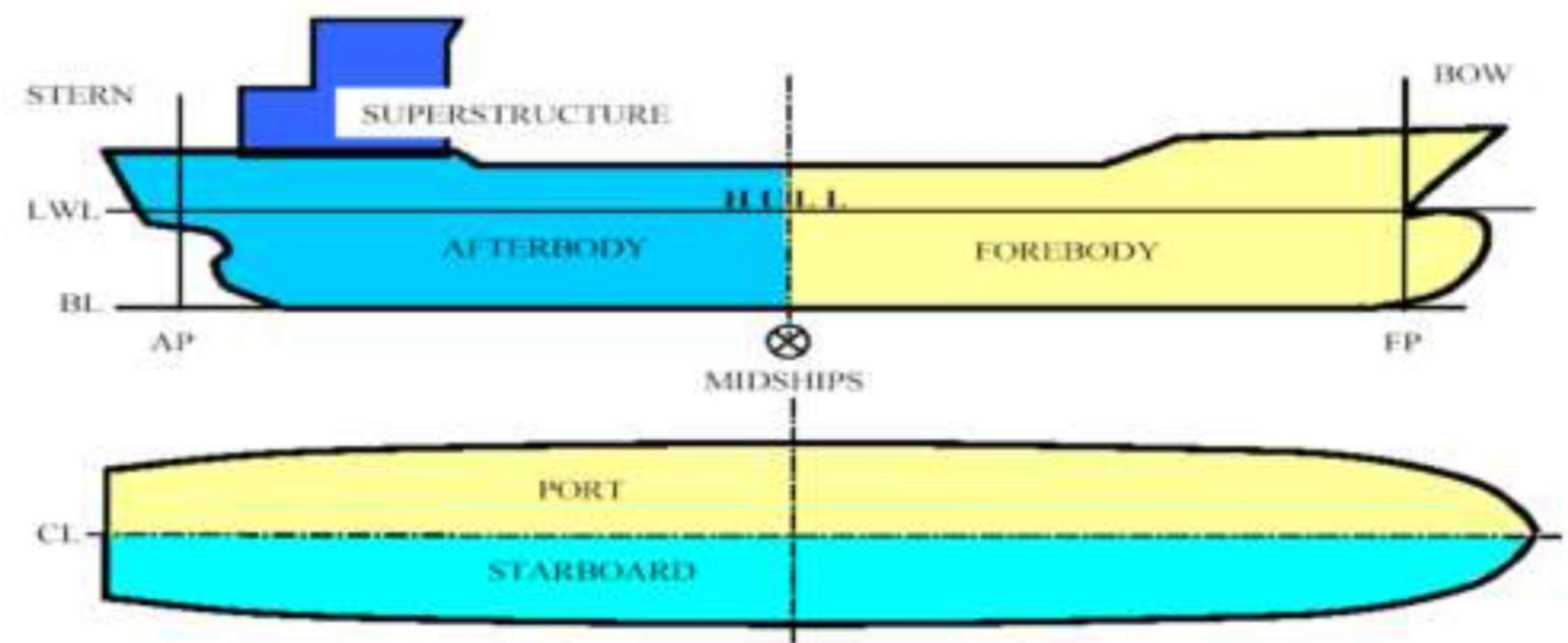
Port and starboard. Viewing the ship from aft, the left side is the port side and the right is the starboard side.
Stem / bow. The front-most part of the boat or ship's bow is termed the stem of the ship.
Forward perpendicular (FP). The point at which the Summer Load Waterline crosses the stem — equivalently, a vertical line at the intersection of the fore side of the stem and the summer load waterline.
After perpendicular (AP). The after side of the rudder post, or the centre of the rudder stock if there is no rudder post. Stated at full length: the intersection of the summer load waterline with the after side of the rudder post or stern post, or the centreline of the rudder stock if there is no rudder post or stern post.
Length between perpendiculars (LBP). The distance between those two points. This is the length used for ship calculations.
Length overall (LOA). The distance from the extreme fore part of the ship to a similar point aft — the greatest length of the ship, or the extreme length measured from the foremost point of the stem to the aftermost part of the stern. This length is important when docking.
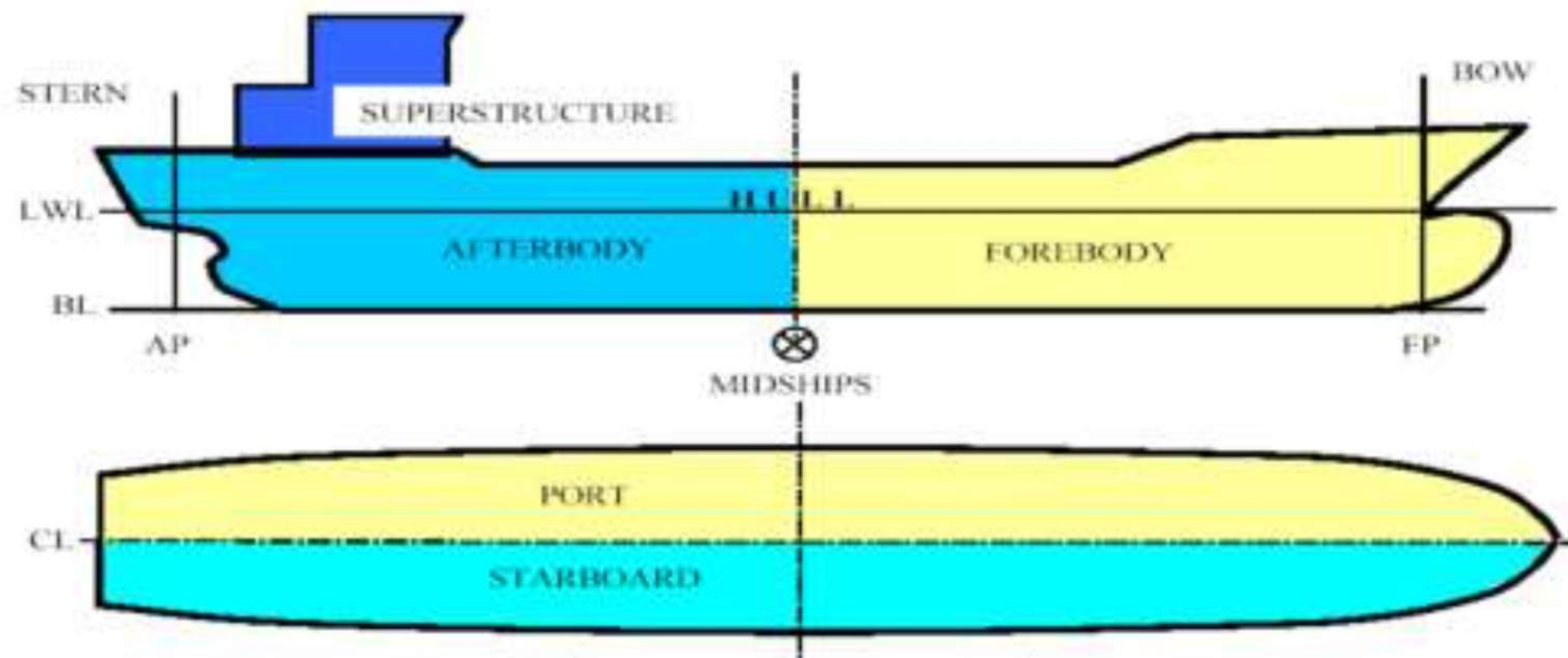
Midships, forebody, afterbody, superstructure. The profile is divided at midships; the part forward is the forebody, the part aft the afterbody, and the deck structure above the main deck is the superstructure.
1b.2 Breadth, depth and draught — extreme against moulded
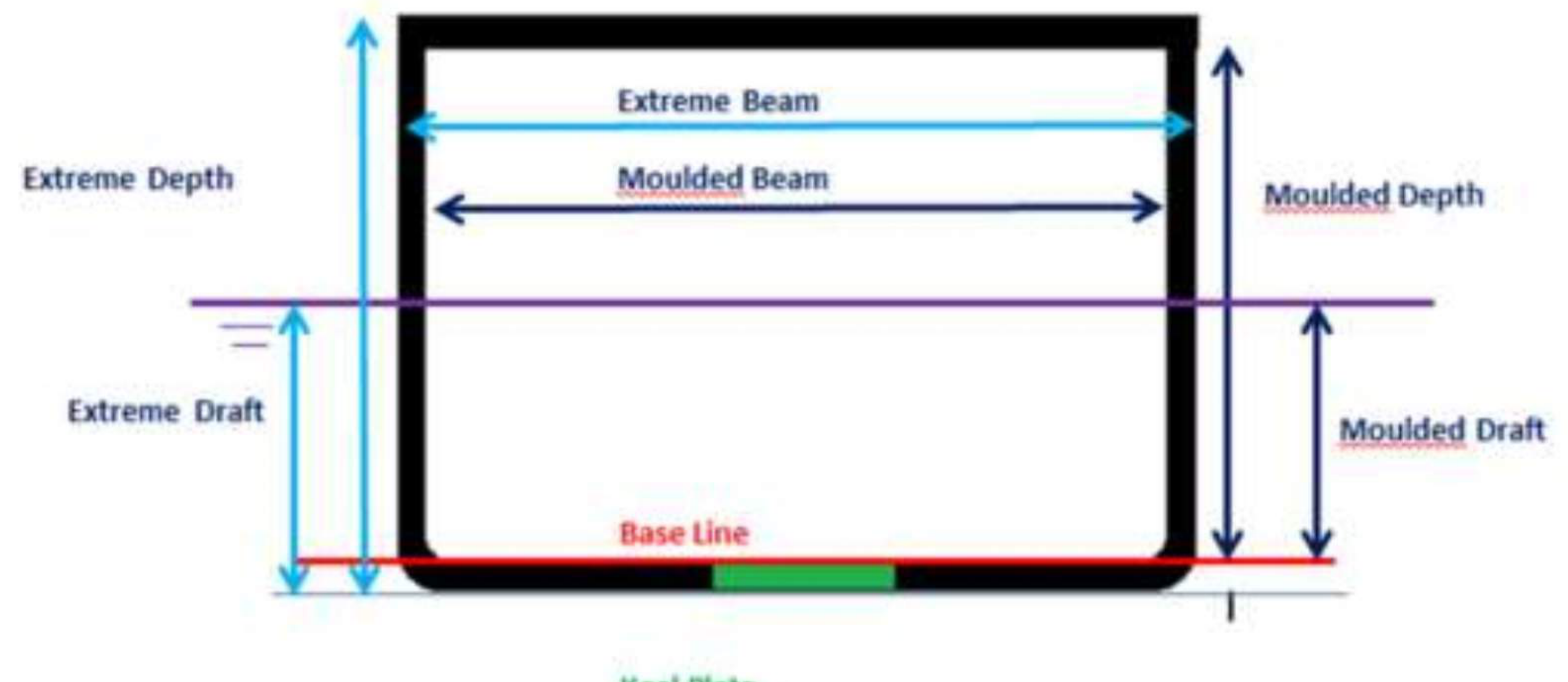
The distinction between extreme and moulded runs through all four of these definitions. Extreme is measured to the outside of the plating; moulded is measured to the inside of the plating, or from the top of the keel.
| Term | Definition |
|---|---|
| Breadth extreme | The greatest breadth of the ship, measured to the outside of the shell plating |
| Breadth moulded | The greatest breadth of the ship, measured to the inside of the inside strakes of shell plating |
| Depth extreme | The depth of the ship measured from the underside of the keel to the top of the deck beam at the side of the uppermost continuous deck amidships |
| Depth moulded | The depth measured from the top of the keel |
| Draught extreme | The distance from the bottom of the keel to the waterline. The load draught is the maximum draught to which a vessel may be loaded |
| Draught moulded | The draught measured from the top of the keel to the waterline |
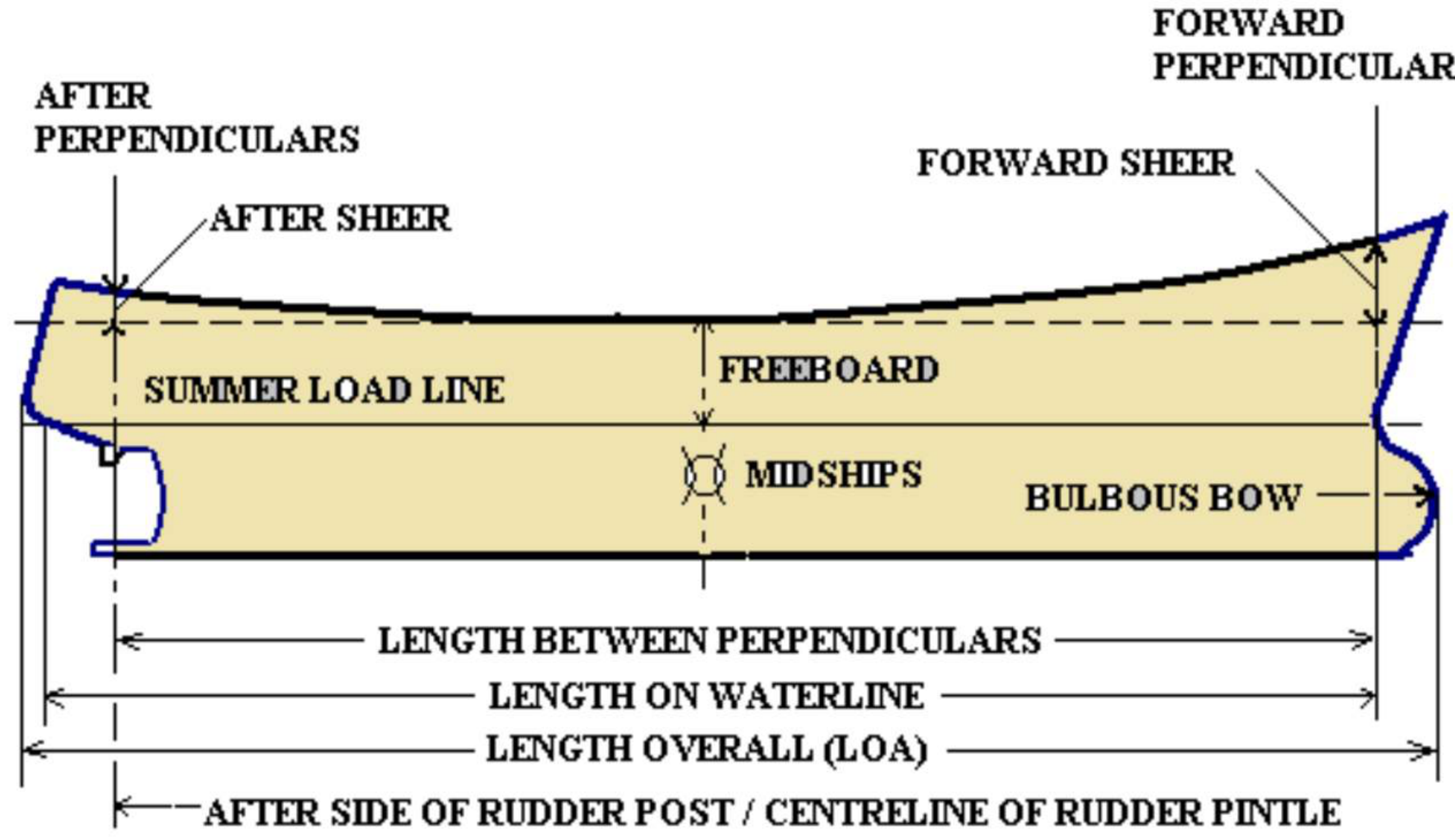
Freeboard. The distance from the waterline to the top of the deck plating at the side of the deck amidships — the vertical distance from the load water line to the top of the freeboard deck.
Freeboard represents the safety margin showing to what depths a ship may be loaded under various service conditions: the type of cargo, the waters to be navigated, and the season of the year. It has considerable influence on the seaworthiness of the ship — the greater the freeboard, the larger the above-water volume of the ship, which provides reserve buoyancy assisting the ship to remain afloat in the event of damage.
The three purposes freeboard serves:
- To ensure that she cannot be loaded beyond her strength.
- To provide the ship with adequate reserve buoyancy.
- To keep the deck high enough from the water to enable the crew to navigate and handle her in all weather conditions.
1b.3 Buttock lines
A buttock line is an equidistant transverse section line from the midship towards forward of the ship, such that it gives the cross-section at various stations at all possible drafts and trims. Buttock lines are mainly used for knowing the light weight displacement at the time of the end of the construction phase of a ship.
1b.4 The four form coefficients
Four coefficients describe the fineness of the hull.
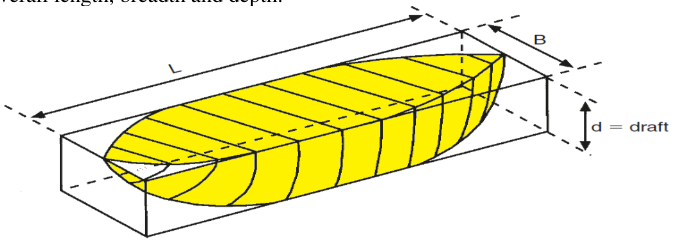
Block coefficient (Cb) — the ratio of the volume of displacement to the product of the length, breadth and draught. Equivalently, the ratio of the underwater volume of the ship to the volume of a rectangular block having the same overall length, breadth and depth.
- Cb changes with the draft, because all three of L, B and d change with draft.
- Cb = 0.8 to 0.85 for ship speeds between 12 and 17 knots for tankers.
- Application: by this we can determine underwater volume.
- A higher Cb indicates a hull with more interior volume and a flat bottom.
- A smaller Cb indicates a fine bow and fine stern section.
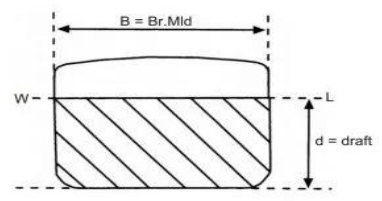
Midship section area coefficient (Cm) — the ratio of the area of the immersed portion of the midship section to the product of the breadth and the draught:
Cm gives an idea of the shape of the ship.
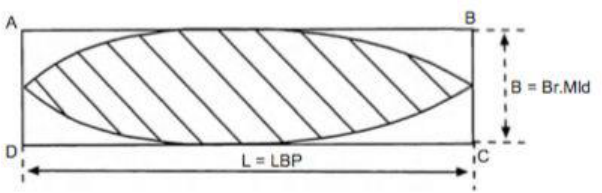
Waterplane area coefficient (Cw) — the ratio of the area of the waterplane to the product of the length and breadth of the ship:
Prismatic coefficient (Cp) — the ratio of the volume of displacement to the product of the length and the area of the immersed portion of the midship section.
The relation between them. The four are not independent. Since the volume of displacement can be written either as Cb × L × B × d or as Cp × L × Am, and Am = Cm × B × d, it follows that:
That identity is why the coefficients are always presented together, and it is the relationship a surveyor is driving at when he asks for all four.