
Shipyard Practice: How a Ship Is Built and Launched
From a signed contract and an empty berth to a launched and trialled ship: steel preparation, sub-assembly, block erection, outfit, the surveyor, the launch and the trials.
Key Principles at a Glance 8 points
- Ship production runs from specification and computerised drawing through steel preparation, sub-assembly, block assembly and erection to launching, final outfit afloat and sea trial.
- Plate and section stowage, shotblasting and priming come before any cutting, because a shipyard loses more steel to corrosion in the stockyard than to cutting error.
- Flame planing removes the mill scale and distortion from a plate and flame profiling cuts it to shape, both by numerically controlled torch.
- Marking, shaping, bending and cutting turn flat plate into the curved shell the hull needs, and the sequence is set by which operation distorts the plate most.
- Sub-assemblies become panel, matrix and curved-unit assemblies, which become blocks; the bigger the block that can be lifted, the less work is done at the berth.
- Outfit is palletised and modularised so that pipe, duct and equipment go into a block while it is still on the shop floor rather than in the hull.
- The classification surveyor attends the construction throughout and holds the stage approvals, which is what turns a built hull into a classed ship.
- Launching and the sea trial are the two moments the whole sequence is aimed at, and the trial is where the propulsion, steering and stopping performance is finally measured.
15.1 How a ship is constructed — the sequence
How the structure described in Parts 6 to 11 actually gets built. Everything before this part assumed the ship exists; this part starts from a signed contract and an empty berth.
15.1.1 The production flow chart
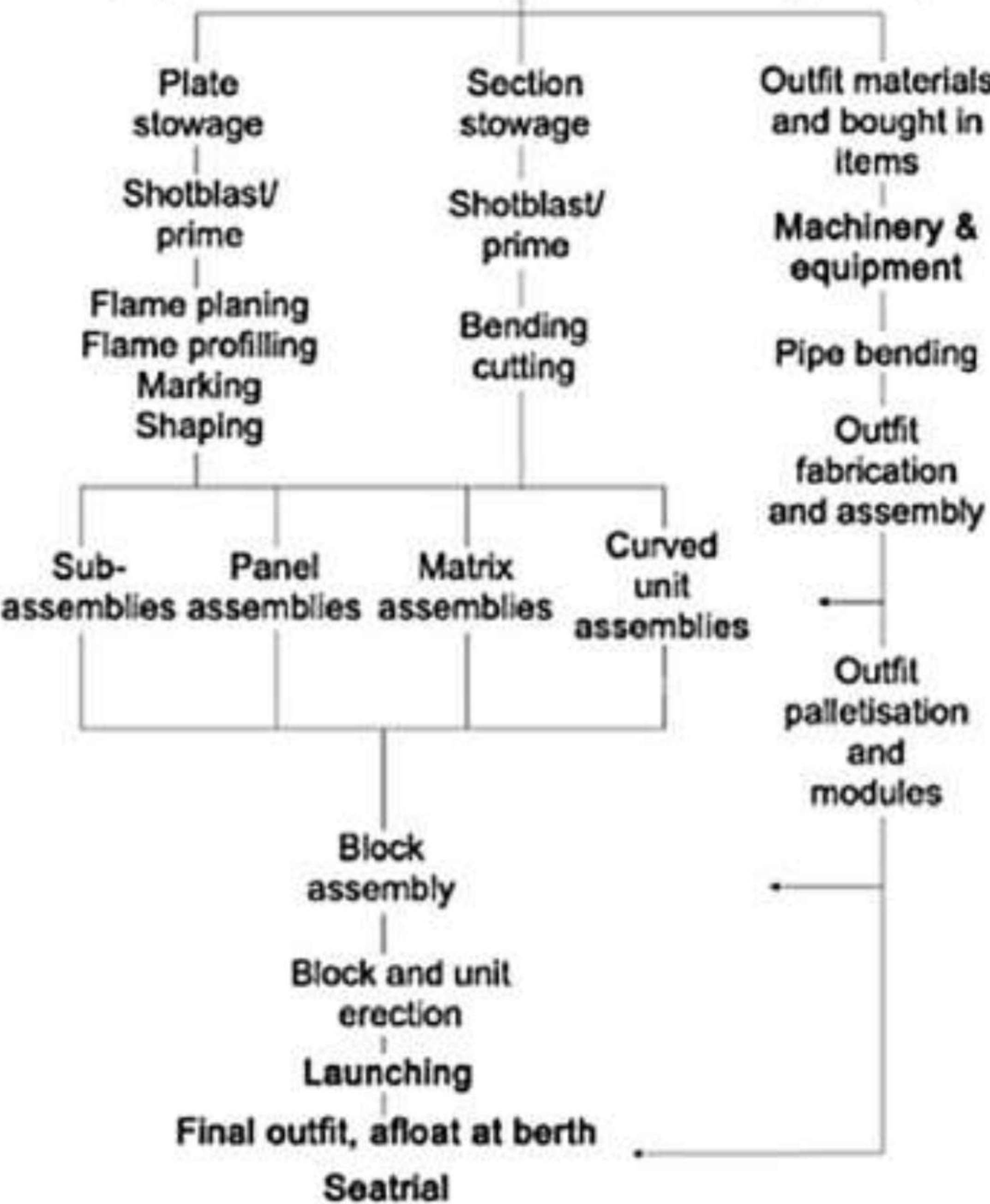
Before yard layouts can be understood, the stages of the ship production process must be known. Conceptually they are one flow chart:
Outfit material and bought-in items, machinery and equipment, and pipe bending feed into the stream alongside the steelwork: outfit fabrication and assembly run concurrent with the hull assemblies.
15.1.2 Series work and concurrent work
Work done in sequence (series): plate stowage, shotblasting, primer coating, marking and cutting. Work done concurrently (all together): welding of sub-assemblies, panel assemblies, matrix assemblies, curved unit assemblies, and pipe bending. With a mix of sequential and concurrent development, time is reduced.
The numbered work flow:
| Step | Work |
|---|---|
| I | Ship design using ship design software |
| II | Steel plate stowage at stockyard |
| III | Shotblasting and primer coating of steel plates |
| IV | Marking and cutting of plates |
| V | Plate bending and pipe bending |
| VI | Sub-assemblies and assemblies |
| VII | Block assemblies and unit erection |
| VIII | Painting of hull |
| IX | Launching and outfitting |
| X | Sea trial and delivery |
15.1.3 Ship specification and computerised drawing
After the signing of the shipbuilding contract — with detailed specification of vessel speed, manoeuvrability, engine power and fuel consumption, principal particulars, tonnage and the like — a 3D design image of the vessel and the engineering drawings are made using ship design software.
15.2 Steel preparation
15.2.1 Plate stowage, shotblast and priming
Steel plates, sections and pipes used in ship construction are ordered and stowed in the stockyard.
Distortion in steel plate is removed by passing through rollers. Plates are shot blasted and primer is applied to prevent rusting during production.
15.2.2 Flame planing and flame profiling
Flame planing and flame profiling are the thermal preparation steps in the flow chart, coming after shotblast priming and before marking: the plate surface is flame-treated flat (planing) and the profile of the part is flame-cut to shape (profiling).
15.2.3 Marking, shaping, bending and cutting
Marking is the process of marking on steel plates for cutting — done manually or by computer. Most cutting is computerised; gas cutting and plasma cutting are applied according to the thickness of the steel.
Plate is bent roughly at first by press bending using a bending mould. Pipes are bent to the engineering drawing specification using a pipe bending machine.
15.2.4 Section stowage and section preparation
Sections follow the same preparation stream as plates — stowage, shotblast and priming, marking, cutting and shaping — in the section shops, before they join the plates in the assembly stages.
15.3 Assembly — from plate to hull
15.3.1 Sub-assembly and panel assembly
Plates cut to shape are welded and formed into sub-assemblies. Sub-assemblies are then assembled into large blocks. The blocks are painted and stowed in the block bay. This technique of making large blocks is called prefabrication.
15.3.2 Curved unit and matrix assembly
Curved units and matrix assemblies are the three-dimensional assemblies — the curved shell panels and the matrix of stiffened structure — built concurrently with the flat panel assemblies and the pipe bending, so that all streams converge on the block stage together.
15.3.3 Block assembly
The assemblies become blocks: large three-dimensional sections of the ship, painted, stored in the block bay, and ready for transport.
15.3.4 Block and unit erection
Blocks travel to the building dock by flat bed trucks, transfer by high capacity cranes to the building berth, and are joined into the hull in order:
- Double bottom blocks laid out first, aligned and welded.
- Side shell and deck erected next.
- Engine, machinery, stern tube, rudder and propeller installed.
- On-deck accommodation and navigation bridge installed.
After erection the hull is painted while still in the building dock — long-term protection of the steel against corrosion.
15.3.5 Material flow and cross handling
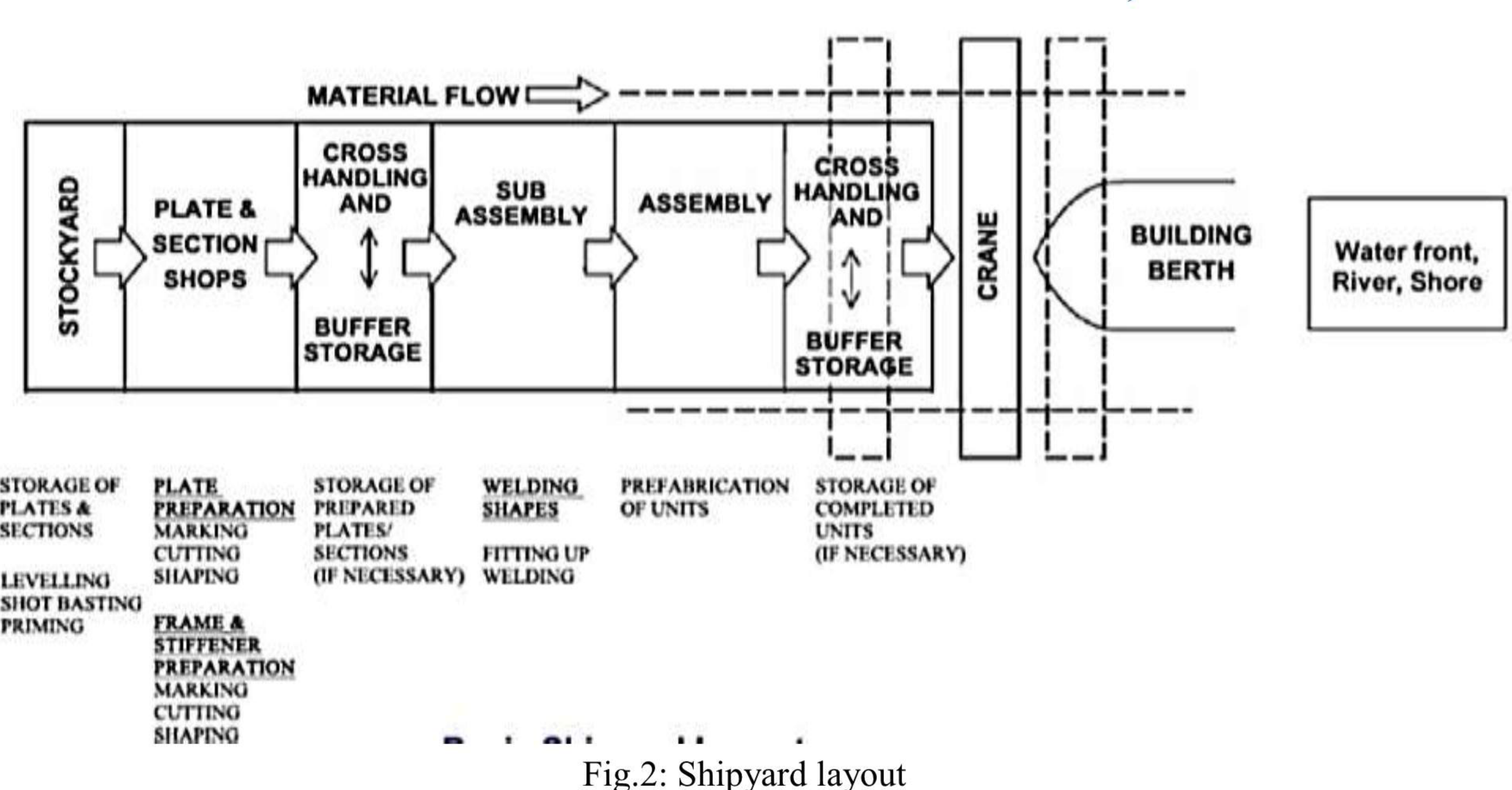
The yard layout follows the production flow: the yard extends back from the waterfront, river or shore where the building berths or building dock sit; the furthest area from the berths is the stockyard; between the two, in sequence, the consecutive work and shop processes.
Many layouts are possible, but the best is the one in which materials travel the shortest possible distance with minimum handling.
15.4 Outfit
15.4.1 Outfit fabrication, assembly, palletisation and modules
Outfit material and bought-in items run as a parallel stream to the steelwork: outfit fabrication and assembly, then outfit palletisation and modules — equipment grouped into installable packages that join the hull at block assembly and unit erection.
15.4.2 Final outfit afloat at berth
After all blocks are joined, the ship is launched — the hull being watertight, the building dock is flooded to float her, and she is towed to the outfitting berth. Starting with the finishing of the accommodation, navigation bridge and engine room, every equipment and instrument is checked and re-examined in practice. This is the final period of shipbuilding.
15.5 The surveyor, the launch and the trial
15.5.1 Role of the classification surveyor in ship construction
A ship to be classified must first be designed to approved drawings according to a society's rules. The societies publish rules principally concerned with the strength of the ship, adequate equipment, and reliability of the machinery; the principal societies have developed software packages for yards incorporating dynamic-based criteria for scantlings, arrangements and details, with realistic dynamic loads and structural responses of critical areas.
Class surveyors are stationed at the shipyard where the ship is built. Construction is supervised to ensure the ship is built from certified materials and components — all steel plates, sections, pipes and the like are certified.
The surveyor's tasks:
- Examine and approve design plans of hulls and equipment — main propulsion engines, auxiliary boilers and turbines, electrical generating plant, refrigeration and air conditioning, pumping systems.
- Inspect standards of construction and witness tests of materials.
- Inspect hulls, machinery and equipment during construction for standards and legislative requirements.
- Survey throughout the ship's life so standards are maintained.
- Perform inspections required by domestic statutes and international conventions.
- Witness tests and operation of emergency and safety machinery.
- Measure ships for tonnage and survey them for load line assignment.
Proof of compliance: on completion of the relevant surveys, Class issues a Provisional or Definitive Certificate of Classification — plus statutory certificates when delegated by the flag administration — bearing the vessel's class notations with annexes for certificate management and surveys. The certificate is valid for five years, with annual and intermediate surveys keeping the vessel safe.
15.5.2 Ship launching
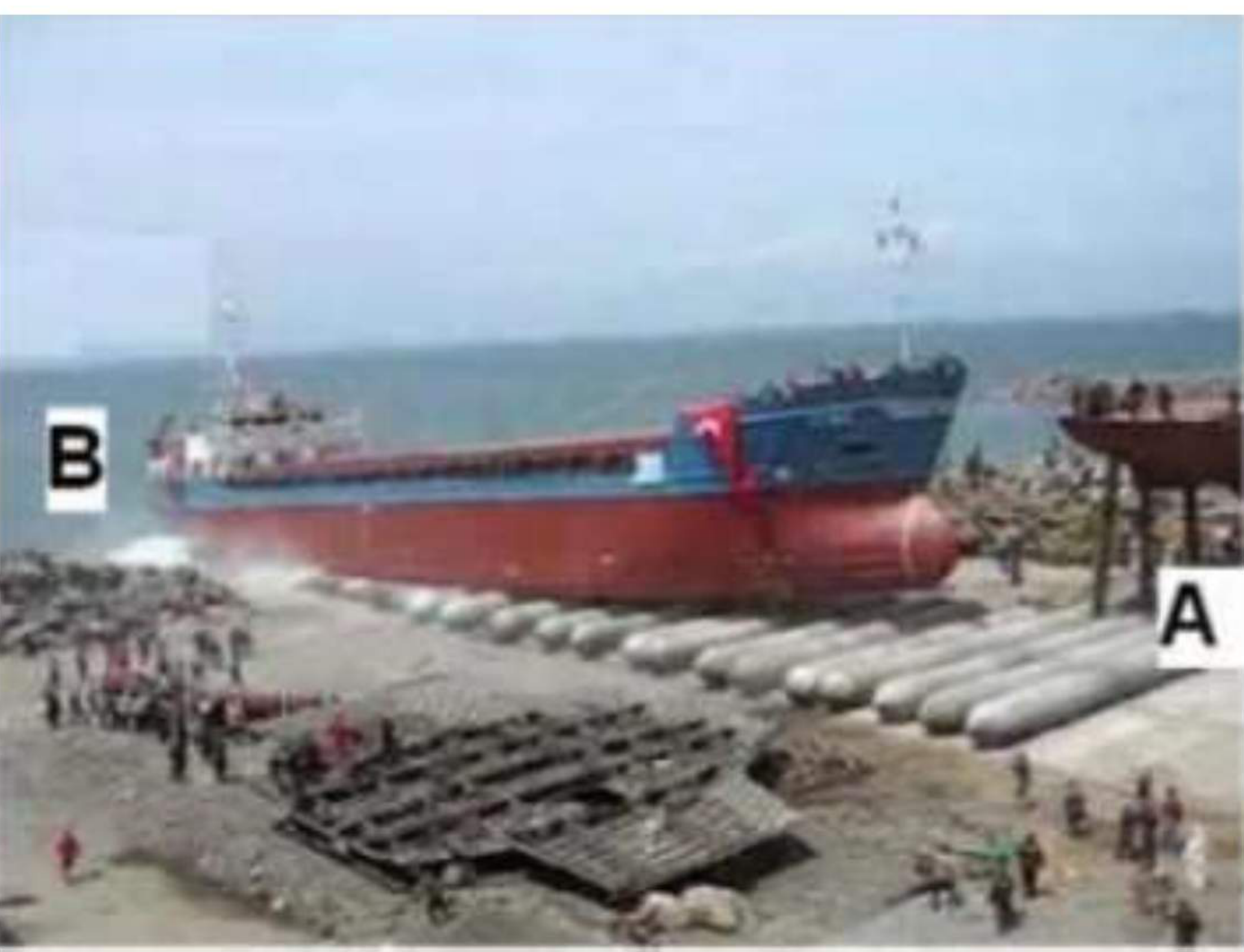
The most common method is virtually unchanged for thousands of years: transferring the ship's weight from the blocks that supported her during construction to the launchways — moving the vessel from dry land to much lower in the water. The traditional launch is stern first, still the most common, though sideways and dry-dock launchings exist.
Three reasons for stern first:
- The stern shape is rounder than the streamlined bow profile, giving greater resistance entering the water.
- The stern gives more buoyancy, lifting the ship from the cradle faster than the bow and favouring gradual detachment from the slipway.
- The greater beam astern stabilises the ship crosswise entering the water, avoiding dangerous listings.
Four main launching methods:
| Method | How |
|---|---|
| Gravitational | The ship slides under her own weight — subdivided into longitudinal oiled slideway (oil or wax assisted; simple equipment for various tonnages, but the oil pollutes and the fore part risks huge pressure), longitudinal steel-roller slideway (high-intensity rollers, security devices and steel board; high initial cost, low running cost, stable — widely used; not for large vessels in the ball variant), and side oiled slideway (used where water width is restricted; no keel declivity, simple cradle, short ground ways not extending into the water) |
| Floating-out | The dock is flooded to float the ship |
| Mechanical | Mechanical means of moving the hull |
| Airbag | Cylindrical reinforced-rubber airbags with hemispherical heads and high load capacity — innovative, safe, usable for all types and sizes |
15.5.3 Sea trials
Sea trials are the final trials of the construction stage: all machinery, equipment and fittings tried for the first time in sea conditions, each system tested as far as practicable at maximum capacity. The classification society confirms the vessel meets its requirements, the SOLAS convention and national and international rules.
Only trials that cannot be done dockside go into the sea trial programme — to confirm the vessel meets the contract specification:
- Vessel speed.
- Vessel manoeuvrability.
- Engine power and fuel consumption.
- Operation of all equipment and instruments.
Results are kept as the vessel's performance record. Delivery is completed by signing the delivery contract; after the ceremony, master, chief engineer and crew embark for the maiden voyage.
15.6 Two specialist footnotes
15.6.1 Buttock lines used to find light displacement
A buttock line is an equidistant transverse section line from midships forward, giving the cross-section area at various stations at all possible drafts and trims. Buttock lines are mainly used for knowing the lightweight displacement at the end of the construction phase of a ship.
15.6.2 Chemical tanker construction under the IBC Code
The IBC Code — the International Code for the Construction and Equipment of Ships Carrying Dangerous Chemicals in Bulk — is the international standard for the safe carriage by sea of dangerous and noxious liquid chemicals in bulk. To minimise risks to ships, crews and the environment it prescribes the design and construction standards of ships and the equipment they carry, with due regard to the products involved — including standards for three ship types (Type 1, 2 and 3) graded by the hazard level of the chemical cargo.