
Load Line, Freeboard and Tonnage Measurement
The legal limit on draught: the marks on the side, the survey that keeps them valid, and the freeboard and tonnage figures behind the certificate.
Key Principles at a Glance 8 points
- The load line is a mark amidships showing the maximum draught to which the ship may be loaded in each zone and season — the Plimsoll line, and the limit is legal, not advisory.
- The marks run S for summer, W for winter, WNA for winter North Atlantic, T for tropical, F for fresh water and TF for tropical fresh water, all referred to the summer line.
- A timber load line is assigned to a ship carrying a timber deck cargo, because the deck cargo itself adds reserve buoyancy.
- The load line survey exists to prove that the ship is still the ship that was assigned her freeboard: closing appliances, guardrails, ventilators, air pipes and scuppers are all checked.
- The conditions of assignment are the structural conditions the ship must keep satisfying to keep her freeboard; a condition broken is a certificate at risk.
- Freeboard is the distance from the waterline to the freeboard deck at the side, and it buys reserve buoyancy, a margin against green water, and a margin of safety in a seaway.
- Gross tonnage measures the whole enclosed volume of the ship and is dimensionless; net tonnage measures the earning space and is always the smaller figure.
- Tonnage is a measure of volume for dues and regulation and has nothing to do with displacement, which is a measure of weight.
14.1 Load line
The legal limit on draught. This is the part the surveyor asks about most often, because it is the part with a certificate attached. Part 2 measured what the ship displaces; this part is where the law says how much of that displacement she may use.
14.1.1 Load line — the definition
A load line is a special marking positioned amidships which depicts the draft of the vessel and the maximum permitted limit in distinct types of waters to which the ship can be loaded.
In the orals' shorter form: the Plimsoll line is a reference mark on a ship's hull indicating the maximum depth to which the vessel may be safely immersed when loaded with cargo. A commercial ship is properly loaded when her waterline is at her Plimsoll line.
14.1.2 Purpose and necessity of load lines
The concept emerged in Britain in the 1870s to prevent merchant ships being overloaded, after numerous accidents at sea from overloading:
The fundamental purpose of a load line is to allow a maximum legal limit up to which a ship can be loaded by cargo. By prescribing such limits, the risk of the vessel sailing with inadequate freeboard and buoyancy can be limited.
A vessel should have sufficient freeboard at all times. Exceptions mean insufficient stability and excessive stress on the hull — and the load line is what detects whether the vessel is overloaded. Lloyd's Register has established a minimum freeboard requirement for its classed ships to ensure good reserve buoyancy in heavy seas.
Buoyancy and immersion depend on the type of water and its density, so no single freeboard limit works everywhere. The convention therefore divides the world into different geographical zones, each with its own prescribed load line: a vessel in the winter North Atlantic gets a greater freeboard than the same vessel in tropical zones and fresh waters.
The convention history:
It applies to ships of more than 24 metres in length. The convention carries three annexes, Annex 1 in four chapters starting with General and the conditions of assignment of freeboard.
14.1.3 Load line marks and types
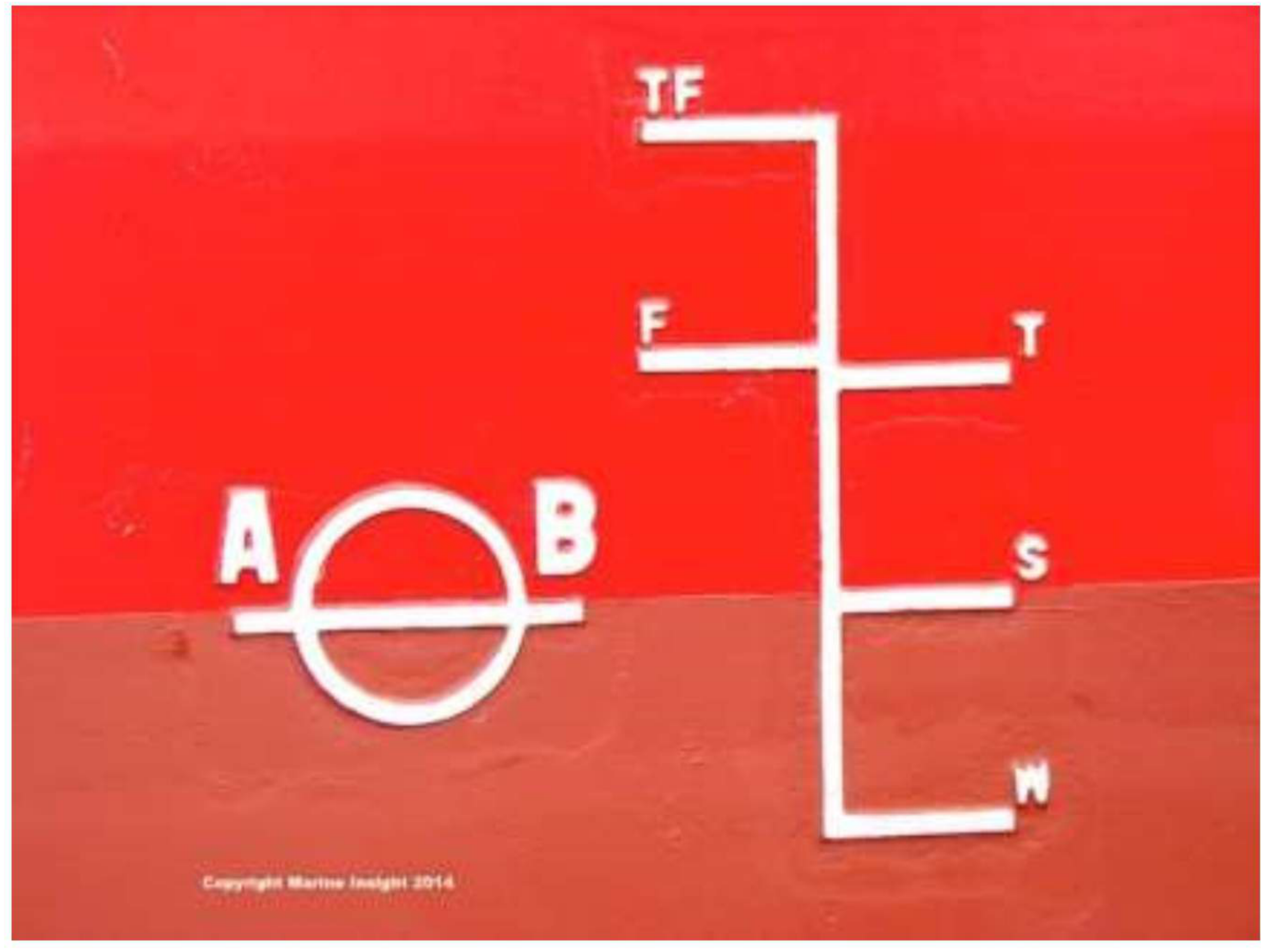
All vessels of 24 metres and more carry the marking at the centre of the length of the summer load waterline, positioned amidships:
- Standard load line marking — applies to all types of vessels.
- Timber load line markings — applies to vessels carrying timber cargo.
The marks are punched into the hull surface, so they stay visible even when the paint fades; painted white or yellow on a dark background, black on a light background.
The complete marking has three vital parts:
| Part | Dimensions | What it marks |
|---|---|---|
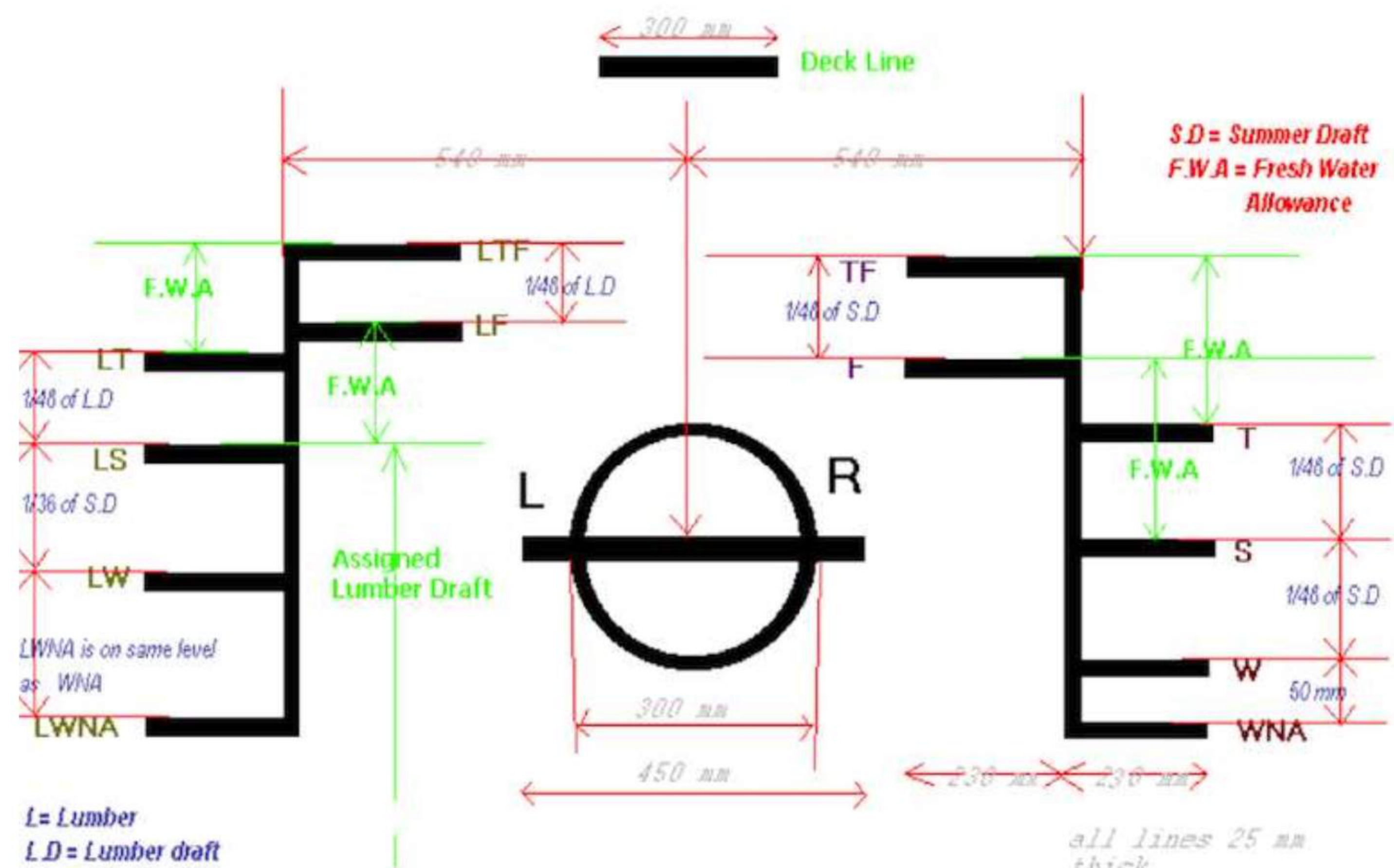
| Deck line | Horizontal line 300 mm by 25 mm | Passes through the upper surface of the freeboard |
| Load line disc | 300 mm diameter, 25 mm thick, with a horizontal line through it | The upper edge of the line is the summer saltwater line — the Plimsoll line |
| Load lines | Horizontal lines 230 mm by 23 mm, extending forward and aft from a vertical line 540 mm from the centre of the disc | Upper surfaces show the maximum submergence in each season and circumstance |
14.1.4 The seasonal lines
S (Summer). The primary freeboard line, at the same level as the Plimsoll line; every other line is marked from it.
| Mark | Position | Meaning |
|---|---|---|
| T (Tropical) | 1/48 of the summer draft above S | Deepest draft in tropical waters — benign weather |
| W (Winter) | 1/48 of the summer draft below S | Deepest draft in winter — rougher weather |
| WNA (Winter North Atlantic) | 50 mm below W | Voyages in the North Atlantic above 36° latitude in winter months |
| F (Fresh water) | Above S by the freshwater allowance | Summer freshwater line; S–F distance is the FWA |
| TF (Tropical fresh) | Above T by the FWA | Freshwater line in the tropics |
In the orals' ordering — deepest permitted draft first:
Fresh water is less dense than salt, so the vessel floats deeper in it — hence the freshwater marks sit above their saltwater counterparts by exactly the allowance.
14.1.5 Timber load line markings
Ships in the timber deck cargo trade carry a second, unique set — the timber load lines — and must comply with the Code of Safe Practices for Ships Carrying Timber Deck Cargo in construction and other requirements, obtaining greater reserve buoyancy and lesser summer freeboard.
The timber set is marked like the standard set, positioned 540 mm above the centre loading disc, with letters prefixed by L for Lumber:
| Mark | Position |
|---|---|
| LS (Lumber summer) | Upper edge marks summer saltwater timber loading, at a specified level above the Plimsoll line |
| LT (Lumber tropical) | 1/48 of the lumber summer draft above LS |
| LW (Lumber winter) | 1/36 of the lumber summer draft below LS |
| LWNA | At the same level as WNA |
| LF (Lumber fresh) | Above LS by the FWA |
| LTF (Lumber tropical fresh) | Above LT by the FWA |
14.1.6 Port and starboard sides
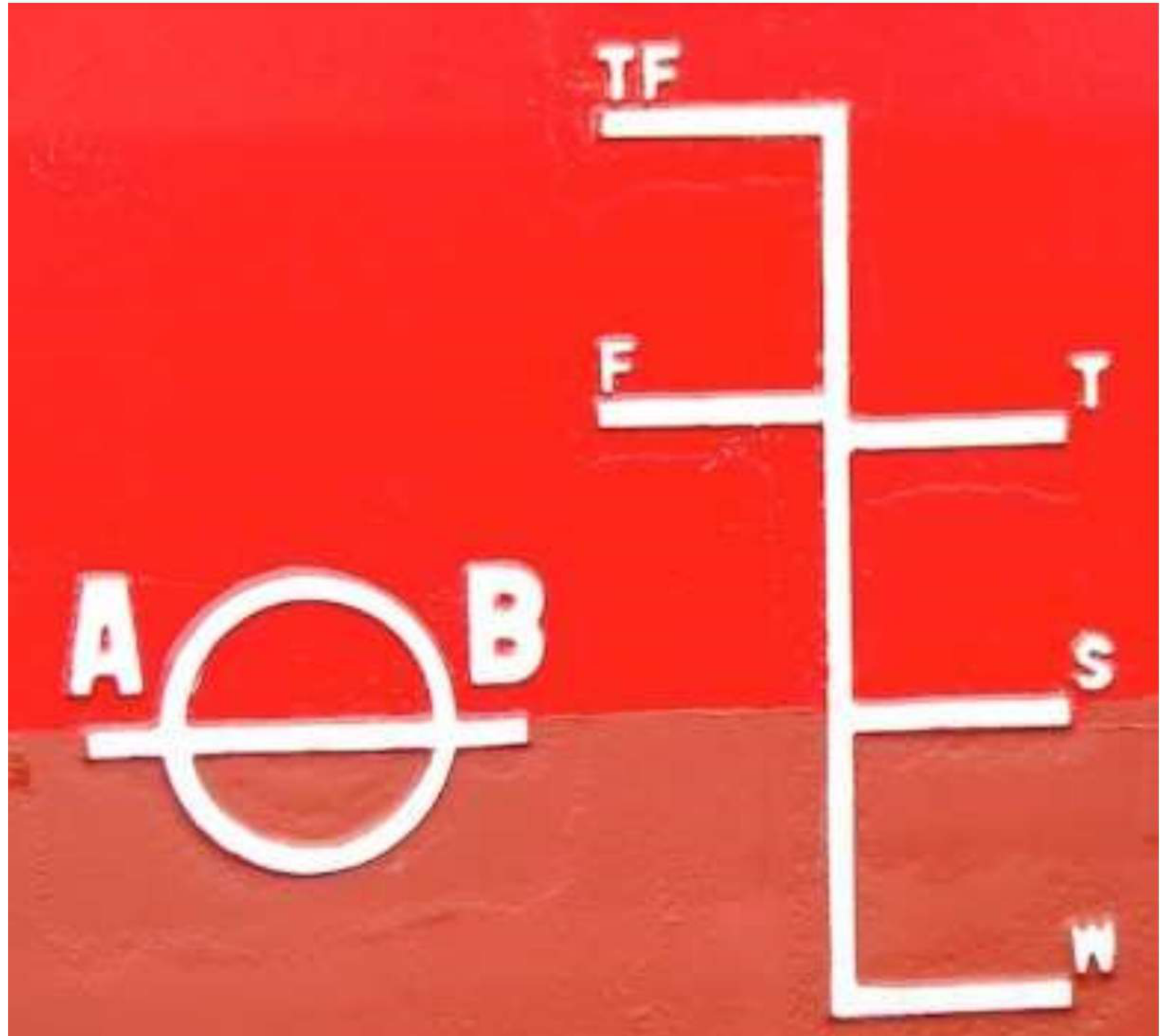
The load line is marked on both the port and starboard sides of the ship.
14.1.7 International load line certification
Every ship surveyed and marked under the convention is issued an International Load Line Certificate by the authorised administration, valid for not more than five years, containing all vital information including the assigned freeboard and freshwater allowance.
After the survey and issue, no changes may be made to the superstructure, markings, equipment or arrangements covered by the survey without contacting the authorised authority.
The survey cycle:
| Survey | When |
|---|---|
| Initial | Before the vessel is put into service |
| Renewal | At intervals not exceeding 5 years |
| Annual | Within ±3 months of the anniversary date of the certificate |
14.2 The load line survey
14.2.1 What the surveyor checks — the survey itself
During the load line survey the surveyor checks the condition of assignment. Preparation should begin months before the expected date, backed by a planned maintenance schedule — not the week before.
14.2.2 Documentation and records
| Item | Detail |
|---|---|
| Certificates | Validity of all certificates under SOLAS and the Load Line Convention |
| Loading information | Sufficient onboard information for loading, discharging, ballasting and de-ballasting: stability booklet, loadicator (cargo shifting, ballasting, hogging and sagging, shear force and bending moment, loading plan), loading manual, intact and damage stability booklets |
| History | Last survey report and any condition of class; record of conditions of assignment |
| Batten | The approved engineering scale (“batton”) carried onboard, by which the surveyor checks |
| Day of survey | Load line certificate and relevant records ready; stability information showing adherence to loading and ballasting rules; Chief Mate to have all appropriate keys working; reasonable manpower available |
14.2.3 Access, ventilators, air pipes, locking bars, tarpaulins
- Access points at enclosed structures: movable parts (clamps, dogs) well greased; gaskets and watertight packings checked for cracks and repaired — rubber packings are integral to watertight integrity.
- Ventilators and air pipes: closing mechanisms provided, installed where missing, damage repaired; heavily rusted flaps replaced.
- Deck clear: portable beams checked for efficiency and securing; equipment squared away.
- Hatches: weather tight, booby hatches included; butterfly screws moving freely.
- Locking bars, locking pins, hatch ventilators: de-rusted, free movement.
- Tarpaulins, where used: top condition, approved material and standard.
14.2.4 Watertightness of manholes and scuppers
Manholes, scuppers and similar water-flow parts checked for watertightness: manholes screwed tight with the T-wrench; scuppers cleaned where clogged; plugs of the exact outlet dimensions used for closing.
14.2.5 Machinery space openings and ports below the deck
- Machinery space openings on deck: thoroughly inspected, general appearance clean — these sections gather oil and dirt.
- Ports below the freeboard deck: strictly checked for watertight integrity; every freeing port moving freely; shutters, hinges and pins free of corrosion, lubricated, free-moving.
14.2.6 Guardrails, bulwarks, safety equipment, side scuttles, records
- Guardrails and bulwarks: fractures repaired — these belong in mint condition at all times for personnel safety, survey or not.
- Marks: deck line, load line marks, draught marks and signages de-rusted and painted, under supervision, with safety gear and LSA standby — the job means hanging over the ship's side.
- Safety equipment: checked and checked again; safety lines rigged; setup overhauled.
- Side scuttles below the freeboard deck and deadlights: watertight integrity, rubber packings inspected for cracks and fissures.
- Records: certificate and records ready for the final day.
The whole survey reduces to one sentence: it makes the hull watertight below the freeboard and weather tight above it.
14.2.7 Conditions of assignment
These are the conditions met before freeboard is assigned and the certificate issued. Freeboards are computed assuming the ship to be a completely enclosed, watertight / weather tight envelope; the convention then recognises the practical need for openings and prescribes their protection and closure. The assignment of the computed freeboard is conditional on those protections — hence the name.
Four headline conditions:
- Enough structural strength.
- Enough reserve buoyancy.
- Safety and protection of the crew.
- Prevent entry of water through the hull.
Ships are surveyed annually to confirm they still fulfil them. The watertight-integrity list:
| Opening | Requirement |
|---|---|
| Hatchways | Watertight integrity; covers weather tight, steel or equivalent, with gaskets and clamping devices; ship-specific approved stability booklet with damage stability calculations for the master's use |
| Machinery space openings | Skylights weather tight |
| Doors and access openings | Superstructure end bulkheads of efficient construction; approved steel weather tight doors; weather tight doors on all exposed-deck access openings |
| Hatchways, doorways, ventilators | Checked for watertight integrity |
| Ventilators and air pipes | Efficient means against ingress of seawater |
| Cargo ports and similar | Water tight if below the freeboard deck |
| Scuppers | Checked |
| Side scuttles | Weather tight above the freeboard deck, water tight below it |
| Freeing ports | Fitted in bulwarks to clear the freeboard deck of seawater |
| Accommodation and movement | Safe weatherproof crew quarters; safe movement within the ship and on/off it; weather-tight fittings for pump-room access; catwalk from accommodation to forecastle; freeing ports where bulwarks are fitted |
If these are not watertight, rough weather puts water below the main deck and the freeboard is lost; green seas left standing on deck do the same and add free surface effect; a girder giving way can fail the structure and flood from within. Coaming heights of hatchways and the heights of sounding and vent pipes are therefore prescribed in the load line rules.
14.2.8 Overboard valves, hatches and deck fittings — the second engineer's checks
Hatches, freeing ports, gunwale and bulwark, manholes and all scupper plugs: condition checked. Specifically as second engineer:
| Item | Check |
|---|---|
| Overboard valve | Corrosion, pitting, damage/leakage, gland packing |
| Seawater piping | Joints, elbows, leakage, condition |
| Sea chest and valve | Condition, remote operation of the valve |
| Repairs | No pipe doublers, cement boxes or soft patches |
| Emergency bilge suction | Condition |
| Bilge well alarms | Operational or not |
| Funnel | Open or close, condition |
| Bilge and ballast pumping | Arrangements working |
| Vents and sounding pipes | Condition |
| E/R and funnel doors | Weather tight integrity |
| Side plating | Initial inspection |
Non-return valves on overboard discharge get their own check for working efficiency — most authorities are stern on this point.
14.3 Freeboard
14.3.1 Freeboard — definition and purpose
Freeboard is the distance from the waterline to the top of the deck plating at the side of the deck amidships — the vertical distance from the load waterline to the top of the freeboard deck, measured from the uppermost continuous weather tight deck (normally the freeboard deck) down to the load line mark amidships.
It represents the safety margin showing to what depths a ship may be loaded under various service conditions — type of cargo, waters to be navigated, season of the year.
14.3.2 The three purposes of freeboard
- To ensure she cannot be loaded beyond her strength.
- To provide the ship with adequate reserve buoyancy.
- To keep the deck high enough from the water for the crew to navigate and handle her in all weather conditions.
14.3.3 Freeboard and seaworthiness, through reserve buoyancy
Freeboard has considerable influence on the seaworthiness of the ship: the greater the freeboard, the more the reserve buoyancy she can call upon.
Reserve buoyancy is the watertight volume above the waterline — the buoyancy the ship can call upon to meet losses from damage to the main hull, and in general working the provision of sufficient freeboard to make the vessel seaworthy.
The freeboard deck itself: the material carries the question as a bare heading with no text, so one line — it is the uppermost continuous weather tight deck, normally the deck to which freeboard is measured.
14.3.4 Tonnages — where they belong
The load line chapter closes with the five tonnages — displacement, lightship weight, deadweight, gross and net tonnage. They are measured and defined in Part 2; nothing is duplicated here.