
Basic Separation Principles in a Marine Purifier
How does a purifier separate oil, water, and solids?
Key Principles at a Glance 8 points
- Separation is gravity settling accelerated: inside a rotating bowl the centrifugal force is thousands of times gravity, so particles that would settle in hours fall in seconds.
- Separation needs a density difference. No density difference means no separation, which is why water droplets and stable emulsions are the hardest to remove.
- The disc stack divides the bowl into many shallow settling chambers, cutting the distance a particle must travel and multiplying the effective settling area.
- Flow between the discs is laminar, and a particle is removed only if it reaches a disc surface before being carried out with the oil — this defines the limit-size particle.
- The limit-size particle is the smallest particle the bowl can remove at a given speed, feed rate, viscosity and disc geometry.
- Clarification and purification are the same physics with different plumbing: a clarifier removes solids only, while a purifier also removes a heavy liquid phase through the interface and gravity disc.
- The bowl must be at rated speed and the water seal established before oil is admitted, otherwise the interface is lost and separation fails.
- Anything that changes bowl speed, viscosity, feed rate or the density difference changes the separation result.
1. Learning objectives
Course position: Topic 2 of the purifier learning sequence
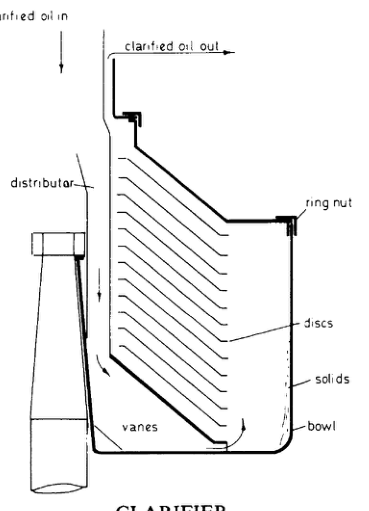
Main question: How does a purifier separate oil, water, and solids?
After this lesson, you should be able to:
- Explain clarification and separation in simple terms.
- Compare gravity settling with centrifugal settling.
- Explain why density difference is necessary for separation.
- Describe the movement of oil, water, and solids inside a rotating bowl.
- Explain the purpose of the disc stack.
- Explain the meaning of streamline flow, viscous drag, and limit-size particle.
- Identify the factors that control separation efficiency.
- Explain the difference between disc-type and tubular-bowl centrifuges.
- Describe purifier and clarifier flow using the manufacturer’s bowl diagrams.
- Predict what happens when temperature, speed, throughput, or disc spacing changes.
2. The fundamental idea
A purifier does not remove contamination by magically “cleaning” oil. It creates a controlled flow path in which materials with different densities move in different directions under centrifugal force.
The incoming liquid is a mixture of:
- Light liquid: oil
- Heavy liquid: water
- Solid particles: sludge, dirt, rust, catalyst fines, and wear material
The purifier separates these materials because they do not respond identically to the rotating field.
In a normal purifier:
- Oil moves toward the axis of rotation.
- Water moves away from the axis of rotation.
- Solids move outward and accumulate at the bowl wall.
The Mitsubishi manual defines this as three-phase separation: oil, water, and solids.
3. Clarification and separation
These are related but different operations.
3.1 Clarification
Clarification means separating solids from a liquid.
A clarifier produces one liquid outlet and collects the solids separately. In marine oil treatment, this normally means:
Reed’s describes a clarifier as a centrifuge arranged to discharge a single liquid while the solids are deposited in the bowl.
3.2 Separation
Separation means separating two liquids, normally oil and water.
A centrifugal separator is arranged to discharge both liquids continuously or in a controlled manner.
Because solids also move to the bowl wall during oil-water separation, clarification occurs at the same time as purification.
3.3 Three-phase purifier operation
A purifier therefore performs:
- Oil-water separation
- Oil-solid clarification
- Controlled discharge of the separated phases
3.4 Two-phase clarifier operation
A clarifier performs:
- Oil-solid separation
- Discharge of clean oil
- Collection of solids
The Mitsubishi manual identifies clarifying operation as liquid-solid, two-phase separation.
4. Gravity settling: the starting point
Before understanding centrifugal force, understand an ordinary settling tank.
When dirty oil is left relatively still:
- Heavy solids settle downward.
- Lighter solids settle more slowly.
- Water settles beneath the oil if a density difference exists.
- Clean oil remains above the settled contamination.
Reed’s explains that in a gravity settling tank the heaviest solids deposit first, while lighter solids are carried farther by the oil before settling.
Limitation of gravity settling
Gravity is relatively weak. Small particles and small water droplets may remain suspended for a long time. A ship cannot always wait long enough for complete gravity settling.
A centrifuge improves the process by replacing the weak effect of gravity with a much stronger rotational field.
5. Centrifugal settling
In a rotating bowl, the apparent separating acceleration acts radially outward.
Conceptually:
The centrifugal effect increases with:
- Particle mass
- Rotation speed squared
- Radius from the axis
A useful conceptual relationship is:
where:
- a_c = centrifugal acceleration
- ω = angular speed
- r = radius from the axis
For a particle, the effective outward force also depends on its mass:
These equations are used here to explain the principle. The operating limits and actual machine values must always come from the purifier manufacturer.
Reed’s specifically states that the centrifugal force acting on a particle depends on its mass, the speed squared, and the radius at which the particle is located.
Why rotation improves separation
Compared with gravity:
- A heavier particle moves outward faster.
- Water moves outward relative to oil.
- The settling path can be made short by using discs.
- Small particles that would remain suspended in a tank can be removed.
6. Density difference: the requirement for separation
The purifier works because the phases have different densities.
Normally:
The larger the useful density difference, the easier separation becomes.
6.1 Oil and water
Water is normally heavier than marine oil, so it moves outward in the rotating bowl. Oil remains closer to the axis and moves toward the clean-oil outlet.
6.2 Solids
Solid particles are usually denser than oil and move outward. Their final movement depends on:
- Particle mass
- Particle size
- Particle density
- Oil viscosity
- Bowl speed
- Radius
- Flow rate
6.3 Difficult density conditions
Separation becomes difficult when:
- Oil density is close to water density.
- The oil is very viscous.
- Water droplets are extremely small.
- Solids are very fine.
- The liquid contains stable emulsions.
- The fuel has unusually high density.
The manual therefore defines specific gravity and notes that its value varies with temperature.
7. The movement of solids in a centrifugal bowl
Reed’s describes the basic movement as follows:
- Dirty oil enters the rotating bowl.
- The oil is thrown outward by centrifugal action.
- Solid particles move through the oil toward the bowl side.
- Heavy solids deposit nearer the lower or outer region.
- Lighter solids deposit farther along the flow path.
- The solids accumulate at the bowl wall and form sludge.
The solids cannot be allowed to accumulate indefinitely. They must be removed by:
- Manual bowl cleaning, or
- Automatic/self-cleaning sludge discharge
8. The disc stack: why it is needed
A large-bowl centrifuge can rotate at high speed, but a particle still needs time to migrate through the oil. The disc stack improves separation by reducing the distance that the particle must travel.
Marine disc-type centrifuges use many closely spaced conical discs.
8.1 Flow between discs
Oil flows radially outward or inward through the spaces between discs depending on the local section of the bowl. In the separation region:
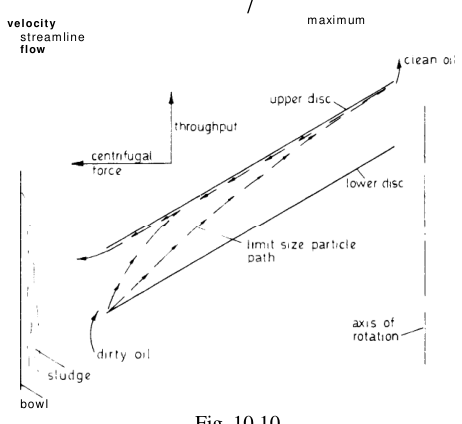
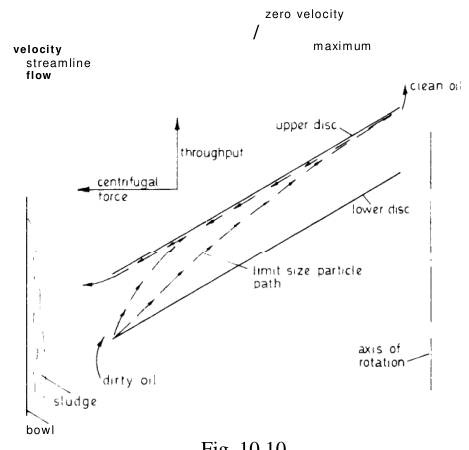
- The oil follows the general streamline path toward the clean-oil outlet.
- Particles experience an additional outward centrifugal force.
- A particle that reaches the underside of a disc enters a low-velocity region.
- It can then move along the underside of the disc toward the sludge space.
Reed’s describes the particle path and states that particles reaching the underside of a disc enter a region of zero velocity, allowing centrifugal movement down the disc into the sludge space.
8.2 Disc stack benefits
The disc stack:
- Reduces the settling distance.
- Increases the effective separation area.
- Helps particles reach a low-velocity surface.
- Improves clarification without requiring an extremely large bowl.
- Helps produce cleaner outlet oil.
8.3 Disc spacing
Disc spacing affects the smallest particle that can be removed.
If discs are too widely spaced:
- Settling distance increases.
- More particles remain suspended.
- Separation becomes less effective.
If discs are correctly spaced:
- Particles reach the disc surface more easily.
- The limit-size particle becomes smaller.
- Cleaner oil is produced.
The exact spacing is a manufacturer design parameter and must not be changed without approval.
9. Streamline flow and velocity profile
Oil flowing between two parallel surfaces does not have the same velocity everywhere.
A simplified profile is:
At the disc surfaces, friction causes the oil velocity to approach zero. The oil moves fastest away from the surfaces, near the middle of the passage.
This matters because a solid particle that reaches the underside of a disc is no longer carried rapidly with the main oil stream. Centrifugal force can move it along the disc into the sludge region.
Streamline flow
Streamline flow means the liquid moves in an orderly path without excessive turbulence.
Good streamline flow:
- Gives particles a predictable path.
- Allows the disc stack to work properly.
- Reduces mixing of separated phases.
- Improves the reliability of the interface.
Poor flow conditions can:
- Carry solids through with clean oil.
- Break up water droplets.
- Increase emulsification.
- Reduce separation efficiency.
10. The limit-size particle
The limit-size particle is the smallest particle that the centrifuge can reliably remove under a particular set of conditions.
Particles smaller than the limit size may leave with the clean oil.
Reed’s identifies the following factors as affecting the limit-size particle:
- Oil viscosity
- Disc spacing
- Disc diameter
- Disc inclination
- Bowl speed
- Throughput
10.1 Oil viscosity
Higher viscosity creates greater viscous drag.
Heating reduces viscosity and allows particles to move more easily under centrifugal force.
10.2 Bowl speed
The centrifugal effect increases with the square of speed. Increasing speed within the maker’s operating limit improves the outward movement of particles.
Never exceed the rated speed. Excessive speed creates dangerous mechanical stress.
10.3 Throughput
At lower throughput:
- Liquid travels more slowly through the separation chamber.
- Particles have more time to migrate outward.
- The limit-size particle becomes smaller.
- Discharged oil is normally cleaner.
At higher throughput:
- Residence time decreases.
- The liquid stream can carry particles through the bowl.
- The limit-size particle becomes larger.
- Fine solids may remain in the clean oil.
Reed’s states that low throughput produces a smaller limit-size particle and cleaner oil, while high throughput produces a larger limit-size particle.
10.4 Disc geometry
The following design features reduce the settling distance:
- Smaller disc spacing
- Larger effective disc area
- Correct conical angle
- Correct disc diameter
- Correct disc condition
The machine’s disc stack is therefore part of the separation system, not merely a structural assembly.
11. Oil flow through a Selfjector bowl
The Mitsubishi bowl arrangement gives a practical example of the theory.
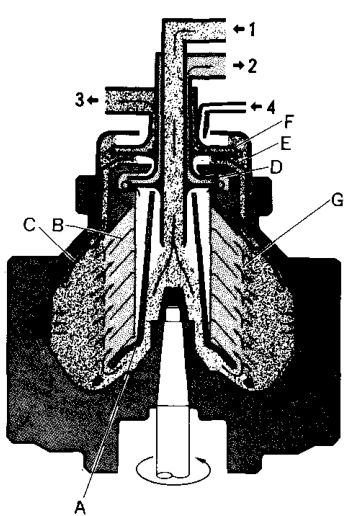
Purifier operation
- Feed liquid enters through the feed-liquid inlet.
- The distributor sends it to the outer part of the disc stack.
- Water and solids move outward.
- Oil moves inward between the discs.
- Clean oil leaves through the light-liquid impeller.
- Water passes outside the top disc.
- Water leaves through the heavy-liquid outlet.
Why the distributor is important
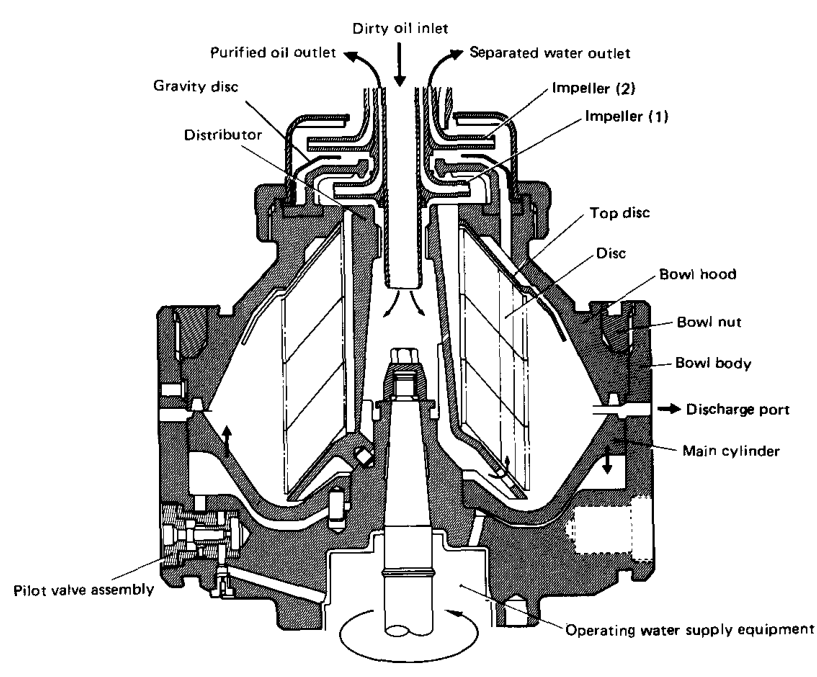
The distributor:
- Introduces feed into the correct bowl region.
- Brings the incoming oil close to bowl speed.
- Reduces sudden disturbance inside the separation chamber.
- Helps establish the intended flow path through the discs.
The Mitsubishi manual describes the bowl as containing a bowl body, bowl hood, bowl nut, separation chamber, disc stack, top disc, and distributor.
12. Purifier interface: where the liquid phases meet
In a two-liquid purifier, oil and water form an interface inside the bowl.
The interface must be positioned in the correct region. If it moves too far inward or outward, the outlet streams become contaminated.
The Mitsubishi manual explains that the interface is controlled by the heavy-liquid outlet diameter, which is selected using a gravity disc.
This topic is developed fully in the next chapter, but its connection to separation principles is important:
- Separation force creates radial movement.
- Density difference creates phase ordering.
- Outlet geometry determines where the two liquid phases divide.
13. Clarifier flow through the discs
In clarifier operation there is no normal oil-water separation.
The flow is:
- Dirty oil enters the bowl.
- The distributor feeds the disc periphery.
- Solids move outward.
- Clean oil moves inward.
- Clean oil leaves through the light-liquid outlet.
- Sealing water is not supplied.
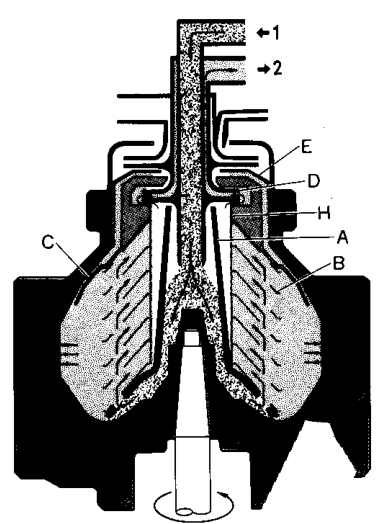
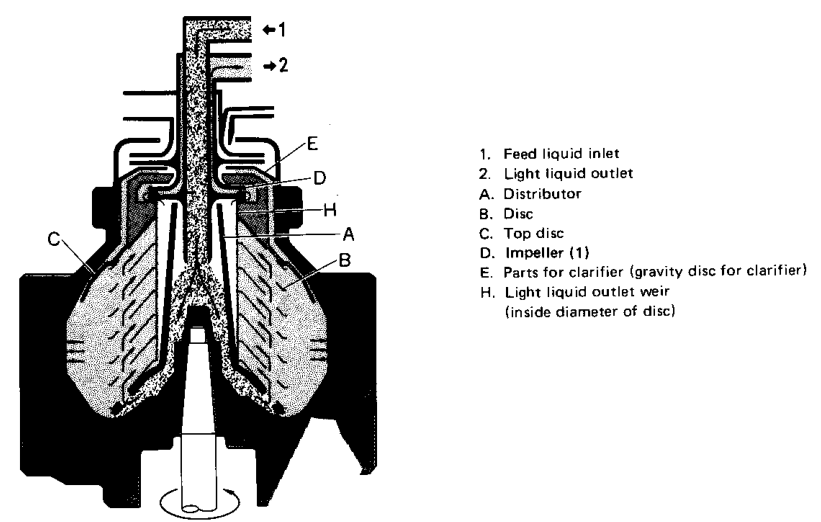
The clarifier therefore uses the same general centrifugal principle but a different liquid arrangement.
14. Disc-type and tubular-bowl centrifuges
Reed’s identifies two basic marine oil-centrifuge types:
- Large-diameter bowl type fitted with discs
- Tubular-bowl type without discs
14.1 Disc-type centrifuge
Characteristics:
- Large bowl diameter
- Disc stack
- Short settling distance
- Good clarification and separation
- Common marine arrangement
- Often operates at approximately 5,000–8,000 revolutions per minute depending on size, according to Reed’s description
The discs compensate for the lower centrifugal settling force compared with a tubular bowl by reducing the distance particles must travel.
14.2 Tubular-bowl centrifuge
Characteristics:
- Narrow, elongated bowl
- No disc stack
- High rotational speed
- Long settling surface
- Suitable for certain separation duties
The two designs use different combinations of bowl geometry and speed to achieve separation.
Comparison
| Feature | Disc-type bowl | Tubular bowl |
|---|---|---|
| Disc stack | Present | Absent |
| Bowl shape | Large diameter | Narrow tubular |
| Main improvement | Short settling distance | High rotational speed and long separation path |
| Flow arrangement | Through disc passages | Through tubular bowl |
| Typical separation aid | Disc geometry | High centrifugal field |
15. Why the purifier must reach operating speed first
The separating force depends on rotational speed. Before the bowl reaches operating speed:
- Centrifugal separation is insufficient.
- The interface is not stable.
- Water and oil may not follow their intended paths.
- Solids may not be driven properly toward the bowl wall.
- Feeding oil can cause overflow or poor separation.
The normal principle is:
Reed’s gives this sequence for purifier operation.
16. Why sealing water matters to the principle
A purifier must maintain a liquid arrangement that keeps oil and water on their correct sides of the interface.
The water seal:
- Prevents oil from escaping through the heavy-liquid outlet.
- Establishes the initial liquid arrangement inside the bowl.
- Helps create the correct interface before oil feed begins.
The Mitsubishi manual states that sealing water must be supplied before feed liquid so that oil does not flow out through the heavy-liquid outlet.
Sealing water is therefore not just a starting procedure. It is part of the hydraulic separation principle.
17. What changes the separation result?
17.1 Increase in viscosity
17.2 Increase in temperature
Within the approved limit:
17.3 Increase in throughput
17.4 Increase in bowl speed
Within the approved limit:
17.5 Incorrect disc condition
17.6 Wrong liquid density assumptions
If the density of the treated oil changes, the interface position also changes. The purifier may require a different gravity-disc arrangement.
18. Why water droplets and emulsions are difficult
The ideal purifier separates distinct oil and water phases. Separation becomes harder when water is dispersed as very small droplets or forms a stable emulsion.
Reasons include:
- High viscosity
- Strong mixing before the purifier
- Surfactants or fuel additives
- Excessive turbulence
- Incorrect temperature
- Inadequate residence time
The purifier can separate phases according to its design limits, but it cannot guarantee complete separation of every stable emulsion.
Correct system practice is therefore important:
- Avoid unnecessary mixing.
- Maintain the correct temperature.
- Use the correct throughput.
- Drain settling and service tanks.
- Monitor the water outlet.
- Investigate repeated water carry-over rather than simply increasing feed rate.
19. Worked conceptual example
Situation
A purifier is treating viscous fuel containing water and fine catalyst particles.
Initial condition
- Oil temperature is too low.
- Feed rate is high.
- Disc stack is clean.
- Bowl speed is normal.
Expected result
The purifier may remove some free water and heavy solids, but fine catalyst particles may pass through with the clean oil.
Correct reasoning
- Low temperature means high viscosity.
- High viscosity increases drag on the particles.
- High throughput reduces residence time.
- Fine particles do not reach the disc surface before the oil exits.
- The limit-size particle becomes larger.
- Clean-oil quality deteriorates.
Corrective direction
Within the maker’s limits:
- Increase temperature to the correct separating value.
- Reduce feed rate.
- Maintain normal bowl speed.
- Check the disc stack and flow passages.
- Verify correct interface and gravity-disc selection.
This example follows the factors listed by Reed’s for the limit-size particle.
20. Diagram-reading method
When studying any purifier diagram, identify these items in order:
- Axis of rotation
- Bowl wall
- Feed inlet
- Distributor
- Disc stack
- Light-liquid path
- Heavy-liquid path
- Sludge region
- Interface
- Outlet impellers or paring discs
Then trace each phase with a pencil:
If you can trace all three paths, you understand the separation principle rather than merely memorizing component names.
21. Common misunderstandings
Misunderstanding 1: “The purifier separates only water.”
Incorrect. A purifier separates water and solids simultaneously.
Misunderstanding 2: “Higher feed rate always means better performance.”
Incorrect. Higher feed rate can make the discharged oil dirtier by reducing residence time.
Misunderstanding 3: “The disc stack filters the oil.”
Not exactly. The discs create short settling distances and low-velocity surfaces. The separation is centrifugal, not ordinary strainer filtration.
Misunderstanding 4: “Every solid particle is removed.”
Incorrect. Particles smaller than the limit size may pass with the clean oil.
Misunderstanding 5: “Heating always improves separation.”
Only within the approved temperature range. Excessive heating creates other problems.
Misunderstanding 6: “A clarifier and purifier have the same liquid arrangement.”
Incorrect. A purifier separates oil and water as well as solids; a clarifier is arranged for oil-solid separation.
Misunderstanding 7: “The bowl can be fed before reaching speed.”
Incorrect and unsafe. The bowl must reach operating speed before normal feed is introduced.
22. Revision questions with answers
Question 1
What is clarification?
Answer: Separation of solids from a liquid.
Question 2
What is separation in marine purifier terminology?
Answer: Separation of two liquids, normally oil and water.
Question 3
Why do solids move to the bowl wall?
Answer: They are denser than oil and experience an outward centrifugal force in the rotating bowl.
Question 4
Why does the disc stack improve separation?
Answer: It reduces the distance particles must travel and provides low-velocity surfaces that help particles move into the sludge space.
Question 5
What is viscous drag?
Answer: Resistance from the oil that opposes particle movement through the liquid.
Question 6
What happens when oil viscosity increases?
Answer: Viscous drag increases, particle movement slows, and separation efficiency decreases.
Question 7
What is the limit-size particle?
Answer: The smallest particle that the centrifuge can reliably remove under a particular operating condition.
Question 8
Name six factors affecting the limit-size particle.
Answer: Viscosity, disc spacing, disc diameter, disc inclination, bowl speed, and throughput.
Question 9
What happens to separation when throughput increases excessively?
Answer: Residence time decreases, the limit-size particle becomes larger, and more fine contamination may leave with the clean oil.
Question 10
What is the difference between purifier and clarifier operation?
Answer: Purifier operation separates oil, water, and solids; clarifier operation separates oil and solids without normal water separation.
Question 11
Why must the bowl reach speed before oil feed?
Answer: Adequate centrifugal force and a stable liquid arrangement are required before separation can occur correctly.
Question 12
What happens to water in a normal purifier bowl?
Answer: It moves radially outward relative to the lighter oil and leaves through the heavy-liquid outlet.
23. Self-test exercise
Draw a cross-section of a disc-type purifier and label:
- Axis
- Bowl wall
- Feed inlet
- Distributor
- Disc stack
- Oil flow
- Water flow
- Solid-particle path
- Sludge space
- Clean-oil outlet
- Heavy-liquid outlet
Then answer:
- Why does water move outward?
- Why does oil move inward?
- Why do solids collect on the bowl wall?
- Why do the discs help?
- Why does high viscosity reduce separation?
- Why does high throughput allow more fine particles to escape?
- What is the limit-size particle?
- How does clarifier flow differ from purifier flow?