
The Purpose of a Marine Oil Purifier
Why is a purifier fitted in a marine fuel-oil or lubricating-oil system?
Key Principles at a Glance 7 points
- A purifier protects the engine, not the oil: it removes water, sludge and solid particles before they reach bearings, injectors and pumps.
- Centrifugal separation works on density difference — oil is the light phase, water the heavy phase and solids the heaviest, so each leaves by a different route.
- A purifier is not a clarifier: a purifier removes water as well as solids and needs a water seal and a gravity disc; a clarifier removes solids only.
- It removes free water and settleable solids, but cannot remove dissolved water, dissolved salts or contamination of the same density as the oil.
- Purification supplements settling tanks, filters and laboratory analysis — it replaces none of them.
- Heating lowers viscosity and widens the density gap, and a lower throughput gives longer residence time; both improve separation.
- Self-cleaning purifiers discharge accumulated sludge periodically so separating capacity is restored without stopping the machine.
1. Learning objectives
Course position: Topic 1 of the purifier learning sequence
Main question: Why is a purifier fitted in a marine fuel-oil or lubricating-oil system?
After studying this lesson, you should be able to:
- Explain why ships purify fuel oil and lubricating oil.
- Identify the three materials handled by a purifier: oil, water, and solids.
- Distinguish a purifier from a clarifier.
- Explain how contamination damages an engine and its fuel or lubricating system.
- State what a centrifugal purifier can remove and what it cannot remove.
- Explain why settling tanks, filters, laboratory analysis, and purifiers are all still required.
- Explain why correct temperature and low throughput improve purification.
- Describe the purpose of fuel-oil and lubricating-oil purification systems.
- Explain the meaning of feed liquid, light liquid, heavy liquid, sludge, and interface.
- Answer the common examination question: “Why is oil purification necessary?”
2. The central idea
A marine engine cannot safely use oil containing excessive water, sludge, or solid particles. The purifier is installed to remove these contaminants before they reach sensitive engine components.
A centrifugal purifier uses a rapidly rotating bowl to separate materials according to their density:
- Oil is the lighter liquid.
- Water is normally the heavier liquid.
- Solid particles and sludge are heavier than oil and move toward the bowl wall.
The Mitsubishi manual defines purifying operation as three-phase separation: liquid, liquid, and solid — in marine terms, oil, water, and solids.
The purifier therefore has two jobs at the same time:
- Liquid-liquid separation: removing water from oil.
- Liquid-solid separation: removing dirt, sludge, rust, wear particles, and other suspended solids from oil.
This is why a purifier is more than an ordinary filter.
3. Why fuel oil must be purified
3.1 Water contamination
Water can enter fuel oil through:
- Sea-water contamination
- Tank condensation
- Poor bunkering practice
- Leaking heating coils or tank boundaries
- Water already present in delivered fuel
- Incompatible or contaminated bunker batches
Water is harmful because it can:
- Reduce the effective heating value of the fuel.
- Cause corrosion in tanks, pumps, injectors, and fuel-system components.
- Carry dissolved salts into the engine.
- Encourage sludge formation.
- Cause poor combustion and unstable fuel injection.
- Carry sodium into the combustion system.
McGeorge explains that sodium may enter fuel with sea water. Sodium is water-soluble, so it can be removed with the water in a purifier. If it reaches the cylinder, sodium can combine with vanadium ash and harm engine exhaust valves.
3.2 Solid contamination
Fuel may contain:
- Rust
- Tank scale
- Sand and dirt
- Settled bunker sludge
- Carbonaceous material
- Abrasive catalyst fines
The most dangerous solids mentioned in the fuel-treatment material are silicon and aluminium catalyst fines. These are highly abrasive and can cause severe engine wear if they are not removed. The source specifically states that slow purification throughput is important for optimum removal.
Catalyst fines can damage:
- Fuel pumps
- Fuel injectors
- Cylinder liners
- Piston rings
- Exhaust valves
- Other fuel-injection and combustion surfaces
3.3 Sludge and incompatibility
Sludge may form because of:
- Incompatible fuel oils being mixed
- Sea-water contamination
- Temperature changes
- Bacterial contamination
- Instability of the fuel
- Long storage periods
Sludge can block:
- Fuel filters
- Pump strainers
- Purifier passages
- Fuel valves
- Tank suction arrangements
The fuel-treatment source notes that filter blockage may indicate sludge carry-over from the purifier or sludge formation in the service tank.
3.4 Dissolved contaminants that purification cannot remove
A purifier does not remove every harmful substance in fuel.
It can remove:
- Water
- Water-soluble contaminants carried with the water
- Heavier suspended solids
- Catalyst fines, when operating conditions permit
It cannot normally remove:
- Substances dissolved directly in the fuel, such as vanadium and sulphur compounds
- Every contaminant in very high-density fuel
- Contamination that is chemically dissolved rather than suspended or water-associated
McGeorge states that dissolved impurities are not removed by the centrifuge. It also notes that some very high-density fuels, above approximately 991 kg/m³ at 15°C, may not permit normal water separation.
Therefore, purification is necessary but is not a substitute for:
- Fuel-quality testing
- Correct bunker segregation
- Settling tanks
- Service-tank draining
- Correct fuel treatment temperature
- Proper engine-cylinder lubrication
- Regular inspection of filters and injectors
4. Why lubricating oil must be purified
Lubricating oil circulates repeatedly through the engine. It is exposed to:
- Bearing wear particles
- Rust and dirt
- Carbon and combustion products
- Water contamination
- Acids and oxidation products
- Sludge
- Additive degradation products
If these remain in the lubricating oil, they can circulate through bearings and other loaded surfaces.
4.1 Water in lubricating oil
Water in lubricating oil is dangerous because it can:
- Reduce the oil film strength.
- Cause rust and corrosion.
- Promote oxidation and sludge formation.
- Damage bearings.
- Encourage acidic corrosion products.
- Reduce the lubricating ability of the oil.
The Reed’s examination material specifically asks candidates to explain the effects of water in lubricating oil and fuel oil, and why regular oil analysis is necessary.
The source also records that sulphur products from fuel can combine with water in lubricating oil to form sulphuric acids, which may be carried around the lubricating-oil system and cause severe crankshaft corrosion.
4.2 Solid contamination in lubricating oil
Suspended solids can act as abrasive material between:
- Bearing surfaces
- Journals
- Piston rings
- Cylinder liners
- Gear teeth
- Pump parts
The purifier reduces this circulating contamination, but it does not make filters unnecessary. Reed’s examination material explicitly asks why centrifuges do not render static filters redundant.
The correct principle is:
A purifier removes a large class of contaminants by centrifugal separation; filters provide another form of protection and remove particles that may not be captured by the purifier.
4.3 Continuous bypass purification
Lubricating-oil purifiers are commonly arranged in a continuous bypass system. Oil is taken from the engine sump or drain tank, passed through the purifier, and returned to the lubricating-oil system. The purifier treats part of the circulating oil continuously rather than requiring all engine oil to pass through it at once.
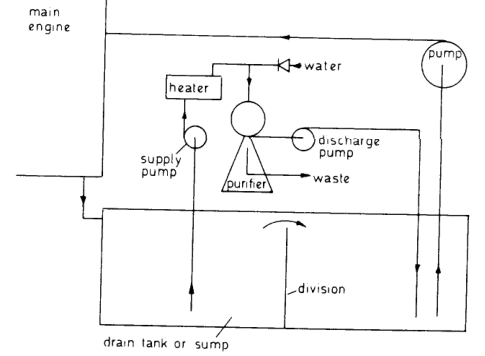
This arrangement allows gradual cleaning while the engine remains in service.
5. Purifier terminology
The following terms are essential for understanding the purpose of the machine.
| Term | Meaning |
|---|---|
| Feed liquid | Untreated oil entering the purifier |
| Light liquid | Purified oil, normally lighter than water |
| Heavy liquid | Separated water or other heavy liquid |
| Sludge | Solids accumulated in the bowl; broadly, the discharged mixture of solids, water, and oil |
| Interface | Boundary between the light liquid and heavy liquid inside the bowl |
| Purifying operation | Three-phase separation of oil, water, and solids |
| Clarifying operation | Two-phase separation of oil and solids |
| Feed rate | Volume of untreated liquid supplied per unit time |
| Actual capacity | Rated treatment capacity under the manufacturer’s stated standard and conditions |
These definitions are taken from the Mitsubishi Selfjector manual.
6. Purifier and clarifier: the essential difference
6.1 Purifier
A purifier is used when the oil contains both water and solids.
It performs:
- Oil-water separation
- Oil-solid separation
- Continuous or controlled removal of water and sludge
A purifier requires a water seal so that the separated oil and water follow their correct outlet paths.
6.2 Clarifier
A clarifier is used primarily to remove solids from oil.
It does not operate as a normal three-phase purifier. Reed’s explains that a clarifier has no water seal in the same arrangement, and the bowl provides more space for oil and solids.
| Feature | Purifier | Clarifier |
|---|---|---|
| Main separation | Oil + water + solids | Oil + solids |
| Number of phases | Three | Two |
| Water seal | Used | Not normally used in the same arrangement |
| Heavy-liquid outlet | Used for water | Not used for normal water separation |
| Interface control | Required | Not used in the same way |
| Main application | Water-contaminated oil | Dry oil containing solids |
6.3 Fuel-treatment arrangement
For diesel fuel, a single-stage centrifugal purification process is normally used. For residual fuel, the source describes a common two-stage arrangement:
- Fuel is heated in a supply or settling tank.
- The purifier inlet pump sends it through a controlled heater.
- The heated fuel enters the centrifugal purifier.
- The dry purified oil is sent to a centrifugal clarifier.
- The clarifier removes remaining solids.
- Treated fuel is sent to the daily service tank.
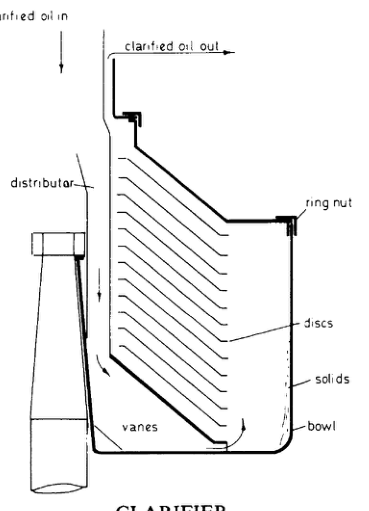
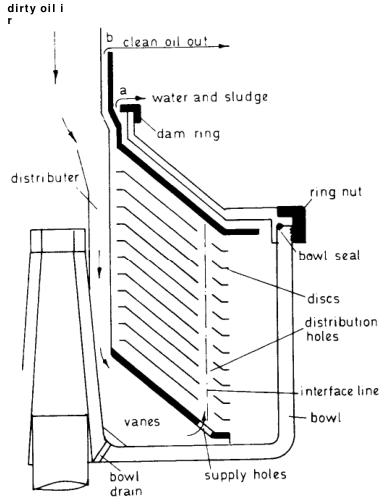
7. What the purifier removes
From fuel oil
The purifier is intended to remove:
- Free water
- Water containing dissolved sodium and other water-soluble contaminants
- Suspended heavy solids
- Rust and scale
- Sludge
- Silicon and aluminium catalyst fines, when throughput and temperature are suitable
From lubricating oil
The purifier is intended to remove:
- Free water
- Suspended solid particles
- Sludge
- Wear debris
- Oxidation-related insoluble material
- Other heavy contamination that can be separated centrifugally
Important qualification
Removal efficiency depends on:
- Density difference between oil, water, and solids
- Oil viscosity
- Separating temperature
- Feed rate
- Bowl speed
- Disc-stack condition
- Correct interface position
- Correct gravity disc
- Correct sealing-water arrangement
- Contaminant size and density
A purifier is not a magic cleaning machine. Its performance depends on correct operating conditions.
8. What the purifier does not replace
8.1 Settling tanks
Settling tanks remain necessary. They allow large amounts of water and heavy sludge to settle before the oil reaches the purifier.
McGeorge states that centrifuges do not make settling tanks redundant. Large quantities of water contamination may still be drained from a settling tank, providing an indication of a serious fuel-contamination problem.
8.2 Filters
Purifiers do not make static filters redundant. Filters provide final or local protection for equipment and may capture particles that the purifier does not remove.
8.3 Fuel testing
Bunker documentation and laboratory testing remain necessary because purification cannot identify or remove every dissolved chemical contaminant. Fuel quality may vary in:
- Density
- Viscosity
- Flash point
- Water content
- Stability
- Compatibility
- Catalyst-fine content
8.4 Correct lubrication practice
Purification cannot compensate for:
- Incorrect cylinder-oil feed rate
- Wrong oil grade
- Poor bearing clearances
- Overheating
- Water ingress that is not repaired
- Continued entry of combustion products
The purifier controls contamination; it does not remove the original cause of contamination.
9. Why temperature matters to the purpose of purification
The purifier works by allowing particles and water droplets to move through oil under centrifugal force. High viscosity resists this movement.
Heating the oil:
- Reduces viscosity.
- Reduces viscous drag on suspended particles.
- Allows water droplets and solids to migrate more easily.
- Improves clarification and water separation.
- Allows the purifier to treat the required oil flow.
Reed’s states that medium- and high-viscosity oils should be heated before purification because reducing viscosity improves clarification by reducing viscous drag on solid particles.
Heating must remain within the manufacturer’s operating limit. Excessive heating can:
- Damage the oil
- Increase oxidation
- Create safety risks
- Damage seals or machine parts
- Waste energy
10. Why lower throughput can give better purification
A high feed rate reduces the time available for separation and may carry fine particles through the bowl before they reach the sludge space.
For maximum separation efficiency:
- Use the correct temperature.
- Use an appropriate feed rate.
- Avoid assuming that rated capacity gives maximum cleanliness.
- Reduce throughput when removing difficult contaminants such as catalyst fines.
Reed’s specifically asks whether a purifier should be operated at rated capacity for maximum efficiency; the fuel-treatment material states that slow throughput is essential for optimum catalyst-fine removal.
The distinction is:
- Rated capacity: the machine’s designed treatment rate.
- Best purification: the rate and conditions that produce the required cleanliness.
These are not always the same.
11. How the centrifugal bowl achieves the purpose
The bowl rotates at high speed. The resulting centrifugal action causes density-based movement:
- Dense solids move outward to the bowl wall.
- Water moves outward relative to oil.
- Oil occupies the inner region.
- The disc stack increases the available separation area.
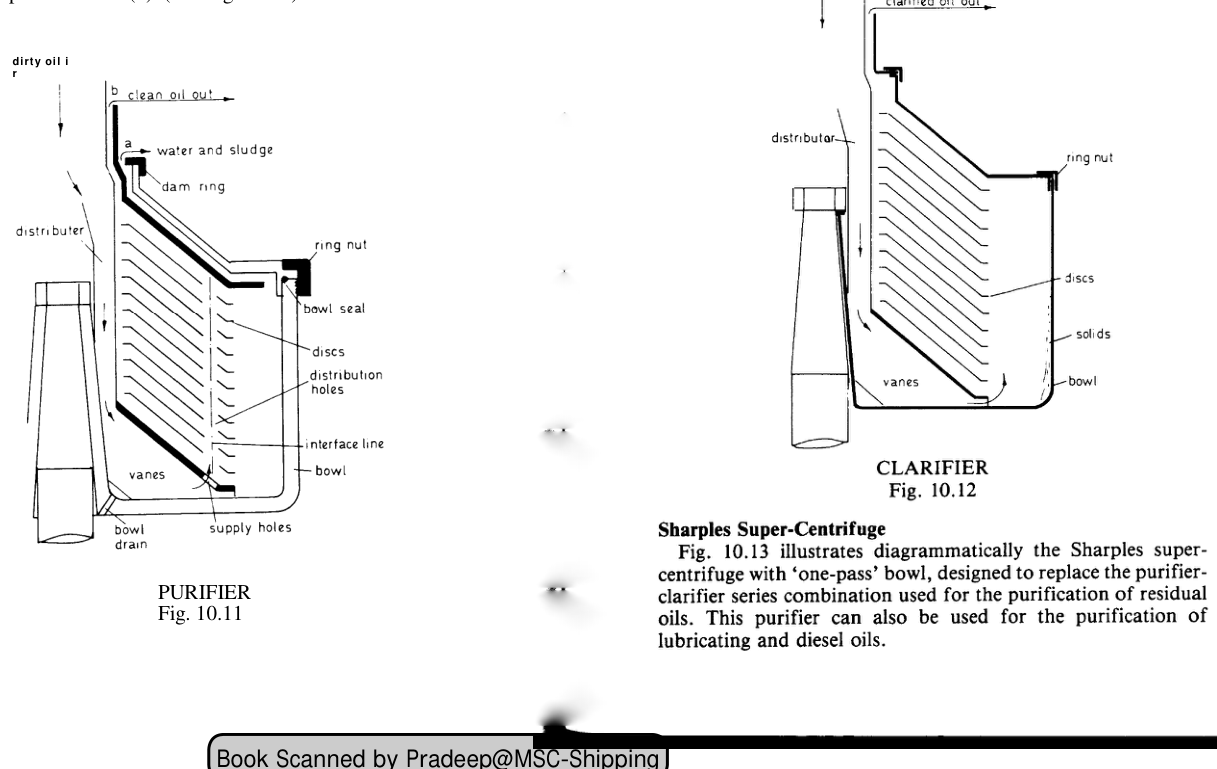
Reed’s describes the operating sequence as follows:
- Bring the centrifuge to operating speed.
- Supply fresh water to form the water seal.
- Feed the oil through the inlet pump.
- Accelerate the oil to bowl speed in the distributor.
- Pass the oil through the disc passages.
- Move water and sludge outward.
- Move purified oil inward.
- Discharge water and purified oil through their respective paths.
This sequence explains the practical purpose of the machine: it creates the conditions needed for contaminated oil to separate into useful oil, separated water, and collected sludge.
12. Self-cleaning and the purpose of sludge discharge
Solids do not disappear after separation. They collect at the bowl periphery and must be removed.
A self-cleaning purifier uses a sliding bowl bottom controlled by operating water:
- Operating water holds the sliding bowl bottom closed.
- Solids collect at the bowl periphery.
- At a selected interval, oil feed is stopped.
- The bowl is opened hydraulically.
- Sludge is discharged through ports.
- The bowl closes again.
- The liquid seal is re-established.
- Oil feed resumes.
This makes continuous or automatic treatment possible without dismantling the bowl after every discharge.
For lubricating-oil purifiers, washing water may be introduced during a scheduled total discharge to help remove solids from the bowl. The Mitsubishi manual notes that washing water is used for lubricating-oil purification, while no washing water is required for its fuel-oil purifier arrangement.
13. The complete purpose in one system view
Fuel-oil system
Lubricating-oil system
The lubricating-oil arrangement is normally a bypass system, so only part of the oil flow is purified at a time while the engine continues operating.
14. Short-answer revision questions
Question 1
What are the three phases separated in purifier operation?
Answer: Oil, water, and solids.
Question 2
What is the difference between a purifier and a clarifier?
Answer: A purifier separates oil, water, and solids. A clarifier mainly separates oil and solids.
Question 3
Why is water dangerous in fuel oil?
Answer: It can cause corrosion, poor combustion, sludge, and transport water-soluble salts such as sodium into the engine.
Question 4
Why are aluminium-silicon catalyst fines dangerous?
Answer: They are highly abrasive and can cause severe wear in fuel pumps, injectors, liners, rings, and related engine parts.
Question 5
Can a purifier remove sulphur and vanadium dissolved in fuel?
Answer: No. Dissolved impurities are not normally removed by centrifugal separation.
Question 6
Why are settling tanks still required?
Answer: They allow large amounts of water and heavy sludge to settle and be drained before the oil reaches the purifier.
Question 7
Why is fuel heated before purification?
Answer: Heating reduces viscosity and viscous drag, allowing water and solids to separate more effectively.
Question 8
Why may slow throughput improve purification?
Answer: It increases the opportunity for fine particles and water droplets to separate, especially catalyst fines.
Question 9
Why are filters still used with purifiers?
Answer: Filters provide additional protection and remove particles that may not be captured by the purifier.
Question 10
What happens to separated solids?
Answer: They collect at the bowl periphery and must be removed by manual cleaning or an automatic/self-cleaning discharge system.
15. Self-test: explain without notes
Try to answer this in five minutes:
A ship receives contaminated residual fuel. Explain why the fuel is sent through settling tanks, a heater, a purifier, and possibly a clarifier before reaching the service tank. State what each stage removes, what the purifier cannot remove, and why slow throughput may be selected.
Your answer should include:
- Water contamination
- Sludge and solids
- Catalyst fines
- Heating and viscosity
- Three-phase purification
- Clarification
- Dissolved contaminants
- Settling-tank drainage
- Filters and fuel testing
- Engine protection