
Liquid Properties That Control Purifier Performance
How do density, specific gravity, viscosity, temperature, and feed rate affect purifier operation?
Key Principles at a Glance 7 points
- The density difference between oil and water drives the whole separation; specific gravity is the same information referenced to water and is the figure used for gravity-disc selection.
- Viscosity governs how freely water droplets and solids move — the higher the viscosity, the slower and less complete the separation.
- Viscosity falls sharply as temperature rises, which is why a purifier runs at a recommended treating temperature instead of at ambient.
- Temperature also lowers oil density, so raising the temperature changes the density difference and therefore the correct gravity-disc condition.
- Feed rate sets residence time: too high a throughput carries particles out with the oil before they can settle.
- Density, temperature and feed rate act together — a gravity disc that is correct at one temperature and feed rate can be wrong at another.
- Water and solids content change the load on the bowl, and therefore the sludge-discharge interval required.
1. Learning objectives
Course position: Topic 3 of the purifier learning sequence
Main question: How do density, specific gravity, viscosity, temperature, and feed rate affect purifier operation?
After studying this lesson, you should be able to:
- Define density and specific gravity.
- Explain why density difference allows oil and water to separate.
- Define dynamic viscosity and kinematic viscosity.
- Explain why viscosity is central to purifier capacity.
- Explain the relationship between temperature and viscosity.
- Select a practical treating temperature from a viscosity-temperature graph.
- Explain the meaning of feed rate and actual capacity.
- Explain why oil data must be measured at a stated temperature.
- Understand why changing oil type requires checking purifier settings.
- Connect liquid properties with gravity-disc selection.
- Diagnose poor separation caused by incorrect temperature, density, or feed rate.
- Read the manufacturer’s temperature-viscosity and gravity-disc diagrams.
2. Why liquid properties matter
A purifier does not operate on every oil in exactly the same way. The machine’s separation result depends strongly on the physical properties of the liquid entering the bowl.
The most important properties are:
- Density
- Specific gravity
- Viscosity
- Temperature
- Water content
- Solid content
- Feed rate
These properties influence:
- The position of the oil-water interface
- The movement of water and solids
- The smallest particle that can be removed
- The purifier’s practical throughput
- The correct gravity disc
- The required heating temperature
- The quality of the discharged oil
The Mitsubishi manual states that purifier capacity depends mainly on the viscosity of the feed liquid and that the feed must be heated to the specified temperature for efficient operation.
3. Density
3.1 Definition
Density is mass per unit volume:
where:
- ρ = density
- m = mass
- V = volume
Typical units are:
- kg/m³
- g/cm³
Reed’s explains that density is important for bunker capacity, heating arrangements, fuel injectors, and purifiers.
3.2 Simple example
If 1 m³ of oil has a mass of 950 kg:
If the same volume of water has a mass close to 1000 kg, the water is denser than the oil and tends to move outward in a centrifugal bowl.
3.3 Why density matters inside the purifier
The purifier relies on density differences:
In normal marine service:
The density difference between oil and water determines how clearly the interface forms. If oil density approaches water density, separation becomes more difficult.
4. Specific gravity
4.1 Definition
Specific gravity is the ratio of the density of a substance to the density of water at the reference condition.
Conceptually:
If oil has a density of 950 kg/m³ and the reference water density is 1000 kg/m³:
The Mitsubishi manual defines specific gravity as the ratio of the mass of a given volume of liquid to the mass of an equal volume of water, and notes that its value changes with temperature.
4.2 Specific gravity is temperature-dependent
Oil expands when heated. Its volume increases while its mass remains essentially constant. Therefore its measured density and specific gravity change with temperature.
This is why the temperature must always be stated with a density or specific-gravity value, for example:
- Specific gravity 0.925 at 15°C
- Specific gravity 0.944 at 50°C
The same oil can give different measured values at different temperatures.
4.3 Reference temperature
Marine fuel data commonly uses 15°C as the reference temperature. Reed’s states that density is normally corrected to the 15°C datum temperature when the measurement cannot be made at exactly 15°C.
Never compare two density values without checking their reference temperatures.
5. Density and purifier interface position
A purifier has an oil-water interface inside the bowl. The correct interface position depends on the relative densities of the light and heavy liquids.
If the treated oil changes from one fuel grade to another, its density may change. The same gravity disc may no longer position the interface correctly.
The Mitsubishi manual warns that a suitable gravity disc must be selected for the gravity of the treated oil. An incorrect diameter can cause oil to flow to the heavy-liquid side or water to circulate over the light-liquid side.
This connects liquid properties directly to operation:
Density is not only a laboratory value; it determines how the purifier’s liquid boundary behaves.
6. Viscosity
6.1 Definition
Viscosity is the resistance of a fluid to flow or to a change of shape. It is caused by internal molecular friction.
A high-viscosity liquid resists movement more strongly than a low-viscosity liquid.
Examples:
- Water: low viscosity
- Diesel oil: relatively low viscosity
- Heavy fuel oil: high viscosity when cold
- Thick lubricating oil: higher viscosity than light diesel oil
Reed’s defines viscosity as resistance caused by internal molecular friction and the resulting frictional drag.
6.2 Why viscosity is critical in a purifier
During centrifugal separation, water droplets and solid particles must move through oil. Viscosity resists this movement.
High viscosity can cause:
- Poor water separation
- Fine solids passing with clean oil
- Lower practical throughput
- Higher pump load
- Greater pressure drop
- More difficult sludge movement
The Mitsubishi manual states that the purifier’s throughput capacity is governed by viscosity.
7. Dynamic and kinematic viscosity
7.1 Dynamic viscosity
Dynamic viscosity describes the force required to shear a fluid. It is commonly represented by μ.
7.2 Kinematic viscosity
Kinematic viscosity is dynamic viscosity divided by density:
where:
- ν = kinematic viscosity
- μ = dynamic viscosity
- ρ = density
Marine fuel and lubricating-oil specifications commonly express viscosity as kinematic viscosity in:
- mm²/s
- cSt, centistokes
For practical purifier operation, the viscosity value must always include its measurement temperature, for example:
- 45 cSt at 50°C
- 150 mm²/s at 40°C
A viscosity number without a temperature is incomplete.
8. Temperature and viscosity
For most petroleum oils:
This is why a cold heavy fuel may be almost impossible to pump or purify effectively, while the same fuel becomes manageable after heating.
8.1 Purifier reason for heating
Heating the feed liquid:
- Reduces viscosity.
- Reduces viscous drag on particles.
- Helps water droplets migrate outward.
- Helps fine solids reach the disc surfaces.
- Allows the purifier to handle the required feed rate.
8.2 Heating is not unlimited
Excessive heating can:
- Waste energy
- Deteriorate the oil
- Increase oxidation
- Damage seals or purifier components
- Create a fire or safety hazard
- Cause excessive thermal stress
The Mitsubishi manual gives an optimum viscosity of approximately 24 cSt for the referenced purifier conditions and a maximum heating temperature below approximately 100°C for that arrangement. Always use the actual maker’s limit for the installed model.
9. Temperature-viscosity diagram
The manufacturer provides a temperature-viscosity graph so the operator can find a treating temperature for a known oil.
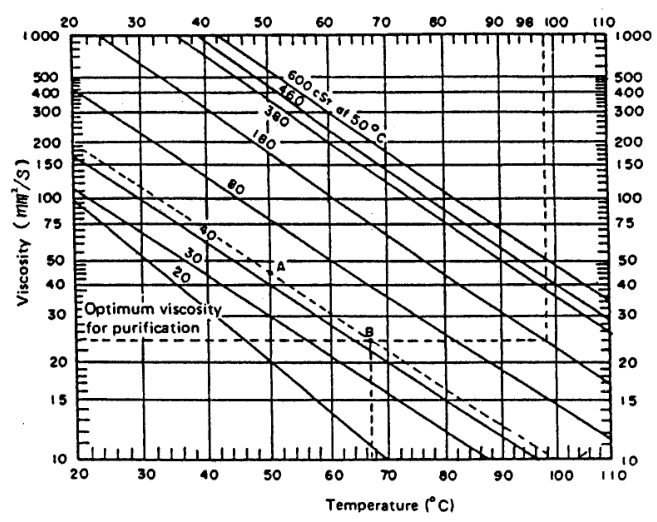
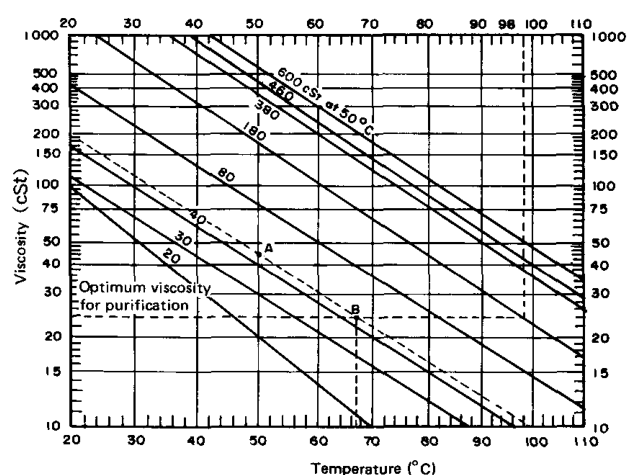
A second version of the graph appears in the operation manual:
How to read the graph conceptually
- Locate the known oil viscosity at its measurement temperature.
- Follow the appropriate oil curve.
- Find the temperature at which viscosity reaches the purifier’s target value.
- Confirm that the temperature remains within the maker’s limit.
- Set the heater and verify actual oil temperature during operation.
Do not estimate temperature from memory when the manufacturer’s graph is available.
10. Worked treating-temperature example
The Mitsubishi manual gives this example:
- Fuel viscosity: 45 cSt at 50°C
- Target viscosity: approximately 24 cSt
- Required treating temperature: approximately 67°C
The graphical method is:
- Locate 45 cSt at 50°C.
- Follow the line parallel to the relevant viscosity relationship.
- Find where the oil reaches 24 cSt.
- Read the corresponding temperature.
- The result is approximately 67°C.
This does not mean every fuel should be heated to 67°C. It applies only to the stated viscosity and the relevant machine’s graph.
11. Reference treating temperatures
The Mitsubishi operation manual gives examples of treating temperatures for different liquids:
| Oil type | Stated viscosity condition | Treating-temperature range or value |
|---|---|---|
| A heavy oil | 14 mm²/s at 40°C | 40°C |
| C heavy oil | 180–700 mm²/s at 50°C | 98°C |
| Lubricating oil, SAE 30 | 100 mm²/s at 40°C | 74–90°C |
| Lubricating oil, SAE 40 | 150 mm²/s at 40°C | 83–95°C |
These are manual examples, not universal settings. The actual temperature depends on:
- Installed purifier model
- Oil type
- Oil viscosity curve
- Manufacturer’s specified target viscosity
- Maximum permitted temperature
- Safety and material limits
12. Feed rate
12.1 Definition
Feed rate is the volume of untreated oil entering the purifier per unit time.
Typical units are:
- L/h
- m³/h
The Mitsubishi manual defines feed rate as the volume per unit time of untreated feed liquid supplied upstream of the purifier.
12.2 Feed rate versus actual capacity
Do not confuse:
- Feed rate: the selected operating flow.
- Actual capacity: treatment capacity calculated under the manufacturer’s standard conditions.
- Rated capacity: the nominal machine capability.
- Best separation rate: the flow that produces the required cleanliness.
A machine may physically accept a high feed rate while producing poorer separation at that rate.
12.3 Effect of feed rate on separation
A lower feed rate generally helps remove fine contamination because the liquid remains in the separation chamber longer.
However, the correct rate must also consider:
- Required fuel demand
- Storage capacity
- Purifier model
- Oil viscosity
- Contaminant loading
- Required separation quality
13. How density, temperature, and feed rate work together
These properties are not independent in practical operation.
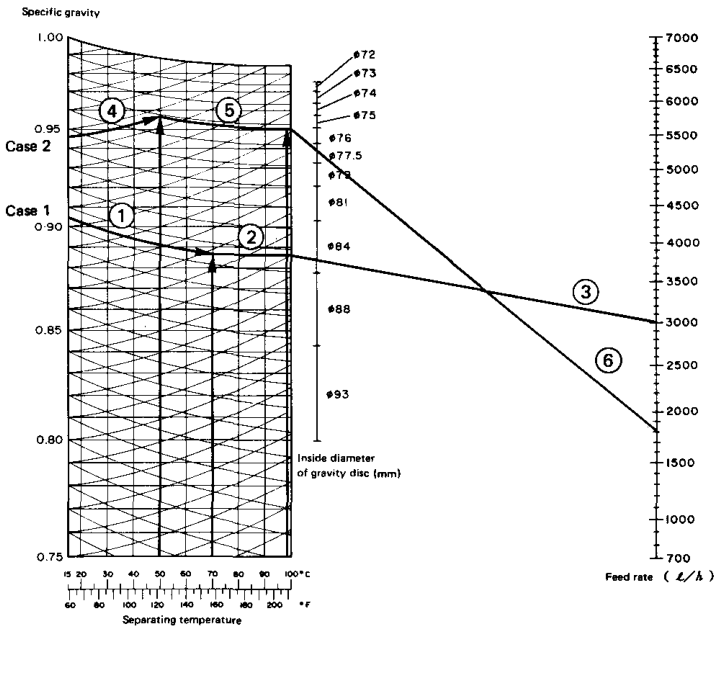
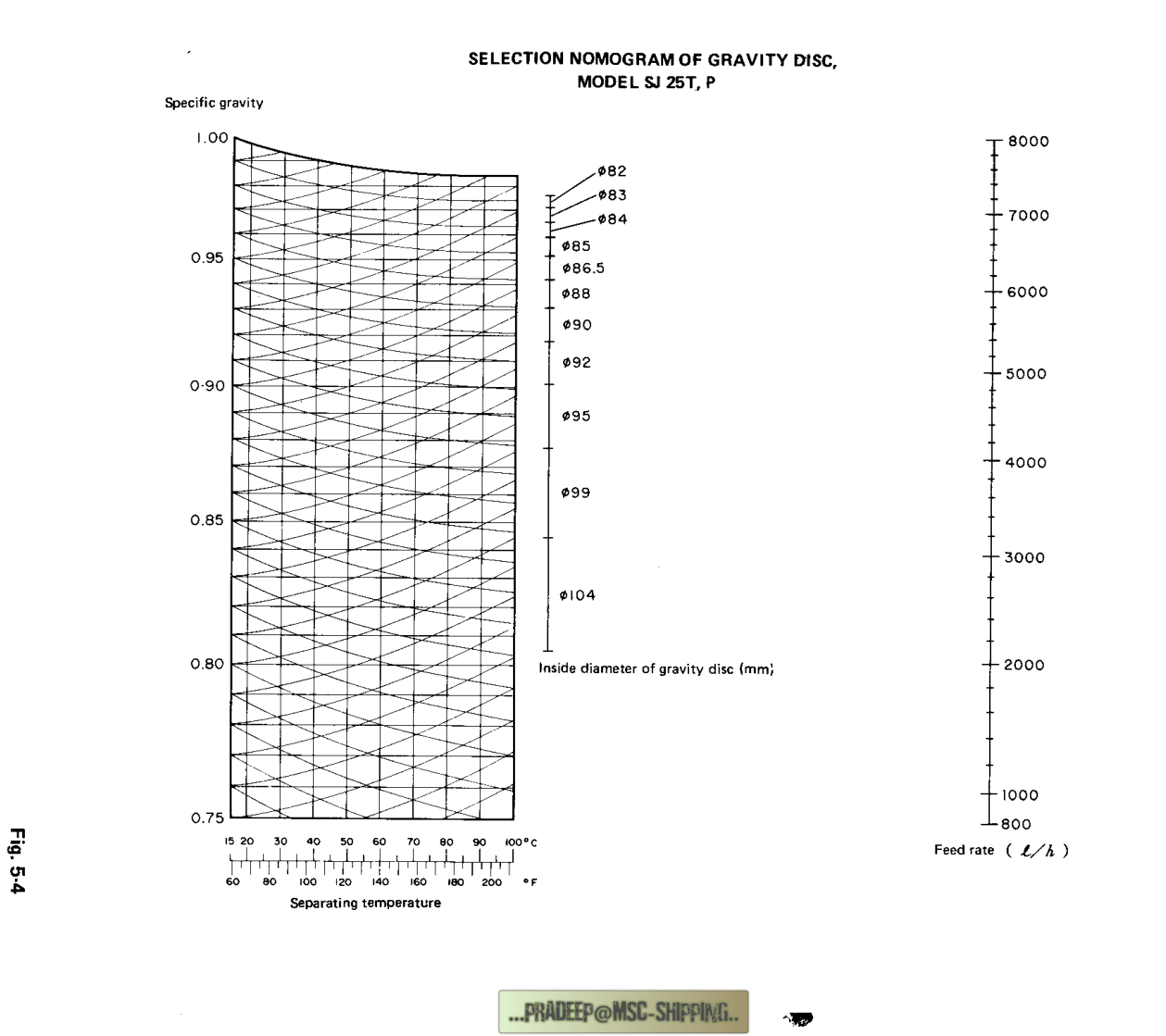
The Mitsubishi gravity-disc nomograms use three key operating inputs:
- Specific gravity
- Separating temperature
- Feed rate
The intersection gives the required gravity-disc inside diameter for the particular purifier model.
14. Gravity-disc selection example
The Mitsubishi manual provides this example:
- Specific gravity: 0.925 at 15°C
- Treating temperature: 70°C
- Feed rate: 3000 L/h
- Selected gravity-disc inside diameter: approximately φ79 mm
The graph procedure is:
- Locate the specific-gravity curve.
- Move to the treating-temperature line.
- Transfer the corrected condition to the reference-temperature scale.
- Connect the condition to the feed-rate point.
- Read the gravity-disc inside-diameter range.
- Select the appropriate disc according to the manufacturer’s table.
Important warning
Changing any of these can change the required disc:
- Fuel grade
- Specific gravity
- Treating temperature
- Feed rate
- Purifier model
Never use a gravity disc selected for a different oil without checking the manual.
15. Why temperature changes the gravity-disc condition
Heating changes both viscosity and density.
Therefore temperature affects the purifier in two ways:
- Flow effect: lower viscosity improves movement and throughput.
- Interface effect: changed density affects the radial balance between oil and water.
This is why the gravity-disc nomogram includes separating temperature as an input.
16. Feed rate and gravity-disc condition
A change in feed rate can shift the interface and alter the hydraulic balance in the bowl.
The manufacturer’s selection procedure therefore uses feed rate together with specific gravity and temperature.
Practical rule:
If the feed rate changes substantially, do not assume that the existing interface condition remains correct.
Observe:
- Water outlet condition
- Oil carry-over to the water side
- Water in clean oil
- Outlet pressure
- Bowl stability
17. Water content and solids content
Although the main property controls are density, viscosity, temperature, and feed rate, the contamination load also matters.
17.1 Water content
High water content can:
- Increase the volume of heavy liquid in the bowl.
- Increase water discharge frequency.
- Overload the separation arrangement.
- Cause water carry-over if the outlet cannot handle the load.
17.2 Solid content
High solid loading can:
- Fill the sludge space rapidly.
- Increase discharge frequency.
- Block water or sludge passages.
- Disturb flow through the disc stack.
- Increase vibration if sludge becomes unevenly distributed.
The purifier must therefore be adjusted not only to the oil’s physical properties but also to its contamination condition.
18. Measuring liquid properties on board
18.1 Density and specific gravity
Reed’s states that density may be determined with a hydrometer and that the measurement temperature must be considered.
Basic procedure:
- Obtain a representative sample.
- Bring the sample to the instrument’s required temperature.
- Ensure the hydrometer is clean and free-floating.
- Read the scale without parallax error.
- Record temperature with the density or specific-gravity result.
- Apply the correct temperature correction if required.
18.2 Viscosity
Viscosity is commonly measured using a viscometer or a fuel-testing kit.
Record:
- Viscosity value
- Temperature of measurement
- Instrument used
- Sample identity
- Time and location of sampling
The same value without its test temperature is not sufficient for purifier setting.
18.3 Representative sampling
The McGeorge fuel material states that fuel samples should be taken from a turbulent bunker-manifold flow after flushing the test cock, and that multiple small samples over the bunkering period produce a more representative composite sample.
A bad sample produces bad operating decisions, even if the purifier is correctly adjusted.
19. Troubleshooting using liquid properties
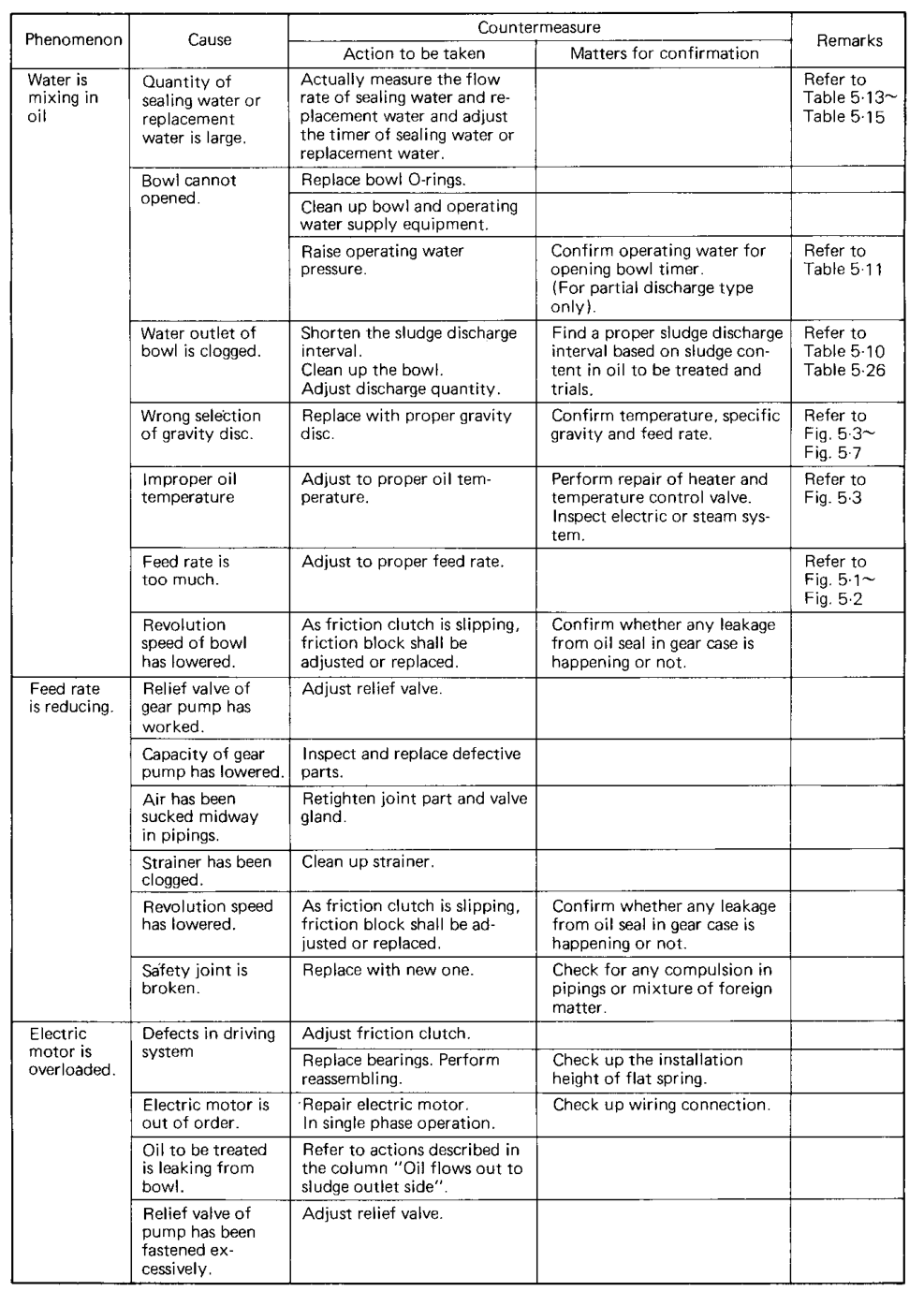
The Mitsubishi troubleshooting table connects poor purification with:
- Incorrect oil temperature
- Excessive feed rate
- Incorrect specific gravity assumption
- Incorrect gravity disc
- Reduced bowl speed
- Heater or temperature-control faults
It recommends confirming temperature, specific gravity, and feed rate when water mixes with oil, and adjusting the purifier settings accordingly.
Fault: water is mixing with clean oil
Check in this order:
- Is the oil temperature correct?
- Is the actual specific gravity known?
- Is the feed rate within the selected condition?
- Is the gravity disc correct?
- Is the water outlet blocked?
- Is the sealing or replacement-water flow excessive?
- Is the bowl speed normal?
Fault: oil flows to the heavy-liquid side
Check:
- Gravity-disc selection
- Specific gravity of treated oil
- Separating temperature
- Feed rate
- Interface position
- Water seal
Fault: purifier capacity is low
Check:
- Oil temperature
- Heater performance
- Oil viscosity
- Strainer condition
- Pump condition
- Feed-line restrictions
- Actual feed rate
20. Practical operating logic
Use this decision path whenever the oil changes:
Do not begin with the gravity disc alone. The disc is selected from the liquid condition.
21. Worked diagnostic example
Observation
Water is appearing in the clean-oil outlet.
Available information
- Oil type has recently changed.
- Heater temperature is lower than usual.
- Feed rate has been increased.
- Gravity disc has not been changed.
Reasoning
- The new oil may have a different specific gravity.
- Lower temperature means higher viscosity.
- Higher viscosity reduces separation and changes flow behaviour.
- Higher feed rate reduces residence time.
- The old gravity disc may no longer position the interface correctly.
- Water can therefore reach the light-liquid side.
Correct investigation
- Measure actual temperature.
- Obtain the new oil’s density or specific gravity.
- Confirm viscosity at its stated temperature.
- Check actual feed rate.
- Consult the appropriate gravity-disc nomogram.
- Inspect the water outlet and sealing-water flow.
This follows the manufacturer’s troubleshooting logic rather than guessing at one component.
22. Common misunderstandings
Misunderstanding 1: “Specific gravity is constant.”
Incorrect. It varies with temperature.
Misunderstanding 2: “Viscosity is just a fuel-quality number.”
Incorrect. It directly controls purifier throughput and separation efficiency.
Misunderstanding 3: “Increasing heater temperature indefinitely improves separation.”
Incorrect. Heating has a practical optimum and a manufacturer’s maximum limit.
Misunderstanding 4: “Feed rate is only a pump setting.”
Incorrect. Feed rate changes residence time and can affect interface position and gravity-disc selection.
Misunderstanding 5: “The same gravity disc works for every fuel.”
Incorrect. Disc selection depends on specific gravity, temperature, feed rate, and purifier model.
Misunderstanding 6: “A viscosity value without temperature is complete.”
Incorrect. Viscosity must be reported at a stated temperature.
Misunderstanding 7: “Density measured at 50°C can be directly compared with density at 15°C.”
Incorrect. Temperature correction or conversion is required.
23. Revision questions with answers
Question 1
What is density?
Answer: Mass per unit volume.
Question 2
What is specific gravity?
Answer: The ratio of the density or mass of a liquid to that of an equal volume of water at the reference condition.
Question 3
Why must temperature be stated with specific gravity?
Answer: Oil expands and its density changes with temperature.
Question 4
What is viscosity?
Answer: Resistance of a fluid to flow or deformation due to internal molecular friction.
Question 5
Why does high viscosity reduce purification?
Answer: It increases viscous drag and slows water droplets and solid particles moving through the oil.
Question 6
Why is oil heated before purification?
Answer: To reduce viscosity and improve the movement of water and solids through the bowl.
Question 7
What is kinematic viscosity?
Answer: Dynamic viscosity divided by density, commonly expressed in cSt or mm²/s.
Question 8
What is feed rate?
Answer: The volume of untreated oil supplied to the purifier per unit time.
Question 9
What happens if feed rate is too high?
Answer: Residence time decreases and fine contaminants may pass through with the clean oil.
Question 10
Which three values are used in gravity-disc nomogram selection?
Answer: Specific gravity, treating temperature, and feed rate.
Question 11
Why can the same gravity disc become unsuitable after changing fuel?
Answer: The new fuel may have a different density, viscosity, temperature condition, or required feed rate.
Question 12
What should be checked when water mixes with clean oil?
Answer: Sealing-water flow, water outlet condition, gravity disc, temperature, specific gravity, feed rate, and bowl speed.
24. Self-test exercise
Given this condition:
- Fuel viscosity: 45 cSt at 50°C
- Required target viscosity: approximately 24 cSt
- Treating temperature from the manual graph: approximately 67°C
- Specific gravity: 0.925 at 15°C
- Feed rate: 3000 L/h
Answer:
- Why can the fuel not be treated efficiently at 50°C?
- What changes when the fuel is heated to approximately 67°C?
- Why must the density reference temperature be recorded?
- Why is the feed rate included in gravity-disc selection?
- What may happen if the old gravity disc is retained after changing fuel?
- What checks should be made if water appears in the clean-oil outlet?
Expected points:
- Viscosity at 50°C is too high for the target condition.
- Heating lowers viscosity and viscous drag.
- Density and specific gravity vary with temperature.
- Feed rate changes hydraulic and residence-time conditions.
- An incorrect disc can move the interface and cause water carry-over.
- Temperature, density, feed rate, gravity disc, water outlet, and sealing water must be checked.
25. Property-summary table
| Property | Meaning | Purifier effect | Operating response |
|---|---|---|---|
| Density | Mass per unit volume | Controls relative movement and interface | Measure at stated temperature |
| Specific gravity | Density ratio relative to water | Used in gravity-disc selection | Use correct reference temperature |
| Viscosity | Resistance to flow | Controls particle and water movement | Heat within maker’s limit |
| Temperature | Thermal condition of feed oil | Changes viscosity and density | Control with heater and sensor |
| Feed rate | Volume per unit time | Controls residence time and capacity | Reduce if separation is poor |
| Water content | Amount of heavy liquid | Increases water-discharge load | Drain and monitor water outlet |
| Solid content | Amount of sludge/particles | Fills sludge space and can block passages | Adjust discharge interval |