
Factors That Control Purifier Separation Efficiency
What makes a purifier separate faster and produce cleaner oil?
Key Principles at a Glance 7 points
- Separation efficiency is how completely the purifier removes the water and solids it is required to remove — proved by the oil quality achieved, not by the machine merely running.
- Anything that reduces the limit-size particle improves efficiency: higher bowl speed, lower viscosity, smaller disc spacing, larger disc diameter and steeper disc inclination.
- A lower feed rate gives longer residence time and better separation; rated capacity is not the same as maximum separation.
- Correct interface position and a sound water seal are prerequisites — without them no amount of speed or temperature will produce clean oil.
- A dirty disc stack, a blocked distributor or an over-full sludge space all reduce the effective separating area.
- Bowl balance and assembly quality matter, because an out-of-balance bowl cannot hold a stable interface.
- Optimise the biggest lever first: temperature and feed rate before disc geometry, and cleaning before settings.
1. Learning objectives
Course position: Topic 8 of the purifier learning sequence
Main question: What makes a purifier separate faster and produce cleaner oil?
After studying this lesson, you should be able to:
- Define purifier separation efficiency.
- Explain the limit-size particle.
- Explain how viscosity affects particle movement.
- Explain why heating improves separation.
- Explain the effect of bowl speed.
- Explain why disc spacing, diameter, and inclination matter.
- Explain the effect of feed rate and residence time.
- Distinguish rated capacity from best purification capacity.
- Explain how bowl condition, water seal, and interface affect performance.
- Diagnose poor separation systematically.
- Answer the examination question: “What factors increase the speed and efficiency of separation?”
2. What separation efficiency means
Separation efficiency is the ability of the purifier to remove the required water and solid contamination while delivering acceptable clean oil.
A purifier may be rotating and producing an outlet flow but still have poor separation efficiency.
Good separation means:
- Water leaves through the heavy-liquid outlet.
- Solids collect in the sludge space.
- Clean oil contains minimal water.
- Fine solids are removed as far as the machine’s design allows.
- Oil losses to the water outlet remain low.
- The purifier operates steadily without excessive vibration or carry-over.
The factors controlling this result include:
Reed’s identifies viscosity, disc spacing, disc diameter, disc inclination, purifier speed, and throughput as factors affecting the smallest particle removed by a centrifuge.
3. The limit-size particle
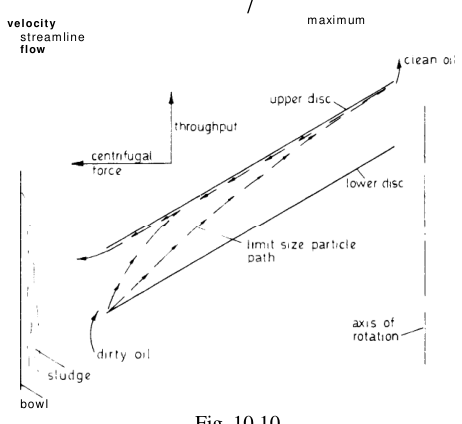
The limit-size particle is the smallest particle that the purifier can reliably remove under the current operating conditions.
- Particles larger than the limit size are more likely to be removed.
- Particles smaller than the limit size may leave with the clean oil.
The limit-size particle is not a fixed value. It changes when operating conditions change.
Lowering the limit-size particle generally means better clarification.
4. The main efficiency factors
The most important factors are:
- Oil viscosity
- Separating temperature
- Bowl rotational speed
- Disc spacing
- Disc diameter
- Disc inclination
- Feed rate or throughput
- Residence time
- Density difference
- Correct interface position
- Correct water seal
- Disc-stack cleanliness
- Sludge discharge frequency
- Correct bowl assembly
- Type and concentration of contamination
The following sections explain each factor and its practical effect.
5. Factor 1 — Oil viscosity
Viscosity is resistance to movement within the liquid.
During separation, water droplets and solid particles must move through oil. High viscosity produces greater drag.
Reed’s states that higher oil viscosity creates greater viscous drag on particles and recommends pre-heating the oil as high as practicable within safe limits.
High viscosity symptoms
- Low practical throughput
- Fine solids in clean oil
- Poor water separation
- High pump load
- Increased pressure drop
- Slow response after starting
Corrective direction
- Confirm heater operation.
- Confirm actual oil temperature.
- Determine viscosity at the measurement temperature.
- Use the manufacturer’s temperature-viscosity graph.
- Do not exceed the permitted temperature.
6. Factor 2 — Separating temperature
Temperature affects purifier performance mainly by changing viscosity.
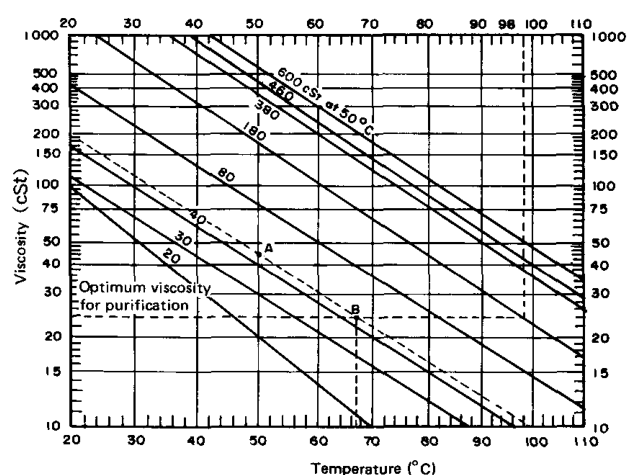
The Mitsubishi manual states that purifier throughput is governed by viscosity and that feed oil must be heated to a specified treating temperature. It gives an approximate target viscosity of 24 cSt for the referenced operating conditions.
Temperature must be controlled, not maximised
Excessive temperature can:
- Deteriorate the oil
- Increase oxidation
- Damage seals or purifier components
- Waste energy
- Create safety risks
The manual gives a highest heating temperature below approximately 100°C for the referenced machine condition. The installed machine’s manual takes priority.
Temperature example
For fuel oil at 45 cSt at 50°C, the Mitsubishi graph method gives approximately 67°C to reach the target viscosity of about 24 cSt.
This is an example, not a universal temperature setting.
7. Factor 3 — Bowl speed
Centrifugal force increases strongly with rotational speed.
A conceptual relationship is:
where:
- a_c = centrifugal acceleration
- ω = angular speed
- r = radial distance
Because speed is squared:
- A moderate speed reduction can significantly reduce separating force.
- Fine-particle removal becomes worse.
- Water and solids migrate more slowly.
Low-speed symptoms
- Poor water separation
- More solids in clean oil
- Unstable interface
- Reduced outlet pressure
- Possible alarms or motor/drive faults
- Increased vibration if the cause is mechanical
Causes of low speed
- Slipping friction clutch
- Motor fault
- Drive-system fault
- Bearing damage
- Excessive mechanical resistance
- Electrical supply problem
Never increase speed beyond the maker’s rated value. Excessive speed creates dangerous stress in the bowl and spindle.
8. Factor 4 — Disc spacing
Disc spacing controls the distance a particle must travel before reaching a low-velocity disc surface.
If spacing is too large:
- Settling distance increases.
- More particles remain suspended.
- Fine contamination may pass through.
- Flow distribution may become less effective.
If spacing is incorrect because of assembly damage:
- Disc stack compression changes.
- The bowl may become unbalanced.
- The hydraulic path changes.
Disc spacing is a design and assembly condition. Do not alter it without the maker’s instructions.
9. Factor 5 — Disc diameter
Disc diameter affects:
- Effective separation area
- Radial path length
- Flow distribution
- Location of the disc surface relative to the bowl radius
A disc stack is designed as a complete set. Mixing disc types or installing a disc in the wrong position can reduce efficiency.
The Mitsubishi bowl instructions identify different disc arrangements, including smaller-diameter discs in the lower portion for applicable models.
The correct disc diameter therefore depends on:
- Purifier model
- Disc position
- Bowl design
- Feed path
- Required separation geometry
10. Factor 6 — Disc inclination
The conical angle of the discs affects the distance and direction through which particles move.
A correct inclination:
- Guides liquid flow.
- Provides a surface for particles to reach.
- Directs solids toward the sludge region.
- Maintains the intended separation geometry.
A damaged, bent, or incorrectly installed disc changes its inclination and may cause:
- Poor separation
- Flow disturbance
- Disc contact
- Vibration
- Local blockage
11. Factor 7 — Feed rate and throughput
Feed rate is the volume of oil entering the purifier per unit time.
High feed rate
Low feed rate
Reed’s states that low throughput produces a smaller limit-size particle and cleaner discharged oil, while high throughput produces a larger limit-size particle.
Rated capacity versus best purification
Rated capacity is not always the flow that gives maximum separation quality.
The best operating rate depends on:
- Oil grade
- Oil viscosity
- Contaminant type
- Required cleanliness
- Water content
- Solid concentration
- Purifier model
Reed’s examination material specifically asks whether a purifier should be operated at rated capacity when maximum separation efficiency is required.
12. Factor 8 — Residence time
Residence time is the time available for oil, water, and particles to separate inside the bowl.
It is affected by:
- Feed rate
- Bowl volume
- Flow path
- Disc-stack geometry
- Internal restrictions
Residence time is not increased by simply leaving the pump running longer. It depends on the flow rate through the bowl.
13. Factor 9 — Density difference
The purifier depends on the density difference between:
- Oil and water
- Oil and solids
A larger density difference generally makes separation easier.
Separation becomes more difficult when:
- Oil density approaches water density.
- Water droplets are extremely small.
- Solids are very fine.
- An emulsion is present.
- The fuel has unusually high density.
The interface and gravity-disc setting must match the liquid density condition.
14. Factor 10 — Correct interface position
Even if the bowl speed and disc stack are correct, poor interface positioning can send phases to the wrong outlets.
Interface too far inward
- Water can enter clean oil.
- Light-liquid quality decreases.
Interface too far outward
- Oil can leave through the water outlet.
- Oil losses increase.
Interface position depends on:
- Gravity-disc inside diameter
- Oil specific gravity
- Treating temperature
- Feed rate
- Outlet conditions
- Sealing-water condition
15. Factor 11 — Correct water seal
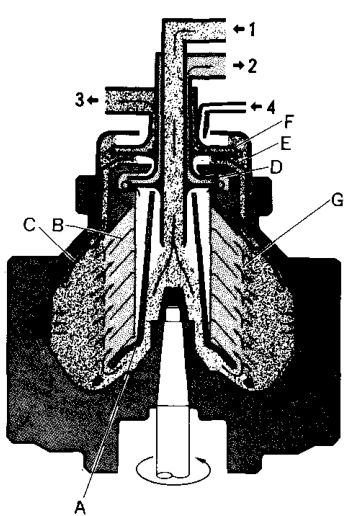
The purifier must form a water seal before oil feed begins.
The water seal:
- Establishes the heavy-liquid region.
- Prevents oil from leaving via the water outlet.
- Helps establish the intended interface.
Reed’s gives the operating order as:
[Reed’s General Engineering Knowledge, Vol. 8, p. 250]
Without a correct water seal:
- Oil may enter the heavy-liquid outlet.
- Separation may become unstable.
- Oil loss can occur from start-up.
16. Factor 12 — Disc-stack cleanliness
Deposits reduce the effective disc-passage area.
A dirty disc stack can cause:
- Poor clarification
- High pressure drop
- Uneven flow distribution
- Fine solids in clean oil
- Increased sludge carry-over
- Unbalance and vibration
Cleaning must not damage the discs or change their shape.
17. Factor 13 — Sludge discharge interval
Solids accumulate at the bowl wall. If they remain too long:
- Sludge space decreases.
- Separation area becomes contaminated.
- Solids may be re-entrained.
- Bowl balance can deteriorate.
- Discharge may become incomplete.
A practical discharge interval depends on:
- Oil type
- Solid concentration
- Water content
- Feed rate
- Bowl size
- Purifier model
- Automatic-control settings
The interval must be long enough to avoid unnecessary oil loss but short enough to prevent excessive sludge accumulation.
18. Factor 14 — Bowl assembly and balance
Incorrect assembly can reduce separation even when operating settings are correct.
Check:
- Correct disc count
- Correct disc order
- Disc-stack compression
- Top-disc seating
- Bowl-nut tightening
- Tally-mark alignment
- Correct gravity-disc installation
- Correct outlet-impeller installation
A disc-stack gap can worsen separation and cause unbalance. The Mitsubishi maintenance instructions state that loss of disc-set elasticity may create a gap between the top disc and disc set, reducing separation efficiency and causing unbalance.
19. Factor 15 — Contaminant type
Different contaminants require different operating conditions.
Free water
Normally easier to remove than a stable emulsion, especially when the density difference is clear.
Fine catalyst particles
Require:
- Correct heating
- Low enough throughput
- Clean disc stack
- Correct bowl speed
- Adequate sludge discharge
Large sludge particles
May be removed rapidly but can fill the sludge space quickly.
Stable emulsions
May not separate well even when the purifier is mechanically correct.
The operator must identify the contamination rather than treating every poor result as the same fault.
20. Factor 16 — Distributor condition
The distributor must accelerate and distribute the feed correctly.
A blocked or damaged distributor can cause:
- Uneven disc-stack loading
- Turbulence
- Bypass flow
- Poor phase separation
- High pressure drop
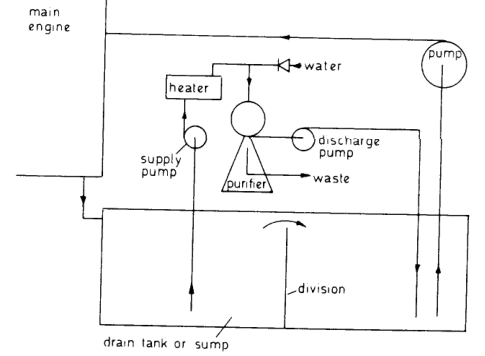
The distributor is the transition between the feed pipe and the rotating disc chamber. It must be clean and correctly assembled.
21. Factor 17 — Outlet condition
Outlet restrictions change the hydraulic balance inside the purifier.
Inspect:
- Clean-oil outlet
- Heavy-liquid outlet
- Connected piping
- Valves
- Back pressure
- Discharge pumps
- Strainers
A blocked water outlet can force water toward the clean-oil side. An incorrect clean-oil back pressure can alter the interface.
Do not diagnose a gravity-disc fault without checking the external outlet system.
22. Factor 18 — Water and operating-water condition
Water has two different roles:
- Separated water: contaminant removed from oil.
- Operating or sealing water: hydraulic/control fluid used by the purifier.
Problems with operating water can affect:
- Bowl closing
- Bowl opening
- Sealing
- Sludge discharge
- Interface establishment
Operating-water strainers, pressure, valves, and timers must be checked when discharge or sealing is abnormal.
23. Efficiency map
No single adjustment compensates for every other fault.
24. Practical optimisation sequence
When the purifier produces poor-quality oil, use this order:
Step 1: confirm safety and mechanical condition
- Check abnormal vibration.
- Check abnormal noise.
- Confirm bowl speed.
- Stop if unsafe.
Step 2: confirm liquid condition
- Oil temperature
- Viscosity
- Specific gravity
- Water content
- Solid loading
Step 3: confirm flow condition
- Feed rate
- Feed pressure
- Clean-oil outlet pressure
- Water outlet flow
- Valve position
Step 4: confirm interface setting
- Gravity-disc size
- Water seal
- Oil carry-over
- Water carry-over
Step 5: inspect the bowl
- Disc stack cleanliness
- Disc count
- Disc compression
- Top disc
- Distributor
- Sludge accumulation
Step 6: confirm discharge system
- Operating-water pressure
- Solenoid valves
- Pilot valves
- Discharge timing
- Open/close movement
25. Worked example: fine solids in clean oil
Observation
The clean oil contains fine abrasive solids.
Possible conditions
- Oil temperature is below the target.
- Feed rate is at rated maximum.
- Bowl speed is normal.
- Disc stack is clean.
Reasoning
- Low temperature means high viscosity.
- High viscosity increases viscous drag.
- Rated maximum feed reduces residence time.
- Fine particles may be below the current limit-size-removal capability.
- More particles leave through the clean-oil outlet.
Corrective direction
- Raise temperature within the maker’s limit.
- Reduce feed rate.
- Maintain correct bowl speed.
- Verify disc geometry and cleanliness.
- Monitor clean-oil quality.
This is the reason slow throughput is important for difficult fine contaminants such as catalyst fines.
26. Worked example: water in clean oil
Observation
Water appears in the light-liquid outlet.
Possible efficiency factors
- Interface too far inward
- Wrong gravity disc
- Excessive sealing or replacement water
- Heavy-liquid outlet restriction
- Excessive feed rate
- Oil density changed
- Temperature changed
- Bowl speed reduced
Investigation
Do not simply increase temperature without identifying the actual cause.
27. Rated capacity versus maximum separation
A purifier’s nameplate capacity is not a promise that the cleanest oil will be produced at that rate.
Rated-capacity operation may be suitable when
- Contamination is low.
- Oil viscosity is already suitable.
- Required cleanliness is moderate.
- The system needs high volume.
Lower-throughput operation may be preferable when
- Fine catalyst particles are present.
- Oil viscosity is high.
- Water separation is difficult.
- The required oil cleanliness is high.
- Contaminant concentration is high.
The correct operating decision is based on the treatment objective, not only the pump capacity.
28. Visual efficiency diagram
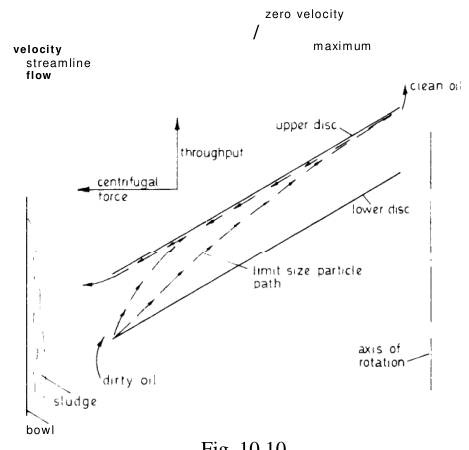
Interpret the diagram as follows:
- Oil flows through the disc passage.
- Velocity is low near the disc surface.
- Particles reaching the low-velocity region are less strongly carried with the main flow.
- Centrifugal force then moves them along the disc toward the sludge region.
- The smallest particle that completes this path is the limit-size particle.
29. Common misunderstandings
Misunderstanding 1: “Maximum flow means maximum purifier performance.”
Incorrect. Maximum flow may reduce separation quality.
Misunderstanding 2: “Heating always improves separation.”
Only within the approved range. Excessive heating can damage oil and equipment.
Misunderstanding 3: “If the bowl is rotating, separation must be good.”
Incorrect. Speed, viscosity, disc condition, interface, and feed rate all matter.
Misunderstanding 4: “A clean disc stack guarantees clean oil.”
Incorrect. Wrong temperature, feed rate, interface, or bowl speed can still cause poor separation.
Misunderstanding 5: “A gravity-disc change fixes every outlet problem.”
Incorrect. Check water seal, outlet restrictions, temperature, feed rate, and liquid properties.
Misunderstanding 6: “Small particles are always removed.”
Incorrect. Particles below the limit size may leave with clean oil.
Misunderstanding 7: “The manufacturer’s maximum temperature is the best temperature.”
Incorrect. The target is the correct viscosity and safe treatment condition.
30. Revision questions with answers
Question 1
What is the limit-size particle?
Answer: The smallest particle that the purifier can reliably remove under the current operating conditions.
Question 2
How does high viscosity affect separation?
Answer: It increases viscous drag and slows the movement of water droplets and solid particles.
Question 3
Why is oil heated before purification?
Answer: To reduce viscosity and improve movement of water and solids.
Question 4
Why should the purifier not always operate at rated capacity?
Answer: Higher throughput reduces residence time and can allow finer contaminants to pass through.
Question 5
What is the effect of low bowl speed?
Answer: Centrifugal force decreases and separation becomes poorer.
Question 6
Why are conical discs fitted?
Answer: To reduce settling distance and increase effective separation area.
Question 7
What happens if disc spacing is too large?
Answer: The settling distance increases and more fine particles may remain in the oil.
Question 8
How does feed rate affect the limit-size particle?
Answer: Low feed rate makes the limit-size particle smaller; high feed rate makes it larger.
Question 9
Why must the water seal be established?
Answer: To create the heavy-liquid region and prevent oil from flowing through the water outlet.
Question 10
Name four causes of poor separation unrelated to temperature.
Answer: Low bowl speed, excessive feed rate, dirty disc stack, wrong gravity disc, blocked outlet, poor water seal, or incorrect assembly.
Question 11
Why is sludge discharge important?
Answer: It prevents the sludge space from filling and disturbing flow, balance, and separation.
Question 12
What should be checked first when performance deteriorates?
Answer: Safety, bowl speed, temperature, feed rate, outlet conditions, interface setting, disc condition, and sludge accumulation.
31. Self-test exercise
Case A
The purifier is running at normal speed. The clean oil is dirty with fine solids.
State the likely effects of:
- Increasing temperature within the maker’s limit.
- Reducing feed rate.
- Increasing speed beyond the maker’s limit.
- Cleaning the disc stack.
- Increasing sludge-discharge frequency.
Correct reasoning:
- Correct heating can reduce viscosity.
- Lower feed rate increases residence time.
- Exceeding rated speed is unsafe and prohibited.
- A clean disc stack restores flow area.
- More frequent discharge prevents sludge accumulation.
Case B
Water is appearing in clean oil.
Prepare a fault tree using:
- Interface
- Gravity disc
- Water seal
- Water outlet
- Temperature
- Specific gravity
- Feed rate
- Bowl speed
32. Efficiency checklist
Before increasing or decreasing purifier throughput, check:
- [ ] Bowl speed is normal.
- [ ] Oil temperature is correct.
- [ ] Oil viscosity is known.
- [ ] Specific gravity is known.
- [ ] Gravity disc matches the liquid condition.
- [ ] Water seal is established.
- [ ] Disc stack is clean.
- [ ] Disc stack is correctly compressed.
- [ ] Distributor is clean.
- [ ] Clean-oil outlet is free.
- [ ] Heavy-liquid outlet is free.
- [ ] Sludge space is not overloaded.
- [ ] Discharge interval is suitable.
- [ ] No abnormal vibration is present.
- [ ] Output quality is being monitored.