
Safety — Crankcase Explosion, Scavenge Fire and Starting Air Line Explosion
The three hazards that are peculiar to a diesel engine and that have killed people — the crankcase explosion, the scavenge fire and the starting air line explosion — together with the devices and the practices that exist to prevent them.
Key Principles at a Glance 5 points
- Each of the three hazards — the crankcase explosion, the scavenge fire and the starting air line explosion — has the same shape: a condition develops slowly and invisibly, and then fails suddenly and violently.
- The devices and practices exist because the condition cannot be seen, and because by the time it is obvious it is too late to act.
- That is why the alarms are treated as seriously as they are, and why the trips are tested.
- The rule about never restarting a hot engine or an engine that has just had an internal event is absolute.
- The engine gives no second warning, and everything in this chapter is there to make the first one count.
1. The crankcase explosion
The safety devices are never isolated, never bypassed and never assumed to work. An engine that has suffered a crankcase explosion or a scavenge fire is stopped, locked out and inspected before it is restarted — never simply restarted.
The crankcase explosion is the classic diesel engine disaster. It is worth understanding properly, because every detail of the precautions follows from the mechanism.
How it happens
The mechanism has four steps, and all four must occur for an explosion:
- A hot spot forms inside the crankcase. Something gets hot enough to vaporise lubricating oil. The usual sources are a bearing running hot because of a loss of oil or a failure of the white metal, a piston or liner running hot, or a blow-by of hot combustion gas past a broken ring.
- Oil vapour forms. The hot spot vaporises oil from the surfaces it touches. At this stage there is a vapour but no fire.
- The vapour condenses into a white mist. As the vapour moves away from the hot spot into cooler parts of the crankcase, it condenses into a mist of fine droplets. The droplets are of the order of 5 to 10 microns across. This mist is the dangerous thing, and it is visible — a white mist, which is why the older accounts describe it as such.
- The mist ignites. A second hot spot, or the original one, ignites the mist.
The concentration of oil in the mist matters, and there is a figure for it. An oil mist concentration of about 50 mg per litre of crankcase volume is the lower explosive limit — below that, the mist will not propagate a flame through the crankcase. Above it, the whole crankcase volume is a flammable mixture, and ignition anywhere ignites it everywhere.
Primary and secondary explosion
What makes the crankcase explosion so destructive is that it happens twice.
The primary explosion is the ignition of the mist. It is usually not very violent in itself, because the quantity of oil actually in mist form at any moment is small. But it does two things: it raises the pressure in the crankcase, and it disturbs all the oil on the surfaces — the oil on the crank webs, the walls, the bearing housings — throwing it into the air as fresh vapour and mist.
The secondary explosion follows, and it is the one that bursts the crankcase. The fresh mist formed by the primary explosion is far more concentrated than the original, and it ignites from the still-hot surfaces or from the flame of the primary event. The pressure rise is violent.
The shock wave travels through the crankcase at roughly 1.5 to 2 miles per second — kilometres per second — and the peak pressure can reach about 30 atmospheres. A crankcase is not built to contain that, and without relief it will burst. The result is burning oil thrown out into the engine room, and a crankcase whose doors and walls have failed.
What is done about it
Three measures, and they work together:
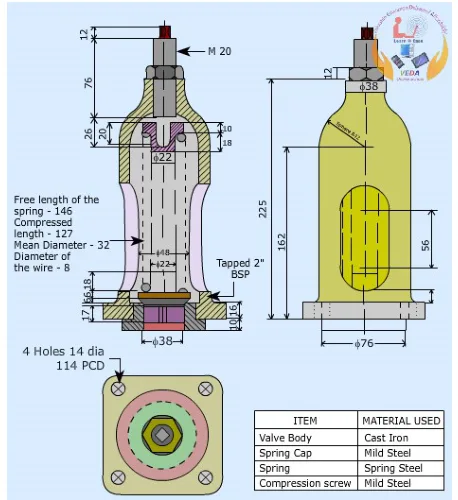
Crankcase relief valves. These are fitted to engines with a bore greater than 300 mm, on the crankcase doors, and they are the last line of defence. They relieve the pressure of the primary explosion before it can burst the crankcase, and they do it without allowing air back in — because air coming in after the primary explosion would feed the secondary one. The relief valve opens at a pressure not greater than 0.2 bar, and it closes again immediately, so that the crankcase is sealed against the ingress of air while the pressure inside is relieved.
The construction of the relief valve is deliberate. It is usually a disc of aluminium alloy held against its seat by a spring, with no valve spindle. The absence of a spindle is not an oversight: a spindle would be a rigid object in the path of a pressure wave, and it would also give the disc something to jam on. A plain disc that lifts and reseats freely is what is wanted, and the aluminium alloy is chosen so that if the disc is distorted it is distorted rather than projected.
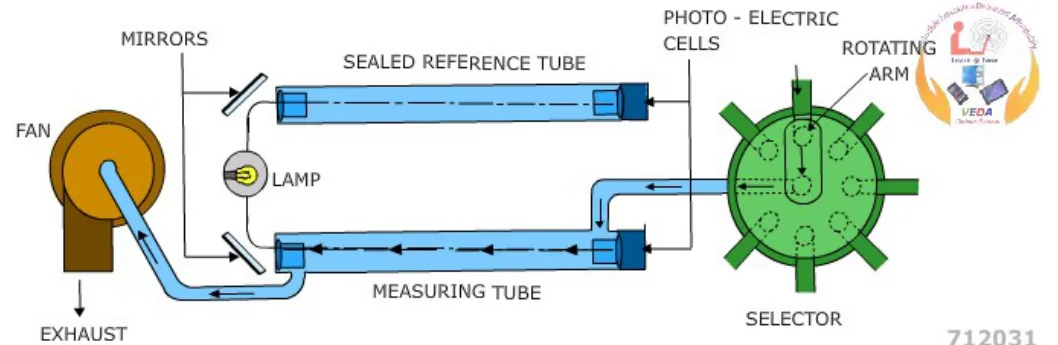
The oil mist detector. This is the device that catches the condition before it becomes an explosion. It works on the principle that the mist has to reach 50 mg per litre before it will ignite, and that a concentration well below that can be detected.
The detector draws a sample of crankcase atmosphere from each crankcase compartment in turn and passes it through a measuring cell, where a beam of light shines through the sample onto a photo-electric cell. Oil mist in the sample scatters the light, and the amount of light reaching the cell changes with the concentration of mist. The reading is compared with a reference tube, which contains clean air, so that the instrument measures the difference between the sample and clean air rather than an absolute value that would drift with temperature and lamp ageing.
A rotating selector valve switches the sampling from one compartment to the next, so a single detector serves the whole engine, and the instrument indicates which compartment is being sampled. When the mist concentration in any compartment exceeds the alarm level, the detector alarms — and on many installations it also trips the engine. Once it has operated, the detector has to be reset deliberately, so that the alarm cannot be cleared by a momentary flicker of the reading.
Operating discipline. The third measure is the engineer's. The crankcase is not opened while the engine is hot, because opening a hot crankcase lets air in and can turn a vapour condition into an explosion. An engine is not restarted after a crankcase explosion without a full inspection, because the primary explosion has disturbed everything inside and the secondary one may not yet have happened. And the crankcase is not ventilated by opening a door and looking in, because the mist that comes out is the hazard.
2. The scavenge fire
A scavenge fire occurs in the scavenge air space or the exhaust gas receiver of a two-stroke engine, where oil and carbon accumulate. A hot spot ignites the deposit, and the fire burns in the space rather than in the cylinder.
On a four-stroke auxiliary engine the equivalent hazard is a fire in the exhaust gas ways or the turbocharger, where the same accumulation of oil and carbon can occur. The mechanism is the same: a deposit that has built up over time, a source of ignition, and a space with enough air to burn.
The prevention is cleaning — keeping the scavenge spaces, the exhaust ways and the turbocharger free of oil and carbon — and the detection is by temperature: thermocouples in the scavenge space or the exhaust receiver, or simply the exhaust temperature and the turbocharger outlet temperature rising without a change in load. A rising temperature with no change in load is the signature.
The action on detecting a scavenge fire is to reduce the engine load and stop the air supply that is feeding it, then stop the engine if the fire does not come under control. Restarting is only done after the space has been inspected and cleaned, for the same reason as the crankcase: the fire has been burning in a space that may still hold unburnt material.
3. The starting air line explosion
A third hazard exists in the starting air system, and it is caused by the air itself rather than by anything the engine burns.
The mechanism is that the starting air line contains a mixture of compressed air and lubricating oil — the oil comes from the compressor, from the lubricator, or from the engine's own oil that has found its way into the line. If the line is heated, or if a flame reaches it from a leaking starting air valve on a cylinder, that oil can ignite. The result is an explosion in the starting air line, and it is a serious event because the line runs the length of the engine and is full of high-pressure air.
Two things are fitted to prevent the consequences:
- Flame traps. A flame trap is fitted in the starting air line close to the engine, and its job is to stop a flame travelling from the engine back down the line. It is a device that lets air through but breaks up the flame front, and it is maintained and checked because a blocked or dirty flame trap defeats the purpose.
- Bursting caps. A bursting cap, or rupture disc, is fitted to the starting air line to relieve the pressure if the line explodes. It is a deliberately weak element that fails at a set pressure and vents the line, so that the line itself does not burst and throw fragments into the engine room.
The maintenance of both is simple and both are neglected at risk: a flame trap that has not been cleaned is not a flame trap, and a bursting cap that has been replaced with a solid plug is not a bursting cap. Both must be the correct item, correctly fitted.
The operational precaution is to keep the starting air line free of oil. The compressor's lubrication is set correctly, the oil and water traps are drained, and the line is not allowed to accumulate oil over time. The oil that causes the explosion is the oil that was allowed to stay.
4. The overspeed trip
An engine that loses its governor and runs away destroys itself, and it can throw parts out of itself in the process. The overspeed trip is the last line of defence: a separate mechanism, driven by the engine, that latches out and cuts the fuel at about 115 % of the rated speed. It is entirely independent of the governor — it does not depend on the governor working, on the electrical supply, or on the engineer noticing. The mechanism, its setting, its two common types and the reason it is fitted at all are described in Chapter 7.
What matters from the safety point of view is the discipline around it:
- It is tested at intervals, by lifting the mechanism or by running the engine up to the trip speed on a test stand, and the test is recorded. A trip that has never been tested is not known to be a trip.
- It is never used as a means of stopping the engine in normal service. It is a protection device, and a protection device that is used routinely stops being a protection device.
5. The other precautions that follow
The three classic hazards produce a set of working practices that apply to an auxiliary engine as much as to a main engine:
- Never open a crankcase, a scavenge space or an exhaust way while the engine is hot. The mist inside is the hazard; air let in is what turns it into an explosion.
- Never restart an engine after a crankcase explosion or a scavenge fire without a full internal inspection. The first event is not always the last.
- Keep the flame traps and bursting caps in place and in condition. They are the difference between a contained event and an explosion.
- Keep the crankcase relief valves free and correctly set. A relief valve that has been painted over, blocked or weighted is not a relief valve.
- Keep the oil mist detector clean, calibrated and tested. It is the only device that gives warning before the mist reaches the point of ignition.
- Keep the starting air line drained of oil. The oil in the line is what explodes.
- Keep the overspeed trip tested and never bypassed.
- Never defeat a trip to keep an engine running. An engine that will not run without a trip bypassed is an engine that is telling you it should not be running.
6. Why these hazards are worth understanding
Each of the three hazards has the same shape. A condition develops slowly and invisibly — a hot spot, an accumulation of oil, a concentration of mist — and then fails suddenly and violently. The devices and practices exist because the condition cannot be seen, and because by the time it is obvious it is too late to act.
That is why the alarms are treated as seriously as they are, why the trips are tested, and why the rule about never restarting a hot engine or an engine that has just had an internal event is absolute. The engine gives no second warning. Everything in this chapter is there to make the first one count.