
The Emergency Generator — Location, Starting, Fuel and the Emergency Board
The emergency generator is the ship's last line of electrical defence.
Key Principles at a Glance 6 points
- The emergency generator must be independent: independence in fuel, in starting means, in cooling and in location is what makes it survive the event it exists for.
- Anything shared with the engine room is a weakness.
- It must be simple, because a small, robust, easily started engine is better for this duty than a large, highly automated one — reliability beats efficiency here.
- It must be tested, because the only proof that an emergency generator works is a recorded test in which it started and carried its load.
- It must be separate from the main board: the interlock that keeps the two sources apart is the boundary between the emergency system and the normal system, and it is what makes the emergency system trustworthy.
- Everything the emergency generator is — its location, its fuel, its battery, its switchboard — is designed around a single assumption: that when it is needed, everything else has already failed.
1. What the emergency generator is for
The emergency generator is a statutory item and its condition is inspected. It is tested on a regular schedule and the test is recorded. A set that has not been tested is not known to be a set that will start.
The ship's normal electrical supply comes from the main generating sets in the engine room. If those sets fail, or if the main switchboard is lost, the ship is in a blackout — no steering, no navigation lights, no alarms, no fire pump, no emergency lighting. In that condition the ship cannot be controlled and cannot be made safe.
The emergency generator exists to prevent that. Its definition is precise:
The emergency generator is a generator, driven by a prime mover, whose function is to supply the emergency switchboard with electrical power when the main power supply fails.
The phrase that matters is emergency switchboard. The emergency generator does not supply the whole ship. It supplies a small, defined set of essential services through its own switchboard, and nothing else. The rest of the ship stays dark until the main supply is restored, which is the correct outcome: the emergency supply is sized and protected to keep the ship safe, not to keep it comfortable.
2. Where it is located, and why
The location of the emergency generator is not a matter of convenience. It is a rule, and the rule exists because the event that calls the emergency generator into use — a fire or a flooding in the engine room — is exactly the event that would destroy it if it were next to the main sets.
The requirements are:
- It is located outside the main and auxiliary machinery space. If the machinery space is lost, the emergency generator survives.
- It is not forward of the collision bulkhead. If the ship is holed forward, the emergency generator is not in the flooded compartment.
- It has its own switchboard nearby. The emergency switchboard is in the same space as the generator, so that no long cable run in a damaged area lies between the two.
- The space is above the bulkhead deck on ships where this applies, so that the set is above the waterline and above the level a flooding would reach.
The typical location is a deckhouse or a dedicated space high in the superstructure or aft of the engine room casing. It is deliberately a long way from the main machinery, and that separation is the whole point.
3. How it starts
An emergency generator that needs an engineer to start it is not an emergency generator. The starting arrangements are therefore automatic and independent of anything in the engine room.
The requirements are:
- It starts automatically when the main power supply fails. No action by the crew is required and no action by the crew can be depended upon, because the failure may happen when nobody is in the right place.
- It starts on its own independent means. Either compressed air from its own dedicated reservoir, or a battery and starter motor. It must not depend on the main starting air system, the main batteries, or any other service located in the machinery space.
- It attempts to start repeatedly. A single failed start is not acceptable. The set must make at least three attempts, and must continue to attempt starting for as long as its starting means allows — with a battery, further attempts within the 30-minute battery life. This covers the case where the first attempt fails for a transient reason.
- It starts cold. The set must be capable of starting with its machinery at a temperature down to 0 °C, without external heating.
For a small set — up to roughly 60 kW — the usual arrangement is a battery and starter motor, charged through a transformer and rectifier from the emergency switchboard itself. For larger machines the usual arrangement is compressed air from a separate reservoir located above the bulkhead deck, so that the air supply survives the same event the generator is there for.
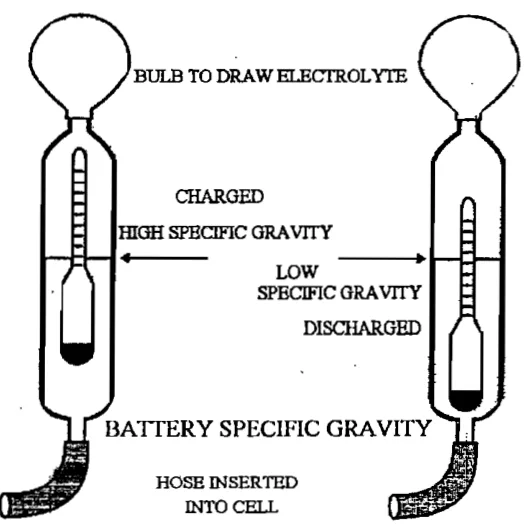
The starting battery
Because so many emergency sets start on a battery, the battery is a piece of safety equipment in its own right and is treated as one. The checks that matter are:
- State of charge, confirmed by measuring the specific gravity of the electrolyte — the direct indication of how much charge is actually stored, as opposed to what the terminal voltage suggests.
- Electrolyte level, topped up with distilled water, with the plates covered.
- Terminals and connections, clean and tight, with no sulphation.
- The charger, working and able to hold the battery at full charge, with the charging current monitored.
- The battery space, ventilated, because a charging battery gives off hydrogen.
A battery that reads a healthy voltage on open circuit can still be unable to deliver the heavy current a starter motor demands. The specific gravity check is what catches it.
4. Its fuel and cooling
The emergency generator has to run on what is available to it, from where it is, with no help from the engine room.
- It has its own independent fuel supply. The tank and the piping are dedicated to the emergency set, so that a fuel problem in the machinery space does not reach it. The fuel is of a grade that the engine will start and run on reliably from cold — not a heavy residual fuel that needs heating.
- The fuel has a flash point of not less than 43 °C. This is a safety requirement on the fuel itself: a fuel that gives off flammable vapour below 43 °C is a fire risk in a space that may be unattended. The emergency generator's fuel is therefore a distillate grade, and it is kept as such.
- Its cooling water is treated with antifreeze. The set is in an unheated space and may be required to start at 0 °C. Plain water would freeze and burst the jacket, and the set would be destroyed without ever having run.
- Heating is provided for cold weather, so that the set is not merely able to start cold but is kept in a condition where it will. The cooling water may be kept warm, and the space may be heated.
Some emergency sets use an air-cooled prime mover rather than a water-cooled one, chosen specifically because an air-cooled engine has good cold-starting characteristics and no cooling water to freeze. The choice is made for the duty, not for the cost.
5. The emergency switchboard
The emergency switchboard is a separate board, in the emergency generator space, and its arrangement reflects its purpose.
- It is fed either from the emergency generator or from the main switchboard, through a connecting feeder. In normal operation the emergency board is supplied from the main board, and the emergency generator is idle; the emergency board is live but its load is small.
- The two sources cannot be connected at the same time. An interlock prevents the simultaneous closure of the main engine room breaker and the emergency generator breaker. Closing both would parallel the emergency generator with the main sets through the connecting feeder, which is not intended and which the protection is not designed for.
- The board is arranged in sections. A typical arrangement is two sections, one at 440 V for power loads and one at 220 V for lighting and small services, each with its own protection.
- The emergency loads are grouped here and nowhere else, so that the board is small, the cable runs are short and the whole thing can be checked in a few minutes.
When the main supply fails, the sequence is: the main breaker on the emergency board opens, the emergency generator starts automatically, comes up to speed and voltage, and its breaker closes onto the emergency board. The emergency loads — steering gear, emergency lighting, navigation lights, alarms, fire pump, radio — are then supplied. When the main supply returns, the reverse happens, with a deliberate delay so that the return is confirmed as stable before the emergency set is taken off.
6. Keeping it ready
An emergency generator spends almost all of its life not running, and that is precisely the danger. A machine that is never used is a machine whose faults are never discovered, and the moment it is needed is the worst possible moment to discover them. The maintenance is therefore built around regular, recorded testing rather than around hours run.
The checks that are made, and why:
- Start it and run it on load on a schedule — typically weekly — and confirm it reaches rated speed and voltage and carries its emergency load. This proves the starting system, the governor, the AVR and the protection all work together.
- Check the fuel level and quality in the dedicated tank, and drain any water. Fuel that has stood for months is not fuel that will burn cleanly.
- Check the starting battery as described above — specific gravity, level, terminals, charger.
- Check the lubricating oil level and the condition of the oil. It does not get changed by hours run, so it is changed by time.
- Check the cooling water level, the antifreeze concentration and the heater.
- Check the space — ventilation, cleanliness, no stored material blocking access, no water ingress.
- Test the automatic start function as an automatic function, not by pressing a manual start button. The point is to prove the set starts when the main supply fails, which is a different test from proving the engine runs.
- Confirm the interlocks operate — that the emergency breaker and the main breaker cannot be closed together.
- Record everything. A test that is not recorded has not been demonstrated.
The weekly no-load or light-load run is the minimum; a proper test brings the set onto its actual emergency load so that the engine is proved under the conditions it will actually face.
7. What follows from the emergency generator
The emergency generator is a small set, but it imposes discipline on the whole plant:
- It must be independent. Independence in fuel, in starting means, in cooling and in location is what makes it survive the event it exists for. Anything shared with the engine room is a weakness.
- It must be simple. A small, robust, easily started engine is better for this duty than a large, highly automated one. Reliability beats efficiency here.
- It must be tested. The only proof that an emergency generator works is a recorded test in which it started and carried its load.
- It must be separate from the main board. The interlock that keeps the two sources apart is not a convenience; it is the boundary between the emergency system and the normal system, and it is what makes the emergency system trustworthy.
Everything the emergency generator is — its location, its fuel, its battery, its switchboard — is designed around a single assumption: that when it is needed, everything else has already failed.