
Operating the Plant — Preparing, Starting, Watchkeeping and Keeping Warm
What an engineer actually does with an auxiliary engine — how it is prepared, started, watched and stopped, and how the automatic systems change that routine on an unmanned ship.
Key Principles at a Glance 5 points
- The smallest set that will carry the load is run, with the others kept as standby, because running a large generating set at light load is both wasteful and bad for the engine.
- The main engine is kept warm from the auxiliary engine jacket water through the cross-connection, so the auxiliary engine's waste heat does a job that would otherwise need a separate boiler or heater.
- Where the plant has a thermostatic three-way valve, the valve mixes cooled and uncooled water to hold the jacket water temperature in its band — typically about 80 to 85 °C — no matter what the load is doing.
- The valve is the automatic equivalent of an engineer opening and closing a sea water valve by hand, and it holds the engine at its correct temperature through load changes that would otherwise swing it.
- Keeping an engine at the right temperature at low load is not a minor matter: running cold causes acid condensation in the crankcase, incomplete combustion, fouled exhaust ways and accelerated wear.
1. Preparing the engine to start
The maker's instruction book governs the sequence, the pressures, the temperatures and the times. The checks below are the minimum; nothing is started, run or stopped on the assumption that someone else has already checked it.
Before an auxiliary engine is started, a set of checks establishes that it is fit to run and that the systems that support it are ready. These are done in a fixed order, because each one depends on the last being sound.
The checks before starting:
- The engine is clean and clear. No tools, rags or loose material on the engine or in the vicinity of the flywheel and coupling. Loose objects near rotating machinery are a hazard and can be drawn in.
- The alarm supply is energised, so that the engine's protective devices are live before the engine is. Starting an engine whose alarms are dead is starting it unprotected.
- The lubricating oil is at the correct level in the sump, and the oil is of the correct grade and in good condition. Low level or contaminated oil is the most common cause of bearing damage.
- The cooling water is at the correct level in the header tank, and the system is full. The jacket water temperature is noted.
- The fuel is available and the system is primed. The fuel valve is open, the system is free of air, and the fuel is the correct grade for the engine at that moment.
- The auxiliary pumps are started and their pressures adjusted — the pre-lubricating oil pump, the diesel transfer pump, the fuel booster module, the nozzle cooling water pump where fitted, the jacket water pump and the fuel service pump. Each is confirmed by its own pressure gauge, and each is at its rated value before the engine turns.
- The starting air pressure is adequate. For an air-started set the receiver is checked against the maker's minimum — typically 25 to 30 bar — on the starting air tank pressure gauge. Below that figure the engine may not turn fast enough to fire.
- The turning gear is disengaged, and the operating lever locked. The interlock that prevents starting with the gear engaged is proved to be in order. Starting an engine with the turning gear engaged wrecks the gear and anything in its path.
- The indicator cocks are open for the first turns, so that any liquid in a cylinder is blown out rather than locked. A cylinder full of water or fuel is incompressible, and the result is a bent connecting rod or a cracked head.
- The governor is set for starting. The load limit is set to the "0" position, and the speed setting knob is rotated at least five revolutions from zero, unless the maker advises otherwise. This pre-loads the speeder spring so that the governor is ready to take control as soon as the engine fires.
- Each fuel pump rack is moved in and out a few times to confirm it is free and not sticking. A rack that has sat for weeks can stick, and a stuck rack on one cylinder means that cylinder either gets no fuel or gets too much.
- The engine is turned over by hand or on the turning gear, where the maker requires it, to confirm it turns freely and that nothing is seized. A stiff engine is a warning, not an obstacle. The prelubrication pump is run to establish oil pressure in all the bearings before the engine turns; this is the single most valuable protection against starting wear.
- The main starting air valve is opened, and clearance and a "GO" signal obtained from the on-duty staff before the start is activated.
Once these are satisfied, the engine is ready. Nothing in the list is optional, and every item on it has a failure history behind it.
2. Starting
The starting sequence for an air-started auxiliary engine follows the same pattern as any diesel start:
- Prelubricate, if this is not done automatically.
- Open the indicator cocks for the first revolutions.
- Turn the engine on air until it is turning at a speed at which it will fire.
- Admit fuel — bring the fuel rack to the starting position, or allow the governor to take over as it comes up to speed.
- Confirm the engine fires on all cylinders, listening for even firing and watching for smoke from the indicator cocks.
- Close the indicator cocks once the engine is firing steadily.
- Bring the engine up to rated speed and let it stabilise.
- Check oil pressure, cooling water temperature, fuel pressure and exhaust temperature before the engine is loaded.
- Warm the engine through at no load or light load before applying full load — the usual warm-through is a run of about 10 minutes at rated speed, with the indicator cocks shut and the oil, fuel and cooling water pressures confirmed at their rated values. A cold engine loaded suddenly suffers thermal shock and uneven expansion.
- Close the breaker and take load, following the synchronising procedure if the board is live.
- Check the load, the frequency and the voltage at the switchboard, and confirm they are within limits.
- Record the start — the time, the reason and the readings.
The first minutes after a start are the most informative. An engine that starts easily, fires evenly, comes up to speed and holds its temperatures is a healthy engine. One that is slow to fire, hunts, or shows a rising temperature is telling you something before it becomes a problem.
3. Running and watchkeeping
Once the engine is running and loaded, the watchkeeper's job is to confirm that nothing is changing. The values that are watched are watched because each of them is the earliest visible sign of a specific fault.
| What is watched | What it tells you | The first sign of trouble |
|---|---|---|
| Lubricating oil pressure | Whether the bearings are being supplied | A falling pressure, or a pressure that falls as the oil warms |
| Lubricating oil temperature | Whether the cooler is working and the oil is not breaking down | A rising temperature with the cooler sea water valve already open |
| Cooling water outlet temperature | Whether the heat is being removed | A rising outlet temperature, or a wide difference between inlet and outlet |
| Exhaust gas temperature, per cylinder | Whether each cylinder is firing evenly and at the right load | One cylinder hotter or colder than the rest — the classic single-cylinder fault indicator |
| Fuel pressure and rack position | Whether the fuel system is delivering | A rack position higher than the load demands, or a fluctuating pressure |
| Speed and frequency | Whether the governor is holding | Hunting, or a slow drift that the governor is following rather than correcting |
| Turbocharger speed and charge air pressure | Whether the air side is matched to the fuel side | Falling charge air pressure at constant load — fouling or a leaking charge air cooler |
| Sump oil level | Whether oil is being lost or fuel or water is getting in | A level that rises (fuel or water ingress) as well as one that falls |
| Bearing temperatures | Whether a bearing is running hot | A rise that continues after the load has stabilised |
| Vibration and noise | Whether something mechanical is changing | Any change in the character of the sound or the level of vibration |
The exhaust gas temperature is worth singling out. On a multi-cylinder engine it is the only routine measurement that compares like with like across the whole machine, and a single cylinder out of step with its neighbours is the earliest indication of an injector, a valve or a ring problem. Reading the exhaust temperatures and comparing them is the cheapest diagnostic available.
4. The safety devices, as they affect a generator
The engine carries protective devices that shut it down or alarm when a limit is exceeded. On a generator engine these devices behave slightly differently from the same devices on a propulsion engine, and the difference is important.
The devices fitted are:
- Low lubricating oil pressure trip, sensing at the main lubricating oil inlet. Loss of oil pressure destroys bearings within seconds, so this trip is fast and it is never bypassed.
- High jacket water temperature trip, sensing at the main fresh water outlet pipe. A rising outlet temperature means the cooling is failing, and the engine must be stopped before it seizes.
- Overspeed trip, described in Chapter 7. It is the last line of defence against a runaway engine.
- Breather pipe with flame trap, so that crankcase gases can escape without allowing a flame back into the crankcase.
- Crankcase relief valves on the crankcase doors, to relieve the pressure of an internal explosion without bursting the crankcase.
- Oil mist detector, which alarms on the concentration of oil mist in the crankcase before that concentration reaches the point at which it can ignite.
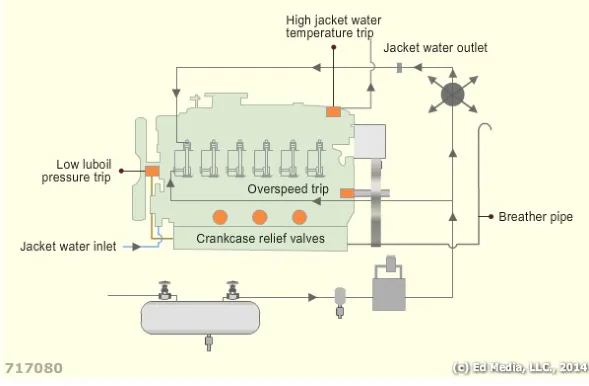
The important difference on a generator is what happens when a device operates. On a propulsion engine, a trip that stops the engine stops the ship, and the consequences are obvious. On a generator engine, the trip must also trip the circuit breaker and off-load the generator — otherwise the engine stops while still connected to the board, and the board is dragged down with it. The safety device therefore acts on two things at once: the fuel, and the breaker. A generator protection system that stops the engine but leaves the breaker closed has not protected anything.
This is why a generator's protection is tested as a system and not device by device. Each device must prove that it stops the engine and opens the breaker. The hazards these devices guard against — the crankcase explosion, the scavenge fire and the starting air line explosion — and the devices themselves in detail are in Chapter 13.
5. Stopping
Stopping an auxiliary engine properly is as deliberate as starting it.
- Reduce the load gradually and off-load the engine, transferring the load to another set if the board is to stay live. Do not open the breaker on a loaded machine unless the situation demands it.
- Open the breaker once the set is off load, and confirm it is open.
- Run the engine at no load for a short period to let it cool evenly. Stopping a hot engine suddenly leaves the turbocharger spinning without oil pressure and the liners cooling unevenly.
- Stop the engine by the normal means — cutting the fuel. The overspeed trip is not a stopping device and is not used as one.
- Keep the prelubrication or the lubricating oil pump running for a period after the engine stops, where the maker requires it, so that the turbocharger and the hot bearings are supplied while they run down and cool.
- Close the fuel supply where the engine is to be shut down for a period.
- Drain any water from the fuel system and attend to the engine if it is to stand idle.
- Record the stop and the reason, together with any readings taken during the run.
An engine that is stopped cleanly and left in good order starts cleanly next time. An engine that is stopped abruptly and left unattended develops faults quietly between runs.
6. Unmanned machinery space operation
Modern ships are commonly operated with the machinery space unmanned for periods, usually overnight, with the machinery monitored from the bridge and from a central control station. The auxiliary engines run through this period unattended, and this changes the engineer's role from operating the plant to supervising an automatic plant.
What the automation does:
- The standby sets are kept warm and ready, circulated with the main engine cooling water, with their lubricating oil primed.
- The sets start and stop automatically according to the load demand. The automation decides when another set is needed and starts it, synchronises it, closes its breaker and shares the load.
- The protection acts automatically — a fault trips the affected set off the board and starts the standby.
- Alarms are transmitted to the bridge and to the duty engineer's cabin, so that a condition needing attention reaches a person.
What the engineer must still do:
- Respond to alarms. The automation can start a set and shed load, but it cannot diagnose a fault or decide what to do about a persistent one.
- Make the rounds when the space is manned, and check the things instruments do not measure — leaks, noises, smells, the condition of the machinery.
- Change over running sets so that no single engine accumulates all the running hours, and so that each one is exercised.
- Keep the standby readiness real — the warm circulating, the oil priming and the battery or air starting means are only as good as their last check.
- Test the alarms and trips on a schedule, because an alarm that is never tested is an alarm that may not work.
The automatic plant is not a substitute for the engineer. It is a way of letting one engineer supervise several engines instead of standing over one, and it only works if the engineer's attention goes where the automation cannot reach.
7. Running in port and keeping warm
A ship in port with no cargo work may need very little electrical power, and running a large generating set at light load is both wasteful and bad for the engine. Two practices follow:
- The smallest set that will carry the load is run, with the others kept as standby.
- The main engine is kept warm from the auxiliary engine jacket water through the cross-connection described in the cooling chapter. The auxiliary engine's waste heat does a job that would otherwise need a separate boiler or heater.
Where the plant is arranged with a thermostatic three-way valve, the valve mixes cooled and uncooled water to hold the jacket water temperature in its band — typically about 80 to 85 °C — no matter what the load is doing. The valve is the automatic equivalent of an engineer opening and closing a sea water valve by hand, and it holds the engine at its correct temperature through load changes that would otherwise swing it.
Keeping an engine at the right temperature at low load is not a minor matter. Running cold causes acid condensation in the crankcase, incomplete combustion, fouled exhaust ways and accelerated wear. The engine is designed to work hot, and keeping it hot when it is not working is part of operating it properly.