
Reciprocating Compressor Classifications and Arrangements
Single or double acting, air or water cooled, V or opposed: the name tells you how it will fail.
Key Principles at a Glance 7 points
- A single-acting cylinder compresses on one side of the piston, while a double-acting cylinder compresses on both and needs valves at both ends plus piston-rod packing and guidance.
- Water-cooled cylinders can work at higher compression ratios than air-cooled ones because they do not rely mainly on radiation for heat rejection.
- Moderate-duty units are commonly single-acting and often air-cooled, and heavy-duty continuous-duty reciprocating machines are generally water-cooled and double-acting.
- Trunk-piston design is simpler and lighter but the piston carries the side thrust, while crosshead design separates the gas end from the running gear and takes the side load on guide shoes.
- Cylinder arrangement is a force-balance decision, and opposed, V, Y, semi-radial and four-cornered arrangements exist to cancel inertia forces and reduce vibration.
- A non-lubricated description covers the cylinder and gas path only, because the frame, bearings and running gear are still lubricated.
- Classification is not academic: action, staging, cooling and lubrication decide the spare parts, the operating procedure and the maintenance interval.
1. Learning objectives
Course position: Air-compressor sequence, Topic 10
Level: Machine construction, arrangement, cooling, lubrication, and service classification
Main question: How are reciprocating compressors classified, and what do single/double acting, stage count, cooling, lubrication, frame arrangement, and cylinder layout mean in practice?
After studying this chapter, you should be able to:
- Define single-acting and double-acting compressors.
- Define single-stage and multistage compressors.
- Compare air-cooled and water-cooled construction.
- Compare lubricated, non-lubricated, and oil-free cylinders.
- Explain trunk-piston and crosshead designs.
- Classify horizontal, vertical, V, Y, opposed, tandem, duplex, and semi-radial arrangements.
- Distinguish portable and stationary compressors.
- Distinguish moderate-duty and heavy-duty machines.
- Explain how arrangement affects vibration and foundation.
- Explain how cylinder arrangement affects capacity and maintenance.
- Select a classification for a marine service.
- Use classification terminology in technical descriptions and examinations.
2. Why classification matters
“Reciprocating compressor” identifies only the broad machine family.
A complete description must also identify:
- Acting arrangement
- Number of stages
- Cooling method
- Cylinder lubrication
- Frame arrangement
- Cylinder arrangement
- Duty rating
- Portability
- Driver
- Service gas
Example:
Water-cooled, lubricated-frame, non-lubricated-cylinder, two-stage, double-acting, V-type, stationary reciprocating air compressor.
This description immediately communicates more useful information than “air compressor.”
3. Single-acting compressor
A single-acting compressor compresses gas on one side of the piston only.
The crank end is not used as a compression chamber.
Characteristics:
- One working end
- Simpler cylinder arrangement
- Lower capacity for a given bore and speed
- Fewer valves
- Easier construction
- Common in small and moderate-duty machines
The basic single-cylinder reciprocating element is single-acting.
4. Double-acting compressor
A double-acting compressor compresses gas on both sides of the piston.
Each end has suction and discharge valves.
Characteristics:
- Higher capacity for a given bore and speed
- Better use of both sides of the stroke
- More valves and passages
- Piston rod packing required
- More complex lubrication and sealing
- Common in heavy-duty continuous-service machines
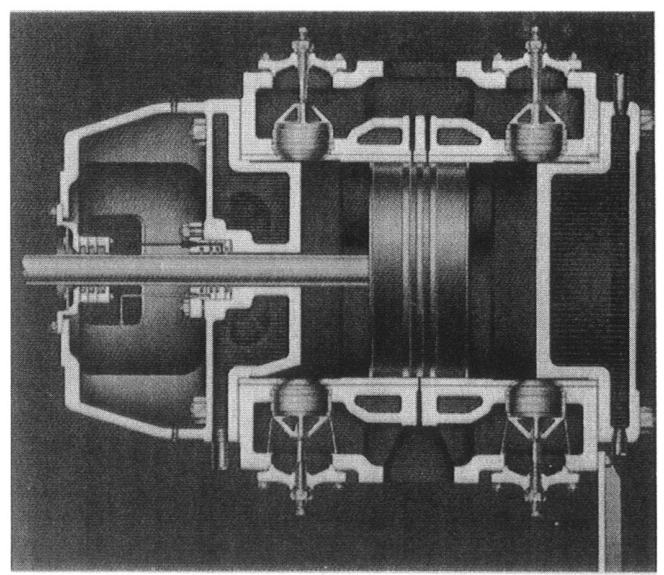
The reference defines double-acting compressors as machines with intake and discharge valves at both cylinder ends.
5. Single-acting versus double-acting
| Feature | Single-acting | Double-acting |
|---|---|---|
| Compression sides | One | Two |
| Capacity per bore | Lower | Higher |
| Valves | One working end | Both ends |
| Rod packing | Usually not in gas cylinder | Required at crank end |
| Construction | Simpler | More complex |
| Foundation/load | Lower for comparable small duty | Higher possible output |
| Typical use | Small/moderate duty | Heavy-duty continuous service |
| Maintenance | Fewer cylinder components | More valves and packing |
Double-acting does not automatically mean more efficient in every service; it means both piston sides perform compression work.
6. Single-stage compressor
A single-stage compressor completes the pressure rise from suction to final discharge in one compression step.
Advantages:
- Simple piping
- Fewer valves
- No interstage cooler
- Lower initial cost
- Simple maintenance
Limitations:
- Higher discharge temperature
- Higher pressure ratio per cylinder
- Lower volumetric efficiency at high ratio
- Greater rod and frame loading
- More difficult high-pressure operation
7. Multistage compressor
A multistage compressor divides the total pressure rise into two or more stages.
Typical arrangement:
Advantages:
- Lower ratio per stage
- Lower peak temperature
- Lower power with effective intercooling
- Better high-pressure operation
- Reduced pressure differential per cylinder
- Condensate removal between stages
Limitations:
- More valves and coolers
- More piping and separators
- Pressure-drop losses
- More maintenance
- Higher initial cost
The compressor reference defines single-stage, multistage, and two-stage machines by the number of distinct compression steps.
8. Air-cooled compressor
An air-cooled compressor rejects heat through fins, surrounding air, or a fan-assisted air path.
Advantages:
- No cooling-water system
- Simple installation
- Useful where water is unavailable
- Lower risk of water-side corrosion
- Suitable for intermittent or moderate duty
Limitations:
- Depends on ambient air temperature
- Lower heat-transfer capacity
- Higher cylinder temperature at high load
- Noise from fan and airflow
- Finned surfaces can foul
- Less suitable for sustained high-pressure duty
Air-cooled cylinders commonly use cast or machined cooling fins.
9. Water-cooled compressor
A water-cooled compressor uses jackets around cylinders and heads, plus water-cooled intercoolers and aftercoolers where required.
Advantages:
- Better heat removal
- Lower gas temperature
- Improved lubrication
- Lower valve deposits
- Higher continuous-duty capability
- Better high-pressure suitability
- Lower power in some services
Limitations:
- Cooling-water pumps and piping
- Fouling and scale
- Corrosion
- Water-leak risk
- Freeze or low-temperature condensation risk
- Need for flow monitoring
The reference states that water-cooled cylinders can operate at higher compression ratios because they do not depend mainly on radiation for heat rejection.
10. Air-cooled versus water-cooled
| Feature | Air-cooled | Water-cooled |
|---|---|---|
| Cooling medium | Ambient air | Fresh, treated, or circulating water |
| Installation | Simpler | More equipment |
| Continuous duty | More limited | Better suited |
| Temperature control | Ambient-dependent | More controllable |
| Fouling | Fins and air passages | Jackets, tubes, strainers |
| Corrosion risk | Lower water risk | Water-side corrosion possible |
| High-pressure service | Limited by temperature | More suitable |
| Maintenance | Fan/fins | Pump, jacket, cooler, drains |
11. Moderate-duty compressor
Moderate-duty machines are generally intended for intermittent or limited continuous operation.
Typical characteristics:
- Often single-acting
- Often air-cooled
- Lower horsepower
- Lower speed or lighter construction depending on design
- Smaller foundation
- Simpler controls
- Lower initial cost
The reference describes moderate-duty units as commonly single-acting and often air-cooled, with water-cooled options in some horsepower ranges.
A moderate-duty rating does not mean unsafe or poor quality. It means the thermal, structural, and maintenance assumptions differ from continuous heavy-duty design.
12. Heavy-duty or continuous-duty compressor
A heavy-duty continuous-service reciprocating compressor is generally associated with:
- Water-cooled cylinders
- Double-acting compression
- Separate crosshead
- Pressure lubrication
- Strong frame
- Low-to-moderate rotational speed
- Intercooling and aftercooling
- Designed foundation
- Continuous monitoring
The reference notes that heavy-duty continuous-duty reciprocating compressors are generally both water-cooled and double-acting.
13. Lubricated cylinder
A lubricated cylinder uses controlled oil injection or distribution to lubricate:
- Piston rings
- Cylinder wall
- Valve components where permitted
- Packing or other moving sealing surfaces
Advantages:
- Lower friction
- Reduced wear
- Better sealing
- Longer ring life
- Tolerance of some operating conditions
Limitations:
- Oil carryover
- Oil separation and filtration
- Deposit formation
- Gas contamination
- Oil compatibility requirements
The lubricant must match gas composition, temperature, pressure, and material compatibility.
14. Non-lubricated or oil-free cylinder
A non-lubricated cylinder is designed so the compression chamber does not receive conventional cylinder oil.
This may use:
- Carbon or filled-polymer rings
- Special rider bands
- Labyrinth piston
- Dry-running sealing materials
- Carefully controlled clearances
- Separate frame lubrication
Advantages:
- Low oil contamination
- Suitable for sensitive process gas
- Useful for oxygen, instrument air, and clean gas
Limitations:
- Greater sensitivity to dirt and moisture
- Special wearing materials
- Higher maintenance precision
- Possible lower allowable temperature or speed
- More demanding installation cleanliness
Non-lubricated does not mean the entire machine contains no oil. The frame, bearings, and crank mechanism may still use oil.
15. Lubrication classification
Use precise language:
- Oil-lubricated cylinder: oil enters the gas cylinder.
- Non-lubricated cylinder: cylinder is designed without conventional oil injection.
- Oil-free gas: delivered gas meets a specified contamination limit; it does not necessarily mean the machine has no oil anywhere.
- Oil-free frame: crankcase or frame lubrication differs from cylinder lubrication.
The reference warns that “non-lubricated” descriptions can be misleading unless cylinder and frame systems are distinguished.
16. Trunk-piston design
A trunk piston is guided directly by its skirt within the cylinder.
Characteristics:
- Piston skirt provides guidance
- Compact construction
- Suitable for higher speed than many crosshead designs
- Common in moderate-duty machines
- Crankcase and cylinder may be closer together
- Oil control depends on rings and design
Trunk-piston compressors resemble the guidance arrangement of an engine.
17. Crosshead design
A crosshead separates piston guidance from the cylinder wall.
Motion path:
Advantages:
- Piston is guided by crosshead shoes.
- Piston can be narrower.
- More valve area may be available.
- Longer stroke is possible.
- Crankcase oil is separated from cylinder gas.
- Piston slap and ring wear can be reduced.
- Higher-pressure construction is possible.
The reference lists these as major crosshead benefits in heavy-duty compressors.
18. Trunk piston versus crosshead
| Feature | Trunk piston | Crosshead |
|---|---|---|
| Piston guidance | Piston skirt | Crosshead and guide |
| Package | Compact | Larger and heavier |
| Speed | Often higher | Usually lower/moderate |
| Oil separation | More difficult | Better separation |
| Stroke | More limited by design | Longer stroke practical |
| Gas cleanliness | More oil-control challenge | Better control |
| Service | Moderate duty | Heavy-duty/high-pressure |
| Maintenance | Piston and skirt | Crosshead, shoes, rod, packing |
19. Horizontal arrangement
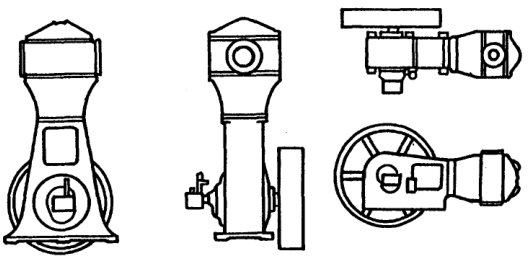
In a horizontal compressor, cylinders lie horizontally from the frame.
Advantages:
- Accessible cylinder heads and valves
- Convenient for large cylinders
- Common in heavy-duty process machines
- Can be arranged opposed for force balance
Limitations:
- Long foundation
- Alignment sensitivity
- Horizontal piston weight and rider-band loading
- Large maintenance envelope
20. Vertical arrangement
In a vertical compressor, cylinders stand above the frame.
Advantages:
- Smaller floor footprint
- Compact arrangement
- Good drainage in some layouts
- Common in moderate-duty and selected heavy-duty machines
Limitations:
- Greater height
- Overhead maintenance access
- Vertical piping and lifting requirements
- Dynamic forces transmitted through the frame and foundation
The reference includes vertical and horizontal single-cylinder arrangements when discussing inertia forces.
21. V-type arrangement
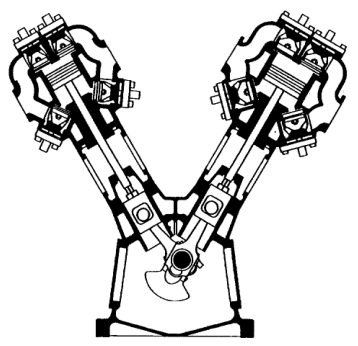
A V-type compressor has cylinders arranged at an angle, commonly around 45° from vertical, and driven from a common crank arrangement.
Advantages:
- Compact footprint
- Several cylinders in a short frame
- Useful force arrangement
- Common for two-cylinder compressors
Limitations:
- More complex access
- Cylinder-angle piping
- Shared-crank loading
- Foundation forces require analysis
22. Y-type arrangement
A Y-type machine uses three cylinder directions or a geometry resembling a Y.
It can provide:
- Multiple cylinders on a compact frame
- Improved force distribution
- Capacity expansion without a long inline frame
The exact balance depends on crank angles, cylinder masses, and phase relationships.
Do not assume every Y-frame is dynamically balanced; inspect the manufacturer’s force and couple analysis.
23. Single-frame straight-line arrangement
A straight-line machine places one or more cylinders in line on one frame.
It may be:
- Horizontal
- Vertical
- Single- or double-acting
- Motor-driven
- Steam-driven
- Tandem with driver cylinders
The reference identifies single-frame straight-line machines as horizontal or vertical double-acting compressors with cylinders in line on a frame.
24. Opposed arrangement
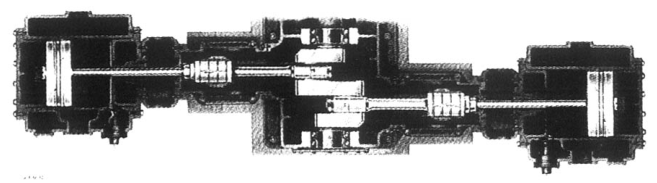
An opposed compressor places cylinders on opposite sides of the crankcase.
Advantages:
- Good primary-force cancellation
- Compact moment arms
- Reduced foundation loading
- Suitable for large process machines
- High capacity in a balanced structure
Limitations:
- Multiple crank throws
- More complex frame and alignment
- Opposed cylinder access
- Crosshead and rod inspection requirements
Balanced-opposed arrangements can transfer couples even when direct forces cancel.
25. Semi-radial arrangement
A semi-radial compressor combines features of V/Y layouts with additional cylinders on each side.
It can provide:
- High capacity
- Compact footprint
- Shared crankshaft
- Multiple cylinders with selected phasing
The cylinder and crank arrangement must be checked for:
- Primary forces
- Secondary forces
- Couples
- Piping arrangement
- Maintenance access
26. Duplex arrangement
A duplex compressor has cylinders on two parallel frames connected through a common crankshaft or drive arrangement.
Possible purposes:
- Greater capacity
- Redundancy within a common package
- Multiple services
- Shared driver or crankshaft
- Flexible loading
A duplex machine is not automatically two independent standby compressors; the common frame, shaft, or driver may remain a single point of failure.
27. Tandem arrangement
Tandem cylinders or pistons are arranged along one line or rod.
Applications include:
- Multiple stages on one axis
- Compact driver-cylinder arrangements
- Selected pressure-ratio designs
Tandem piston rods carry combined loads, so frame and rod-load limits must be checked.
The reference describes tandem piston rods with two or more pistons mounted on one rod where combined loading remains within allowable limits.
28. Four-cornered arrangement
A four-cornered motor-driven compressor uses multiple compressing cylinders around a central or shared drive arrangement.
A steam-driven four-cornered machine may place driver and compressor cylinders at opposite ends of frames.
Advantages:
- Compact use of a common driver
- Multiple services or stages
- Potential force balancing
Limitations:
- Complex crankshaft and frame
- Difficult alignment
- More extensive piping and maintenance planning
29. L-type or integral arrangement
An L-type integral machine may combine:
- Vertical or vertical-V power cylinders
- Horizontal compressor cylinders
- Common crankshaft or integral driver
This arrangement is often associated with gas- or oil-engine-driven compressors.
Selection depends on:
- Available fuel
- Driver speed
- Foundation
- Maintenance access
- Heat balance
- Service pressure and capacity
30. Portable compressor
A portable compressor and driver are mounted so the unit can be moved as a package.
Typical requirements:
- Skid or frame
- Lifting points
- Vibration isolation
- Flexible hoses
- Compact receiver or no receiver
- Quick connection
- Protection from transport damage
Portable units may sacrifice some cooling, noise, maintenance access, or continuous-duty capability for mobility.
31. Stationary compressor
A stationary compressor is permanently installed on a foundation or equipment skid.
Advantages:
- Larger capacity
- Better cooling systems
- Permanent piping
- Larger receiver and separators
- More robust controls
- Easier integration with plant systems
Installation must include:
- Foundation
- Alignment
- Piping flexibility
- Pulsation control
- Drainage
- Ventilation
- Maintenance access
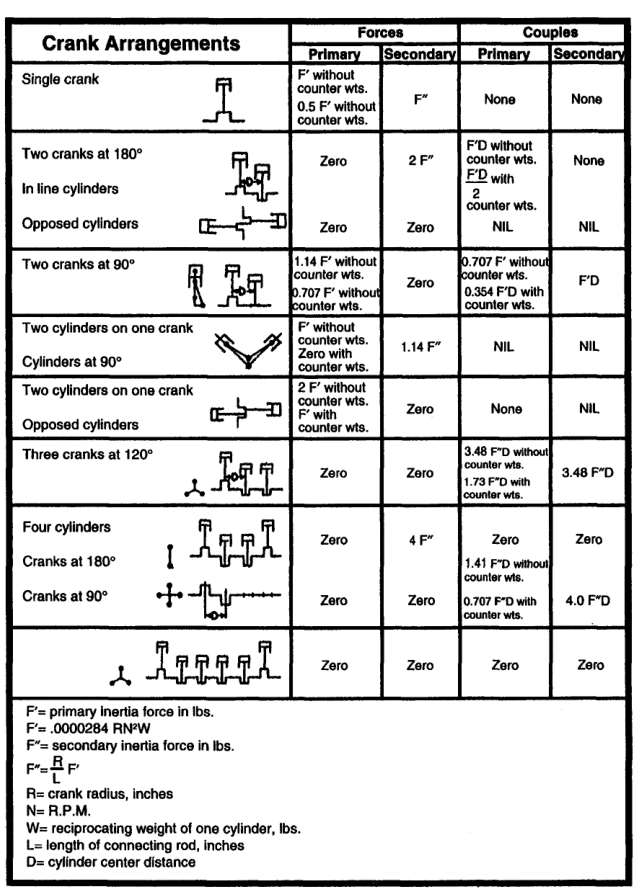
32. Cylinder arrangement and force balance
Reciprocating masses create:
- Primary inertia forces
- Secondary inertia forces
- Primary couples
- Secondary couples
- Gas forces
The arrangement determines how these forces combine.
A good arrangement may:
- Cancel opposing forces
- Reduce couples
- Lower foundation vibration
- Reduce piping movement
- Improve bearing load distribution
The arrangement must be considered with actual crank angles and cylinder masses, not only with its visual shape.
33. Cylinder arrangement and capacity
Capacity can be increased by:
- Increasing bore
- Increasing stroke
- Increasing speed
- Adding cylinders
- Using double-acting cylinders
- Adding stages
- Using multiple frames
Each option changes:
- Driver power
- Rod load
- Foundation force
- Pulsation
- Cooling requirement
- Maintenance
Adding cylinders is not only a capacity decision; it is a dynamic and structural decision.
34. Cylinder arrangement and maintenance
Inline
- Simple sequence
- Easy to understand
- Long frame and piping
- Access may be good from one side
V/Y
- Compact footprint
- More complex valve and piping access
- Shared-crank maintenance
Opposed
- Good balance
- Multiple cylinder ends on both sides
- Large maintenance envelope
Duplex
- Multiple services or capacity
- More complex shaft and frame
35. Lubricated versus non-lubricated selection
Choose non-lubricated or oil-free cylinder construction when:
- Product gas must not contain oil.
- Oxygen or reactive gas is handled.
- Instrument air quality is critical.
- Downstream oil removal is difficult.
- Process contamination is costly.
Choose lubricated construction when:
- Oil carryover is acceptable or removable.
- High sealing and wear resistance are needed.
- Simpler cylinder maintenance is preferred.
- Gas and lubricant are compatible.
Non-lubricated machines require exceptionally clean intake and interstage piping; dirt, rust, scale, and moisture accelerate wear.
36. Air-cooled versus water-cooled selection
Choose air cooling when:
- Duty is intermittent.
- Capacity is small or moderate.
- Cooling water is unavailable.
- Simplicity and mobility matter.
- Ambient temperature is acceptable.
Choose water cooling when:
- Duty is continuous.
- Pressure ratio is high.
- Discharge temperature must be controlled.
- Cooling water is available.
- Long valve and lubricant life matter.
Cooling-water failure should produce an alarm or trip where temperature risk is significant.
37. Moderate-duty versus heavy-duty selection
| Requirement | Moderate duty | Heavy duty |
|---|---|---|
| Operating pattern | Intermittent or limited continuous | Continuous |
| Cooling | Often air | Usually water |
| Acting | Often single | Commonly double |
| Guidance | Trunk piston | Crosshead |
| Speed | Often higher | Often lower |
| Foundation | Smaller | Designed heavy foundation |
| Maintenance | Simpler | More detailed |
| Cost | Lower initial | Higher initial, lifecycle focus |
The correct rating depends on actual load factor, not only the motor horsepower.
38. Marine-service classification example: starting-air compressor
A typical starting-air compressor may be described as:
Stationary, water-cooled, multistage, double-acting or heavy-duty reciprocating compressor with automatic capacity control, intercooling, aftercooling, moisture separation, and receiver charging.
Important checks:
- Final pressure
- Charging time
- Standby availability
- Condensate drainage
- Relief valves
- Cooling-water flow
- Oil carryover
- Receiver safety
39. Marine-service classification example: instrument air
A typical instrument-air compressor may be described as:
Stationary, oil-free-cylinder, water- or air-cooled compressor with filtration, drying, receiver storage, automatic control, and low oil carryover.
Important checks:
- Dew point
- Oil contamination
- Part-load operation
- Dryer capacity
- Receiver pressure
- Redundancy
- Valve and ring materials
40. Marine-service classification example: workshop air
A workshop compressor may be:
Portable or stationary, air-cooled or water-cooled, single- or two-stage, single-acting reciprocating or rotary screw compressor with receiver and automatic pressure control.
Selection depends on:
- Intermittent demand
- Portability
- Noise
- Pressure
- Flow
- Available power
- Maintenance resources
41. Why classification affects spare parts
Classification determines likely spare parts:
Single-acting air-cooled
- Piston rings
- Suction and discharge valves
- Fan components
- Filters
- Gaskets
Double-acting water-cooled crosshead
- Valve assemblies
- Piston rings
- Rider bands
- Packing rings
- Crosshead shoes
- Bearings
- Cooler seals
- Jacket components
Non-lubricated
- Special dry-running rings
- Rider bands
- Clean-service filters
- Special valve materials
Correct classification improves spare-parts planning.
42. Classification and operating procedures
The classification determines operating precautions.
Air-cooled
- Keep fins clean.
- Maintain fan airflow.
- Avoid prolonged overload.
- Observe ambient temperature.
Water-cooled
- Confirm water flow before starting.
- Monitor inlet and outlet temperature.
- Prevent fouling and scale.
- Avoid condensation from overcooling.
Non-lubricated
- Maintain clean intake gas.
- Prevent moisture and rust scale.
- Use correct dry-running materials.
Double-acting
- Monitor both cylinder ends.
- Inspect packing.
- Compare valve temperatures.
43. Selection checklist
Before choosing a classification, define:
- Gas composition
- Suction pressure
- Suction temperature
- Discharge pressure
- Required capacity
- Duty cycle
- Load factor
- Cooling medium
- Lubricant acceptability
- Oil-free requirement
- Driver type
- Speed
- Space
- Weight
- Foundation
- Noise
- Vibration
- Maintenance access
- Spare-parts capability
- Required redundancy
44. Revision questions with answers
Question 1
What is a single-acting compressor?
Answer: A compressor that compresses gas on one side of the piston only.
Question 2
What is a double-acting compressor?
Answer: A compressor that compresses on both sides of the piston.
Question 3
What is a single-stage compressor?
Answer: A compressor that completes the pressure rise in one step.
Question 4
Why is multistaging used?
Answer: To divide pressure rise, reduce temperature, save power, and limit mechanical load.
Question 5
Why is water cooling useful?
Answer: It removes compression heat and supports continuous, higher-ratio operation.
Question 6
What is a crosshead?
Answer: A guided reciprocating member between connecting rod and piston rod that guides the piston.
Question 7
What is a trunk piston?
Answer: A piston whose skirt guides it directly in the cylinder.
Question 8
Why is non-lubricated cylinder construction used?
Answer: To minimise oil contamination of the compressed gas.
Question 9
What is a V-type compressor?
Answer: A compressor with cylinders arranged at an angle from a common crank arrangement.
Question 10
What is an opposed compressor?
Answer: A compressor with cylinders on opposite sides of the crankcase.
Question 11
What is a duplex compressor?
Answer: A compressor using two parallel frames or cylinder groups connected through a common arrangement.
Question 12
Why do reciprocating compressors need foundation consideration?
Answer: Their reciprocating masses and gas forces create inertia forces and couples.
Question 13
What is the main difference between moderate and heavy duty?
Answer: Heavy-duty machines are designed for sustained operation with stronger cooling, structure, guidance, and lubrication systems.
Question 14
What does portable mean?
Answer: The compressor and driver are mounted so they can be moved as one unit.
Question 15
What information is required for classification selection?
Answer: Pressure, capacity, gas, duty, cooling, lubrication, driver, space, foundation, controls, maintenance, and reliability.
45. Self-test scenarios
Scenario A — continuous high-pressure service
Choose a likely classification:
- Water-cooled
- Double-acting
- Multistage
- Crosshead
- Stationary
- Heavy-duty
Then check driver, cooling, foundation, and redundancy.
Scenario B — portable workshop service
Likely classification:
- Portable
- Moderate-duty
- Air-cooled
- Single-acting or small two-stage
- Trunk piston
Check intermittent duty, noise, receiver size, and transport protection.
Scenario C — oil-free instrument air
Likely classification:
- Non-lubricated or oil-free cylinder
- Clean intake filtration
- Suitable cooling
- Receiver and dryer
- Automatic control
Check that “oil-free” refers to delivered-air quality, not necessarily an oil-free frame.
Scenario D — excessive vibration after adding a cylinder
Check:
- Crank phasing
- Primary forces
- Secondary forces
- Couples
- Foundation stiffness
- Pipe strain
- Pulsation
Scenario E — high-temperature single-stage machine
Consider:
- Water cooling
- Two-stage conversion
- Intercooling
- Lower speed
- Reduced load factor
- Improved valve condition
46. Chapter-ten study checklist
- ☐ Define single-acting.
- ☐ Define double-acting.
- ☐ Define single-stage.
- ☐ Define multistage.
- ☐ Compare air and water cooling.
- ☐ Compare lubricated and non-lubricated cylinders.
- ☐ Explain oil-free terminology.
- ☐ Explain trunk piston.
- ☐ Explain crosshead.
- ☐ Compare horizontal and vertical frames.
- ☐ Explain V and Y arrangements.
- ☐ Explain opposed arrangement.
- ☐ Explain semi-radial arrangement.
- ☐ Explain duplex arrangement.
- ☐ Explain tandem arrangement.
- ☐ Explain portable and stationary classifications.
- ☐ Compare moderate and heavy duty.
- ☐ Explain force and couple balance.
- ☐ Explain classification-specific maintenance.
- ☐ Classify a starting-air compressor.
- ☐ Classify an instrument-air compressor.
- ☐ Complete a classification selection.