
Pressure, Units and Pressure Ratios in Air Compressors
Gauge or absolute: one word decides whether your pressure ratio is right.
Key Principles at a Glance 7 points
- Absolute pressure is measured from a perfect vacuum and must be used for every pressure ratio and gas-law calculation; gauge pressure is not a substitute.
- Standard atmosphere is 14.696 psia, 1.01325 bar absolute or 101.325 kPa, which are the same pressure written three ways.
- 1 bar equals 100 kPa and approximately 14.5 psi, and 1 MPa equals 10 bar.
- Interstage pressure is the best single indicator of stage balance, because a deviation shows which stage is doing too much or too little work.
- Atmospheric pressure falls with altitude: at 5,000 ft it is about 12.2 psia, so the same gauge reading gives a different absolute pressure and a different compression ratio.
- Differential pressure across a cooler, separator or filter rises as the element fouls, which makes it a maintenance indicator rather than just a reading.
- Pulsating pressure from a reciprocating compressor makes a gauge needle flicker, so a reading taken at the wrong moment misrepresents the true mean pressure.
1. Learning objectives
Course position: Air-compressor sequence, Topic 2
Level: Foundation
Main question: How should compressor pressure be defined, measured, converted, recorded, and used in calculations?
After studying this chapter, you should be able to:
- Define pressure as force per unit area.
- Distinguish atmospheric, gauge, absolute, differential, and vacuum pressure.
- Convert gauge pressure to absolute pressure.
- Convert absolute pressure to gauge pressure.
- Explain psig, psia, bar, kPa, MPa, kgf/cm², in. Hg, mm Hg, and in. H₂O.
- Explain why pressure ratios use absolute pressure.
- Calculate compressor pressure ratio.
- Distinguish suction pressure, discharge pressure, and interstage pressure.
- Explain how altitude changes atmospheric and absolute pressure.
- Read pressure gauges without confusing the reference datum.
- Understand pressure measurement errors and instrument limitations.
- Apply pressure concepts to air receivers, compressor stages, and troubleshooting.
- Interpret pressure diagrams from the compressor references.
2. The shortest definition of pressure
Pressure is force acting on a unit area.
where:
- P = pressure
- F = force
- A = area
Rearranged:
A pressure of 1 bar acting over a large area produces a much larger total force than the same pressure acting over a small area.
This is why a relatively modest gauge pressure can create a dangerous force on:
- Receiver end covers
- Valve covers
- Cylinder heads
- Pipe joints
- Flanges
- Manholes
- Hoses
The compressor reference defines pressure as force per unit area and lists units such as psi, lb/ft², grams/cm², and kilograms/cm².
3. Pressure is always a comparison
A pressure reading is meaningful only when its reference is known.
Examples:
- Pressure above atmosphere
- Pressure measured from a perfect vacuum
- Difference between compressor inlet and outlet
- Difference across a filter
- Difference across a valve
- Difference between two sides of a piston
The same physical system can be described as:
- 8 bar gauge
- Approximately 9 bar absolute near sea level
- Approximately 116 psig
- Approximately 131 psia
These are not four different pressures. They are different reference systems and units describing approximately the same condition.
4. Pressure reference datums
There are two important zero references.
4.1 Atmospheric datum
A simple pressure gauge uses local atmospheric pressure as its zero.
At atmospheric pressure, the gauge reads zero even though the gas still has absolute pressure.
This produces gauge pressure.
4.2 Perfect-vacuum datum
Absolute pressure uses perfect vacuum as zero.
It measures the total pressure from zero pressure upward.
This produces absolute pressure.
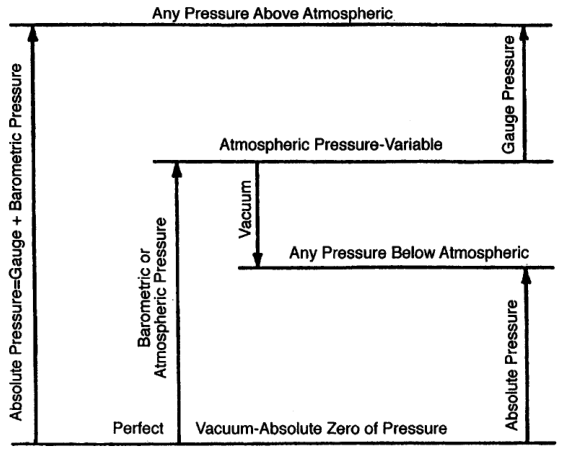
The compressor reference recommends explicitly identifying every pressure as gauge or absolute.
5. Atmospheric pressure
Atmospheric pressure is the force exerted by the weight of the surrounding atmosphere.
At standard sea-level conditions, a commonly used approximate value is:
- 14.696 psia
- 14.7 psia
- 1.01325 bar absolute
- 101.325 kPa absolute
- 29.92 in. Hg
- Approximately 10.33 m H₂O
Atmospheric pressure is not constant everywhere.
It changes with:
- Altitude
- Weather
- Temperature
- Local barometric conditions
At higher altitude, atmospheric pressure is lower. Therefore, a gauge pressure may represent a different absolute pressure at a different location.
The compressor reference gives approximately 12.2 psia atmospheric pressure at 5,000 ft as an example of altitude effect.
6. Gauge pressure
Gauge pressure is pressure above local atmospheric pressure.
It is normally shown by a pressure gauge mounted on the compressor, receiver, cooler, or pipe.
Common symbols:
- psig — pounds per square inch gauge
- barg — bar gauge
- kPag — kilopascals gauge
- MPag — megapascals gauge
Formula:
A receiver gauge reading of zero means the receiver pressure is approximately equal to local atmosphere, not that it is a perfect vacuum.
Example
If:
- Receiver pressure = 8 bar gauge
- Atmospheric pressure = 1 bar
Then:
7. Absolute pressure
Absolute pressure is measured from perfect vacuum.
Common symbols:
- psia — pounds per square inch absolute
- bara — bar absolute
- kPaa — kilopascals absolute
- MPaa — megapascals absolute
Formula:
Absolute pressure is required for:
- Gas laws
- Compression ratios
- Thermodynamic calculations
- Stage pressure calculations
- Density calculations
- Free-air corrections
- Vacuum interpretation
Never write simply “100 psi” in a technical calculation if it is important whether the value is psig or psia.
8. Gauge and absolute pressure example
Problem
A compressor delivers air at 100 psig at sea level. Find approximate discharge pressure in psia.
Solution
At sea level:
Therefore:
The compressor reference gives this same relationship when explaining a 100-psi-gauge air system.
Important
The answer is not 100 psia.
The gauge has omitted the atmospheric pressure because its zero is atmospheric.
9. Vacuum pressure
A gas is under vacuum when its pressure is below atmospheric pressure.
Vacuum can be expressed as:
- in. Hg vacuum
- mm Hg vacuum
- in. H₂O vacuum
- kPa vacuum
- Negative gauge pressure
- Absolute pressure below atmospheric
A vacuum gauge normally shows the difference between atmosphere and the system.
If atmospheric pressure is not given, a vacuum value in in. Hg or mm Hg does not uniquely identify the absolute pressure.
The compressor reference warns that vacuum readings should be accompanied by the barometric or atmospheric reference.
10. Vacuum example
Problem
A vacuum gauge reads 20 in. Hg vacuum. Local atmospheric pressure is 29.92 in. Hg absolute equivalent. Find approximate absolute pressure.
Solution
The system is not at zero absolute pressure. It is at approximately 9.92 in. Hg absolute.
Why altitude matters
At high altitude, local atmospheric pressure may be lower than 29.92 in. Hg. The same vacuum-gauge reading therefore corresponds to a different absolute pressure.
11. Pressure units
11.1 Pascal
The SI unit of pressure is the pascal:
Practical units:
- kPa = 1,000 Pa
- MPa = 1,000,000 Pa
11.2 Bar
A bar is a convenient engineering unit:
A bar is close to atmospheric pressure but is not exactly equal to standard atmospheric pressure.
11.3 Pound-force per square inch
- psi — pounds-force per square inch
- psig — pounds-force per square inch gauge
- psia — pounds-force per square inch absolute
11.4 Kilogram-force per square centimetre
- kgf/cm²
- kg/cm² in older technical documents
This is a force-based unit and should not be confused with kilogram mass per square centimetre.
11.5 Liquid-column units
Pressure may be expressed as the height of a liquid column:
- m H₂O
- ft H₂O
- in. H₂O
- mm Hg
- in. Hg
The height of the column produces a pressure through its weight and density.
12. Useful approximate conversions
Use exact standards for certification and design. The following are practical approximations:
| Pressure | Approximate equivalent |
|---|---|
| 1 bar | 100 kPa |
| 1 bar | 14.5 psi |
| 1 psi | 6.895 kPa |
| 1 kgf/cm² | 98.07 kPa |
| 1 MPa | 10 bar |
| 1 bar absolute | 100 kPa absolute |
| 1 atmosphere | 1.01325 bar absolute |
| 1 atmosphere | 14.696 psia |
| 1 atmosphere | 29.92 in. Hg |
| 1 in. H₂O | approximately 249 Pa |
The refrigeration reference lists conversions including psi to kPa, kgf/cm² to kPa, bar to kPa, and in. H₂O to pascals.
13. Unit-conversion examples
Example 1 — bar to kPa
Example 2 — bar to psi
Using 1 bar ≈ 14.5 psi:
Example 3 — psi to kPa
Example 4 — MPa to bar
Example 5 — kgf/cm² to kPa
Always preserve the reference:
- 7 barg ≠ 7 bara
- 100 psig ≠ 100 psia
- 1 MPag ≠ 1 MPaa
14. Pressure difference and differential pressure
Differential pressure is the difference between two pressures.
Applications:
- Pressure drop across an air filter
- Pressure drop across an intercooler
- Difference across a valve
- Difference across a piston
- Difference between cylinder and discharge line
- Suction-to-discharge pressure rise
A differential-pressure instrument may read zero even when both sides are at high absolute pressure, provided both sides are equal.
Example
If:
- Filter inlet = 8.2 barg
- Filter outlet = 8.0 barg
Then:
The filter pressure drop is 0.2 bar.
15. Pressure force example
Problem
A valve cover has an exposed area of 0.02 m² and internal gauge pressure of 10 bar. Estimate the pressure force using 1 bar = 100,000 Pa.
Solution
This is approximately 20 kN of force, before considering external pressure, bolts, geometry, and safety factors.
This illustrates why a valve cover must never be opened while pressure remains trapped.
16. Atmospheric pressure and the barometer
A barometer measures atmospheric pressure using a column of liquid, commonly mercury.
At standard sea-level conditions, atmospheric pressure supports approximately:
- 29.92 inches of mercury
- 760 mm of mercury
- 14.696 psia
The top of a mercury barometer column is referenced to near-zero absolute pressure. The supported column height represents atmospheric pressure.
The compressor reference describes the barometer as a pressure measurement based on the weight of a mercury column balanced by atmospheric air.
17. Pressure diagram interpretation
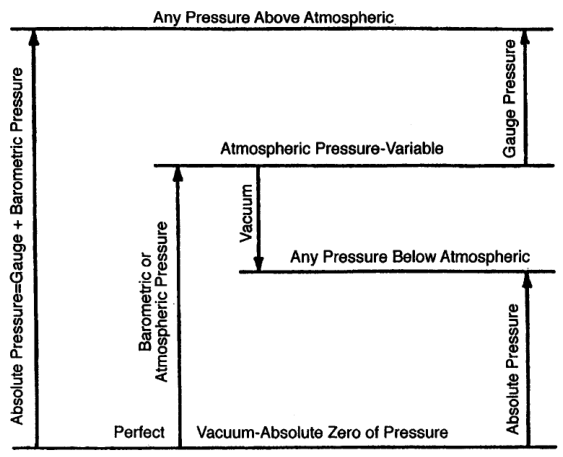
Read the diagram from left to right:
- Perfect vacuum is the absolute-zero datum.
- Pressures above vacuum are absolute pressures.
- Atmospheric pressure is a particular absolute pressure that changes with location.
- Gauge pressure begins at atmospheric pressure.
- Vacuum is the region below atmospheric pressure.
Important distinction
Gauge pressure can be positive or negative relative to atmosphere.
Absolute pressure cannot be negative in ordinary engineering use.
18. Why pressure notation matters
The following statements are incomplete:
- “The compressor delivers 100 psi.”
- “The suction is 2 bar.”
- “The vacuum is 20 inches.”
- “Interstage pressure is 5.”
Correct forms are:
- 100 psig
- 2 bara
- 20 in. Hg vacuum at 29.5 in. Hg barometric pressure
- 5 barg at the intercooler outlet
The compressor reference specifically recommends writing psig or psia after the pressure and identifying the barometric pressure when psig is used.
19. Suction or inlet pressure
Suction pressure is the pressure at the compressor inlet or suction flange.
It may be:
- Above atmospheric pressure
- Approximately atmospheric pressure
- Below atmospheric pressure in some process or vacuum applications
Suction pressure affects:
- Air density
- Mass flow
- Pressure ratio
- Compression temperature
- Power
- Volumetric efficiency
- Cylinder loading
The same compressor displacement admits a different mass of air when suction pressure changes.
Lower suction pressure
Usually means:
- Lower inlet density
- Lower mass flow
- Higher pressure ratio for the same discharge pressure
- Possible filter or suction-piping restriction
Higher suction pressure
May mean:
- Higher inlet density
- Increased mass flow
- Lower pressure ratio for the same discharge pressure
- Pressurised inlet system
20. Discharge pressure
Discharge pressure is the total pressure measured at the compressor discharge flange or specified discharge point.
It must be identified as:
- Discharge psig
- Discharge psia
- Discharge barg
- Discharge bara
Discharge pressure affects:
- Pressure ratio
- Power requirement
- Discharge temperature
- Valve loading
- Receiver pressure
- Capacity
- Frame and rod loads
The compressor reference defines discharge pressure at the discharge flange and states that it may be expressed as gauge or absolute pressure.
21. Compression ratio
The overall compression ratio is:
Both pressures must use the same absolute unit.
Example 1 — sea-level plant air
- Suction = 14.7 psia
- Discharge = 114.7 psia
The compressor reference gives this approximate 7.8:1 example for 100 psig discharge at sea level.
Example 2 — bar units
- Suction = 1.0 bara
- Discharge = 9.0 bara
Incorrect method
Do not calculate:
A gauge reading of zero at atmospheric suction cannot be used as the denominator.
22. Why pressure ratio matters
Pressure ratio affects:
- Work of compression
- Discharge temperature
- Volumetric efficiency
- Valve loading
- Lubricant condition
- Need for multiple stages
- Interstage pressure
- Cooling requirements
As pressure ratio increases, a single stage may become impractical because discharge temperature and power rise.
This is one reason high-pressure compressors use multiple stages.
23. Interstage pressure
In a multistage compressor, interstage pressure is the pressure between stages, commonly measured at the intercooler or second-stage suction.
Interstage pressure shows whether the stages are sharing the compression work properly.
The compressor reference states that normal interstage pressure should be observed regularly because changes can identify valve or stage problems.
24. Stage pressure ratio
For a two-stage compressor:
where:
- r₁ = first-stage absolute pressure ratio
- r₂ = second-stage absolute pressure ratio
For approximately equal stage ratios:
Example
If overall pressure ratio is 16:
The approximate intermediate absolute pressure is:
Actual values depend on cooling, valve condition, leakage, gas properties, and design.
25. Interstage pressure fault interpretation
Low interstage pressure
A low interstage pressure may point to a problem in the preceding cylinder:
- First-stage suction-valve problem
- First-stage discharge-valve problem
- Piston-ring leakage
- Restricted first-stage inlet
- Low first-stage delivery
If pressure drops nearly to zero under load, a serious discharge-valve fault may exist.
High interstage pressure
A high interstage pressure may point to a problem in the succeeding cylinder:
- Second-stage suction-valve problem
- Restricted second-stage inlet
- Broken suction valve
- Reduced second-stage capacity
- Interstage restriction
Improper interstage pressure can affect rod loads, vibration, and capacity.
26. Pressure and altitude
At higher altitude:
- Atmospheric pressure decreases.
- Absolute suction pressure may decrease.
- A gauge reading may not change in the same way as absolute pressure.
- The pressure ratio for a given gauge discharge can increase.
- Mass intake per swept volume decreases.
- Compressor capacity and power behaviour change.
Example
At sea level:
- Suction ≈ 14.7 psia
- Discharge = 100 psig = 114.7 psia
- Ratio ≈ 7.8
At altitude with atmospheric pressure ≈ 12.2 psia:
- Discharge = 100 psig ≈ 112.2 psia
- Suction ≈ 12.2 psia
- Ratio ≈ 9.2
The same gauge discharge can correspond to a different absolute pressure ratio.
The compressor reference discusses altitude effects on atmospheric pressure, cylinder sizing, capacity, and derating.
27. Free air and standard air
Free air generally means air at normal atmospheric conditions, but it is not identical everywhere.
Atmospheric pressure, temperature, and altitude vary.
Therefore, “free air” must be linked to reference conditions.
The compressor reference warns that the terms free air and standard air are not necessarily interpreted identically by every user because local pressure and temperature conditions vary.
When reading a compressor rating, identify:
- Reference suction pressure
- Reference suction temperature
- Relative humidity, if specified
- Reference discharge pressure
- Measurement location
- Whether capacity is mass flow or volumetric flow
28. Pressure measurement instruments
28.1 Bourdon pressure gauge
A curved elastic tube deforms under pressure. Mechanical linkage moves a pointer over a calibrated dial.
Advantages:
- Simple
- Robust
- No electrical supply required
- Easy local indication
Limitations:
- Mechanical wear
- Vibration sensitivity
- Calibration drift
- Pulsation damage
- Incorrect scale or range
28.2 Pressure transmitter
A sensor converts pressure into an electrical signal.
Used for:
- Remote monitoring
- Automatic control
- Alarm systems
- Data logging
- Compressor sequencing
28.3 Differential-pressure instrument
Measures pressure difference between two connection points.
Used for:
- Filter blockage
- Cooler pressure drop
- Separator condition
- Flow measurement
28.4 Barometer
Measures atmospheric pressure.
It is needed when converting gauge and vacuum readings to absolute pressure accurately.
29. Gauge selection
A pressure gauge should be selected for:
- Correct pressure range
- Correct reference: gauge or absolute
- Compatible gas
- Temperature range
- Pulsation level
- Vibration
- Accuracy
- Connection type
- Material compatibility
- Calibration requirement
A gauge operating constantly near the top of its scale may be inaccurate or damaged.
A gauge with a very large range may be difficult to read accurately at normal pressure.
30. Gauge errors and bad readings
Possible causes of an incorrect pressure reading:
- Gauge out of calibration
- Blocked sensing line
- Condensate in sensing line
- Pulsation
- Wrong pressure tap
- Gauge filled with wrong liquid
- Damaged Bourdon tube
- Temperature effect
- Pressure impulse valve closed
- Transmitter zero drift
- Incorrect unit scale
Before changing compressor settings, compare the indication with a known accurate instrument.
31. Pulsating pressure
Reciprocating compressors produce pulsating flow and pressure.
Pressure pulsation can cause:
- Needle vibration
- Gauge fatigue
- Pipe vibration
- Flange leakage
- Incorrect readings
- Valve stress
- Resonance
Solutions may include:
- Snubbers
- Gauge dampers
- Pulsation bottles
- Correct pipe supports
- Flexible connectors
- Proper gauge location
A rapidly fluctuating gauge needle should not automatically be interpreted as unstable compressor pressure.
32. Pressure drop in an air system
Pressure decreases as air flows through resistance.
Sources of pressure drop:
- Dirty intake filter
- Small pipe
- Long pipe
- Elbows and fittings
- Cooler tubes
- Moisture separator
- Check valve
- Partly closed isolating valve
- Dirty final filter
Pressure drop causes:
- Lower pressure at the user
- Increased compressor discharge pressure if compensated
- Higher energy use
- Lower capacity at the point of use
Filter example
If:
- Filter inlet = 9.0 barg
- Filter outlet = 8.7 barg
Then filter drop is:
A rising pressure drop at constant flow indicates increasing restriction.
33. Pressure measurement locations
A compressor system may contain several pressure points:
- Atmospheric pressure
- Intake or suction pressure
- First-stage cylinder pressure
- First-stage discharge pressure
- Intercooler inlet pressure
- Intercooler outlet pressure
- Second-stage suction pressure
- Final discharge pressure
- Aftercooler outlet pressure
- Receiver pressure
- Distribution-header pressure
- User pressure
These pressures are not interchangeable.
The location must be written next to every recorded value.
34. Pressure at the compressor versus pressure at the receiver
The compressor discharge gauge may show a higher pressure than the receiver gauge because of:
- Discharge-pipe friction
- Cooler pressure drop
- Check-valve pressure drop
- Flow rate
- Pulsation
- Gauge location
During charging:
When flow stops, static pressures may equalise if valves are open and no leakage exists.
35. Pressure and compressor loading
The compressor experiences different loads depending on pressure conditions.
Higher discharge pressure generally means:
- Greater force on piston and rod
- Higher compression work
- Higher discharge temperature
- Higher valve loading
- Greater frame loading
- Possible reduced capacity
A reciprocating compressor is commonly described as a constant-volume, variable-pressure machine within its design limits.
This means the geometric displacement is relatively fixed at a given speed, while the pressure and power vary with system conditions.
36. Pressure and force on the piston
For a piston with effective area A:
For a reciprocating compressor, the net gas force depends on the pressure difference on the two sides of the piston.
In a double-acting compressor:
- Head-end pressure acts on one side.
- Crank-end pressure acts on the other side.
- The piston rod reduces effective area on the crank end.
- Pressure changes alter rod loads.
This is why pressure conditions affect crankshaft, connecting rod, crosshead, and frame loads.
37. Pressure and temperature connection
As pressure ratio increases, discharge temperature tends to rise.
Factors affecting discharge temperature:
- Suction temperature
- Discharge pressure
- Suction pressure
- Compression ratio
- Gas properties
- Cooling effectiveness
- Valve leakage
- Cylinder condition
A high pressure reading and high discharge temperature should be investigated together.
High temperature can also cause pressure abnormalities by:
- Reducing gas density
- Damaging valves
- Breaking down lubricant
- Increasing leakage
- Fouling passages
38. Pressure and gas laws
For an ideal gas at constant temperature:
This is Boyle’s law.
If volume is reduced to half while temperature remains constant:
If:
then:
The refrigeration reference gives this example using atmospheric pressure and absolute pressure.
Important limitation
Actual compressor compression is not perfectly isothermal. Temperature changes, valve losses, clearance, and cooling must be considered.
39. Gauge-pressure calculation trap
Wrong calculation
A compressor takes air at “0 bar” and delivers at 8 bar. The operator calculates:
This is invalid because 0 bar gauge means approximately atmospheric pressure, not zero absolute pressure.
Correct calculation
Assuming atmospheric pressure ≈ 1 bar:
- Suction ≈ 1 bara
- Discharge ≈ 9 bara
40. Why the word “absolute” must not be omitted
Compare:
- 2 bar
- 2 bara
- 2 barg
These have different meanings.
At approximately 1 bar atmosphere:
- 2 bara ≈ 1 barg
- 2 barg ≈ 3 bara
The difference is operationally important.
A pressure-ratio error can lead to:
- Wrong power estimate
- Wrong temperature estimate
- Wrong stage sizing
- Wrong valve loading
- Wrong capacity estimate
- Wrong alarm settings
41. Pressure notation checklist
When recording a pressure, always include:
- Value
- Unit
- Gauge or absolute reference
- Measurement location
- Temperature if relevant
- Date/time if trending
- Machine operating condition
Example of a good log entry:
Second-stage suction pressure: 4.2 bara at 80% load, suction temperature 35°C, 2026-07-21 10:00.
Poor log entry:
Interstage: 4.2.
42. Pressure in compressor performance logs
A useful compressor log records:
| Measurement | Reference |
|---|---|
| Intake pressure | bara or barg, location stated |
| First-stage discharge | bara or barg |
| Interstage pressure | bara or barg |
| Final discharge | bara or barg |
| Receiver pressure | barg and local atmosphere if needed |
| Cooling-water pressure | barg |
| Oil pressure | barg relative to crankcase or atmosphere |
| Filter differential | bar differential |
| Atmospheric pressure | bara or barometric equivalent |
Use the same units and reference every day so trends are meaningful.
43. Pressure fault diagnosis
Low discharge pressure
Possible causes:
- Low speed
- Suction restriction
- Valve leakage
- Piston-ring leakage
- Capacity-control unloading
- Air leaks
- Excessive system demand
- Incorrect pressure switch
High discharge pressure
Possible causes:
- Closed downstream valve
- Blocked pipe
- Receiver pressure high
- Faulty pressure control
- Excessive system resistance
- Wrong pressure switch setting
Abnormal interstage pressure
Possible causes:
- Stage valve fault
- Intercooler restriction
- Condensate accumulation
- Piston-ring leakage
- Incorrect load sharing
44. Pressure safety rules
- Never open a pressure-containing cover without confirming zero pressure.
- Never trust one gauge during maintenance.
- Isolate and vent both sides of a component.
- Remember that trapped air may remain after the main valve is closed.
- Treat receiver pressure as stored energy.
- Use the correct pressure rating for hoses and fittings.
- Do not replace a safety valve with a blank flange.
- Do not block a relief path.
- Identify gauge or absolute reference before adjusting controls.
- Record atmospheric pressure when vacuum accuracy matters.
45. Worked example: pressure ratio at altitude
Problem
A compressor discharges at 100 psig. Compare the pressure ratio at:
- Sea level atmospheric pressure = 14.7 psia
- High-altitude atmospheric pressure = 12.2 psia
Assume suction is open to the local atmosphere.
Sea level
High altitude
Meaning
The same gauge discharge pressure corresponds to a higher pressure ratio at altitude because the suction absolute pressure is lower.
46. Worked example: interstage pressure
Problem
A two-stage compressor has:
- Suction pressure = 1 bara
- Final discharge pressure = 16 bara
Estimate an equal stage-ratio intermediate pressure.
Solution
Overall ratio:
Approximate stage ratio:
Intermediate pressure:
Actual interstage pressure may differ because of:
- Intercooler pressure drop
- Unequal stage efficiency
- Valve condition
- Gas temperature
- Piston size
- Leakage
47. Worked example: differential pressure
Problem
A moisture separator has 9.2 barg at its inlet and 8.9 barg at its outlet.
Solution
If the pressure drop increases over time at the same flow rate, the separator may be blocked or overloaded.
48. Pressure diagrams to master
Study the following diagrams until you can explain each one without notes:
- Relationship between vacuum, atmospheric, gauge, and absolute pressure — Compressors, p. 24.
- Volume reduction during piston compression — Compressors, p. 42.
- Interstage pressure and multistage compression work — Compressors, pp. 36–37.
- Gas-law pressure and volume relationship — Refrigeration & Air Conditioning, p. 11.
The pressure diagram is the most important for this chapter.
49. Common mistakes
Mistake 1: Treating 0 barg as 0 bara
Zero gauge pressure is approximately atmospheric absolute pressure.
Mistake 2: Adding atmospheric pressure twice
Convert once, then keep all calculations in absolute pressure.
Mistake 3: Mixing bar and psi without conversion
Use one consistent unit system in each equation.
Mistake 4: Mixing gauge and absolute stage pressures
All pressures in a pressure ratio must share the same absolute reference.
Mistake 5: Ignoring altitude
Atmospheric pressure changes with elevation.
Mistake 6: Treating vacuum as negative absolute pressure
A vacuum gauge commonly shows pressure below atmosphere; absolute pressure remains positive.
Mistake 7: Comparing gauges at different locations without considering pressure drop
Compressor flange, receiver, and user pressures can differ during flow.
Mistake 8: Assuming the gauge is correct because the needle moves
The instrument may be blocked, out of calibration, or on the wrong scale.
50. Revision questions with answers
Question 1
What is pressure?
Answer: Force per unit area.
Question 2
What is the reference for gauge pressure?
Answer: Local atmospheric pressure.
Question 3
What is the reference for absolute pressure?
Answer: Perfect vacuum.
Question 4
What is the relationship between absolute and gauge pressure?
Answer: Absolute pressure equals gauge pressure plus atmospheric pressure.
Question 5
What does 0 barg mean?
Answer: The system is approximately at local atmospheric pressure, not at zero absolute pressure.
Question 6
What does psia mean?
Answer: Pounds per square inch absolute.
Question 7
What does psig mean?
Answer: Pounds per square inch gauge.
Question 8
Why is absolute pressure used in a pressure ratio?
Answer: Compression relationships use pressure measured from a zero-pressure datum.
Question 9
What is vacuum?
Answer: Pressure below atmospheric pressure.
Question 10
What is differential pressure?
Answer: The difference between two pressure values.
Question 11
What is interstage pressure?
Answer: Pressure between compression stages, commonly measured around the intercooler.
Question 12
Why does altitude affect compressor calculations?
Answer: Atmospheric and suction absolute pressure decrease with altitude.
Question 13
What is the approximate sea-level atmospheric pressure in psia?
Answer: Approximately 14.7 psia.
Question 14
What is the approximate relationship between 1 bar and kPa?
Answer: 1 bar is approximately 100 kPa.
Question 15
What information should accompany a pressure log entry?
Answer: Value, unit, gauge/absolute reference, location, and operating condition.
51. Self-test scenarios
Scenario A — “The compressor suction is zero bar.”
Explain the statement.
Correct interpretation: It probably means zero gauge pressure, which is approximately atmospheric absolute pressure. Ask whether the instrument is barg or bara.
Scenario B — “The compressor ratio is 8 bar divided by 1 bar.”
Is the calculation valid?
Answer: Only if both values are absolute pressures. If 8 bar is gauge and 1 bar is absolute, convert the discharge to approximately 9 bara first.
Scenario C — A filter differential rises from 0.1 bar to 0.6 bar.
Likely meaning:
- Filter loading
- Increased flow
- Moisture or dirt accumulation
- Instrument problem
Confirm flow and instrument calibration before replacing the filter.
Scenario D — Interstage pressure suddenly falls.
Check:
- First-stage suction and discharge valves.
- First-stage piston-ring leakage.
- Intercooler pressure measurement.
- Condensate accumulation.
- Pressure-gauge or transmitter condition.
Scenario E — The same 100 psig discharge is used at sea level and altitude.
The absolute pressure ratio is higher at altitude because suction absolute pressure is lower.
52. Chapter-two study checklist
- ☐ Define pressure as force per area.
- ☐ Explain the two pressure datums.
- ☐ Define atmospheric pressure.
- ☐ Define gauge pressure.
- ☐ Define absolute pressure.
- ☐ Define vacuum pressure.
- ☐ Define differential pressure.
- ☐ Convert psig to psia.
- ☐ Convert barg to bara.
- ☐ Convert bar to kPa.
- ☐ Explain liquid-column units.
- ☐ State approximate sea-level atmospheric pressure.
- ☐ Calculate compressor pressure ratio.
- ☐ Explain suction pressure.
- ☐ Explain discharge pressure.
- ☐ Explain interstage pressure.
- ☐ Explain altitude effect.
- ☐ Explain free-air reference conditions.
- ☐ Identify pressure-gauge errors.
- ☐ Explain pressure safety and stored energy.
- ☐ Solve the altitude example.
- ☐ Solve the interstage example.
- ☐ Interpret the pressure diagram.