
Shaft Bearings — Plain, Tilting Pad and Roller
The intermediate shafting runs between the thrust block and the stern tube, and it has to be carried.
Key Principles at a Glance 5 points
- The intermediate shafting runs in plain, tilting pad or roller bearings — the first two with individual oil sumps circulated by a collar and scraper, the roller bearings grease lubricated.
- A plain journal bearing carries load over only about one third of its area, because oil is lost at the bearing ends and peripherally — and that single fact is why the tilting pad bearing exists.
- Tilting pads present their own oil wedge and every pad carries load, so the load capacity is higher and the bearing can be shorter, or fewer of them used.
- Roller bearings do not depend on speed for effective lubrication and have low friction at all speeds, which suits slow steaming; but they must be sealed from dirt and are rapidly destroyed once overloaded.
- Only a bottom half is normally fitted with the top acting as a cover — except the aftermost plummer block, which is always a full bearing because the propeller weight arches the shaft and loads it from above.
1. Where the bearings are, and what each one does
A journal bearing carries the shaft on an oil film that only exists once the shaft is turning, and only over part of the bearing. Anything that stops the film forming — no oil, low speed, a bearing that has been run dry — puts the shaft and the white metal in contact. The bearings are checked for load and temperature, not for appearance.
The intermediate shafting between the tailshaft and the main engine, gearbox or thrust block may be supported in plain, tilting pad or roller bearings.
The bearings are known by several names according to where they sit and how they are built:
- Plummer blocks and shaft carriages carry the intermediate shafting in the tunnel. One or more may be fitted, and they are the bearings that can be adjusted to set the line of the shaft.
- Tunnel bearings are the same duty further aft.
- The aftermost bearing, immediately forward of the stern tube, is the one that sees the effect of the propeller weight and is built to take it.
The two former types — plain and tilting pad — usually have individual oil sumps, the oil being circulated by a collar and scraper device. Roller bearings are grease lubricated.
The individual oil sumps usually have cooling water coils or a simple cooling water chamber fitted. Cooling water is provided from a service main connected to the sea water circulating system, and passes directly overboard.
2. Plain journal bearings — how the film is formed
Any oil between a static shaft and the plain journal bearing in which it rests tends to be squeezed out, so that there is metal-to-metal contact while the shaft is stopped.
At the start of rotation the journal is inclined to roll up the bearing surface against the direction of rotation until friction slip occurs. Then, provided there is oil in the clearance space, the oil clings to the moving surface and is dragged between the shaft and the bearing. As the shaft speeds up it continues to carry oil to the underside of the shaft, developing a film with sufficient pressure to hold the shaft clear of the bearing.
The pressure build-up is related to the speed of rotation. Oil delivered as the shaft turns at normal speed forms a layer or film which separates shaft and bearing and prevents direct metal-to-metal wear.
That dependence on speed is the weakness of the plain bearing. At low speeds there may be metal-to-metal contact with wear and damage, and friction at low rotational speeds is high. Adequate speed for the build-up of fluid film pressure is vital for journal bearings.
3. Why only part of a plain bearing carries the load
The pressure generated in the oil film is most effective over about one third of the bearing area, because of oil loss at the bearing ends and peripherally. Load is supported and transmitted to the journal mainly by the area where the film is generated. The remaining two thirds of the area does not carry load.
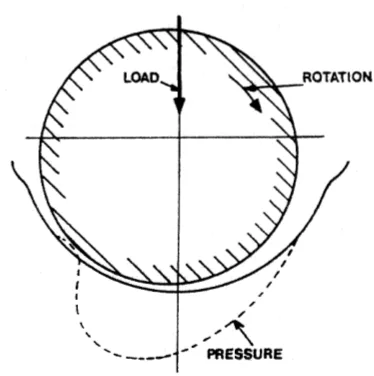
That single fact is the reason the tilting pad bearing exists.
4. Tilting pad bearings
Replacing the ineffective side portions of the journal with pads capable of carrying load considerably increases its capacity. Tilting pads, based on those developed by Michell for thrust blocks, are used for the purpose.
Each pad tilts as oil is delivered to it, so that a wedge of oil is formed. The three pressure wedges give a larger total support area than that obtained with a plain bearing.
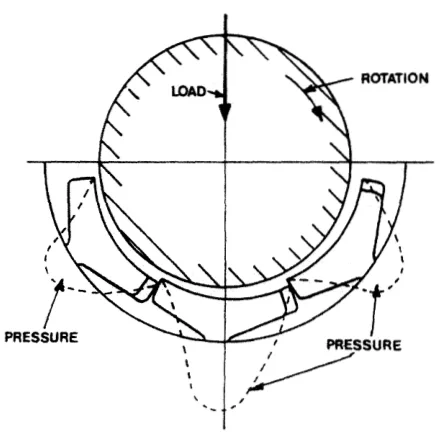
The tilt of the pads automatically adjusts to suit load, speed and oil viscosity. The wedge of oil gives a greater separation between shaft and bearing than does the oil film in a plain journal. The result is that the enhanced load capacity of a tilting pad design permits the use of shorter bearings, or fewer of them — which is why a modern shaft line can be shorter than an older one of the same power.
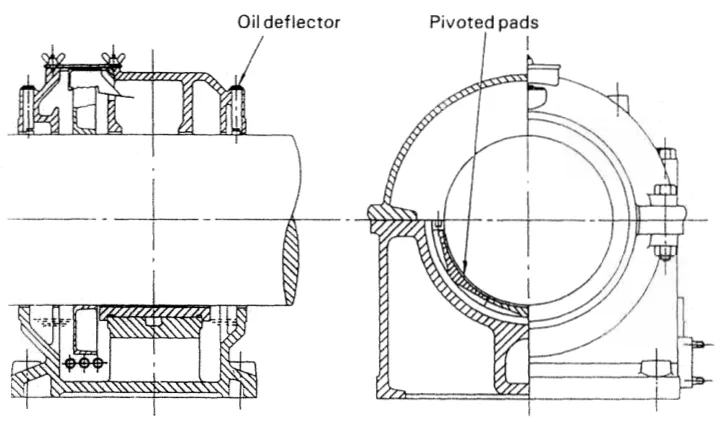
The pads are the same principle as the thrust pads in Chapter 3, and the same manufacturer's name appears on both.
5. Roller bearings
Roller bearings are supplied in sizes to suit shafts up to the largest diameter. Because the shaft line has flange couplings in it, the roller bearing races must be in two parts for fitting — a roller bearing cannot be threaded over a flange, so both the inner and the outer race are split.
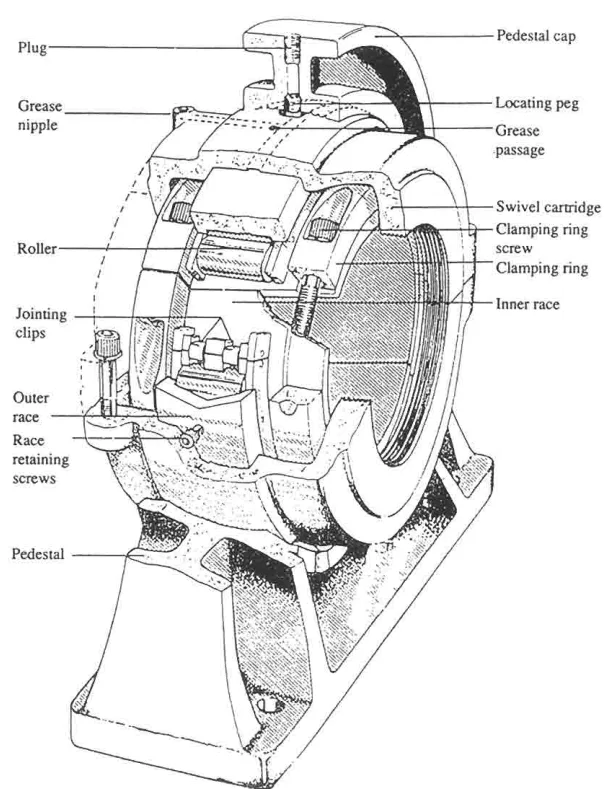
The length of shaft where the split roller bearing is to be fitted must be machined very accurately and with a good finish. The two halves of the inner and outer races are fitted and held with clamping rings.
The advantage of the roller bearing is the mirror image of the plain bearing's weakness:
| Plain or tilting pad journal | Roller | |
|---|---|---|
| Lubrication depends on speed? | Yes — the film has to be built up | No |
| Friction at low speed | High; metal-to-metal contact possible | Low at all speeds |
| Lubricant | Oil, circulated from a sump | Grease |
| Shaft centring | Clearance in the bearing | Negligible diametric clearance |
| Tolerance of dirt | Reasonable | Poor — must be sealed from dirt entry and grease escape |
| Overload | Tolerates it | Rapidly destroyed once overloaded |
Because roller bearings are not dependent on speed for effective lubrication, and friction is low at all speeds, they are suitable for steam turbine installations and in ships where slow steaming may be necessary. That last point is the important one today: a ship that spends long periods at reduced speed on a slow-steaming regime is a ship in which the oil film in a plain bearing is thinner than it was designed to be, and a roller bearing sidesteps the problem.
Where fitted, roller bearings are grease lubricated.
6. Only a bottom half — with one exception
Usually, for plain and tilting pad bearings, only a bottom half is provided, with the top acting purely as a cover.
The aftermost plummer block, however, always has a full bearing. This bearing, and any bearing in the forward end of the stern tube, may be subject to negative loading — that is, they may be carrying the shaft up rather than letting it rest down on them, because the propeller weight at the far end arches the shaft line. A bearing in that duty needs white metal top and bottom, and needs to be checked for contact on the top half as well as the bottom.
This is also why the forward bush of a stern tube is treated as a bearing that may or may not be doing work — on some installations it is not fitted at all, and on others it is the bearing that takes the negative load.
7. What the watchkeeper watches
Four things, in order of how quickly they change:
- Oil level and oil condition in each sump. A bearing with its oil drained, or with the sump full of water from a leaking cooling coil, is a bearing about to be destroyed.
- Cooling water flow. The sump cooling coil or chamber is fed from the sea water service; a choked coil shows up as a rising bearing temperature long before anything else does.
- Temperature. Bearing temperature is the direct indication of whether the film is there. A bearing that is running hotter than its neighbours on the same shaft is either wrongly loaded or losing its oil.
- Grease to the roller bearings. A grease-lubricated bearing that is not greased will run until it fails, and it will give little warning because grease does not leak away visibly.
The alignment side of the same question — what the bearing loads ought to be, and how they are measured by jacking — is in Chapter 11.
8. When a bearing is suspect
The bearings on the intermediate shafting are the easiest of all the shaft line bearings to inspect, because they are inside the ship and can be opened. If a bearing is found with:
- white metal wiped, cracked or carried round — it has been run without oil, or with the wrong load on it;
- a bright polished patch with no oil film staining — it has been running in contact;
- the top half showing contact — the shaft is being pushed up into it, and the alignment wants looking at rather than the bearing;
- oil in the sump emulsified or full of water — the cooling coil has failed, and the bearing has been running on an oil that will not form a film;
then the bearing is a symptom. The cause is either lubrication or alignment, and replacing the white metal without answering which of the two it was will produce the same bearing again.