Emergency Generator: Testing & Requirements
Two starting modes, the weekly/monthly test schedule, battery/hydraulic/automatic start procedures and the stored-energy rules.
Key Principles at a Glance 6 points
- The emergency generator provides power if the main generators fail, creating a dead ship/blackout condition; at least two modes of starting must be available, normally battery start and hydraulic (or pneumatic) start.
- PSC may detain a ship or allow time to correct the deficiency if the second mode of starting is not operating.
- The weekly test runs the emergency generator unloaded to check that it starts on battery mode; the hydraulic start is done monthly, and the automatic start is also tested monthly to confirm it starts and comes on load.
- The battery start procedure uses test mode (generator starts but does not come on load), checks voltage/frequency, runs 10–15 minutes checking exhaust temperature and sump level, then stops in manual mode.
- The hydraulic start uses the accumulator: check oil pressure, open the accumulator valve, push the spring-loaded valve to start, run and check, stop, then re-pressurise the accumulator and close the valve.
- Emergency generating sets must start readily at 0°C with stored energy for at least three consecutive starts plus a second source of energy for three more starts within 30 minutes; the emergency generator is located outside the machinery space and supplies steering gear, emergency fire and bilge pumps, watertight doors, fire-fighting, navigation/emergency lights, and communications/alarms.
1. Purpose & Starting Modes
- The emergency generator on a ship provides power in case the main generators fail, creating a dead ship / blackout condition.
- According to the general requirement, at least two modes of starting an emergency generator should be available.
- The two modes should be — battery start and hydraulic or pneumatic start.
- Port State Control (PSC) might detain a ship or provide some time to correct any deficiency found if the second mode of starting is not operating.
If the battery is flat, the generator must still start by hydraulic/pneumatic energy; if that fails, the battery remains. Two independent stored-energy sources guarantee the emergency generator can start when the ship has blacked out — which is exactly when it is needed.
2. Testing Schedule
Weekly:
- The testing of the ship's emergency generator is done every week as part of the weekly checks, running it unloaded to check if it starts on battery mode.
Monthly:
- The hydraulic start is done every month to ensure that it is working fine.
- Every month the automatic start of the generator is also done to check its automatic operation and to see whether it comes on load.
| Frequency | Test | Purpose |
|---|---|---|
| Weekly | Run unloaded, battery start | Confirm it starts on battery mode |
| Monthly | Hydraulic start | Confirm the hydraulic system works |
| Monthly | Automatic start | Confirm automatic operation and that it comes on load |
Weekly = battery start unloaded. Monthly = hydraulic start + automatic start on load. The weekly test proves the primary mode; the monthly tests prove the second mode and the automatic changeover.
3. Battery & Hydraulic Start Procedures
Procedure for Battery Start:
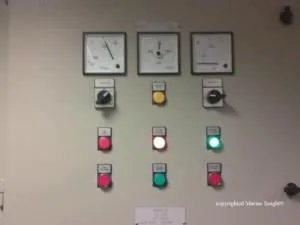
- Go to the emergency generator room and find the panel for the emergency generator.
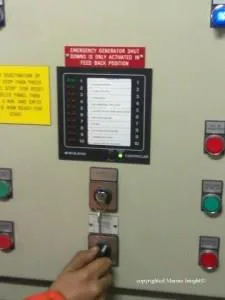
- Put the switch on test mode from automatic mode. The generator will start automatically but will not come on load.
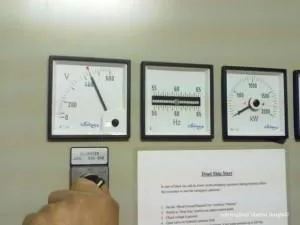
- Check voltage and frequency in the meter.
- Keep the generator running for 10–15 min and check the exhaust temperature and other parameters.
- Check the sump level.
- For stopping the generator, put the switch in manual and then stop the generator.
Procedure for Hydraulic Start:
- Put the switch in manual mode as above and check the pressure gauge for sufficient oil pressure.
- Open the valve from the accumulator to the generator.
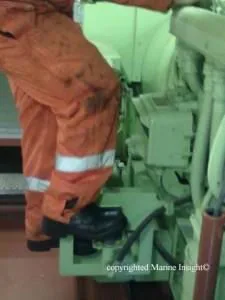
- Push the spring-loaded valve and the generator should start.
- Check voltage and frequency.
- Keep the generator running for 10–15 min and check the exhaust temperature and other parameters; check the sump level.
- For stopping, use the manual stop button from the panel.
- After stopping the generator, pressurise the hydraulic accumulator to the desired pressure.
- Close the valve from accumulator to generator.
After every hydraulic start, the accumulator must be re-pressurised and the supply valve closed — otherwise the second starting mode will not be ready next time. This is a common PSC finding.
4. Automatic Start, EGS Requirements & Power Supplied
Procedure for Automatic Start:
- A breaker connects the Emergency Switch Board (ESB) and the Main Switch Board (MSB), with an interlock so that the emergency generator and the main power cannot be supplied together.
- To test, simulate by opening the breaker from the tie line, which can be done from the MSB or the ESB panel.
- After opening the breaker, the emergency generator starts automatically on batteries and supplies essential power to the machinery and pumps connected to the ESB.
- To stop, the breaker is closed again and, due to the interlock, the generator becomes off load; put the switch to manual mode and press stop.
Requirements for Emergency Generating Sets:
- Requirements involve starting in cold condition and starting energy-storing devices.
- Emergency generating sets shall be capable of being readily started at a temperature of 0°C; if impracticable or lower temperatures are likely, heating arrangements shall be provided.
- Each automatically started set shall have approved starting devices with stored energy for at least three consecutive starts.
- A second source of energy shall be provided for an additional three starts within 30 min, unless manual starting is demonstrated to be effective.
- Stored energy maintenance: electrical and hydraulic systems from the ESB; compressed air from main/auxiliary receivers through a non-return valve, or an emergency air compressor (if electric) from the ESB; all starting/charging/energy-storing devices located in the emergency generator space.
- Where automatic starting is not required, manual starting is permissible (manual cranking, inertia starters, manually charged hydraulic accumulators, powder charge cartridges) where demonstrated effective.
Power Supplied by the Emergency Generator:
- On failure of the main power generation, the emergency/standby system ensures essential machinery keeps the ship operating; batteries, an emergency generator, or both may be used.
- Essential systems supplied include: (a) steering gear; (b) emergency bilge and fire pumps; (c) watertight doors; (d) fire-fighting system; (e) navigation lights and emergency lights; (f) communication and alarm system.
- The emergency generator is normally located outside the machinery space, to avoid situations where access to the engine room is not possible; a switchboard in the emergency generator room supplies the essential machinery.
Surveyors commonly ask: "How do you test the emergency generator?" Give the schedule (weekly battery unloaded; monthly hydraulic + automatic on load) and the procedures, then add the two starting modes, the 3+3 starts requirement and the essential services supplied.