
Steering Gear Rules — Main and Auxiliary Gear, Performance and Tests
What the rules demand of a steering gear, because the rules are what the machinery is designed around.
Key Principles at a Glance 6 points
- The rules are not good practice added on at the end: the performance figures, the duplication, the alarms, the alternative power supply and the test schedule are the specification the machinery is designed around.
- The main gear must put the rudder from 35° one side to 30° the other in not more than 28 seconds at maximum ahead service speed and deepest draught; the auxiliary gear must go 15° to 15° in not more than 60 seconds.
- Power operation is mandatory where the rudder stock is 120 mm diameter or more at the tiller, and where it exceeds 230 mm the gear must also have a guaranteed alternative power supply.
- A single failure must not take the steering out, so the power actuating system is duplicated and the duplication is automatic — which is why the bridge must be alarmed and the engine room must have local control.
- For oil tankers, chemical tankers and gas carriers of 10,000 GT and upwards, steering must be regained within 45 seconds of a single failure in one power actuating system, with automatic detection and isolation of the failed half.
- The tiller, the quadrant and the rudder stock are accepted as single points of failure, which is why they must be built strong enough that their failure is not credible.
1. What the steering gear has to do
The flag administration's regulations, the classification society rules, SOLAS, the maker's manual and the Chief Engineer's orders override these notes. The steering gear is the one piece of machinery whose failure leaves the ship unable to keep out of the way of anything. No gear is put into service, and no control is changed over, without the checks and the communication being done properly.
The steering gear turns the rudder, and the rudder turns the ship. That is the whole of its purpose, and everything about it follows from the fact that there is no second way to steer a conventional ship.
Two consequences shape the whole design.
The gear must work while it is being asked to work. Not after a changeover, not after an engineer has been called — immediately, on the bridge's command, with the ship moving at full speed in a seaway. A steering gear that works perfectly when the ship is alongside is worth nothing at all.
The gear must survive its own failures. Since the ship cannot steer without it, the gear is built so that a single failure — one pump, one pipe, one control system — does not take the whole thing out. That principle of single-failure survival is the reason the gear is duplicated, split, alarmed and automatically isolated, and it is the thread that runs through every chapter in this volume.
2. Where the rules come from
Four sources set the requirements, and they overlap:
| Source | What it sets |
|---|---|
| The flag administration | The national regulations — in the United Kingdom, the Department of Transport or the Coastguard, through the Merchant Shipping Construction and Survey Regulations |
| The classification society | The survey requirements, the materials, the strength calculations and the survey intervals — Lloyd's Register, the American Bureau of Shipping, Bureau Veritas and the others |
| The IMO and SOLAS | The international requirements, in particular SOLAS 1974 Chapter II-1 Regulation 29 |
| The maker | The detailed design, the pressures, the settings and the maintenance intervals |
The class rules and the flag regulations are what the ship is surveyed against. SOLAS is what the flag regulations are written to satisfy. The maker's manual is what the actual machine on board was built to, and it is the document the engineer works from day to day.
The reason the rules are so demanding on this particular item of machinery is a matter of history. Serious pollution casualties — the Amoco Cadiz above all — were attributed at least in part to the failure of a steering gear or its control system, and the international requirements were tightened as a result. The duplicated hydraulic circuits, the automatic isolation and the split-system arrangements described later in this volume all came out of that work.
3. Main gear and auxiliary gear
Every ship must have a main steering gear and an auxiliary steering gear, arranged so that the failure of one does not render the other inoperative.
That is the rule in its simplest form, and the rest of it is the list of circumstances in which the second gear may be dispensed with.
An auxiliary steering gear need not be fitted if the main steering gear has two or more identical power units and is arranged so that, after a single failure in its piping system or in one of its power units, steering capability can be maintained. To meet this alternative the gear has to comply with the main gear's operating conditions with any one of its power units out of operation.
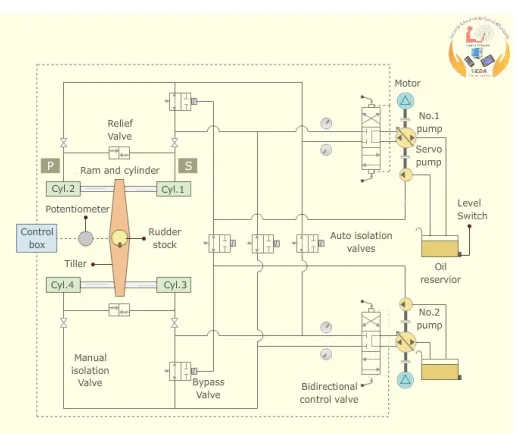
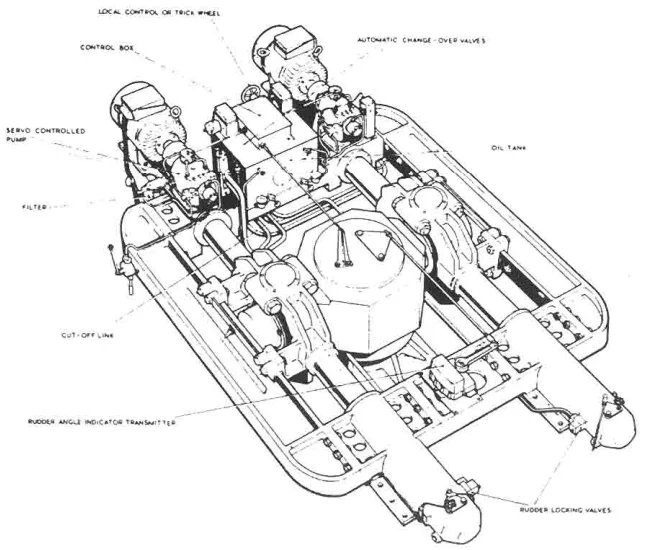
This is why so many ships have a single steering gear with two pumps rather than two separate gears. The duplication is inside the gear: two power units, two sets of piping, and a valve arrangement that lets one half be isolated and the other half carry on. It satisfies the rule and it is cheaper and simpler than a genuine second gear.
For large tankers, chemical tankers and gas carriers the provision of two or more identical power units for the main steering gear is mandatory. There is no option to fit an auxiliary gear instead. The reason is the pollution consequence of a tanker losing steerage, and the rule has been written to remove the possibility of the ship being built with only one means of steering.
4. The performance figures
These are the numbers the gear is designed to meet, and they are worth knowing exactly, because they are the figures the gear is tested against.
The main steering gear
The main steering gear must be able to steer the ship at maximum ahead service speed, and must be capable at that speed and at the ship's deepest service draught of putting the rudder from 35° on one side to 30° on the other side in not more than 28 seconds.
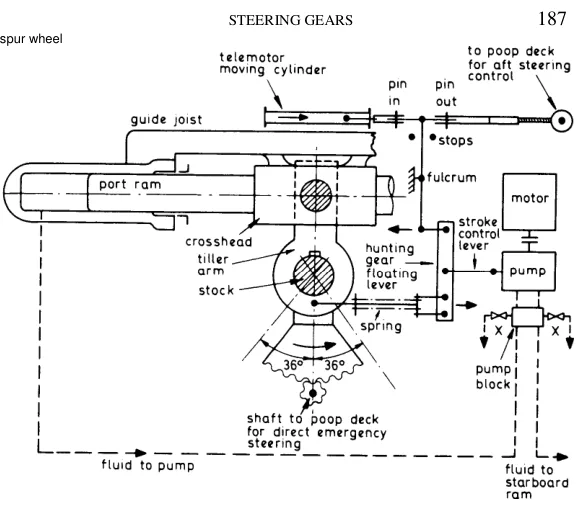
There is an apparent anomaly in that figure — 35° one way but only 30° the other — and it is worth understanding rather than memorising. The reason is that the feedback from the hunting gear shortens the variable delivery pump's stroke as the rudder approaches the ordered angle, so the last part of the movement is slower and it is difficult to judge exactly when the final position has been reached. The 30° is the allowance made for that. In practice the gear is timed between hard-over positions and the 28-second figure is the one that matters.
Where the rudder stock is required to be 120 mm diameter at the tiller, excluding any ice-strengthening allowance, the steering gear has to be power operated. Below that size a hand gear is permitted; above it, the rudder cannot be moved by hand at the speed the rules require and power operation is mandatory.
The auxiliary steering gear
The auxiliary steering gear must be capable of being brought speedily into operation, and must be able to put the rudder over from 15° on one side to 15° on the other side in not more than 60 seconds with the ship at its deepest service draught and running ahead at the greater of one half of the maximum service speed or 7 knots.
The two figures to hold on to are the pair: 35° to 30° in 28 seconds for the main gear, and 15° to 15° in 60 seconds for the auxiliary gear. The auxiliary gear is allowed to be slower and to work over a smaller angle because it is a fallback, not the normal means of steering.
Where the rudder stock is over 230 mm diameter at the tiller, excluding ice strengthening, the gear has to be power operated. This is the same threshold that triggers the alternative power supply requirement in section 6, and it is worth noticing that they are the same number: the size of rudder stock that cannot be moved by hand is the size of rudder stock that must have a guaranteed second source of power.
5. Control from the bridge and from the steering gear room
Steering gear control must be provided both on the bridge and in the steering gear room, for the main steering gear. The bridge controls the ship; the steering gear room controls the machine, and must be able to do so without the bridge.
Where the main steering gear comprises two or more identical power units, there must be two independent control systems, both operable from the bridge. This does not mean two steering wheels are required — it means two separate control channels, so that a failure in one does not remove the bridge's ability to steer. A single wheel feeding two independent transmission systems satisfies it.
When a hydraulic telemotor is used for the control system, a second independent system need not be fitted — except in the case of a tanker, chemical carrier or gas carrier of 10,000 gt and over. A telemotor is regarded as inherently reliable enough to stand alone on an ordinary ship, but not on a tanker, where the consequence of losing control is a pollution incident.
Auxiliary steering gear control must be arranged in the steering gear room, and where the auxiliary gear is power operated, control must also be arranged from the bridge and must be independent of the main steering gear control system. The auxiliary gear's bridge control must not share anything with the main gear's bridge control, or the failure that took out the main gear could take out the fallback too.
It must be possible, from within the steering gear room, to disconnect any control system operable from the bridge from the steering gear it serves. This is the provision that makes it safe to work on the gear while the bridge is still in control of the ship: the engineer in the flat can take the bridge's control off the machine and put it beyond use. It must also be possible to bring the system into operation from the bridge again.
6. Alarms, oil supplies and the alternative power supply
Power failure alarms
A power failure to any one of the steering gear power units, or to its control system, must result in an audible and visual alarm on the navigating bridge. The bridge must know that it has lost a power unit without having to be told by telephone.
The power units must be arranged to restart automatically when power is restored. A unit that has tripped on a supply failure and stays off until somebody presses a button is not acceptable: the supply comes back, and the gear must be whole again.
The hydraulic fluid
Hydraulic power systems must be provided with arrangements to maintain the cleanliness of the hydraulic fluid. Filters, in other words, and the means to keep them working — the pump inlet filter and the return-line silt filter described in Chapter 10.
A low level alarm must be fitted on each hydraulic fluid reservoir, giving an early audible and visual indication on the bridge and in the engine room of any hydraulic fluid leakage. The alarm is early by design: it is meant to warn of a leak while there is still oil to steer with, not to announce that the system is empty. On the split systems described in Chapter 11, the same alarm is the first of the three float switch levels.
Power operated steering gears require a storage tank arranged so that the hydraulic systems can be readily re-charged from a position within the steering gear compartment, and the tank must be of sufficient capacity to recharge at least one power actuating system. This is the tank the routine check list calls "one complete system replenishment". It exists so that a system that has been drained or topped up can be refilled without waiting for a delivery of oil to the ship.
The alternative power supply
Where the rudder stock is required to be over 230 mm diameter at the tiller, an alternative power supply capable of providing power to operate the rudder must be provided automatically within 45 seconds.
The alternative supply must feed:
- the power unit,
- its control system, and
- the rudder angle indicator.
It can come from the ship's emergency power supply, or from an independent source of power located within the steering compartment and dedicated to this purpose. Where the source is dedicated, it is sized for the steering gear alone and is not shared with anything else.
Its capacity must be at least 30 minutes for ships of 10,000 gt and over, and 10 minutes for other ships.
The 45-second figure is the one that matters operationally. It is the time allowed for the alternative supply to come on and for the ship to regain steerage, and it is the figure the three-monthly drill exists to prove. A supply that can be made available in 45 seconds but only by an engineer who happens to be in the right place has not met the requirement.
7. The tiller and the shock relief
Two structural requirements sit alongside the performance figures.
Two tillers, or their equivalent, are required, unless the working tiller is of special design and strength. The tiller is the last mechanical link between the gear and the rudder stock, and it is not practical to duplicate the stock. Where a single tiller is fitted it has to be built and proved as a component whose failure is not credible — which is why the fork type tiller and the heavy forged and cast steel tillers described in Chapter 3 are made the way they are.
Power operated gears must be fitted with a device to relieve shock. This is the shock relief valve requirement, and it exists because of what a heavy sea can do to a rudder. The relief valves and the way they protect the rudder stock are described in Chapter 11.
8. The remaining requirements
The rules that do not fit into the sections above are short but each of them has a reason.
Any lead connections — steam, hydraulic or electric — should be independent to the gear only. The steering gear's services must not be shared with anything else, so that a failure elsewhere cannot take the steering gear's power or control away with it.
Electric leads and fuses are to allow 100 per cent overload. The gear's electrical supply is sized to carry double its normal current, because the current that matters is the starting current of a pump motor or the current of a motor pulling a jammed gear.
Moving parts of steering gears should be guarded to avoid injury to personnel. This is the guarding requirement, and it is dealt with as a safety matter in Chapter 12.
Hydraulic systems should employ non-freezing fluid. A steering gear whose oil has frozen, or whose telemotor fluid has frozen, cannot steer. The fluid specification for the telemotor is given in Chapter 7.
A clear view from the steering position is required, and the wheel, the tell-tale indicators and the rudder movement must correspond in the correct amount and in the correct direction for the ship's head. This is the requirement that the rudder angle indicator is not decorative: it must read the true rudder angle, in the right sense. A rudder angle indicator that reads backwards or reads the wrong angle is worse than no indicator at all, because the helmsman will believe it.
Operating trials should be carried out on steering gears to ascertain the degree of action, the time of operation, the angle of heel at speeds, and so on. The trials are the demonstration that the figures in section 4 have been met on this ship, not on the drawing board.
It is worth noting the general expectation behind all of it: the steering gear should have a reasonably quick action, and an indication of full port to full starboard rudder movement should take place in about 30 seconds with the vessel at speed. That is the practical version of the 28-second rule, and it is the figure to hold in mind when watching a gear work.
9. The 45-second rule and the split system
For oil tankers, chemical tankers and gas carriers of 10,000 tons gross tonnage and upwards, the requirements go further than the general rule.
The main steering gear must be arranged so that, in the event of loss of steering capability due to a single failure in any part of one of the power actuating systems of the main steering gear — excluding the tiller, the quadrant or components serving the same purpose, or the seizure of the rudder actuators — steering capability is regained in not more than 45 seconds after the loss of one power actuating system.
The exclusions are as important as the rule. The tiller, the quadrant and the rudder stock itself are accepted as single points of failure, which is why they must be built strong enough that their failure is not credible. What the rule demands is that the power actuating system — the pumps, the pipes, the valves, the cylinders — can lose one of its halves and still steer within 45 seconds.
The main steering gear must comprise either:
- two independent and separate power actuating systems, each capable of meeting the requirements; or
- at least two identical power actuating systems which, acting simultaneously in normal operation, are capable of meeting the requirements.
Where necessary to comply, interconnection of hydraulic power actuating systems must be provided, and loss of hydraulic fluid from one system must be capable of being detected and the defective system automatically isolated so that the other actuating system or systems remain fully operational.
That last sentence is the legal origin of the automatic fail-safe split system. The detection is by float switch; the isolation is by solenoid-operated valves; and the whole thing happens without the bridge doing anything. The machinery that does it is described in Chapter 11.
Steering gears other than of the hydraulic type must achieve equivalent standards. An all-electric gear is judged against the same requirement, not against a softer one.
For tankers, chemical tankers and gas carriers of 10,000 gt and upwards but of less than 100,000 tons deadweight, other solutions to an equivalent standard may be acceptable. These requirements have a tendency to spread to other classes of ship over time, and the engineer is well advised to know them whatever ship they are on.
10. Testing and drills
The rules do not stop at requiring the gear to be capable. They require it to be demonstrated capable, on a schedule, and the demonstration to be recorded.
The pre-departure test
Except in the case of ships regularly engaged on short voyages, the steering gear should be thoroughly checked and tested within 12 hours before departure. On short-voyage ships the test is carried out at least once a week instead.
The test is required to cover the gear itself — main and auxiliary — together with the remote control systems, the bridge steering positions, the emergency power supply, the rudder angle indicators checked against the actual rudder position, the control system and power unit failure alarms, and the automatic isolating arrangements. It must include full rudder movement, a visual inspection of the gear and its connecting linkage, and the operation of the communication between the bridge and the steering gear compartment. The itemised list is in Chapter 9.
The point of the requirement is concentrated in three of those items. The alarms, the emergency power supply and the automatic isolating arrangements are the features that make the gear single-failure proof, and an untested automatic system is an assumption rather than a protection.
The three-monthly drill
Every three months an emergency steering drill should be held, covering direct control from within the steering gear compartment, communication with the navigating bridge, and the operation of alternative power supplies as applicable.
The drill is the only way the emergency arrangements are ever exercised. The changeover pin, the trick wheel, the hand pump and the after steering position all sit unused for months at a time, and a drill that finds one of them stiff, missing or wrongly rigged has done its job.
Records, familiarity and instructions
All officers are required to be familiar with the steering gear and the changeover arrangements. Instructions for changeover must be displayed in the steering compartment and on the bridge. The various tests and checks should be logged.
The instructions are displayed in both places because in an emergency the person who has to make the changeover may be the officer on the bridge or the engineer in the flat, and neither will have time to look for a manual. The responsibilities of the Master and Chief Engineer, and the practice of logging, are set out in Chapter 9, together with the itemised test procedure, the routine check list and the safe isolation procedure.
11. What follows from all this
The rules in this chapter can be read as a list of requirements, or they can be read as a description of the machine. Read the second way, they say:
- The gear must work at full speed with a full rudder — so it must be powerful, and it must be timed.
- A single failure must not take it out — so it must be duplicated, and the duplication must be automatic.
- The bridge must know when something has failed — so it must be alarmed.
- The gear must be steerable from the engine room — so it must have local control and a means of isolating the bridge.
- The loss must not be allowed to become a casualty — so it must have an alternative power supply, and the fluid must be kept clean and watched.
- All of it must be proved — so it must be tested before departure and drilled every three months.
The chapters that follow describe the machinery that satisfies each of those sentences.