
Hatch Covers and Cargo Access — Types, Seals, Cleats and Surveys
The hatch cover is not strictly a machine, but it is a mechanism with hydraulics, seals, cleats and a maintenance burden that falls on the engine department.
Key Principles at a Glance 5 points
- The hatch cover is in an engineering volume because its periodic maintenance may fall to the engine department, and lack of it causes deterioration, costly port delays and cargo claims.
- The seal is compressed, not crushed: overtightening a cleat takes the gasket past its elastic limit and the cover then leaks for the rest of the seal's life.
- Standard rubber gaskets last four to five years, and quick-acting cleats carry neoprene washers that lose their elasticity — the washer, not the cleat, is the wearing part.
- A new seal is cut about 3 per cent long, joints are cut square and glued on three sides, the minimum rubber insert is 500 mm, and the compression is measured and recorded at fitting.
- An annual survey is done with the hull survey, and a special survey at a maximum interval of five years requires a hose test.
1. Why this is in an engineering volume
The seal is compressed, not crushed. Overtightening a cleat does not make a cover tighter — it takes the gasket past its elastic limit, and the cover then leaks for the rest of the seal's life. The seal is also what makes the cargo space weathertight, which is a cargo claim question as much as an engineering one.
Although not strictly a machinery item, the mechanical complexity of present-day cargo hatch covers — whose periodic maintenance may fall in the domain of the ship's Engineering Department — warrants some mention.
The reason it matters commercially is stated plainly: the lack of proper maintenance causes a steady deterioration in performance, and the possibility of costly delays in port, when hatch covers are not able to be operated. That is followed by the costs of claims and port delays. The manual gives the routine maintenance due, which includes the greasing, care of wire ropes and other fittings, and the maintenance of the hydraulic or other system which operates them.
2. The types
Many types of mechanically operated hatch covers can now be found at sea. The principal ones are:
| Operating mode | Type |
|---|---|
| Rolling and tipping | single pull |
| Rolling | end rolling; side rolling; lift and roll ('piggy-back'); rolltite |
| Roll stowing | — |
| Folding | hydraulic folding; wire-operated folding |
| Sliding / nesting | direct pull; tween-deck sliding |
3. The single pull cover
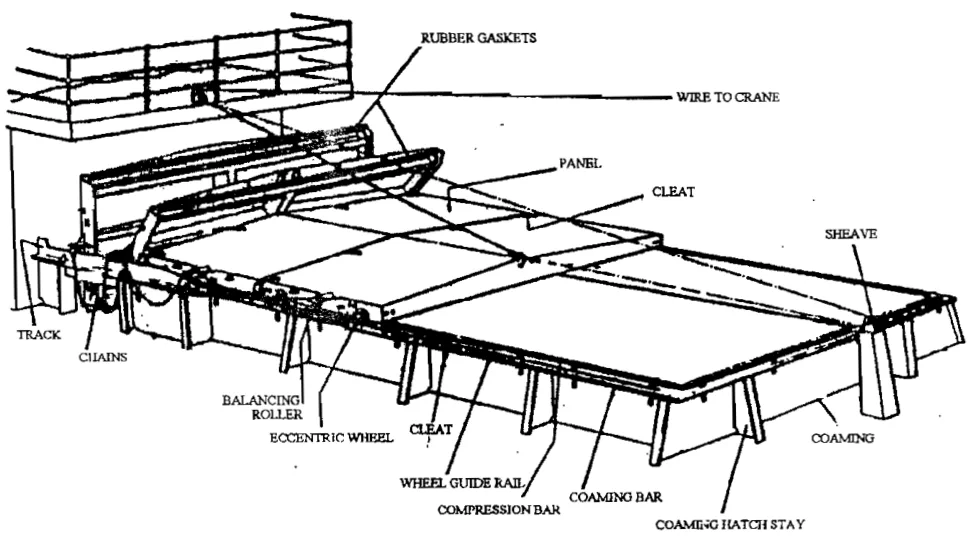
The single pull hatch cover consists of a number of transverse panels which span the hatchway and are linked together by chains.
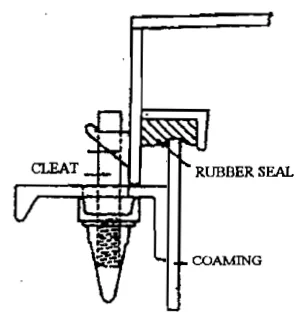
How it seals. In the closed position, the panel sides sit firmly on a horizontal steel bar attached to the top of the hatch coaming. Just inside the side plates is a rubber gasket housed in a channel on the underside of the hatch cover, and it rests on a steel compression bar to form a weathertight seal. When closed, the covers are held on to the seals by a series of peripheral cleats. Rollers are arranged on the sides of the covers to facilitate opening and closing.
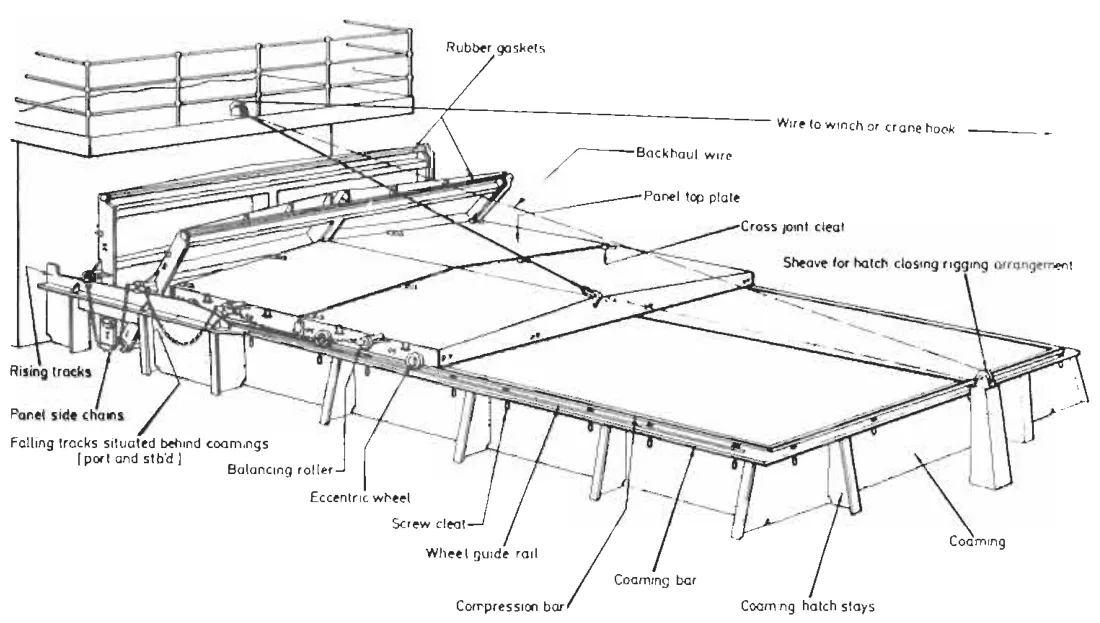
How it opens. To open a single pull cover:
- the securing cleats are first freed;
- each panel is raised off its compression bars by hydraulic jacks;
- the cover wheels, which are arranged on eccentrics, are rotated through 180° and locked into position;
- the jacks are then removed, and the cover can be pulled backwards or forwards as required.
The rail arrangement on both sides at the end of the hatch coaming is designed to turn the panels so that they are left stacked upright in the space provided.
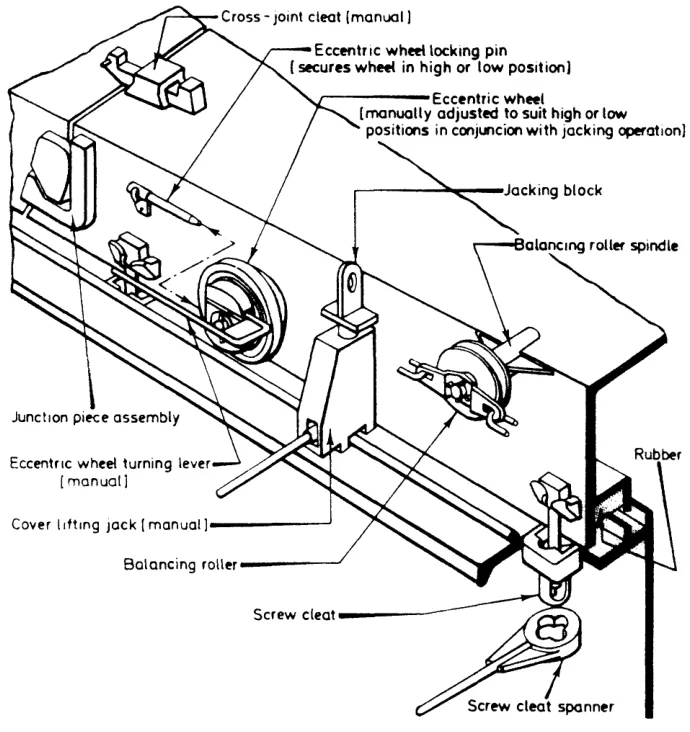
An alternative arrangement uses a fixed chain drive on the periphery of the hatch, complete with its own electric or hydraulic motor.
4. Folding covers
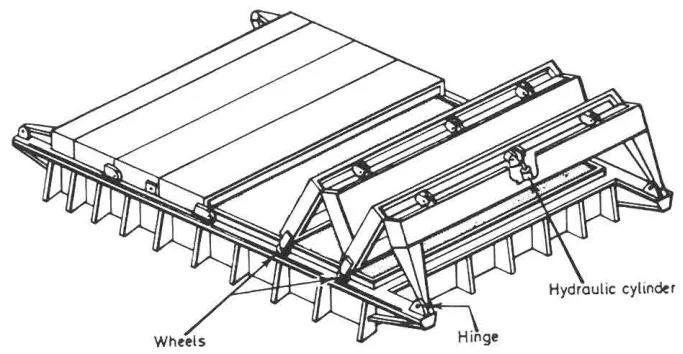
Covers of the folding type are hinged together and arranged to be opened by a wire pull or operated hydraulically.
The multi-panel, end-folding, hydraulically operated cover has a part panel at each end with hinged arms. As the system is acted upon by the hydraulic cylinder, they fold and travel on the wheels to stow on the end extensions of the rails. Other folding covers may have fewer panels but work in a similar way, with hydraulic cylinders supplying the effort.
The hydraulic system. The hydraulic system for hatch covers may be based on a fixed displacement pump, the output from which is bypassed until required for cylinder operation. When pump output is channelled to the cylinders, system pressure and pump motor load rise. Protection is provided by the system relief valve and motor protective devices. This is the constant-delivery arrangement described in Chapter 3, and it is why a hatch cover pump is heard to load up when the covers are moved.
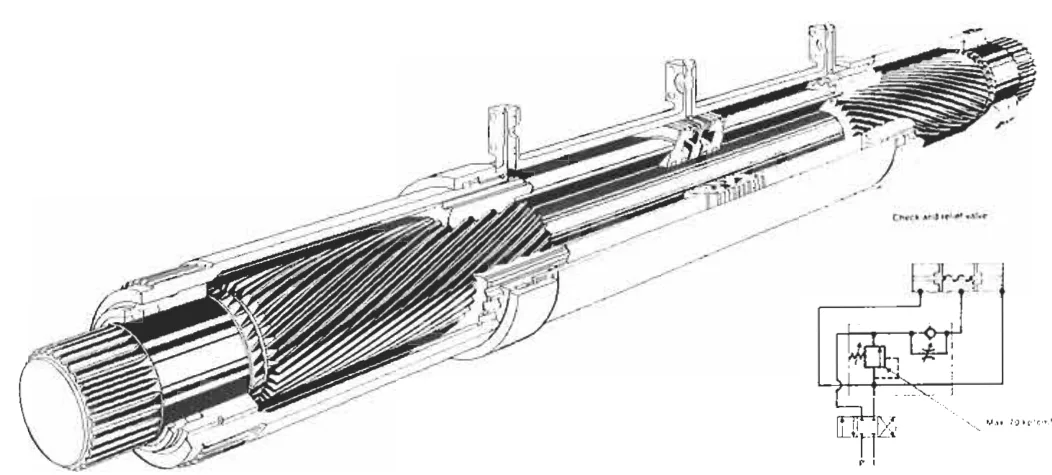
The Navire Hydratorque hinge. An interesting hydraulic arrangement is the Navire Hydratorque hinge. It incorporates a pair of helixes attached to two pistons. When hydraulic pressure is applied between the two pistons it forces them and the helixes apart, thus causing rotation through the mating helixes and operation of the hinge. Pressure applied to the outside of the pistons creates a torque in the opposite direction. A rotary actuator and a hinge in one component.
5. Seals, cleats and compression
The seal is the part of a hatch cover that is most easily ruined by well-meant attention.
Do not overtighten the cleats. The seal should be compressed but not beyond the elastic limit of the gasket material.
Life. Standard rubber gaskets can be expected to last from four to five years of normal service.
In freezing conditions, special grease or commercial glycerine should be spread over the surface of all gaskets to prevent them from sticking to their compression bars.
Quick-acting cleats are fitted with thick neoprene washers arranged to exert the correct degree of compression. After a time these lose their elasticity and the cleat must be adjusted or replaced — the washer, not the cleat, is the wearing part, and it is the reason a cleat that was correctly set when new can be over-compressing the seal a few years later.
6. Replacing a seal
Rubber seals are normally expected to last for at least four to five years, but may fail due to neglect or damage by wrong operation, by painting over them, or even by over-compression.
If the seal channels are corroded, this should be rectified before trying to fit a new seal, which may not seat properly. Usually the channels would need to be grit-blasted and coated with a zinc based coating, by an approved workshop, before fitting a new seal.
The fitting rules are worth keeping together:
- The seal is cut to the required lengths keeping an additional allowance of about 3 per cent to take care of shrinkage or unevenness.
- Joints must be cut square and smooth, and glued on three sides.
- Sharp tools should never be used, which could damage the seal rubber.
- Pay particular attention to the corners, which are prone to leakage.
- Minimum length of rubber insert to be 500 mm.
- When replacing the seal rubber, do so completely, since parts of old rubber may not match the thickness of the new one.
- To take care of friction between the compression bar and the seal, a special grease is usually applied on the seal rubber.
- The compression bars are to be chipped, ground and painted before fitting a new seal, in order to prevent damage to the new seal from any rough surfaces.
- Seal compression is to be measured and noted down at the time of fitting of the new seal.
That last item is the one that makes the next survey possible. Without a record of the compression at fitting, there is nothing to compare the present condition against.
7. Maintenance
Hatch cover equipment, like the other deck machinery, has to exist in a very hostile environment, and the importance of regular maintenance cannot be over-emphasised:
- Drive boxes and electrical enclosures should be checked regularly for watertightness.
- Drive chains, trolleys and adjusting devices such as peripheral and cross-joint cleats should be cleaned and greased regularly.
- Seals, compression bars and coamings should be inspected and cleaned at each port.
- Drain channels should be cleared regularly.
8. Surveys
An annual survey is done along with the hull survey. A special survey is required at a maximum interval of five years, and this requires a hose test.
Alongside the class survey sits the load line survey item, under which gasketted steel hatch covers are to be tested, or alternatively to be proven tight.