
Mooring Equipment — Winches, Capstans, Wire Rope and Tension Control
Mooring is the duty that has changed most, from a job for a dozen men on the forecastle to a job for two men and a set of automatic winches.
Key Principles at a Glance 5 points
- A plain mooring winch cannot pay out wire unless the brake is overhauled, or recover it unless manually operated, so wires become slack — which is the whole reason the automatic winch exists.
- An automatic winch renders at a pre-set maximum tension and recovers at a lower one; the tension band between them is a deliberate compromise, because narrowing it causes hunting of the controls.
- Automatic mooring winches are spur geared because spur gearing improves the backward efficiency of the train for rendering; worm geared automatic winches are uncommon for that reason.
- Wire rope is limited to 140 mm circumference by what the crew can handle, and in multi-layer stowage the top tensioned layer cuts into the layers beneath unless a divided barrel is used.
- The capstan is controlled at the machine and its safety depends on the rope being tended by hand, which is why nobody stands in the bight of a rope on a capstan.
1. Full load duties
The mooring wire is a spring. A winch that takes a strain and holds it rigidly will break the wire; a winch that renders at a set tension will not. Everything about automatic mooring winch design follows from that one fact.
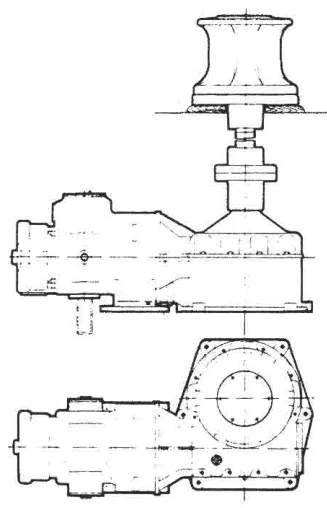
Full load duties of warping capstans and mooring winches vary between 3 and 30 tonnes at 0.3 to 0.6 m/s, and twice full load speed is normally provided for recovering slack lines.
2. Wire rope and its problems
The size of wire rope used on mooring winch barrels is governed by the weight of wire manageable by the crew; this is currently accepted as 140 mm circumference maximum.
The basic problems associated with the use of wire ropes are that:
- they are difficult to handle,
- they do not float, and
- when used in multi-layers, due to inadequate spooling, the top tensioned layer cuts down into the underlying layers, causing damage.
To counteract the multi-layer problem, a divided barrel can be used, such that the wire may be stored on one portion and a single layer of wire transferred to the second portion when tensioned. Only one layer is ever under load, and the damage to the layers beneath cannot happen.
Synthetic ropes — low density, high breaking strength — of polypropylene, nylon or terylene offer certain advantages over wire. Their main disadvantage is a tendency to fuse if scrubbed against itself or the barrel, which is a handling discipline as much as a material one.
3. Mooring winches
Mooring winches provide the facility for tensioning the wire up to the stalling capacity of the winch, usually 1.5 times full load; thereafter the load is held by the motor brake, or by the barrel brake when the power is shut off.
The limitation of a plain mooring winch is stated exactly by the source and is worth reading twice: the winch cannot pay out wire unless the brake is overhauled, or recover wire unless manually operated — thus wires may become slack. That is the whole reason the automatic winch exists.
4. Automatic mooring winches
Automatic mooring winches provide the manual control previously described, but in addition incorporate control features such that, in the automatic setting:
- the winch may be overhauled and wire is paid off the barrel at a pre-determined maximum tension, and
- wire is recovered at a lower tension should it tend to become slack.
The tension band. There is therefore a certain range of tension, associated with each step of automatic control, when the wire is stationary. It is not practical to reduce this range to the minimum possible, as this results in hunting of the controls — the winch would be paying out and recovering continuously against itself. The band is a deliberate design compromise, not a fault.
Why the automatic controls exist. It should be noted that the principal reason for incorporating automatic controls with the features described is:
- to limit the render value of the winch and avoid broken wires, and
- to prevent mooring wires becoming slack.
Those two purposes pull in opposite directions — one wants the winch to let go, the other wants it to hold — and the tension band is where they are reconciled.
How the winch senses load. Load sensing devices are used with automatic mooring winches. Spring-loaded gearwheels and torsion bars are widely used with steam and electric winches, and fluid pressure sensing, either steam or hydraulic oil pressure, is also used where appropriate.
5. Control of mooring winches
Mooring winches are usually controlled at the local position, that is, the winch itself. For vessels of unusually large beam, or where docking operations are a frequent occurrence — in ships regularly traversing the St. Lawrence Seaway, for example — remote and shipside controllers are of great advantage.
As mooring techniques vary widely, the position and type of control must be engineered to suit the application. It is considered, especially on vessels where mooring lines may be long and ship position critical, that the greatest asset to the operator is knowledge of the wire tensions existing during the mooring operation, coupled with an indication of the amount of wire paid off the barrel. It is quite feasible to record these at a central position, and mooring lines would then only have to be adjusted periodically as indicated by the recording instruments.
This is the same principle as the remote windlass indication in Chapter 4: where the operator cannot see the load, the load has to be brought to him as a reading.
6. Gearing
The majority of automatic mooring winches are spur geared, and the reason is specific: spur gearing improves the backward efficiency of the gear train for rendering. When the winch is overhauled and pays out wire, the gear train is being driven backwards from the barrel, and a spur train does that with far less loss than a worm.
The gearing and bearings are totally enclosed and lubricated from the oil sump.
On larger mooring winches where a barrel brake is fitted, it is now common practice to design the brake to withstand the breaking strength of the mooring wire.
Worm geared automatic mooring winches are uncommon. The reason is that the multi-start feature required to improve gear efficiency reduces the main advantage of the worm gear, which is the high gear ratio. The same feature that makes a worm gear useful — the high reduction in one step — is what makes it unsuitable for a winch that has to render.
7. The capstan
The warping capstan is the simple member of the family: a vertical barrel driven through gearing, used for taking a rope or wire in any direction without the need to spool it. It is used for warping the ship along a quay, for heaving a line that is not on a drum, and for the light line duties for which a winch drum is unsuited.
Its duties are included in the figures at the head of this chapter. The capstan is normally controlled at the machine, and its safety depends on the rope being tended by hand — which is why the standing instruction is always that nobody stands in the bight of a rope on a capstan.