Cargo Winches and Derricks — Duties, Union Purchase and Slewing Rigs
The winch and derrick combination is the older half of cargo handling, and it is still the arrangement on a great many ships.
Key Principles at a Glance 5 points
- A cargo winch has seven requirements, of which taking up slack without undue stress, dropping the load smartly and accelerating well are what separate a good winch from an adequate one.
- An electrically driven winch must additionally refuse to let the load run back if the supply fails, and refuse to restart when it is restored until the controller is back in the correct position.
- Cycle time is shortened by high speeds — about 0.45 m/s at full load to 1.75 m/s light, with the power required varying from 40 kW at 7 tonnes to 20 kW at 3 tonnes.
- The Union Purchase rig needs only two winches per pair of derricks and has a faster cycle, but the load it can lift is less than the derricks' safe working load because an indirect lift is used.
- A slewing derrick needs three winches per derrick — hoist, luff and slew — but it does not interrupt cargo work for adjustment and can place cargo more accurately in the hold.
1. The duty of a deck winch
A cargo winch is judged on its cycle time and on what it does when the power fails. It has to lift, hold, lower, take up slack, drop the load smartly, stall without damage and accelerate well — and if it is electrically driven it must also refuse to drop the load when the supply goes.
The duty of a deck winch is to lift and lower a load by means of a fixed rope on a barrel, or by means of whipping the load on the warp ends, to top or luff the derricks, and to warp the ship.
2. The seven requirements
In fulfilling those duties it is essential that the winch should be capable of carrying out the following:
- lift the load at suitable speeds;
- hold the load from running back;
- lower the load under control;
- take up the slack on the slings without undue stress;
- drop the load smartly on the skids by answering the operator's application without delay;
- allow the winch to be stalled when overloaded, and to start up again automatically when the stress is reduced;
- have good acceleration and retardation.
Requirements 4, 5 and 7 are the ones that separate a good cargo winch from a merely adequate one. Taking up slack without shock, dropping the load the instant the operator moves his lever, and doing both with fast acceleration is what shortens the cycle.
3. The extra requirements when electrically driven
In addition, when the winch is electrically driven the requirements are:
- prevent the load being lowered at a speed which will damage the motor armature;
- stop the load running back should the power supply fail;
- prevent the winch starting up again when the power is restored until the controller has been turned to the correct position.
The third of these is the one most often overlooked. A winch that restarts by itself when the supply returns, with a load on the hook and nobody at the control, is a serious hazard.
4. Cargo winches — numbers, capacity and speeds
It is usual to select the number and capacity of winches and to group them in such a way that, within practical limits, all hatches can be worked simultaneously and, having regard to their size and the hold capacity beneath them, work at each can be carried out in the same period.
Reduction of the cycle time during cargo handling is best accomplished by the use of equipment offering high speeds — say from 0.45 m/s at full load to 1.75 m/s light, the power required varying from 40 kW at 7 tonnes to 20 kW at 3 tonnes. Which drives deliver that wide speed range, and why they can, is in Chapter 2 section 9. The pole-change induction motor is the commonest answer and gives two or more discrete speeds of operation in fixed gear, with a mechanical change speed gear normally provided for half load conditions.
Fail-safe. Normally all modern cargo handling machinery of the electric or electro-hydraulic type is designed to fail safe. A typical application of this is the automatic application of the disc brake on an electric driving motor should the supply fail, or when the controller is returned to the OFF position.
5. The steam winch
Most ships no longer have one, but the steam winch is the machine the modern winch descends from, and its construction explains why a winch is laid out the way it is.
A steam winch consists of two vertical side frames to which the steam cylinders are bolted. These frames house bearings for the shafts.
- The barrel shaft is fitted with the barrel, two warping ends and the main double helical toothed wheel.
- The second motion shaft lies parallel with the barrel shaft and has a pinion meshing with the main wheel, clutched to it. At the other end of this shaft a second gear wheel is fixed rigidly to it. The drums on this shaft are used for light cargo work.
- The crankshaft (the power shaft) lies parallel with the second motion shaft and has two pinions meshed to it — one meshes with the second wheel and the other with the main wheel. The connecting rods are connected to cranks on the ends of the crankshaft, and this gives the drive.
The winch has single and double purchase: the drive can be through the crankshaft and then through the second motion shaft to the barrel shaft for double purchase, or through the crankshaft directly to the barrel shaft for single purchase, by manipulating the clutches.
That is the origin of the two-speed winch, and of the arrangement in which the barrel, the warping ends and the gear train all sit on parallel shafts in a pair of side frames.
6. Derricks — fixed outreach and the Union Purchase rig
Most older ships have winches in conjunction with derricks for working cargo. The derricks may be arranged for fixed outreach working, or slewing derricks may be fitted.
A fixed outreach system uses two derricks, one topped to a position over the ship's side and the other to a position over the hold. The usual arrangement adopted is known as the Union Purchase rig.
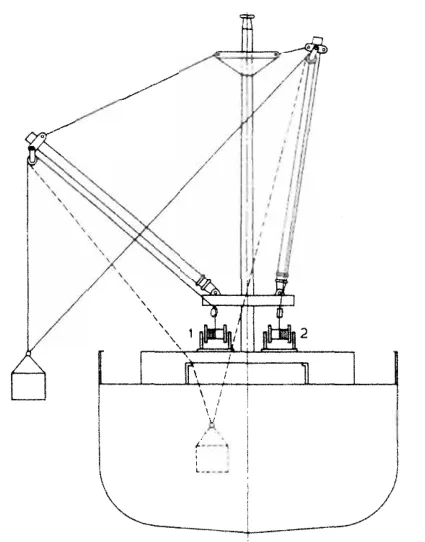
The disadvantages of the fixed outreach system are that:
- if the outreach requires adjustment, cargo work must be interrupted;
- the load that can be lifted is less than the safe working load of the derricks, since an indirect lift is used; and
- considerable time and manpower is required to prepare a ship for cargo working.
The advantages are that:
- only two winches are required for each pair of derricks, and
- it has a faster cycle time than the slewing derrick system.
7. Slewing derricks
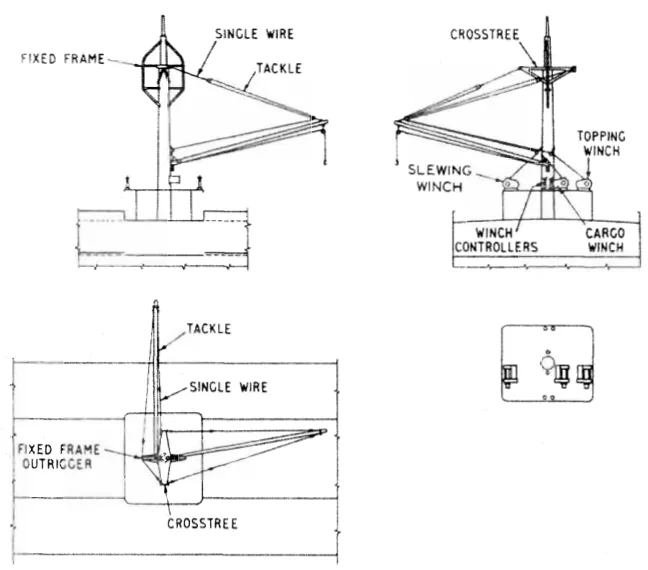
The slewing derrick system has the advantages that:
- there is no interruption in cargo work for adjustments, and
- cargo can be more accurately placed in the hold.
The cost of those advantages is stated plainly in the source: three winches are required for each derrick, to hoist, luff and slew.
8. Heavy lift
For the handling of heavy loads, although this may be accomplished with conventional derrick systems using multi-part tackle, specially designed heavy lift equipment is available. The winches used with these heavy lift systems may have to be specially designed to fit in with the mast arrangements, and the winch duty pull may be as high as 30 tonne.
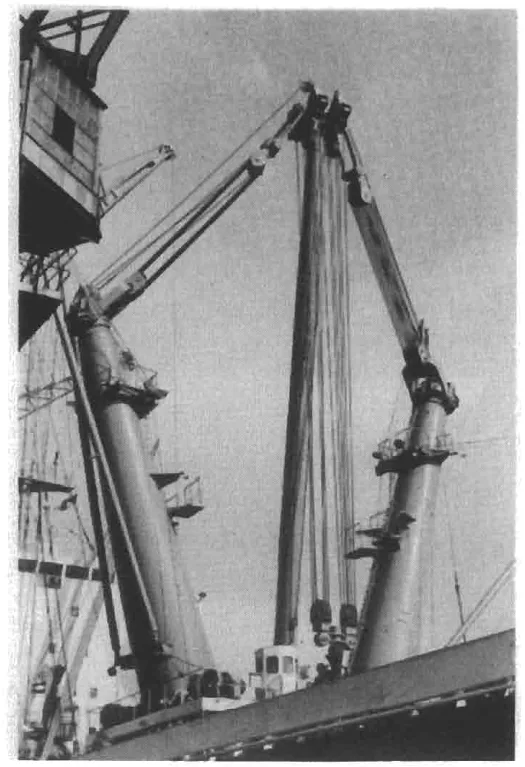
Ships specialising in carrying very heavy loads are invariably equipped with special derrick systems such as the Stulken, which are capable of lifting loads of up to 500 tonnes.