
Anchor Handling and the Windlass — Duties, Brake and Slipping Clutch
The anchor windlass is the piece of deck machinery whose failure has the most immediate consequences, because it is the machine that has to hold a ship off a lee shore.
Key Principles at a Glance 5 points
- The windlass has three duties: control the running cable when letting go, heave a specified weight at a specified speed, and hold the cable at not less than 40 per cent of its breaking strength.
- The brake is sized by the letting-go duty, which is done with the cable lifter disconnected from the gearing, at average cable speeds of 5 to 7 m/s.
- The gearing is designed with an adequate margin on strength rather than on wear, because the duty is intermittent and heavy rather than continuous.
- On a modern windlass the cable lifter brake is spring applied and hydraulically released — the fail-safe direction — which is what makes remote control acceptable at all.
- The slipping clutch between the motors and the gearing exists to stop the inertia of the rotating parts being carried into the gear train when the anchor comes hard against the hawse.
1. The three duties
The windlass is required for intermittent duty only, so its gearing is designed with an adequate margin on strength rather than on wear. That is a statement about how it is expected to be treated — occasional, heavy, and at low speed — and it is not an invitation to run it continuously.
The efficient working of the anchor windlass is essential to the safety of the ship. An anchor windlass can expect to fulfil the following:
1. Control the running anchor and cable when letting go. The windlass cable lifter brakes must be able to control the running anchor and cable when the cable lifter is disconnected from the gearing, as it is when letting go. Average cable speeds vary between 5 and 7 m/s during this operation. This is the duty that sizes the brake, and it is done with the gearing out of the picture entirely.
2. Heave a certain weight of cable at a specified speed. This full load duty of the windlass varies and may be as high as 70 tonne; figures between 20 and 40 tonne are not unusual. Commonly the load is between 4 and 6 times the weight of one anchor. The speed of haul is at least 9 m/min and up to 15 m/min.
3. Hold the cable. The braking effort obtained at the cable lifter must be at least equal to 40 per cent of the breaking strength of the cable.
Most anchor handling equipment incorporates warpends for mooring purposes, and light line speeds of up to 0.75 to 1.0 m/s are required at them.
2. Mooring windlasses
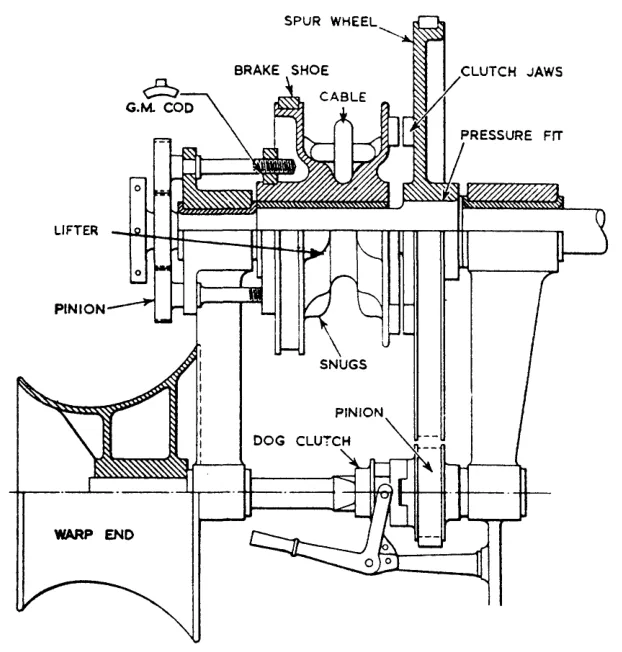
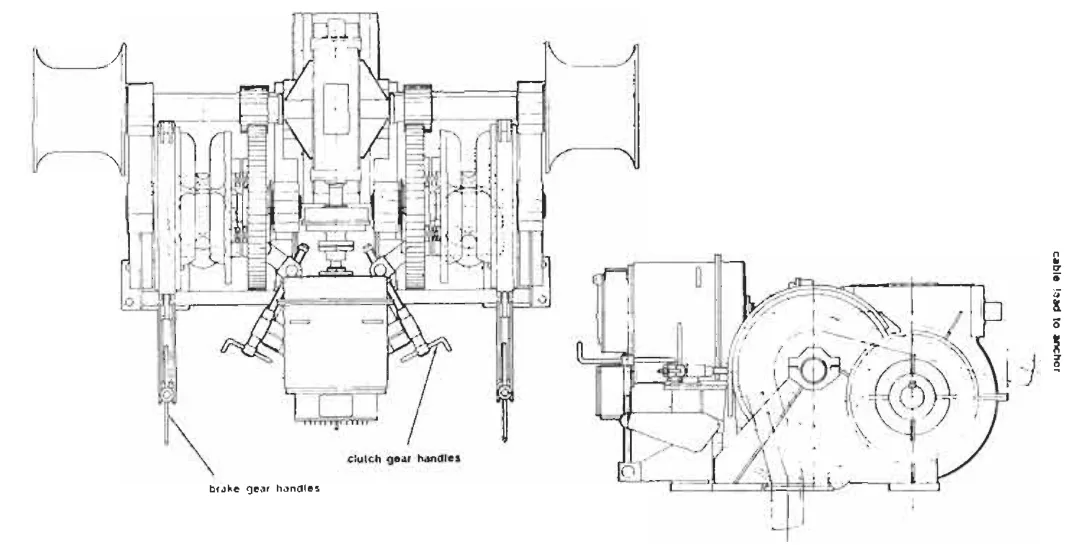
This equipment is self-contained, and normally one electric or hydraulic motor drives two cable lifters and two warpends. The warpends may not be declutchable, and so will rotate when the cable lifters are engaged — a point worth remembering before standing next to one.
There is some variation in the detailed design of cable lifters and in their drives. Because of the low speed of rotation required of the cable lifter whilst heaving anchor — 3 to 5 rev/min — a high gear reduction is needed when the windlass is driven by a high-speed electric or hydraulic motor. This is generally obtained by using a high ratio worm gear followed by a single step of spur gears between the warpend shaft and the cable lifters. Alternatively, multi-steps of spur gear are used.
3. Anchor capstans
With this type of equipment the driving machinery is situated below the deck and the cable lifters are mounted horizontally, being driven by vertical shafts. A capstan barrel is mounted above the cable lifter, although with larger equipment — above 76 mm diameter cable — it is usual to have only the cable lifter, the capstan barrel being mounted on a separate shaft.
The advantage of the arrangement is that the gearing and the motor are below deck and out of the weather. The disadvantage is that everything depends on the vertical shaft and its bearings, which are neither easy to inspect nor easy to replace.
4. Winch windlasses
This arrangement utilises a forward mooring winch to drive a windlass unit, thus reducing the number of prime movers required.
The port and starboard units are normally interconnected, both mechanically and for power, in order to provide a stand-by drive and to utilise the power of both winches on the windlass should this be required. It is an economical arrangement, and the interconnection is the whole of its value — without it there is no stand-by.
5. Control of windlasses
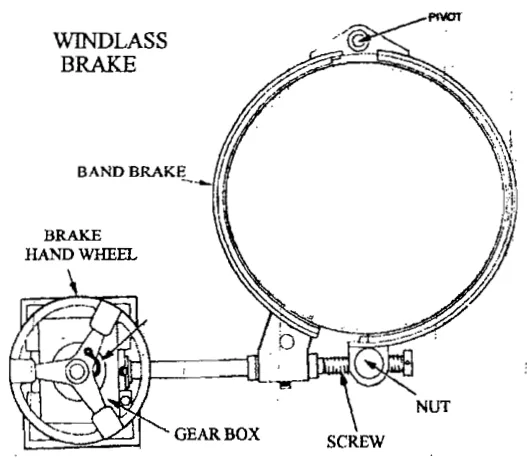
Locally, by hand. Windlasses are normally controlled from a local position. The operator manually applies the cable lifter brake as required to control the speed of the running cable, and whilst heaving anchor he is positioned at the windlass or at the shipside so that he can see the anchor for housing purposes. The position matters: the brake is applied by eye, on the speed of the cable, and the anchor is housed by eye.
From a remote position. It is quite feasible to control all the functions of the windlass from a remote position. Two features make it work:
- The spring applied cable lifter brakes are hydraulically released, so the brake is held off by pressure and applied by the spring if that pressure is lost. This is the fail-safe direction, and it is the reason remote control is acceptable at all.
- To aid the operator, the running cable speed and the length paid out are indicated at the remote position during letting go.
The cable lifter can also be engaged from the remote position, so that the anchor can be veered out to the waterline before letting go, or heaved in as required.
6. The brake and the slipping clutch
Two devices sit between the motor and the cable, and they do different jobs.
The cable lifter brake is the device the operator works by hand to control the speed of the running cable when letting go, and it is the device that has to hold at least 40 per cent of the cable's breaking strength. On a modern windlass it is spring applied and hydraulically released.
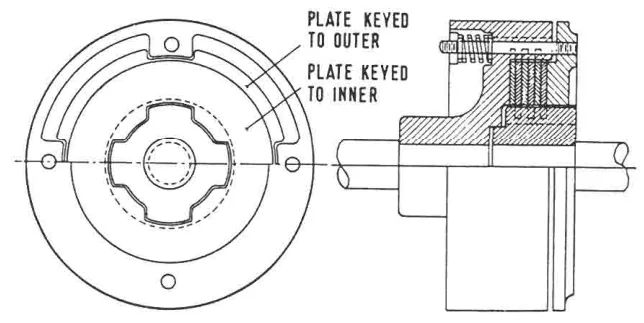
The slipping clutch may be fitted between the drive motors and the gearing to avoid the transmission of inertia in the event of shock loading on the cable — when, for example, the anchor is being housed. When the anchor comes hard against the hawse, the cable stops dead; without a slipping clutch, everything that was turning carries its inertia into the gear train.
7. Maintenance of the windlass
The windlass is in the most vulnerable position so far as exposure to the elements is concerned, and maintenance demands should be an absolute minimum.
- Primary gearing is normally enclosed and splash lubricated, maintenance being limited to pressure grease points for gunmetal sleeve bearings.
- However, due to the large size of the final of the bevel or spur reduction gears, and the clutching arrangements required, these gears are often of the open type and are lubricated with open gear compounds. An open final gear on a windlass is normal, not a defect, and it needs the grease it is given.
The maintenance schedule these items sit within is in Chapter 10.