
Ship Accommodation, Midship Section & Container Stowage
Knowing your ship's particulars, the midship section, TEU/FEU container sizes and tare, net and gross weights.
Key Principles at a Glance 6 points
- A surveyor may ask ship-specific questions — the length of your ship's accommodation, the length of the cargo hold, how many containers are carried on deck and in the hold — so keep your own ship's particulars ready.
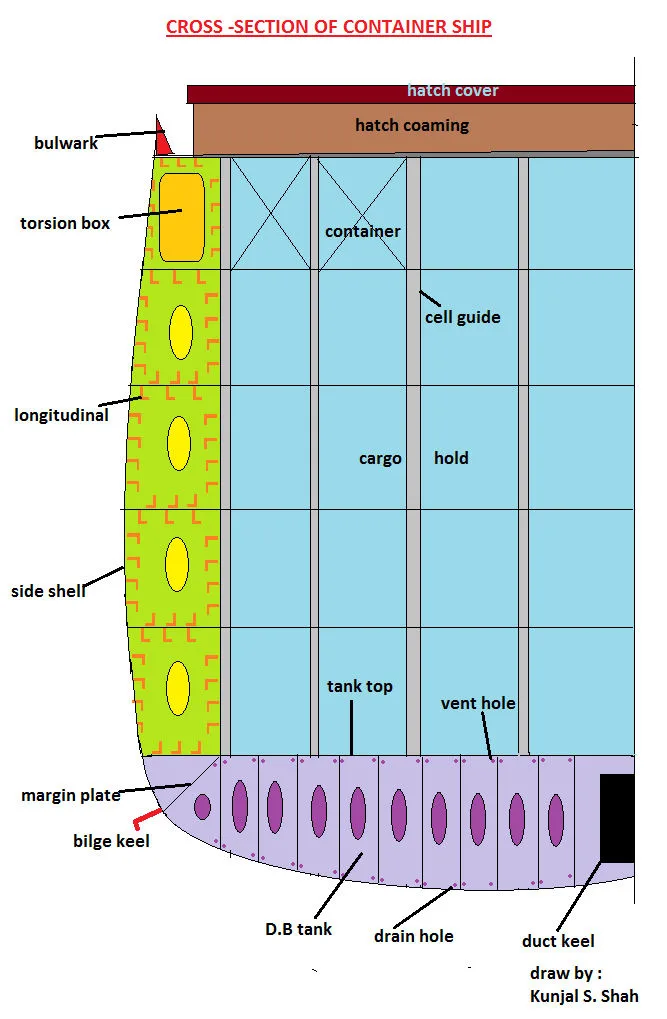
- The midship section shows the vessel at its widest point and includes the deck, hatch openings, side shell, double bottom, hopper and topside tanks for a container ship.
- TEU = Twenty-foot Equivalent Unit and FEU = Forty-foot Equivalent Unit: 20 foot = 6.1 m = 1 TEU and 40 foot = 12.192 m = 1 FEU.
- A standard container is 20 × 8 × 8.6 (length × width × height in feet) for a 20-footer and 40 × 8 × 8.6 for a 40-footer.
- Tare weight is the weight of the empty container, net weight is the weight of the cargo placed into it, and gross weight = net weight + tare weight (e.g. 100 kg + 50 kg = 150 kg).
- Containers are secured in the hold by cell guides, stacking cones and twist locks, with lashings and lashing rods/bridge fittings, and container capacity depends on the stowage plan, trim and stability.
1. Know Your Ship's Particulars
A surveyor can ask ship-specific questions, so you must know your own vessel's details:
- What is your ship's accommodation length?
- How is a container secured in the hold?
- Draw a ship and explain the cargo hold length.
- How many containers are carried on deck and in the cargo holds?
- The answer to all such questions is simply to keep your ship's details ready — dimensions, capacities and securing arrangements.
Ship Particulars You Should Know:
- Length overall (LOA) and length between perpendiculars (LBP).
- Breadth, depth and summer draught.
- Gross tonnage (GT), net tonnage (NT) and deadweight (DWT).
- Number of cargo holds, hold lengths and hatch dimensions.
- Container capacity (TEU) in holds and on deck, and the number of reefer plugs.
- Number of crew, accommodation location and layout.
Surveyors use your own ship to test whether you truly know it. Details such as accommodation length, cargo-hold length, number of holds and container capacity are found in your ship's Capacity Plan, General Arrangement and Cargo Securing Manual — study them before the oral.
2. The Midship Section
Drawing and explaining your ship's midship section is a common surveyor request, especially for a container ship. The midship section shows the ship at her widest point and includes:
Longitudinal hull-girder strength depends on the section modulus of the midship section — which in turn depends on the scantlings and layout of the structural members in the midship region. The midship region extends one-fourth of the ship's length forward and aft of midships; over this region member scantlings are kept the same, because the maximum longitudinal bending moment acts within this zone. Different ship types therefore carry different midship sections — statutory structural plans approved by the classification society.
- Strength deck / main deck at the top, with the hatch opening and hatch coaming.
- Side shell plating and the sheer strake at the deck edge.
- Double bottom with the centre girder, floors, bottom longitudinals and tank top.
- Hopper tanks (topside of the inner bottom) and topside tanks where fitted, forming the double side.
- Longitudinal and transverse framing with the web frames and deck longitudinals.
- Divided by transverse bulkheads into cargo holds, with the hatch above.
Always base your answer on your ship's midship section drawing (in the General Arrangement/Construction plan) — naming the real structural members of your vessel is far more convincing than a generic sketch.
3. Container Terms: TEU, FEU & Dimensions
- TEU — Twenty-foot Equivalent Unit.
- FEU — Forty-foot Equivalent Unit.
- 20 foot = 6.1 m = 1 TEU.
- 40 foot = 12.192 m = 1 FEU.
Standard Container Sizes:
| Container | Length | Width | Height | Equivalent |
|---|---|---|---|---|
| 20 ft | 6.1 m (20 ft) | 8 ft | 8.6 ft | 1 TEU |
| 40 ft | 12.192 m (40 ft) | 8 ft | 8.6 ft | 1 FEU (2 TEU) |
Ship container capacity is quoted in TEU. A 40-ft (FEU) container occupies two TEU, so a ship rated at, say, 8000 TEU can carry a mix of 20-ft and 40-ft boxes totalling 8000 TEU.
4. Weights & Securing Containers in the Hold
Weights:
- Tare weight: the weight of an empty container — the weight of the thing the object will be placed into.
- Net weight: the weight of the cargo placed into the container.
- Gross weight = Net weight + Tare weight.
Example: if a machine weighs 100 kg (net weight) and the container weighs 50 kg (tare weight), then gross weight = 100 + 50 = 150 kg.
| Term | Meaning | Example |
|---|---|---|
| Tare weight | Weight of the empty container | 50 kg |
| Net weight | Weight of the cargo inside | 100 kg |
| Gross weight | Net + Tare | 150 kg |
Securing Containers in the Hold:
- Cell guides: vertical guides in a purpose-built container hold that locate and restrain each stack.
- Stacking cones / interbox twist locks: lock each container to the one below so the stack acts as a unit.
- Twist locks / base locks: secure the bottom container to the tank top (sockets) or deck.
- Lashings: lashing rods, bridge fittings and turnbuckles on deck stows, tensioned per the Cargo Securing Manual.
- Lashing plan: the approved Cargo Securing Manual gives the lashing pattern, maximum stack weights and forces for each stowage position.
- Weight distribution is planned so that the ship's stability (GM), trim and hull stresses remain within limits (checked on the loadicator).
Surveyors commonly ask: "How is a container secured in the hold?" and "What is tare/gross weight?" Answer with cell guides, stacking cones/twist locks, base locks and lashings, and gross = net + tare (with the 100/50/150 kg example).