
Safety
Quick Closing Valve: Construction & Working
The remote spring-loaded valve that shuts off fuel in an emergency, and how it differs from a pressure relief valve.
Key Principles at a Glance 6 points
- A quick closing valve is a kind of pressure-reducing/automatic process control valve for fluid pressure control, used for unmanned machinery spaces, where careful selection of the valve trim (the parts in contact with the controlled fluid) forms the actual control portion.
- The key difference from a pressure relief valve is that the quick closing valve does not come in direct contact with the fluid it is controlling — the operating mechanism is external.
- The lever is connected externally to a remote operating mechanism which may be pneumatically or hydraulically controlled.
- The controlling system has a piston which moves with the pressure of air or fluid, simultaneously moving the lever attached to it; the lever at the other end is connected externally to the spindle attached internally to the valve.
- The valve is spring-loaded: the spindle passes through a spring which re-positions the valve to the open position when the air or fluid pressure in the control cylinder reduces.
- All quick closing valves are generally set in the open position; when the control piston moves up, the piston end of the pivoted lever moves up, the other end moves down pushing the spindle downwards, closing the valve and shutting off the flow.
1. What Is a Quick Closing Valve & Where It Is Used
- A quick closing valve is a kind of pressure-reducing valve — an automatic process control valve for fluid pressure control used for unmanned machinery spaces.
- Correct operation is achieved by careful selection of the valve trim, i.e. the parts of the valve that come into contact with the controlled fluid and form the actual control portion.
- It is used to shut off the flow quickly in an emergency — most commonly the fuel oil supply to the engine room or to individual units — remote from the compartment, so that a fire cannot be fed by fuel.
Why "Quick Closing"?
In an engine-room fire, the fastest way to kill the fire is to cut off the fuel. The QCV lets the crew (or an automatic system) shut the fuel valve from outside the space — often from the fire control station or by releasing the air/fluid pressure — instantly, without entering the fire zone.
2. Construction
- The valve trim (the parts in contact with the controlled fluid) is carefully selected to form the actual control portion.
- The lever is connected externally to a remote operating mechanism, which may be pneumatic or hydraulically controlled.
- The controlling system has a piston which moves with the pressure of air or fluid and simultaneously moves the lever attached to it.
- The lever at the other end is connected externally to the spindle, which is attached internally to the valve.
- The valve is spring-loaded — the spindle is placed through a spring which helps in re-positioning the valve to the open position when the air or fluid pressure in the controlling cylinder reduces.
Key Parts:
| Part | Function |
|---|---|
| Valve trim | Contact surface that actually controls the fluid |
| Spindle | Moves the valve open/closed; passes through the spring |
| Spring | Re-positions the valve to OPEN when control pressure drops |
| Lever (pivoted) | Transfers motion from the piston to the spindle |
| Piston / control cylinder | Moves with air or fluid pressure to operate the lever |
| Remote mechanism | Pneumatic or hydraulic supply that drives the piston |
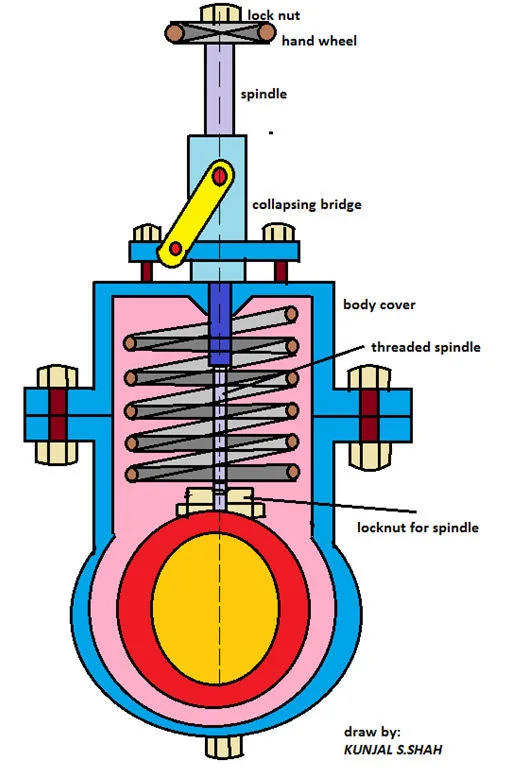
3. Working
- All quick closing valves are generally set in the open position.
- When the piston of the controlling cylinder moves up, the end of the lever which is connected to the piston moves up.
- As the lever is pivoted at the centre, the other end of the lever moves down and pushes the spindle downwards.
- This closes the valve and shuts the flow of the fluid.
- When the air or fluid pressure is released, the spring re-positions the valve to the open position.
Step by Step:
- Normal (open): the spring holds the spindle up, the valve is open and fluid flows.
- Emergency: air/fluid pressure is applied to the control cylinder, moving the piston up.
- The piston raises one end of the pivoted lever.
- The other end of the lever moves down, pushing the spindle down.
- The valve closes and the fluid flow stops.
- Reset: releasing the pressure allows the spring to return the valve to open.
4. Difference from a Relief Valve & Remote Operation
Key Difference:
- The difference between a pressure relief valve and a quick closing valve is that the quick closing valve does not come in direct contact with the fluid it is controlling.
- The QCV operating mechanism (lever, spindle end, piston) is external to the fluid path; the relief valve, by contrast, senses and releases the fluid directly.
Remote Operating Mechanism:
- The lever is connected externally to a remote operating mechanism which may be pneumatic or hydraulically controlled.
- The controlling system's piston moves with the pressure of air or fluid and simultaneously moves the lever.
- This allows the valve to be closed from a remote, safe position — the fire control station or another compartment — without approaching the fire.
Surveyor Asks
Surveyors commonly ask: "Draw and explain the quick closing valve." Show the normally-open spring-loaded valve, the pivoted lever with the control piston, and state the key difference: the QCV does not contact the fluid it controls, and it is operated remotely by pneumatic or hydraulic pressure.