
Load Line: Marks, Letters & Conventions
The Plimsoll mark, TF/F/T/S/W/WNA letters, how the marks are derived, the Load Line Convention and why the mark is on both sides.
Key Principles at a Glance 6 points
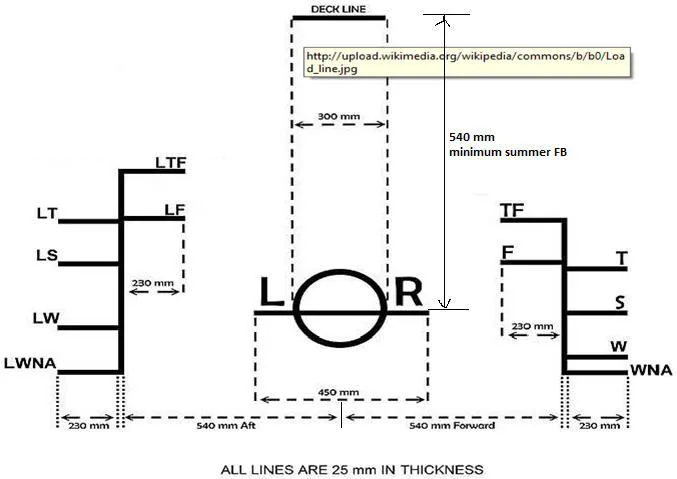
- The original "Plimsoll Mark" is a circle with a horizontal line through it showing the maximum draught of a ship; the horizontal line through the circle is at the same level as the summer load line, and additional marks allow for different water densities and sea conditions.
- The letters mean: TF Tropical Fresh Water, F Fresh Water, T Tropical Seawater, S Summer Temperate Seawater, W Winter Temperate Seawater, WNA Winter North Atlantic, and an L in front indicates the Timber load line.
- Fresh water has a density of 1000 kg/m³ and sea water 1025 kg/m³; a ship loaded to her Fresh Water mark floats at her Summer mark in sea water, and loaded to her Tropical Fresh Water mark she floats at her Tropical mark.
- The summer load line is primary and all other marks are derived from it: winter is 1/48 of the summer load draft below, tropical is 1/48 above, and the fresh water mark is an amount equal to (displacement / TPC) cm above the summer line; WNA is 50 mm below the winter mark for ships ≤100 m.
- Class society initials (AB, LR, GL, BV, IR, RI, NV) appear at the sides of the mark, approximately 115 mm high and 75 mm wide, and the mark is placed amidships on both sides with the deck line.
- The Load Line Convention was adopted in 1966, enforced on 21 July 1968 (with a 1988 Protocol), and the International Load Line Certificate has a 5-year validity; the mark must be on both sides so the draught can be read whichever way the ship is listed.
1. The Plimsoll Mark & Load Line Basics
- The original "Plimsoll Mark" was a circle with a horizontal line through it to show the maximum draught of a ship.
- Additional marks have been added over the years, allowing for different water densities and expected sea conditions.
- Letters may also appear to the sides of the mark indicating the classification society that has surveyed the vessel's load line.
- The horizontal line through the circle of the Plimsoll mark is at the same level as the summer load line.
- The mark is called the Plimsoll mark after Samuel Plimsoll; the international load line was enforced around 1930 in about 54 countries.
- The mark will vary from vessel to vessel depending on length and gross tonnage.
The summer load line is the primary load line, and all other marks are derived from it. Its position is calculated from the Load Line Rules and depends on many factors — length of ship, type of ship, type and number of superstructures, amount of sheer, bow height, and so on.
2. Load Line Letters, Densities & Mark Relationships
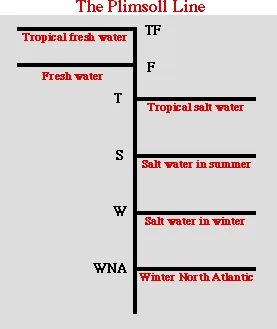
The Letters on the Load Line Marks:
- TF — Tropical Fresh Water.
- F — Fresh Water.
- T — Tropical Seawater.
- S — Summer Temperate Seawater.
- W — Winter Temperate Seawater.
- WNA — Winter North Atlantic.
- In some cases, an L in front of the marking indicates the Timber load line (LT, LF, etc.).
Densities & Fresh Water Allowance:
- Fresh water is considered to have a density of 1000 kg/m³ and sea water 1025 kg/m³.
- Fresh water marks make allowance for the fact that the ship will float deeper in fresh water than in salt water.
- A ship loaded to her Fresh Water mark in fresh water will float at her Summer mark once she has passed into sea water.
- Similarly, if loaded to her Tropical Fresh Water mark, she will float at her Tropical mark once she passes into sea water.
How the Marks Are Derived from the Summer Load Line:
- Winter load line — one forty-eighth (1/48) of the summer load draft below the summer line.
- Tropical load line — one forty-eighth (1/48) of the summer load draft above the summer line.
- Fresh Water load line — an amount equal to (displacement ÷ TPC) centimetres above the summer line, where displacement is in metric tons at the summer load draft and TPC is the tonnes per centimetre immersion at that draft. Where this cannot be ascertained, the fresh water load line is at the same level as the tropical load line.
- Tropical Fresh load line — its position relative to the tropical load line is found in the same way as the fresh water load line is to the summer load line.
- Winter North Atlantic (WNA) — used by vessels not exceeding 100 m in length when in certain areas of the North Atlantic Ocean during the winter period; when assigned it is 50 mm below the winter mark.
3. Class Society Initials & Marking Rules
Classification Society Initials:
- AB — American Bureau of Shipping.
- LR — Lloyd's Register.
- GL — Germanischer Lloyd.
- BV — Bureau Veritas.
- IR — Indian Register of Shipping.
- RI — Registro Italiano Navale.
- NV — Det Norske Veritas.
These letters should be approximately 115 millimetres in height and 75 millimetres in width.
Marking Rules:
- All assigned load lines must be marked amidships on each side of the ship, together with the deck line.
- Certification and load line marking are assigned by the Classification Society; the Load Line Certificate is issued by the Administration.
- The scantling length is usually referred to during and following load line calculations.
Classification Society = assigns and marks the load line. Administration = issues the Load Line Certificate. Don't mix these up in an oral answer.
4. The Load Line Convention & Why Both Sides
Load Line Convention:
- Adopted: 1966. Enforced: 21 July 1968. Protocol: 1988.
- It was adopted to establish uniform principles and rules with respect to the limits to which ships on international voyages may be loaded, and to provide minimum freeboard for the safeguard of life, property and environment.
- The International Load Line Certificate has a 5-year validity.
- All assigned load lines must be marked amidships on each side of the ship, together with the deck line.
Why the Load Line Is on Both Sides:
- If the ship is listed to starboard and the marking is only on the port side, the mark would be out of the water and you could not tell the true draught as the ship tries to come upright.
- Having the mark on both sides means the draught can always be read, whichever way the ship is listed.
- It is also an IMO regulation requirement.
Surveyors commonly ask: "Draw the load line and explain TF, F, T, S, W, WNA", "When was the Load Line Convention adopted?" (1966, enforced 21 July 1968, Protocol 1988), and "Why is it on both sides?" (so the draught is readable even when the ship is listed).
5. Load Line Survey Prep — The 15-Point Round
Surveyors ask "how did you prepare for the load line survey?" Walk the round as close — tight — clear — move — seal — record: start prep a few months before (a Planned Maintenance Schedule beats last-minute work), and remember the surveyor's rule of thumb — watertight below the freeboard deck, weathertight above it:
Close & seal (openings):
- 1. Access points — clamps, dogs greased; gaskets and watertight packings checked for cracks.
- 2. Ventilators & air pipes — closing flaps fitted and moving; rusted flaps renewed.
- 4. Hatches — weathertight, booby hatches included; butterfly screws move freely.
- 5. Locking bars, pins & hatch ventilators — de-rusted, free movement (WD-40 liberally).
- 6. Tarpaulins — top condition, approved material and standard.
- 9. Machinery-space deck openings — inspected, oil/dirt cleaned off.
Tight & move (waterways):
- 3. Deck clear — portable beams secured, tools squared away.
- 7. Manholes & scuppers — manholes screwed tight with the T-wrench; scuppers de-clogged, exact-size plugs.
- 8. Non-return valves — overboard-discharge NRVs proven working (authorities are stern on these).
- 10. Ports & freeing ports — every port below the freeboard deck watertight; freeing-port shutters, hinges and pins de-rusted, lubricated, free.
- 11. Guardrails & bulwarks — fractures repaired (crew safety, survey or not).
- 14. Side scuttles & deadlights — watertight below the freeboard deck; deadlight rubber packings checked for cracks and fissures.
Clear & record (marks & paper):
- 12. Marks painted — deck line, load line mark, draught marks and signages de-rusted and repainted (side-of-ship work: LSA standby, safety gear on).
- 13. Safety gear in order — safety lines rigged, safety setup overhauled.
- 15. Records ready — load line certificate, stability information (loading/ballasting adherence), all keys working, manpower stood by.
Close with: "hull watertight below the freeboard deck, weathertight above — certificate, stability book and keys ready for the surveyor."