
Fuel Consumption & Speed Relationship
Why fuel burn climbs with the cube of speed — specific fuel consumption, the fuel coefficient, and daily consumption.
Key Principles at a Glance 6 points
- The fuel consumption of a ship depends upon the power developed; the overall efficiency of the power plant is often measured in terms of the specific fuel consumption — the consumption per unit of power, expressed in kg/kWh.
- Efficient diesel engines may have a specific fuel consumption of about 0.20 kg/kWh, while that for a steam turbine may be about 0.30 kg/kWh.
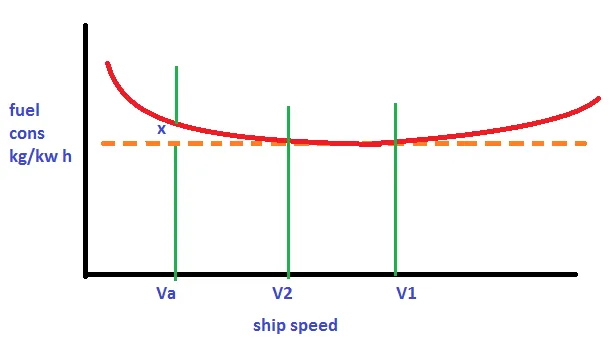
- The specific fuel consumption of a ship follows a characteristic form when plotted against load/power.
- Because the power required to drive a ship varies approximately with the cube of speed, the fuel consumption also varies approximately with the cube of speed (fuel ∝ speed³) — a small increase in speed means a large increase in fuel burned.
- Fuel consumption per day is measured in tonnes (daily consumption = SFOC × power × 24 ÷ 1,000,000, in tonnes).
- The value of the fuel coefficient lies between 40,000 and 120,000, used with the displacement and speed to estimate daily fuel consumption.
1. Fuel Consumption & Power Developed
- The fuel consumption of a ship depends upon the power developed.
- Indeed, the overall efficiency of the power plant is often measured in terms of the specific fuel consumption — which is the consumption per unit of power, expressed in kg/kWh (i.e. kg per kW-hour).
- Efficient diesel engines may have a specific fuel consumption of about 0.20 kg/kWh.
- A steam turbine may be about 0.30 kg/kWh.
- The specific fuel consumption of a ship follows the form shown in the figure (it varies with the load on the engine).
| Plant Type | Typical SFOC |
|---|---|
| Efficient diesel engine | ≈ 0.20 kg/kWh |
| Steam turbine | ≈ 0.30 kg/kWh |
Specific Fuel Consumption (SFOC) is the mass of fuel burned per unit of energy produced. A lower SFOC means a more efficient engine — which is exactly why the modern two-stroke diesel (≈ 0.20 kg/kWh) beats the steam turbine (≈ 0.30 kg/kWh).
2. The Cube Law — Fuel ∝ Speed³
- The power required to drive a ship through the water varies approximately as the cube of the speed (the propeller law).
- Since fuel consumption is proportional to the power developed (at constant SFOC), it follows that fuel consumption also varies approximately as the cube of speed.
Fuel consumed ∝ Speed³ — for example, doubling the speed requires about 2³ = 8 times the power and hence about 8 times the fuel per unit time. This is why "slow steaming" saves so much fuel.
| Speed Change | Power / Fuel (per unit time) Change |
|---|---|
| × 1.5 | × 3.375 (1.5³) |
| × 2 | × 8 (2³) |
| × 0.8 (slow steaming) | × 0.512 (0.8³) → about half |
3. Daily Consumption & the Fuel Coefficient
Fuel Consumption per Day
- Fuel consumption per day is expressed in tonnes.
- Daily consumption is found from the specific fuel consumption and the power developed:
FC per day (tonnes) = SFOC (kg/kWh) × Power (kW) × 24 ÷ 1,000,000
The Fuel Coefficient
- The value of the fuel coefficient is between 40,000 and 120,000.
- It is used to relate the displacement, speed and daily fuel consumption of similar ships:
Daily fuel consumption = (Displacement2/3 × Speed³) ÷ Fuel Coefficient - A higher fuel coefficient means a more economical ship (less fuel for the same displacement and speed).
SFOC
- SFOC (Specific Fuel Oil Consumption) is the yardstick of plant efficiency — the mass of fuel used per unit of power produced (kg/kWh).
Fuel burn depends on power (from speed, ≈ V³) and on efficiency (SFOC). Reducing speed cuts the power term dramatically; improving SFOC or maintaining a high fuel coefficient cuts the consumption for the same power and displacement.