
Why the Oily Water Separator Is Fitted
Set out what the oily water separator is actually for, what the two international requirements are, and what the machine is made of.
Key Principles at a Glance 5 points
- An oily water separator exists for one legal reason: to let a ship pump out its bilges and oil-contaminated spaces without putting oil into the sea.
- The separator alone must produce under 100 p.p.m. whatever the feed; the complete installation — separator, filter and monitoring — must reach 15 p.p.m., and 15 p.p.m. is what governs whether the overboard valve may be open at all.
- A plain gravity separator realistically manages about 150 p.p.m., and that gap between 150 and 15 is precisely why the second and third stages exist.
- An installation is three things working together: the coarse separator, the coalescing filter, and the control and monitoring unit that makes the discharge legal rather than merely effective.
- Penalties attach to individuals, not just the company — over 100 mg of oil per litre, or more than 60 litres of oil per nautical mile, can be heavily fined and so can the Master personally.
1. The duty of the machine
The maker's manual, the approved operating procedure, the SMS, the class rules, the IOPP Certificate and its supplement, and the Chief Engineer's orders always override anything in these notes. No oil is to be discharged to sea outside the regulation. The overboard valve is locked and the key is held by the Chief Engineer.
An oil/water separator is fitted so that a ship can pump out its bilges, its oil tanks and any other oil-contaminated space without putting oil into the sea. That is the whole purpose, and it is a legal purpose rather than an operational convenience. Without the separator the only lawful way to get rid of machinery space bilge water would be to retain it until the ship reached a shore reception facility, which no ship can do indefinitely.
The regulation behind it is MARPOL 73/78, the international convention for the prevention of pollution from ships. Annex I of that convention deals with oil, and the oily water separator is the piece of equipment Annex I assumes you have.
2. The two requirements — learn these word for word
There are two numbers that define the performance of the plant, and both matter.
First requirement. An oily water separator for bilge and ballast applications must be capable of producing an effluent containing less than 100 parts per million of oil, irrespective of the oil content of the feed supplied to it — that is, whether the feed is nearly clean water or nearly neat oil.
Second requirement. A filtering system must go further and produce an effluent of no more than 15 parts per million under all inlet conditions.
The distinction matters. The 100 p.p.m. figure is what a plain gravity separator is asked to achieve. The 15 p.p.m. figure is what the complete installation — separator plus filter or coalescer plus monitoring — is asked to achieve, and 15 p.p.m. is the number that governs whether the overboard valve is allowed to be open at all.
It is worth knowing how far short the older machines fell. Most gravity-type separators fitted in older vessels delivered somewhere between 50 and 1,500 p.p.m., and even the optimistic end of that range is probably generous — 150 p.p.m. would be a more realistic figure for a plain gravity separator on its own. That gap between 150 and 15 is precisely why the second and third stages of the plant exist.
3. Why the law exists
It is easy to treat the regulation as paperwork. It is not, and the reason is straightforward.
Free oil and oily emulsions discharged into a waterway interfere with natural processes such as photosynthesis and re-aeration. They induce the destruction of the algae and plankton that fish life depends on. A discharge close inshore damages bird life and pollutes beaches, and the damage is visible to the public in a way that a discharge in mid-ocean is not.
The penalties reflect that. A ship found discharging water containing more than 100 milligrams of oil per litre, or discharging more than 60 litres of oil per nautical mile, can be heavily fined — and so can the Master personally. That last point is the one worth remembering: the consequences of a careless discharge fall on individuals, not just on the company.
4. The three parts of an installation
A complete oily water separator installation is not one vessel. It is three things working together:
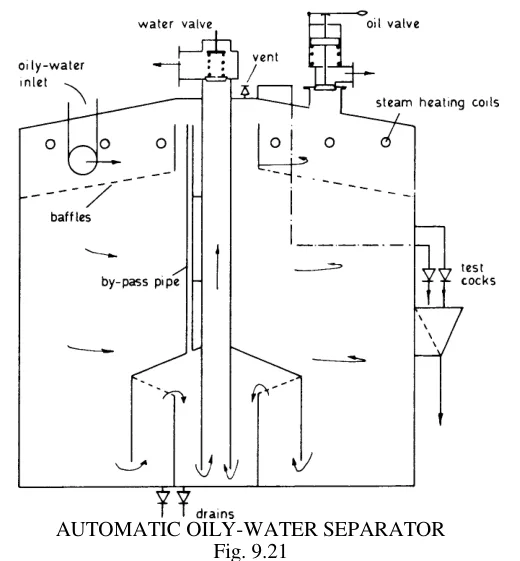
- The separator. A coarse separator, usually built with baffle plates, whose job is to accumulate the small oil particles and let them rise. This is the gravity stage.
- The filter. The unit holding the coalescence filters, which take out the droplets the gravity stage could not lift.
- The control unit. The control device and the monitoring device together — a test chamber, a mixing or sampling pump, a light source, and a controller that receives inputs for discharge rate, ship's speed and oil content.
The control unit is the part that makes the installation legal rather than merely effective. A separator that works but cannot demonstrate that it works — cannot show the oil content, cannot alarm, cannot stop the discharge — does not satisfy the regulation.
5. Where the rest of the plant sits
Three things surround the separator and are dealt with in later chapters:
- The bilge system that feeds it, and the discipline that keeps the overboard connection closed.
- The oil content monitor that watches the effluent and trips the discharge when the limit is exceeded.
- The sludge and incinerator arrangements that deal with the oil the separator takes out.
The separator is therefore the middle of a chain that begins at the bilge suction and ends at a shore reception facility or an incinerator. Any link in that chain failing turns the whole installation into a retention system by default.