
Ship Pipelines — Seawater, Bilge, Ballast & Fuel Systems
What each system carries, where each one fails first, and the sounding pipe you must never leave open.
Key Principles at a Glance 6 points
- Ancillary systems carry every support fluid — seawater, bilge, ballast, fuel, lube oil, cooling water, compressed air, steam and condensate.
- Seawater circuits cool everything and corrode everything — anodised and rubberised pipe plus exchanger anodes are the defence.
- Bilge pumps die from suction air ingress: valve lids held by dirt, failed strainer-cover seals — vacuum lost, then suction lost, then pumping stops.
- Hidden bilge leaks are found by isolating, blanking and back-flooding sections under pressure — with hold valves verified shut first.
- Fuel lines through heated tanks breathe through expansion bends; heating coils hold heavy fuel pumpable; oil through ballast spaces must be short, thick-walled and strongly flanged.
- A sounding pipe left open is a flooding path — deck caps shut, engine-room self-closing cocks never tied open.
1. The Ancillary Lineup — Every Support Circuit
Idea in one line: main machinery does the work, but ancillary piping keeps it alive — one failed support circuit stops the engine as surely as a broken piston.
Water circuits
Seawater circulation, bilge, ballast, cooling water, condensate — the ship moves water more than anything else.
Oil circuits
Fuel oil bunkering and transfer, lubricating oil — viscous, heated, and a fire and pollution risk at every leak.
Air and steam
Compressed air, steam distribution — pressure energy on tap, with water-hammer and scald hazards built in.
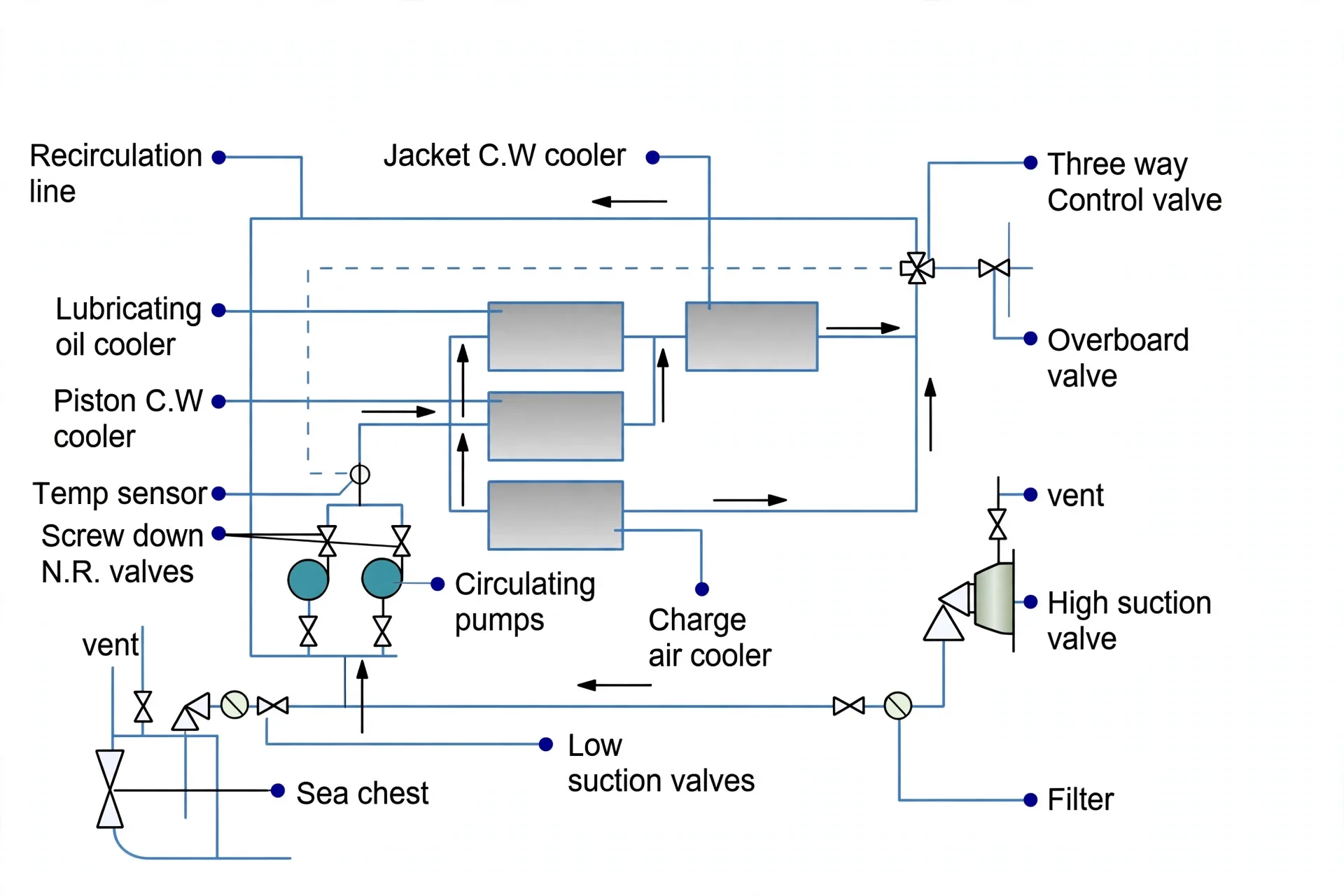
Why seawater is the study piece: abundant and an excellent coolant — and aggressively corrosive. Anodised and sometimes rubberised piping plus sacrificial anodes at the heat exchangers hold the line, and this circuit is examined for damage and repair precisely because it suffers most.
2. Bilge — Vacuum Is Everything
Idea in one line: a bilge pump does not pump water — it holds a vacuum that pushes water up to it, and any air leak kills that vacuum first.
Bilge suctions rot from both sides: corrosive collected fluid inside, air outside. Oily bilge water is never pumped straight overboard — decant to a holding tank, discharge only through the 15 ppm separator.
| Air entry point | Mechanism | Fix |
|---|---|---|
| Valve lid held by dirt | Foreign matter under the lid stops closure — air streams into the suction side | Lift, clean, prove closure |
| Strainer / mud-box cover seal | Cover refitted on a tired joint leaks air at the seal after cleaning | New joint or gasket every opening |
Finding hidden leaks — back-flood the section
Corrosion strikes the lowest pipe points first. When the leak hides:
Isolate and blank the suspect length so the test covers one section only.
Pull one pump's bilge suction valve and flood the section back with pressurised seawater through the valve chest.
Read the weeps. Pressure water finds the hole air was using — the leak shows as a drip.
Engine-room sections any time. Hold lines only with holds empty — and hold bilge valves verified shut first, or the test floods the cargo it was meant to protect.
3. Ballast, Bunkering & Pipes That Breathe
Idea in one line: ballast is stability plumbing run before every port move; fuel transfer is heated plumbing that must grow and shrink without tearing itself apart.
Ballast — stability first
Ballasting and de-ballasting run before every arrival and departure. The water moved is the ship's stability margin — this is not housekeeping, it is ship safety.
Bunkering — fuel in bulk
Pipelines, valves, strainers, transfer pumps and centralised tank sounding move fuel from the main into storage, deep and double-bottom tanks. Low-pressure legs serve tank-to-tank and suction sides; injection delivery runs high-pressure.
Pipes breathe — let them
Lines crossing heated fuel tanks swing across wide temperatures. Expansion bends and omega loops absorb the growth freely — forced alignment under thermal stress fails at flanges and valves.
| Rule | Why |
|---|---|
| Exposed heavy-fuel lines get insulation + steam tracers underneath | High-viscosity fuel must stay hot to stay pumpable — cold legs wax up and stop |
| Heating coils in every residual-fuel location | Storage, settling and daily-use tanks each hold temperature for pumping viscosity |
| Oil pipe through ballast space (or reverse) must be short, thick-walled, strongly flanged | One leak becomes pollution or contamination — class sets the standard, not convenience |
4. Air Vents & Sounding Pipes — Small Pipes, Sinking Risks
Idea in one line: every enclosed space must breathe when liquid moves, and every tank must be measurable — but each opening is a flooding path if left unsealed.
Air pipes — let tanks breathe
Pumping liquid out or temperature swings would over- or under-pressure a sealed space. Air pipes pass through the weather deck with self-closing watertight headers — a Load Line requirement, not an option.
Sounding pipes — measure the contents
Small-bore mild-steel runs that pass a tape or rod to tank bottom or hold bilge. Deck pipes carry screw-down caps; engine-room double-bottom pipes carry self-closing cocks.
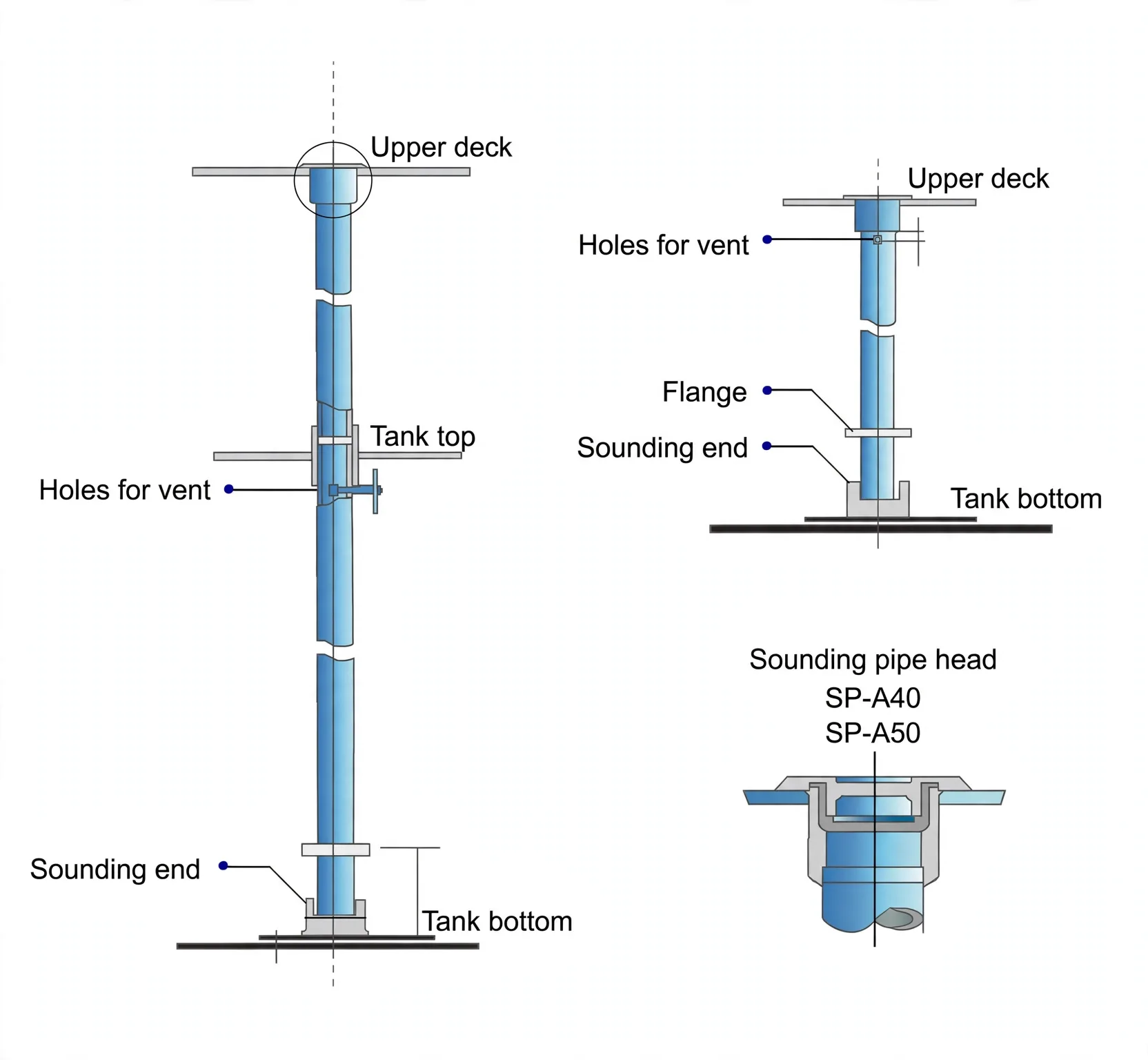
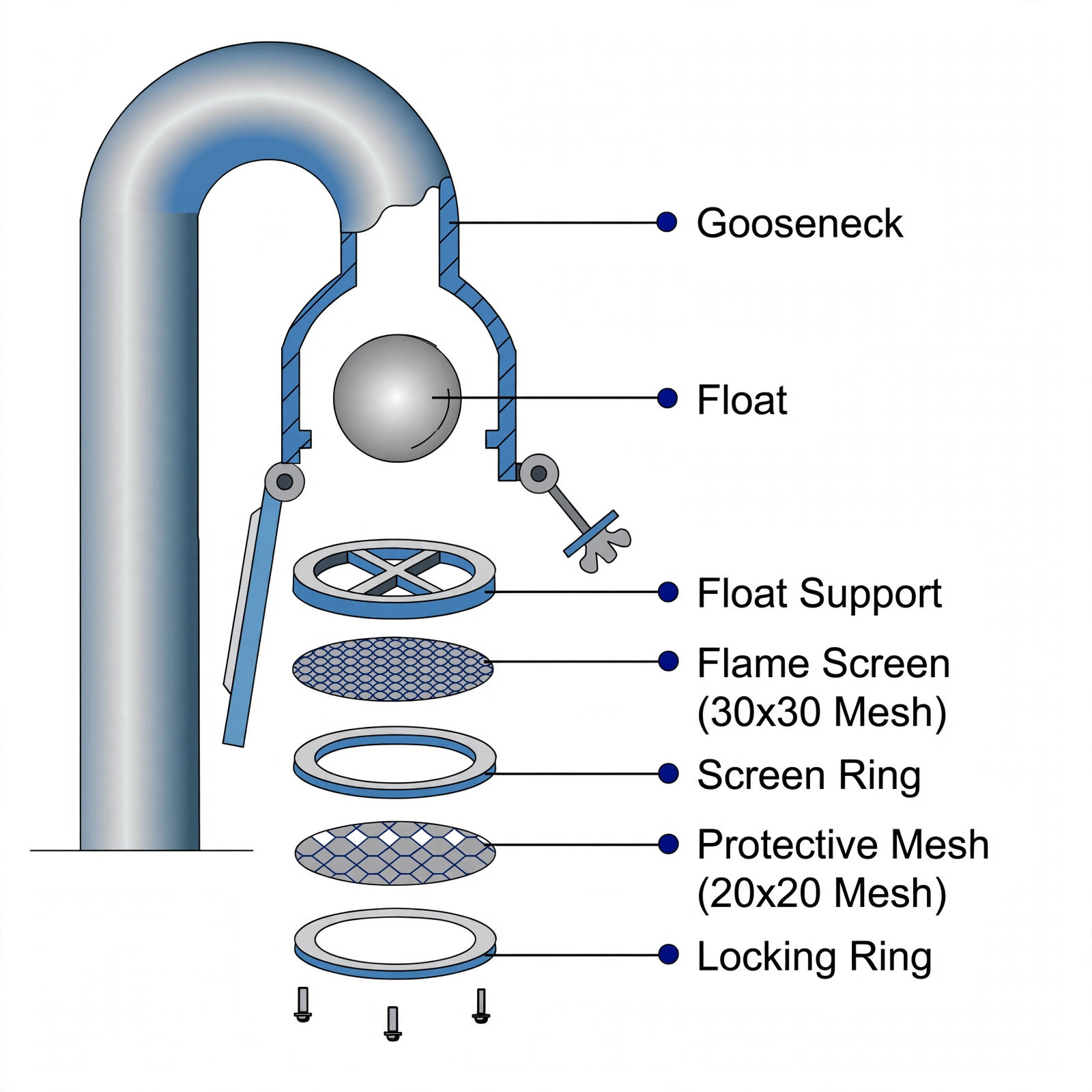
A holed bottom floods the engine room through an open sounding pipe; heavy weather floods a hold through an open deck pipe; a holed weather-deck air pipe does the same. Caps stay screwed shut — never wooden plugs, never mislaid. Engine-room cocks are never tied open. Open and inspect weather-deck headers internally every five years after first special survey (inside corrosion never shows outside) and keep heads galvanised. Pipes through dry cargo spaces need impact-damage inspection from grabs and bulldozers.