
How Oily Water Separation Works — Gravity, Coalescence and Why Turbulence Ruins It
The physics behind the separator, in enough depth to explain why the plant is built the way it is and why certain operating habits destroy its performance.
Key Principles at a Glance 5 points
- An oil globule rises or does not rise on three things: the size of the globule, the density difference between oil and water, and the viscosity of the oil.
- Anything that shears or churns the mixture breaks the oil into finer droplets and destroys separation — laminar, streamlined flow is what the whole design is trying to achieve.
- Heating to about 60 °C and using sea water both help, because each increases the density differential and reduces the oil's viscosity.
- Coalescence type elements are oleophilic and separate oil out of the water and last; absorption type elements are glass wool, separate water out of the oil, and must be renewed after a period.
- Practical installations are three-stage — a gravity first stage followed by two coalescing stages — because a single pass cannot reliably take the effluent to 15 p.p.m. across the whole range of inlet conditions.
1. The basic mechanism
The maker's manual and the approved operating procedure override these notes. This chapter explains behaviour; it does not set throughput limits.
An oil globule suspended in water is acted on by two things at once: it is buoyed upwards by the difference in density between oil and water, and it is resisted by the viscosity of the water as it tries to move. Separation happens when the upward (terminal) velocity is enough to carry the globule to the surface before the water carries it out of the vessel.
That terminal velocity depends on three things, and all three are under the operator's influence to some degree:
- the size of the oil globule — large globules rise much faster than small ones;
- the relative density difference between oil and water — a bigger difference means a bigger driving force;
- the viscosity of the oil — a thinner oil rises more readily than a thick one.
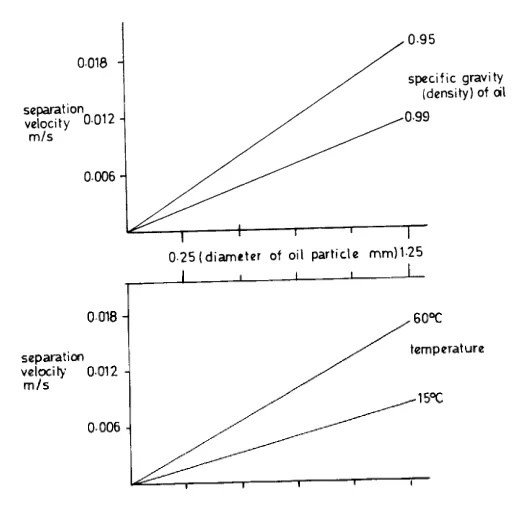
What encourages good separation
- Large oil globule size. The bigger the droplet, the faster it rises. Anything that shears or churns the mixture makes the droplets smaller and the separation worse.
- Elevated temperature. Warming the mixture increases the specific gravity differential between oil and water and reduces the viscosity of the oil. Both effects help. This is why steam heating coils are fitted and why about 60 °C is the working figure.
- Using sea water. Sea water has a higher density than fresh water, so the density differential against the oil is greater.
What destroys separation
Turbulence and agitation. They cause mixing and re-entrainment of oil that had already separated — the oil is stirred back into the water and carried out with it. Laminar, streamlined flow is what the design is trying to achieve, and everything about the installation — the pipe sizes, the pump type, the entrance area — is arranged to get it.
2. The design features that exploit the physics
A well-designed separator is a machine for making the flow behave. The features that do it:
- A large entrance area, so that the flow velocity is low and large slugs of oil can move to the surface quickly instead of being swept through. The low-capacity supply pump is part of this — a deliberately slow, gentle flow is the design intent, not a limitation.
- Alternation of the flow path in a vertical direction, which repeatedly brings oil near the surface. Weirs are used to reduce the liquid depth at those points, shortening the distance the globule has to travel.
- Angled surfaces on which oil accumulates and forms globules large enough to float away.
- Fine gauze screens, which act as coalescing surfaces — oil wets the gauze and builds up on it until the globule is big enough to rise.
3. Two stages, always
Every practical installation separates in two stages:
- First stage — gravity separation. Coarse oil is floated off.
- Second stage — coalescence filtration. The droplets that gravity could not lift are caught and grown until they can be lifted.
The second stage works because the filter elements remove small droplets of oil and hold them until they merge into larger droplets — they coalesce — and the enlarged droplets then rise to the oil collecting space and are drained off.
Coalescence type against absorption type
There are two different filter materials, and the distinction matters because the names sound similar but the action is opposite:
| Coalescence type | Absorption type | |
|---|---|---|
| Material | Oleophilic — oil-attracting | Glass wool |
| What it separates | Separates oil out of the water | Separates water out of the oil |
| Renewal | Frequent replacement not required | Must be renewed after a certain period |
The way to hold it in the head: a coalescer is oleophilic, so it grabs the oil and lets the water through. An absorber is the other way round — it grabs the water. A coalescer lasts; an absorber is consumed and has to be renewed.
4. Three stages
Most installations in service are described as three-stage, and the arrangement is worth being able to sketch from memory.
The first stage is the automatic gravity separator. The second and third stages are coalescers. Effluent from the first stage enters the bottom of the second stage and passes up through the middle of the coalescer. Coalesced oil collects at the top of the coalescer, and the water discharges at the bottom and passes on to the next stage.
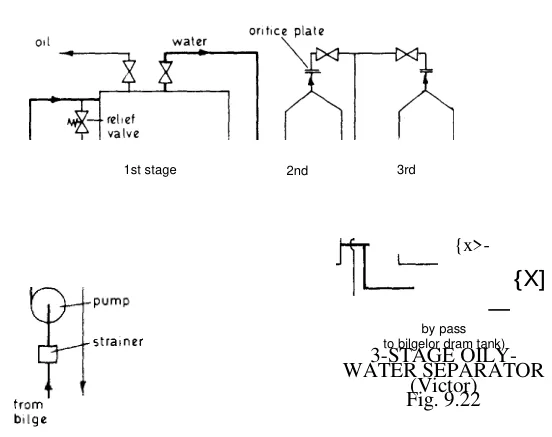
The reason for two coalescing stages rather than one is simply that a single pass cannot reliably take the effluent from the gravity stage all the way down to 15 p.p.m. over the whole range of inlet conditions the regulation demands.