
OWS Pump Selection and the Suction Mode — Why the Pump Decides the Result
The single factor most often got wrong on board.
Key Principles at a Glance 6 points
- The pump decides the droplet size before the oil ever reaches the separator, and no amount of plate area can recover a fine dispersion below about 200 micrometres.
- A centrifugal supply pump is unsatisfactory: it churns the mixture into droplets too small for the plates to lift, and the 100 p.p.m. requirement cannot be met.
- Positive displacement pumps — double vane, triple screw, single vane, rotary gear, reciprocating, hypocycloidal, diaphragm, disc and shoe — are satisfactory; a flexible vane pump only if derated to 50 %.
- In suction mode the pump sits after the separator, so the oil separates while it is still in large globules; one such design is claimed to reach 2 p.p.m. or less without second and third stage coalescers at all.
- Suction mode also allows the pump to be valved round to back-flush the coalescer without breaking a joint, which is what keeps the second stage working between overhauls.
- Pipework shears oil in the same way as the pump: avoid sharp bends and constrictions, and size the pipe so laminar flow is guaranteed at the design throughput.
1. Why the pump matters more than the separator
The maker's manual specifies the pump. Do not substitute a pump type, and do not change the suction arrangement, without the Chief Engineer's authority and the maker's agreement.
The separator can only work with what it is given. If the oil arrives as large globules it will float out readily. If it arrives as a fine dispersion of droplets under 200 micrometres across, the buoyancy force on each droplet is tiny and the rising velocity is negligible — and no amount of plate area will recover it.
The pump is what decides which of those two things happens. The type of pump delivering the oily water mixture governs, to a considerable extent, the degree of contamination in the effluent.
2. Centrifugal pumps — the unacceptable choice
A centrifugal pump imparts energy to the fluid by whipping it round at high speed. It works by turbulence, and turbulence is exactly what an oily water separator cannot tolerate.
A centrifugal supply pump churns the supply and breaks the oil into small droplets, under about 200 micrometres, dispersed through the water. At that droplet size the 100 p.p.m. requirement cannot be met — and the second and third stages will not rescue it either, because they are sized to polish an already-separated effluent, not to recover a finely dispersed emulsion.
The verdict is therefore blunt: centrifugal pumps are unsatisfactory as oily water separator supply pumps.
3. The satisfactory pumps
A positive displacement pump performs far better, because it moves the fluid by trapping a fixed volume and pushing it along rather than by agitating it. It does not generate large quantities of small droplets.
| Verdict | Pump types |
|---|---|
| Satisfactory | Double vane, triple screw, single vane, rotary gear, reciprocating, hypocycloidal, diaphragm, disc and shoe |
| Satisfactory, but at 50 % derating | Flexible vane |
| Unsatisfactory | Centrifugal |
Note the middle row. A flexible vane pump is acceptable only if it is derated to half its rated capacity — it works, but it is not gentle enough to be run at full flow.
The practical rule to carry: slow-running, positive displacement, gentle. Anything that churns is wrong.
4. The suction mode
There is a second way to protect the oil globules, and it is a design decision rather than a component choice.
Normally the supply pump is placed before the separator — it pushes the mixture into the vessel. The alternative is to place the pump after the separator, so that the separator is under suction and the pump pulls the mixture through it. This is called operating in the suction mode.
With any kind of pump operating in the suction mode, it is claimed that 15 p.p.m. or less can be met without second and third stage filters or coalescers at all. The reason is that the separator is doing its work before the mixture passes through the pump, so the oil has already been given the chance to separate while it is still in large globules. Using the separator in suction rather than delivery mode avoids disintegration of the oily water mixture prior to separation.
One suction mode design is claimed to reach 2 p.p.m. or less. That is a maker's claim rather than a regulation, but it demonstrates the principle: protect the globule size and the machine does its job.
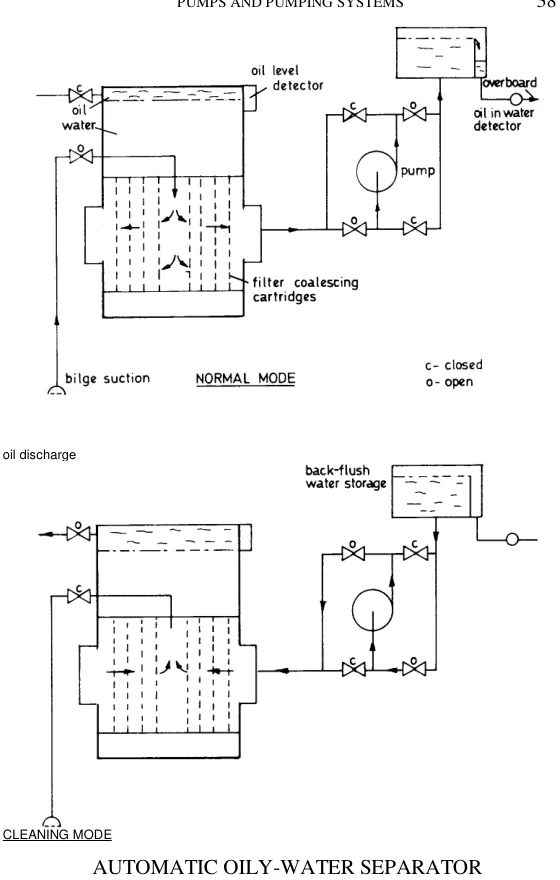
Why the cleaning mode is worth having
The lower half of the figure is the part that pays for itself in service. A coalescer that is never back-flushed holds the oil it has captured, loses free area, and starts passing droplets it should have caught. Being able to reverse the pump through the element without breaking a joint is what keeps the second stage working between overhauls — and it is only possible because the pump sits downstream.
5. Pipe design — the same argument again
The pump is not the only thing that can shear the oil. Pipework can do it too, and the same logic applies:
- Avoid turbulence from sharp bends or constrictions. Every elbow and every reduction in bore disturbs the flow.
- Size the pipe so that laminar flow is guaranteed at the design throughput. A pipe that is too small for the flow will produce exactly the turbulence the separator cannot tolerate.
This is why the pipework of a properly installed separator looks generous for the flow it carries. It is not over-sized by accident.
6. How this connects to the rest of the plant
The pump decision is made at build, but its consequences are seen every day:
- A centrifugal pump shows up as an effluent that is high in oil content from the moment the separator is started, with the alarm tripping repeatedly and no amount of heating or cleaning helping.
- A correct positive displacement pump, correctly sized pipework, and suction mode where available shows up as a stable reading and a separator that only trips when the feed is genuinely foul.
When troubleshooting a separator that will not perform, the pump is the first thing to question — after confirming the discharge is actually permitted, which is a different question entirely.