
Oily Sludge and Its Disposal
What happens to the oil the separator takes out.
Key Principles at a Glance 7 points
- The sludge tank is a statutory fitting: at least 1 % of the used heavy fuel oil for 30 days or ½ % of the diesel oil, with manholes, heating, a designated pump, a standard discharge connection and a high level alarm.
- No direct connection is permitted between the sludge tank discharge piping and the overboard discharge piping — that one arrangement is what makes an accidental discharge impossible.
- Sludge tank volume is V = K · C · D, so capacity is driven by fuel consumption and voyage duration, not by the size of the ship.
- At sea, incinerate in the waste oil incinerator with the Chief Engineer's permission and enter the amount in the Oil Record Book; in port, land it ashore and obtain the received letter from the shore authority.
- The incinerator burns waste oil, oil and water mixtures up to 25 % water content, rags and galley waste, and solid matter from the sewage plant — its burning capacity is stated in the supplement to the IOPP Certificate.
- It shuts down and alarms on pilot or main burner failure, flue gas above 400 °C and cooling fan failure, and the hinged furnace door carries a micro switch interlock.
- The cooling fan has three separate jobs: cool and protect the shell, keep the combustion chamber at a negative pressure, and keep the flue gas temperature below a safety limit.
1. Sludge tank requirements
The IOPP Certificate and its supplement, the SMS and the Chief Engineer's orders override these notes. Sludge is never discharged overboard. It is incinerated at sea with the Chief Engineer's permission and entered in the Oil Record Book, or landed ashore against a receipt.
The sludge tank is a statutory fitting and its requirements are specific:
- Capacity of at least 1 % of the used heavy fuel oil for 30 days, or ½ % of the used diesel oil for 30 days.
- Sufficient manholes to reach all parts of the tank.
- An adequate heating arrangement.
- No direct connection between the sludge tank discharge piping and the overboard discharge piping. This is the single most important requirement on the list — it is the arrangement that makes an accidental discharge impossible.
- A designated pump of suitable capacity and discharge head.
- A standard discharge connection — the International Discharge Connection — for landing sludge ashore.
- A high level alarm.
2. The capacity formula
The required sludge tank volume is calculated as:
| Symbol | Meaning |
|---|---|
| K | 0.01 where heavy fuel oil is purified for the main engine — that is, 1 %; 0.005 for ships using diesel or heavy oil that does not require purification — that is, ½ % |
| C | Daily fuel oil consumption |
| D | Maximum period of the voyage between ports, in days — use 30 days in the absence of precise data |
The formula is worth being able to write down, because it shows that the capacity is driven by fuel consumption and voyage duration, not by the size of the ship.
3. Sludge control
At sea — incinerate the sludge in the waste oil incinerator, after the Chief Engineer's permission, and enter the amount in the Oil Record Book.
In port — send it to shore, and obtain the received letter from the shore authority. That receipt is not paperwork for its own sake; it is the evidence that the sludge left the ship legally.
The two routes are mutually exclusive by location. Sludge cannot be incinerated in port and cannot be landed at sea.
4. The incinerator
A waste disposal burning unit which will burn solid material and all types of waste oil, fitted to prevent pollution of the sea.
The burning capacity is stated in the supplement to the IOPP Certificate — which is where an inspector will look, and where the ship's own figures are recorded.
What it should be able to burn
- Waste oil.
- Oil and water mixture up to 25 % water content.
- Rags and galley waste.
- Solid matter from the sewage plant.
That last item links this chapter to the sewage treatment plant: the incinerator is one of the two legitimate destinations for sewage sludge.
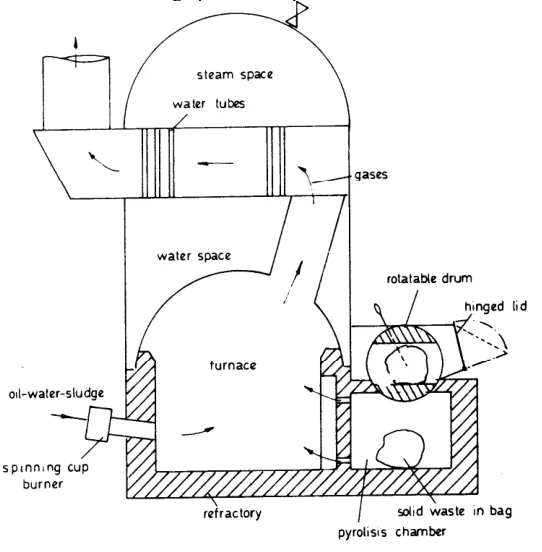
The safety devices
The unit shuts down and alarms on:
- pilot or main burner failure;
- flue gas temperature above 400 °C;
- cooling fan failure.
It also carries an emergency fuel shutdown valve, and a micro switch on the hinged furnace door as an interlock, which prevents the loading door and the ash pit door being opened while the burner is running.
The cooling fan
The cooling fan has three functions, and they are not the same function:
- cool and protect the shell from overheating;
- keep the combustion chamber at a negative pressure;
- keep the flue gas temperature below a safety limit.
The negative pressure point is the one people miss. A combustion chamber under slight negative pressure keeps hot gas and flame inside the furnace where they belong.
To incinerate waste oil
- Get the Chief Engineer's permission.
- Heat the waste oil service tank to about 60 °C.
- Drain out the water at the drain valve.
- Start the agitator, and mix in some diesel oil if necessary.
- Run the fan to purge the furnace for at least one minute. This purge is a safety step, not a warm-up.
- Open the diesel oil tank valve.
- Adjust the fuel/air ratio.
- Light the pilot with the spark igniter.
- Start the main burner and check the flame.
- When stable, open the waste oil valve and close the diesel oil valve — cracking the diesel valve open again if the flame needs support.
- Enter the amount, the position and the time in the engine log book and the Oil Record Book.