
Classes of Fire & Portable Fire Extinguishers on Ships
Fire classes A to D plus electrical, the fire tetrahedron, SOLAS portable-extinguisher rules, and water, foam, CO2 and DCP types — with the pressures, weights and throw ranges surveyors ask for.
Key Principles at a Glance 6 points
- Class A carbonaceous fires take water, Class B oil fires take foam, DCP or CO2, Class C gas and chemical fires take DCP, Class D metal fires take DCP, and electrical fires take DCP plus CO2.
- The fire tetrahedron is broken by starvation, smothering, cooling, and inhibition — remove one side and the fire goes out.
- SOLAS requires portable extinguishers in accommodation, service spaces and control stations to Administration satisfaction, at least 5 on ships of 1000 GT and above, each not exceeding 23 kg with 9–13.5 L capacity, stowed at entrances — and no CO2 type in accommodation.
- Water soda-acid cools Class A fires with 74 g CO2 at 36 bar driving 9 L of water over 6 m for 60 s; foam mechanical smothers Class A and B with AFFF at 97 to 3, same 6 m and 60 s figures, aimed at a vertical surface or allowed to fall gently, refilled only with the same manufacturer powder.
- CO2 type smothers Class B, electrical and enclosed-space fires with 4.5 kg at 53 bar, 3–4 m throw for 20 s, tested to 210 kg per sq cm and recharged ashore at 10 percent loss; DCP smothers Classes A–D plus electrical with 4.5 kg of sodium bicarbonate plus magnesium stearate, inner 60 g CO2 cartridge, 3–4 m for 20 s, tested to 35 kg per sq cm every 3 years.
- Semi-portable CO2, DCP and foam units carry about 55 L or kg on a 15 m hose reel discharging within 3 minutes, with weekly and annual checks — CO2 adjacent to the main switchboard (MSBD), DCP and foam at the boiler and purifier rooms.
1. FFA Map, Classes of Fire & the Tetrahedron
When the surveyor opens with "what is your FFA?", walk the ship in order before zooming into portables. The file groups fire-fighting appliances into four families:
Full FFA map (Q17) — say it in this order:
- Portable extinguishers: water, mechanical foam, DCP and CO2 types.
- Semi-portable extinguishers: semi-portable CO2, semi-portable DCP and semi-portable foam.
- Fixed extinguishing systems: CO2 gas fixed system, water sprinkler system, fire main system, high and low expansion foam system, and hypermist (water-mist) system.
- Fireman's outfit: SCABA set, waterproof heat-resistant protective clothing, electrically non-conductive boots and gloves, rigid helmet, axe with insulated handle, fireproof lifeline, belt for carrying the auxiliary line, and battery-operated safety lamp.
- Other critical appliances: emergency generator, emergency air compressor, emergency air bottle, emergency fire pump, fire and bilge pumps, fire mains with isolating and section valves, quick-closing valves, remote stops for fuel-oil pumps, B.A. compressor, international shore coupling, fire alarm and detection system, and the fire plan with the muster list.
Classes of fire — with the correct medium (Q18):
- Class A — carbonaceous (wood, paper, cloth): extinguish with water mostly.
- Class B — oil fires (volatile petroleum, paint, oil): extinguish with foam, DCP or CO2.
- Class C — gas and chemical fires: extinguish with DCP.
- Class D — metal fires: extinguish with DCP.
- Electrical fires: extinguish with DCP plus CO2.
The fire tetrahedron — four sides, four kills:
- Starvation — cutting of the fuel.
- Smothering — separating the fuel from the oxidant.
- Cooling — lowering the temperature, usually with water.
- Inhibition (retardation of the combustion reaction) — removal of the molecular chain reaction.
Name the class, name the medium, then name the tetrahedron side you are attacking — surveyors award marks when Class B → foam → smothering comes out as one fluent sentence.
Portable & Semi-Portable
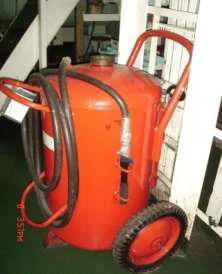
Portable: Water (9 L), AFFF Foam (9 L), Dry Chemical Powder (4.5 kg), CO2 (4.5 kg).
Semi-Portable: 45 L foam trolley, 136 L main boiler/engine room wheeled units, 16 kg CO2 sets.
Fixed Extinguishing Systems
High-pressure CO2 total flooding for engine room and cargo holds • High-pressure freshwater hypermist • Automatic quartzoid sprinkler systems • Deck foam monitors for tankers • Fire main and hydrant line.
Fireman's Outfit (SOLAS)
Self-Contained Breathing Apparatus (SCBA) with 1200 L air (≥30 min) • Flame-retardant suit, waterproof boots & gloves • Non-conducting safety helmet & rigid non-sparking axe • Explosion-proof safety lamp • Steel-core lifeline.
Critical Support Equipment
Emergency fire pump (independent diesel/electric outside E/R) • Emergency generator (45-second start) • Quick Closing Valves (QCV) pneumatic/hydraulic bank • International Shore Connection (ISC) • Fire Control Plan.
2. SOLAS Portable Extinguisher (PFE) Rules
For "what does SOLAS say about portable extinguishers?" (Q19a), give the regulation as a checklist:
- Portable fire extinguishers (PFE) shall be provided in accommodation, service spaces and control stations, of appropriate type and in sufficient number to the satisfaction of the Administration.
- Minimum number: ships of 1000 GT and above shall carry at least 5 portable extinguishers.
- Size limits: total weight shall be not more than 23 kg, and capacity of the fluid not less than 9 litres and not more than 13.5 litres.
- Stowage: one of the extinguishers intended for use in any space shall be stowed near the entrance to that space.
- CO2 extinguishers shall not be used in accommodation spaces.
- Extinguishers shall be situated ready for use at easily visible positions.
- Each extinguisher shall be provided with a device indicating whether it has been used.
- Spare charges: spares shall be provided for 100 percent of the first 10 extinguishers and 50 percent of the remaining extinguishers capable of being recharged on board — but not more than 60 total spare charges are required.
- For extinguishers which cannot be recharged on board, additional extinguishers of the same quantity, type and capacity shall be provided in lieu of spare charges.
"Why no CO2 in accommodation?" — because CO2 smothers by displacing oxygen and is an asphyxiation risk in cabins and alleyways. Say no CO2 in accommodation firmly and move on.
3. Water Soda-Acid & Foam Mechanical Types
These are the two liquid-medium portables. Learn each under the same headings: principle, use, safety, body, charge, throw, working.
Water type (soda-acid) portable:
- Working principle: cooling effect.
- Use: carbonaceous Class A fires.
- Safety: relief hole and safety pin.
- Body: solid drawn steel, internally zinc coated.
- Charge: CO2 cartridge 74 g (varies with cylinder weight and capacity) at 36 bar pressure, plus 9 litres minimum of water.
- Throw: 6 m jet for 60 seconds.
Water type — operation:
- Carry the extinguisher near the fire and keep it towards the fire.
- Remove the safety pin and strike the plunger to pierce the CO2 cartridge.
- When pierced, pressure builds in the upper part of the container and water rises through the dip tube and is thrown as a jet spray.
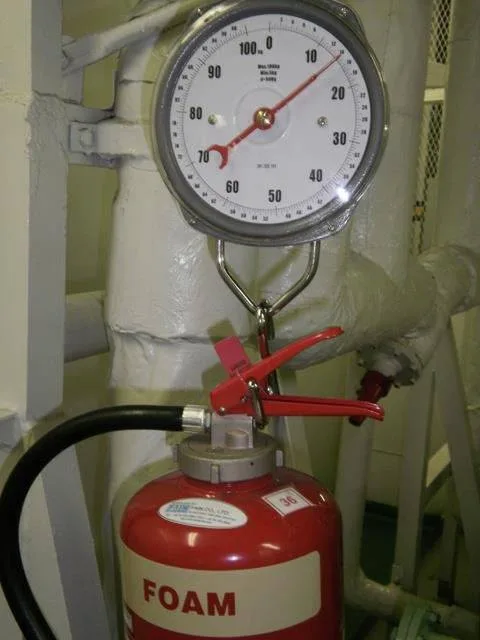
Mechanical foam type portable:
- Working principle: smothering effect.
- Use: volatile petroleum, paint and oil — Class A and B fires.
- Safety: relief hole and safety pin.
- Body: solid drawn steel, internally zinc coated.
- Charge: CO2 cartridge 74 g (varies with cylinder weight and capacity) at 36 bar pressure, plus foam liquid at AFFF 97 percent water to 3 percent concentrate.
- Throw: 6 m jet for 60 seconds.
Foam type — operation and technique (Q19e):
- Carry the extinguisher near the fire, keep it towards the fire, remove the safety pin and strike the plunger to pierce the CO2 cartridge — pressure drives the foam up the dip tube as a jet spray.
- Do not allow foam to strike the surface of the burning liquid.
- Direct the foam at some nearly vertical surface so that it runs down the side and blankets the liquid.
- If no vertical surface is found, keep a distance such that the discharge falls gently on the liquid surface.
- Use the same manufacturer for refills, and if using a pre-mix fluid, do not increase or decrease the proportion — it affects extinguisher efficiency.
| Specification | Water (Soda-Acid / Gas Cartridge) | Mechanical Foam (AFFF) |
|---|---|---|
| Fire Class Rating | Class A (Wood, paper, textiles) | Class A & Class B (Flammable liquids, oil, paints) |
| Extinguishing Action | Cooling (Removes heat below flashpoint) | Smothering & Cooling (Aqueous film seals fuel vapours) |
| Standard Charge | 9 Litres freshwater + 74 g CO2 cartridge | 9 Litres (97% freshwater + 3% AFFF concentrate) |
| Discharge Jet & Time | 6 metres for 60 seconds | 6 metres for 60 seconds |
| Tactical Discharge Method | Direct jet straight into the seat of the fire | Aim at vertical bulkhead so foam runs down gently; never plunge jet directly into liquid |
4. CO2 & DCP Types, FSS Markings and Semi-Portables
The two gas-and-powder portables plus the markings plate and the larger semi-portable units:
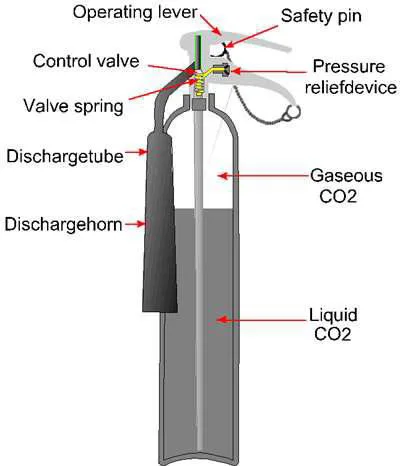
CO2 type portable:
- Working principle: smothering effect.
- Use: oil, electrical, petroleum products and gaseous substances in enclosed spaces — Class B.
- Safety: control valve or safety valve, pressure-relief device and safety pin.
- Discharge hose of non-conductive material.
- Body: solid drawn steel, internally zinc coated.
- Charge: CO2 4.5 kg (varies with cylinder weight and capacity) at 53 bar pressure.
- Throw: 3–4 m jet for 20 seconds.
- Pressure tested to 210 kg per sq cm before recharging.
- Recharge only ashore, when the weight has reduced by 10 percent and more.
- Storage: at least 750 mm above the floor, never where it is likely to gain heat from surrounding equipment or processes.
CO2 type — operation:
- Carry the extinguisher near the fire and remove the safety pin.
- Direct the hose at the base of the fire, starting at one edge and sweeping across the burning surface.
- In open air, stand on the upwind side of the fire.
- On electrical equipment, first switch off the current supply.
DCP (dry chemical powder) type portable:
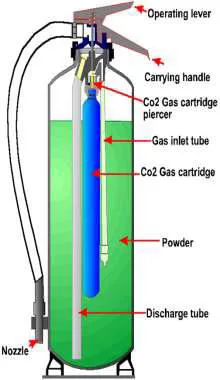
- Working principle: smothering effect.
- Use: oil, electrical, petroleum products and gaseous substances in enclosed spaces — Class A, B, C, D and electrical — the all-rounder.
- Safety: safety pin and relief hole, plus an inner container for the CO2 cartridge — sodium bicarbonate would freeze on direct contact with CO2 because CO2 is a cool gas.
- Body: solid drawn steel, internally zinc coated.
- Charge: inner shell CO2 60 g (varies with weight and capacity); outer shell 4.5 kg of DCP powder — a mixture of sodium bicarbonate plus magnesium stearate, NaHCO3 + Mg(C18H35O2)2.
- Magnesium stearate is added so the powder does not choke; if choking occurs, remove and replace with a fresh charge.
- Throw: 3–4 m for 20 seconds.
- Pressure tested to 35 kg per sq cm before recharging, once in 3 years.
DCP type — operation:
- Carry the extinguisher to the fire and keep it upright.
- Remove the safety pin and strike the plunger — CO2 escapes into the main shell and pushes the powder out in the form of fog.
- Outdoors, operate from the upwind side for better range.
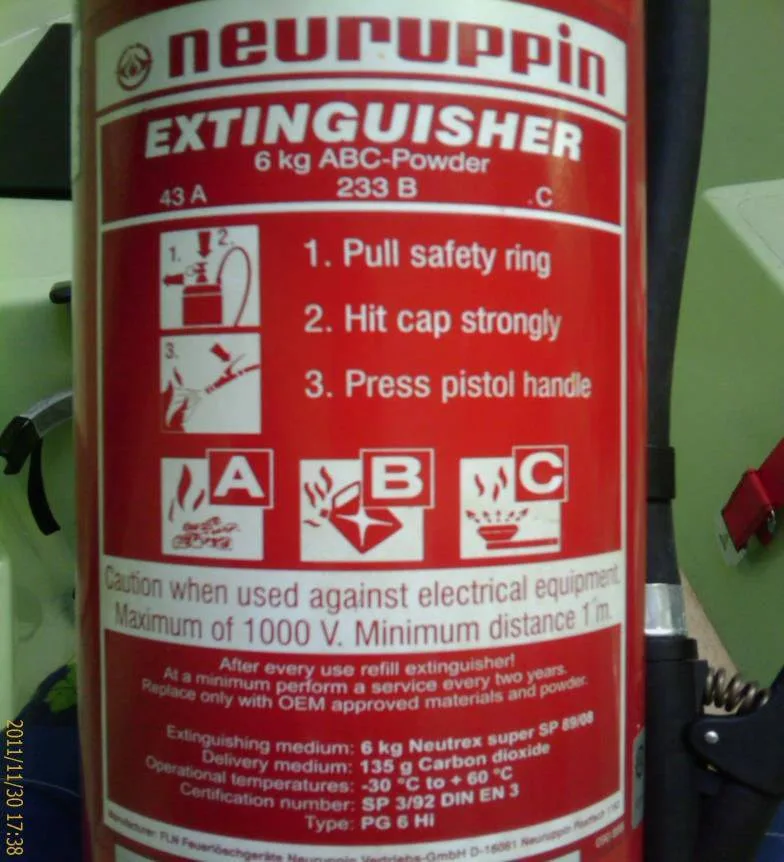
| Parameter | CO2 (Carbon Dioxide) 4.5 kg | DCP (Dry Chemical Powder) 4.5 kg |
|---|---|---|
| Classes Suitable | Class B (flammable liquids) & Electrical equipment | Class A, B, C, D & Electrical equipment (All-rounder) |
| Extinguishing Medium | 4.5 kg liquid CO2 under 53 bar saturated vapour pressure | 4.5 kg NaHCO3 (Sodium Bicarbonate) + Mg Stearate (Anti-coagulant) |
| Propulsion Mechanism | Self-expelling high-pressure gas (53 bar @ 20 °C) | Separate internal 60 g CO2 gas cartridge (prevents caking/freezing) |
| Discharge Throw & Time | 3–4 metres for 20 seconds | 3–4 metres for 20 seconds |
| Hydraulic Test Pressure | 210 bar (kg/cm²) before recharging | 35 bar (kg/cm²) every 3 years |
| Discharge Horn / Hose | Non-conductive composite discharge horn with insulated grip | Flexible discharge hose with squeeze control nozzle |
| Tactical Technique | Approach upwind, sweep base of fire edge-to-edge; isolate electrics | Keep strictly upright, discharge fog cloud from upwind edge |
Markings on the extinguisher (as per FSS Code — 8 items):
- Name of the manufacturer.
- Type of fire for which the extinguisher is suitable.
- Quantity and type of extinguishing medium.
- Approval details.
- Instructions for use and recharge.
- Year of manufacture.
- Temperature range over which the extinguisher will operate.
- Test pressure.
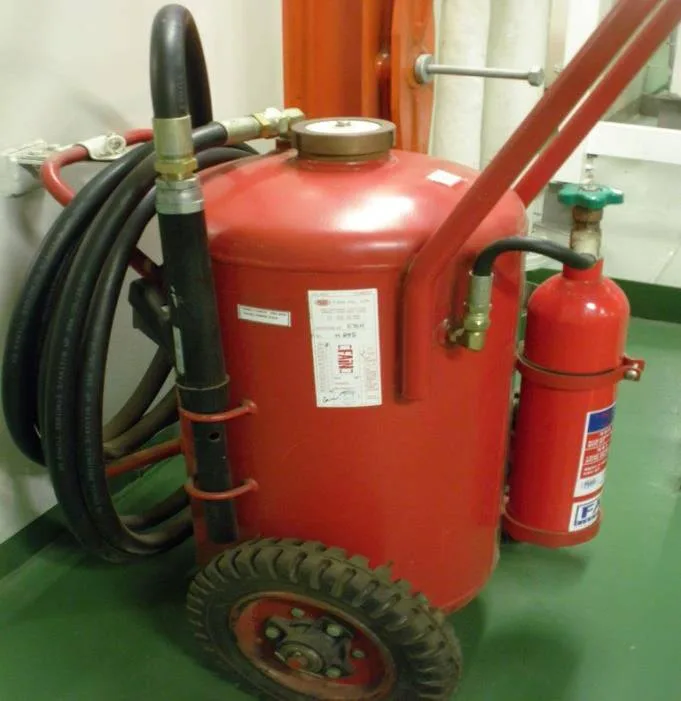
Semi-portable extinguishers:
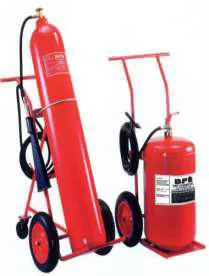
- Types: CO2, dry chemical powder and mechanical foam.
- Propellant: externally fitted CO2 cartridge.
- Capacity: 55 litres or kg (varies).
- Discharge mechanism: 15 m hose-reel type.
- Period of discharge: maximum 3 minutes.
- Head assembly: brass with tell-tale hole relief system; the CO2 cartridge operating lever carries a safety pin.
- Maintenance: weekly physical inspection and annual complete servicing.
- Location: CO2 adjacent to the MSBD; DCP and foam at the boiler and purifier rooms.
| Type | Principle | Classes | Charge | Throw / Time | Test |
|---|---|---|---|---|---|
| Water soda-acid | Cooling | A | 74 g CO2 @ 36 bar + 9 L | 6 m / 60 s | Relief hole + pin |
| Foam mechanical | Smothering | A + B | AFFF 97/3 | 6 m / 60 s | Same-maker refill |
| CO2 | Smothering | B + elect + enclosed | 4.5 kg @ 53 bar | 3–4 m / 20 s | 210 kg/cm²; recharge @ 10% |
| DCP | Smothering | A–D + elect | 4.5 kg + 60 g CO2 | 3–4 m / 20 s | 35 kg/cm² every 3 yr |
5. Maintenance Tables, Weighing & Anti-Choke Drill
For "weekly, monthly and yearly maintenance?" (Q19b), give one table per type — the surveyor listens for weighing, plunger, spring, relief hole and the pressure-test figure:
Water and foam — weekly / monthly / yearly:
- Weekly: check the exterior and clean it; check the nozzle outlet and clean it; check the relief hole and clean it.
- Monthly: check the internal condition; check the gas cartridge; check the plunger; check the spring; carry out weighing of the cylinder.
- Yearly: pressure test at 35 bar before recharging.
CO2 — weekly / monthly / yearly:
- Weekly: check the exterior and clean it; check the hose outlet and clean it.
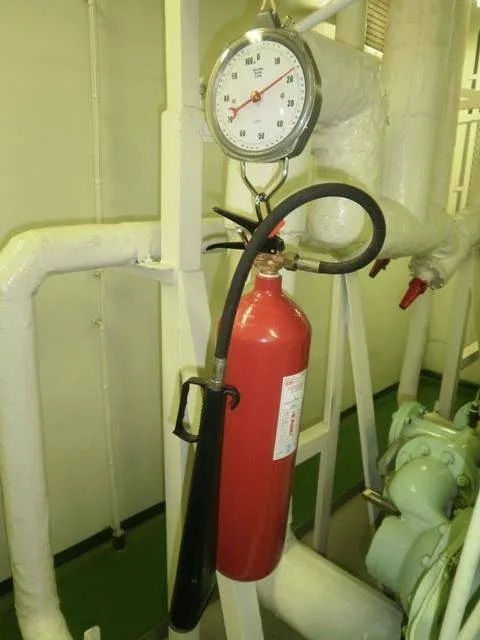
- Monthly: carry out weighing of the cylinder — if 10 percent less, send ashore for recharge.
- Yearly: pressure test at 210 kg per sq cm before recharging.
DCP — weekly / monthly / yearly / 3-yearly:
- Weekly: check the exterior and clean it; check the pressure-indicating needle — it must sit in the green zone; check the nozzle outlet and clean it; check the relief hole and clean it.
- Monthly: check the internal condition and the powder for any choking effect; check the gas cartridge; check the plunger; check the spring; the extinguisher must be inverted once a month to avoid choking of the powder; carry out weighing of the cylinder.
- Yearly: one-third of the total number of extinguishers should be put into operation for evaluating their satisfactory performance.
- 3-yearly: as per IMO, pressure test at 35 bar before recharging.
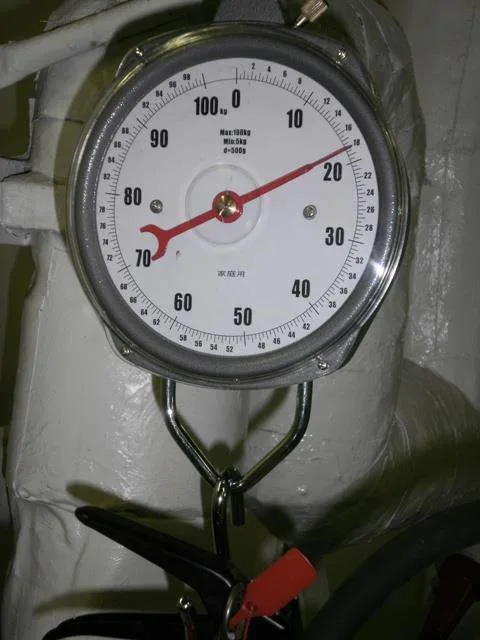
Weighing the extinguisher (Q19c):
- Weigh the cylinder and compare against its charged weight — CO2 types go ashore for recharge at 10 percent loss.
- On DCP, the magnesium stearate keeps the powder free-flowing, but if choking is found, remove and replace with a fresh charge.
- Invert every DCP monthly as the anti-choke routine — this single line is the favourite DCP follow-up.
Close every maintenance answer with weighing of the cylinder: water and foam monthly, CO2 monthly with 10 percent ashore rule, DCP monthly with the invert-and-check-choke routine, and the one-third yearly live test for DCP.
6. Operation Drill — Answering the Surveyor on the Spot
The surveyor's favourite cross-check is "show me how you use it" — answer with hands, wind and switches, not just numbers:
- Water and foam: carry near the fire, face the fire, pin out, strike the plunger, dip-tube jet — foam then goes vertical-surface-or-gentle-fall, never a direct strike.
- CO2: carry near the fire, pin out, hose at the base, edge-to-edge sweep — upwind outdoors, switch off electrics first.
- DCP: carry to the fire, keep upright, pin out, strike the plunger, fog discharge — upwind outdoors for range.
- Failed vertical surface? Hold the distance so the foam falls gently on the liquid — say this exact line for Q19e.
- Wrong proportion? Pre-mix off-ratio kills efficiency — same maker, same ratio, every refill.
- Used or not? Point at the used-indicator and the green-zone needle on DCP before you touch anything.
Recite cold: 23 kg / 9–13.5 L / 5 at 1000 GT / 60 spares max, water and foam 74 g at 36 bar, 6 m, 60 s, CO2 and DCP 4.5 kg, 3–4 m, 20 s, CO2 53 bar, 210 test, 750 mm, 10 percent ashore, DCP 60 g inner, 35 test at 3 years, invert monthly, one-third yearly.