
LSA Chapter 5: Lifeboats — Types, Engine, Davit & Drills
Open, enclosed and freefall lifeboats: compression-ignition engines, post-2014 hooks, 30 items of equipment, gravity davits and weekly/monthly maintenance.
Key Principles at a Glance 8 points
- Lifeboats are open, partially or totally enclosed, or freefall launched from aft; every boat carries an approval certificate stating maker name and address, model and serial, month and year of manufacture, and persons capacity.
- Strength rules demand launching fully loaded, launching and towing at 5 knots headway in calm water, withstanding a 3.5 m/s lateral impact plus a 3 m drop when loaded with complement, skates and fenders, and no boat exceeding 150 persons.
- Merchant boats are sized by ship type and complement, stowed both sides port and starboard, painted international bright orange with ship name; ships of 20,000 GT and above must launch at 5 knots headway, and at least 1 rescue boat with designated crew is carried.
- The compression-ignition engine uses fuel of flash point above 43 °C, may be 2- or 4-stroke started by hand or power from accumulator batteries or hydraulics with 2 independent sources, starts at 15 °C within 2 minutes, runs flooded to crankshaft waterline, drives 6 knots loaded for 24 hours plus towing the biggest raft at 2 knots with 25 persons, and runs 5 minutes cold out of water with naphtha or butane spray.
- Post-2014 hooks must carry no load on the release mechanism, have non-opening locking devices with hydrostatic auto-reset interlocks, and tanker enclosed boats add self-righting, self-contained air with oxygen release over fire, and sprinkler protection.
- The 30 equipment items run from 2 boat hooks and sufficient buoyant oars through 6 hand flares, 4 rockets, 2 smokes, EPIRB, food 500 g and water 500 ml per person per day for 3 days, 3 tin openers, 50 seasickness tablets, 2 buckets, 2 painters up to 15 m and a tool set, marked in Roman alphabet with 8 entries.
- Gravity davits work at 15 degrees heel with gripes, falls lower at or below 36 m per minute by centrifugal brake, hoist at or above 0.3 m per second, and are guarded by 6 safeties led by the dead-man handle; maintenance is weekly engine runs ahead and astern with battery, linkage, limit-switch and embarkation lowering plus 3-monthly launching with a round turn.
- No-start checks run a 12-point list from empty tank to defective starter motor; the dead-man handle lowers only while held and releases the boat about 1 m above the water, with off-load release on water contact and on-load release by inside lever; freefall boats follow seat, trim, list, 1.3-times-height and release-system rules.
1. Types, Approval & Strength Regulation
When the surveyor asks "what are the types of lifeboat?", name all three families:
- Open lifeboat: as the name suggests it has no roof and is normally propelled by manual power using hand-propelled oars; a compression-ignition engine may also be fitted. Open boats are becoming obsolete under stringent safety norms but survive on older ships — they give little help in rain or bad weather and the possibility of water ingress is highest.
- Closed lifeboat: the most popular type — enclosed, saving the crew from seawater, strong wind and rough weather, with higher watertight integrity and the ability to get upright on its own if toppled by waves. Further classified as partially enclosed and fully (totally) enclosed lifeboats.
- Freefall lifeboat: similar to an enclosed boat but launched entirely differently — aerodynamic so it penetrates the water without damaging the body. Located at the aft of the ship, giving maximum clear area for free fall.
Approval certificate — four entries:
- Each lifeboat is fitted with a certificate of approval endorsed by the Administration containing at least: manufacturer name and address; lifeboat model and serial number; month and year of manufacture; number of persons approved to carry.
Strength and sizing rules to quote:
- Of sufficient strength to safely launch when fully loaded with full complement of persons and equipment.
- Capable of being launched and towed when the ship is making headway at 5 knots in calm water.
- Except freefall boats, each falls-launched boat must withstand, when loaded with full complement and equipment with applicable skates or fenders in position, a lateral impact against the ship side at at least 3.5 m/s and also a drop into water from at least 3 m.
- Maximum persons: no lifeboat carries more than 150 persons.
- Size, number and capacity for a merchant vessel are decided by the type of ship and number of crew; minimum two lifeboats provided, one on each side (port and starboard).
- Ships of 20,000 GT and above must be capable of launching when heading at 5 knots.
- The ship must carry one rescue boat — one lifeboat may be designated as the rescue boat if more than one lifeboat is present.
- Gravity davits must hold and slide the boat down even when heeled 15 degrees either side; ropes holding the boat in its cradle are called gripes.
- The wires that lift or lower the boat are the falls: descent speed not more than 36 m/min, controlled by centrifugal brakes.
- Hoisting speed not less than 0.3 m/s with the boat loaded to full capacity.
- The lifeboat must be painted in international bright orange with the ship name painted on it.
150 persons maximum, 5 knots launch-and-tow and 5 knots headway launch at 20,000 GT, falls impact at 3.5 m/s with 3 m drop, davit heel 15 degrees, descent capped at 36 m/min and hoist at 0.3 m/s.
Open Lifeboat
Traditional open hull powered by oars or compression-ignition diesel. Superseded on modern international cargo and tanker tonnage by enclosed craft.
Partially Enclosed
Rigid permanent canopy at bow and stern with foldable canvas shelter in midships. Fitted primarily on passenger ships for rapid embarkation and sheltering.
Totally Enclosed (TEML)
Inherently self-righting when fully loaded and battened down. Tanker versions carry compressed air cylinders (≥10 min positive pressure) and external water-spray deluge fire protection.
Freefall Lifeboat
Stern ramp skid launch. Sliding entry converts gravity into forward hydrodynamic momentum, making positive headway instantly to clear the vessel even against 10° trim and 20° list.
Strength & Statutory Rules
Max capacity 150 persons. Towing capability 5 knots in calm water. Capable of launching under 5 knots headway for ships ≥20,000 GT. Falls impact test 3.5 m/s.
2. Engine, Fuel System & Release Hooks
For "tell me about the lifeboat engine", build the answer from fuel to propeller:
- Type: powered by a compression-ignition engine; no engine may be used if its fuel has a flash point of 43 °C or less.
- Cycle and start: either two-stroke or four-stroke, started either by hand or by power.
- Power starting uses accumulator batteries or hydraulics, with two independent rechargeable energy sources normally provided.
- Any starting method must start the engine at 15 °C ambient within 2 minutes of commencing the starting procedure.
- Flooded running: capable of operating with the boat flooded up to the waterline of the crankshaft.
- Gearbox: power transmitted through a gearbox capable of disengaging the engine and engaging ahead or astern.
- Exhaust: pipe arranged to prevent water entering the engine during normal operation.
- Cold start: starting aids fitted as necessary to start at −15 °C within 2 minutes.
- Speed and endurance: speed at least 6 knots with a full complement of persons and equipment; fuel capacity sufficient to run at 6 knots for not less than 24 hours.
- Towing capacity: sufficient to tow a 25-person life raft loaded with its full complement at not less than 2 knots.
Release hooks — the 2013–2019 SOLAS redesign (Nitin Kumar):
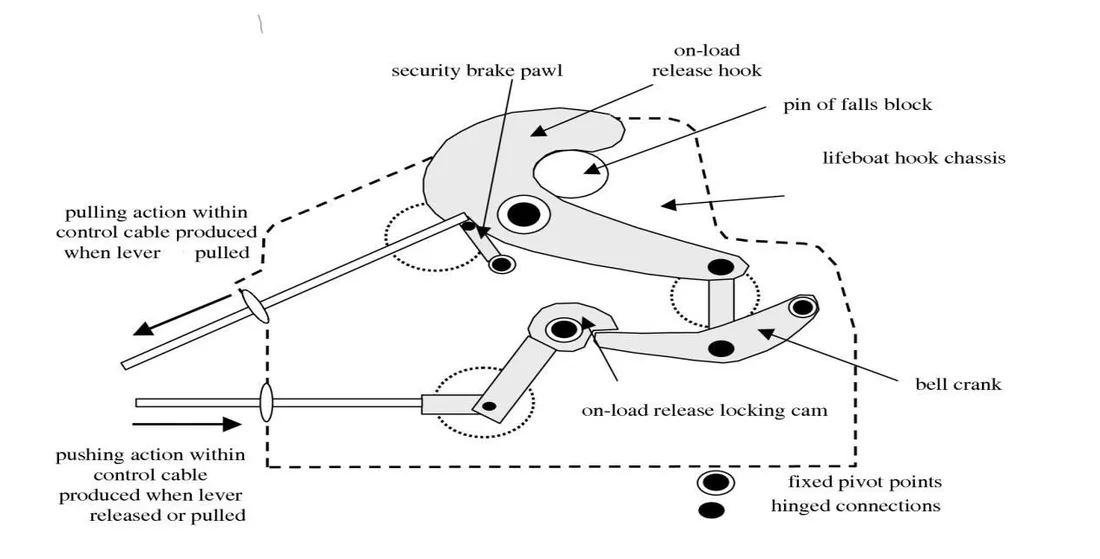
- Older lifeboat hooks suffered accidental release while suspended from davits. Revised hook rules apply from 1 January 2013: new criteria for hook stability, locking devices, hydrostatic interlocks and the release mechanism.
- No load on release mechanism: the geometry ensures cable and release lever forces do not open the hook while supporting the boat's weight.
- Hydrostatic interlock (off-load safety): prevents manual release until the boat is floating and water pressure moves the diaphragm, unlocking the release handle — the interlock resets itself on lifting the boat clear of the water.
- Fall preventer devices (FPDs): by 1 July 2019 every lifeboat needs FPDs plus the on-load release and retrieval system fitted.
- Emergency on-load override: allows release under load (e.g. rough seas, ship sinking quickly, or fire around the falls) by breaking a tamper-evident seal and pulling an override lever.
Four instruments the surveyor points at:
- Inclinometer — angle of heel. Chronometer — universal (GMT) time. Anemometer — wind velocity. Barometer — atmospheric pressure.
Tanker lifeboats with fire-protection and self-contained air:
- Fire-protected lifeboats: when waterborne, capable of protecting occupants through a continuous oil fire envelope for not less than 8 minutes.
- Water-spray system: engine-driven seawater pump draws from beneath the boat and sprays water over the entire exterior canopy through a piping manifold.
- Self-contained air system: bank of compressed air bottles supplies breathing air for the full complement and engine combustion air for not less than 10 minutes, maintaining positive pressure inside the cabin to prevent ingress of smoke and toxic gases.
3. Lifeboat Equipment (30 Items) & Markings
A surveyor asking "what is inside the lifeboat?" expects the 30 SOLAS inventory items structured logically:
| Category | SOLAS Equipment Items |
|---|---|
| Boat Handling & Propulsion | Buoyant oars (pair) with crutches, 2 boat hooks, buoyant bailer, 2 galvanized buckets, survival craft compass in binnacle, sea anchor (drogue) with hawser and tripping line, 2 painters (one toggle painter secured fwd). |
| Signalling & Pyrotechnics | 4 rocket parachute flares, 6 hand flares, 2 buoyant smoke signals, 1 electric torch with spare batteries/bulb in watertight case, 1 daylight signalling mirror, 1 whistle, 1 radar reflector, 1 EPIRB, 1 SART. |
| Sustenance & Medical | Airtight food rations (≥10,000 kJ per person), watertight water containers (3 litres per person, of which 1 L may be replaced by desalting apparatus), rustproof drinking cup with lanyard, 3 tin openers, 1 first aid outfit, 50 seasickness doses per person + seasick bags. |
| Tools & Protection | 1 jackknife with lanyard attached to boat, 1 set fishing tackle, 2 thermal protective aids (TPAs) or 10% of complement, 1 portable fire extinguisher (oil-rated), 1 searchlight (6 h operation), bilge pump. |
Statutory Lifeboat Markings (8 Items):
- 1 — Ship name: painted in block Roman letters on both bows.
- 2 — Port of registry: marked clearly on both bows.
- 3 — Lifeboat number: odd numbers on starboard, even numbers on port.
- 4 — IMO ship identification number: clearly marked.
- 5 — Call sign: ship radio call sign.
- 6 — Principal dimensions: length, breadth, and depth.
- 7 — Carrying capacity: number of persons approved.
- 8 — Retro-reflective tape: fitted on hull and canopy for radar and searchlight location.
30 Equipment Items Grouped
Propulsion & Handling: Oars, 2 boat hooks, compass, sea anchor, 2 painters.
Signalling: 4 rockets, 6 hand flares, 2 smoke signals, torch, mirror, whistle, radar reflector, SART, EPIRB.
Sustenance: Food 10,000 kJ/p, water 3 L/p, cup, 3 tin openers, first aid, 50 seasick doses.
Repair & Survival: Jackknife, fishing gear, 2 TPAs, extinguisher, searchlight, pump.
Statutory Markings & Colors
Painted in international bright orange with high-intensity retro-reflective tape. Marked on bows in clear Roman capital block letters: Ship name, Port of registry, Boat number (odd starboard / even port), IMO number, Call sign, Principal dimensions, Approved persons capacity.
Rescue Boat Drill — Seven Numbers (Clyde)
Rigid or inflatable, 3.8 m to 8.5 m long: 6 knots for 4 hours manoeuvring; 5 seated persons + 1 lying on a stretcher; inboard or outboard engine; recovery within 5 minutes with full complement; launchable at 10° trim and 20° list. Stowage: 1 each side on ships ≥ 500 GT, 1 boat on ships < 500 GT (passenger ships ≥ 500 GT carry at least 1 per side); a lifeboat may count as the rescue boat if launching and recovery arrangements comply.
4. Davit, Maintenance, No-Start Checks & Lowering Drill
For "how does the davit work?", describe the gravity system with its numbers:
- Gravity davits swing out and lower by the boat's own weight, effective at 15 degrees heel either side with gripes securing the boat in the stowed position.
- Descent speed: not more than 36 m per minute, governed by a centrifugal brake.
- Hoisting speed: not less than 0.3 m per second on recovery with the boat fully loaded.
Lowering drill — the full deck sequence:
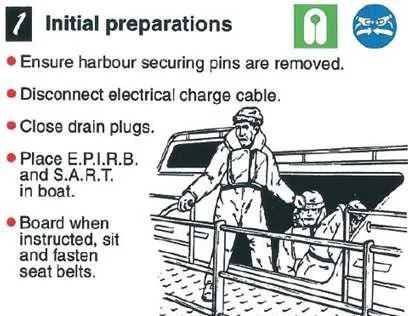
- One person goes inside the boat, passes the end of the toggle painter and plugs the drain.
- Check all lifelines and falls are clear of the boat.
- Make fast the other end of the toggle painter on a strong point forward of the ship.
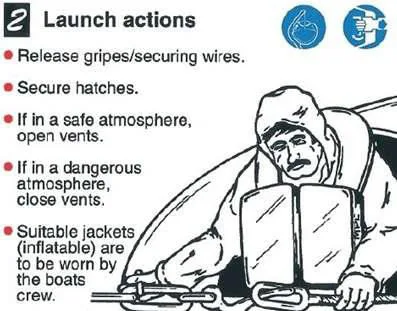
- Remove the forward and aft gripes; both persons stand by for passing the bowing tackle and tricing pendant.
- Remove the harbour safety pin.
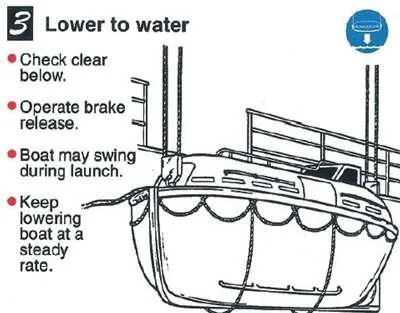
- Make sure the ship side is free of everything — no water or garbage outlet discharging.
- One person lifts the dead-man handle slowly, releasing the brake — the boat with its cradle slides downward to the embarkation deck.
- Pull the tricing pendant to bring the boat alongside the embarkation deck.
- Persons embark inside the boat.
- Remove the tricing pendant so the whole load comes on the falls, then lower further with the dead-man handle.
- The dead-man handle is nothing but a simple handle operated by only one person from inside; as soon as the boat comes to about 1 m above the seawater it can be released.
Lowering checks as the engineer:
- Battery properly charged.
- Rudder turning both port and starboard.
- Fuel tank, fuel pipe and lube-oil level.
- Air bottle pressure.
- Engine running in both directions — ahead and astern.
- Electrical connections.
- Bilge pump and plug condition.
- All tools in the toolbox.
- Shaft sealing.
Davit safety devices — six to name:
- 1 — Dead-man (dead hook) handle — lowering stops the instant the operator releases grip; the boat is lowered only while one person holds it.
- 2 — Harbour pin — locks the davit arm in harbour/stowed position.
- 3 — Winch upper limit switch — cuts hoisting before the blocks foul the davit head; cleaned and checked weekly.
- 4 — Drum brake — holds the falls on the winch drum under load.
- 5 — Release gear hook ring (release hooks) — post-2014 simultaneous-release hooks with locks and interlocks.
- 6 — Winch brake counterweight — assists controlled lowering and brake release.
Off-load versus on-load release:
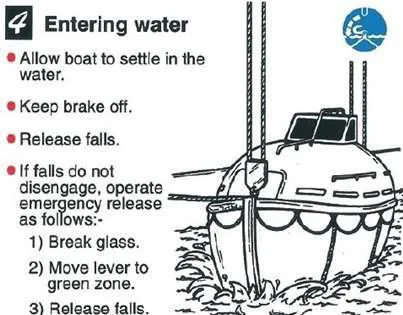
- Off-load: releases the boat after the load transfers to the water — when the boat touches the surface the load on the falls and hooks releases and the hooks detach; any crew member can remove a stuck hook. Often manually disengaged on malfunction — but in fire it is dangerous to go out and release the hook.
- On-load: releases the boat from the wire with the boat still above water and all crew inside — load still on the falls. Normally about 1 m height is kept so the fall is smooth without damaging the boat or harming the crew. A lever inside the boat operates it — safe without going outside when there is fire on board.
Maintenance and weekly checks:
- Engine trial weekly — propulsion checked both ahead and astern.
- Battery checks by the electrical officer, renewed about every 2 years.
- Mechanical linkages and electrical launching-gear equipment checked including lubrication; cleaning of the davit limit switch.
- Weekly the boat is lowered to the embarkation ladder and all davit mechanism inspected and checked.
- Winch hand-operated brake gets static and dynamic tests.
- The boat is launched once in 3 months and taken for a round to prove proper functioning.
- Tanker air system: the O2 cylinders are provided so oxygen is released when the boat passes through fire.
Lifeboat engine not starting — 12 checks:
- Empty fuel tank.
- Incorrectly attached fuel supply hose.
- Damaged fuel supply hose.
- Defective fuel pump.
- Contaminated fuel.
- Improper starting procedure.
- Faulty, spoiled or incorrectly positioned spark plug(s).
- Improper maintenance.
- Emergency shut-off de-activated.
- Undercharged starter battery.
- Loose electrical connections.
- Bad ignition coil and defective starter motor.
Crew member enters boat, screws in brass bottom drain plug, and passes toggle painter forward to a strong deck cleat. Check overside is completely clear of garbage chutes, ballast overboard valves, and flotsam.
Release forward and aft lashing gripes from davit arms. Rig tricing pendants and bowsing tackles. Remove the davit harbour safety locking pin.
Lift the dead-man brake handle; gravity davit arms swing out and lower boat to embarkation deck level. Secure bowsing tackles taut against ship side, board complement quickly, fasten 4-point harnesses, and release tricing pendants onto falls.
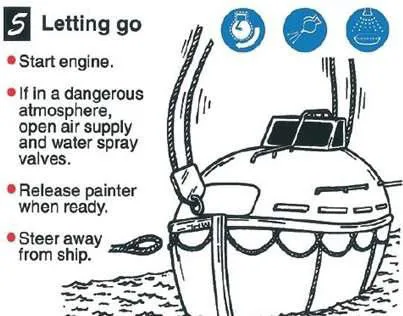
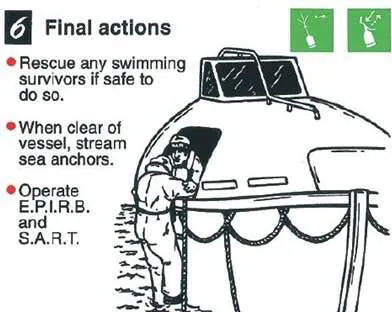
Operate dead-man handle from inside (or deck winch); centrifugal brake regulates descent to ≤36 m/min. At ~1 m above seawater, actuate on-load release handle (or allow hydrostatic off-load release upon floating), cast off toggle painter, and steer clear at 6 knots.
6 Davit Safeties: Dead-man brake handle • Harbour safety pin • Upper limit cut-off switch • Winch drum brake • Automatic resetting hook ring • Winch counterweight.
Common Engine No-Start Faults: Fuel valve shut / empty tank • Air lock in fuel line / contaminated fuel • Dead starter battery (<24V) • Emergency shut-off tripped • Loose electrical terminals • Defective solenoid/starter motor.
Dead-man handle use:
- Hold the handle to lower; release to stop instantly — never lash or wedge it open.
- Lower in short controlled stages, watching both falls; stop on any uneven fall, list change, or overside obstruction.
"When did you last lower and launch?" — lower to embarkation weekly, launch with round turn 3-monthly, engine ahead and astern weekly, battery about 2-yearly, davit descent capped at 36 m/min and hoist at 0.3 m/s.
5. Freefall Rules & Oral-Exam Rapid Fire
Freefall boats must meet totally-enclosed requirements plus the freefall rules below — the surveyor's favourite closing station:
- Capacity: the number of persons that can be provided with a seat without interfering with propulsion or equipment operation.
- Seat dimensions: width at least 430 mm; free clearance in front of the backrest at least 635 mm; backrest extending at least 1000 mm above the seat pan.
- Headway and clearing: must make positive headway immediately after water entry and not contact the ship after freefall launching against a trim up to 10° and a list up to 20° either way from the certification height when fully equipped and loaded with: full complement; occupants giving the most forward centre of gravity; occupants giving the most aft centre of gravity; operating crew only.
- Strength: must withstand, loaded with full complement and equipment, a freefall launch from at least 1.3 times the freefall certification height.
Release system — five rules:
- Two independent activation systems, operable only from inside the boat and marked in a contrasting colour.
- Must release under any loading from no load up to at least 200% of normal load of the fully equipped boat with its approved persons.
- Adequately protected against accidental or premature use.
- Designed to test the release system without launching the boat.
- Factor of safety 6 on ultimate material strength.
Seat Ergonomics & Safety
Every occupant provided with an aft-facing contoured seat: width ≥ 430 mm, forward leg clearance ≥ 635 mm, backrest height ≥ 1000 mm above seat pan. Fitted with 4-point shock-absorbing safety harness and head support.
Release Gear & Testing
Two independent release systems operable only from inside. Releases under any load from 0% to ≥200% of fully equipped boat weight. Factor of Safety 6. Fitted with secondary hydraulic test valve to test release gear without launching craft.
Freefall certificate extras — three entries:
- Beyond the fully-enclosed certificate, the approval must also state the freefall certification height, the required launching ramp length, and the launching ramp angle for that height.
Oral-exam rapid fire:
- "Engine?" — compression ignition, flash above 43 °C, 2/4-stroke, hand or power, 15 °C in 2 min, crankshaft-waterline flooding, 5 min cold, 6 kn / 24 h, tows biggest raft 2 kn / 25 persons.
- "Hooks?" — post-2014: no load on release gear, non-opening locks, hydrostatic auto-reset.
- "No start?" — run the 12-check list from empty tank to starter motor.
- "Markings?" — Roman alphabet: ship name, maker + trademark, serial, port, IMO, call sign, capacity, dimensions — orange hull.
- "Drill weeks?" — weekly engine + embarkation lowering, 3-monthly launch with round turn.
Quote the chain: fully loaded launch → 5 kn tow → 3.5 m/s + 3 m falls test → 43 °C fuel → 6 kn / 24 h → 36 m/min down → 0.3 m/s up → 1 m release → 3-monthly round turn — every number in one breath.