
Boiler Water Treatment, Testing, and Blowdown
Every litre of feedwater carries salts and gases that stay behind and concentrate — treatment holds the chemistry inside limits.
Key Principles at a Glance 8 points
- Untreated water causes four separate problems: scale and deposits, corrosion, foaming and carryover, and sludge accumulation.
- Calcium sulphate scale is the dangerous one — its solubility falls as temperature rises, so it deposits preferentially on the hottest surface where cooling matters most.
- Magnesium chloride breaks down to hydrochloric acid at boiler pressure, and the acid regenerates itself, so a small quantity does a great deal of damage.
- Chloride is the primary indicator of seawater ingress and a hard limit, not a target — a rising result is a leak to be found, not a number to be dosed away.
- Caustic alkalinity is measured separately from total alkalinity because caustic concentration, not total alkalinity, causes caustic embrittlement.
- Dose to the minimum that holds the tests in range, and inject slowly over a long period rather than in one large dose.
- Bottom blowdown is short, frequent blows of about 5 to 10 seconds — a single long blow stirs the whole boiler and loses water and heat.
- Treat the cause, not the reading: rising chloride means find the leak; falling phosphate means find what is consuming it.
1. Why the boiler water must be controlled
Feedwater is never pure. Every litre carries dissolved salts, dissolved gases, suspended matter, and sometimes oil. As steam leaves the boiler, those impurities stay behind and concentrate. Without control, the concentration rises until the water starts to attack the boiler or throw solids out with the steam.
Untreated water causes four separate problems:
Scale and deposits — solids precipitate onto hot surfaces and insulate them.
Corrosion — the water chemistry becomes aggressive to steel and copper alloys.
Foaming and carryover — dissolved solids and oil make the water surface frothy, and water leaves with the steam.
Sludge accumulation — precipitated solids settle in low-velocity areas and choke circulation.
Water treatment exists to do five things:
- Keep the water alkaline so acidic attack cannot proceed.
- Precipitate or complex hardness so it leaves as removable sludge instead of hard scale.
- Remove dissolved oxygen before it pits the metal.
- Keep dissolved solids below the level at which foaming starts.
- Protect the condensate and feed system, so corrosion products do not accumulate in the boiler.
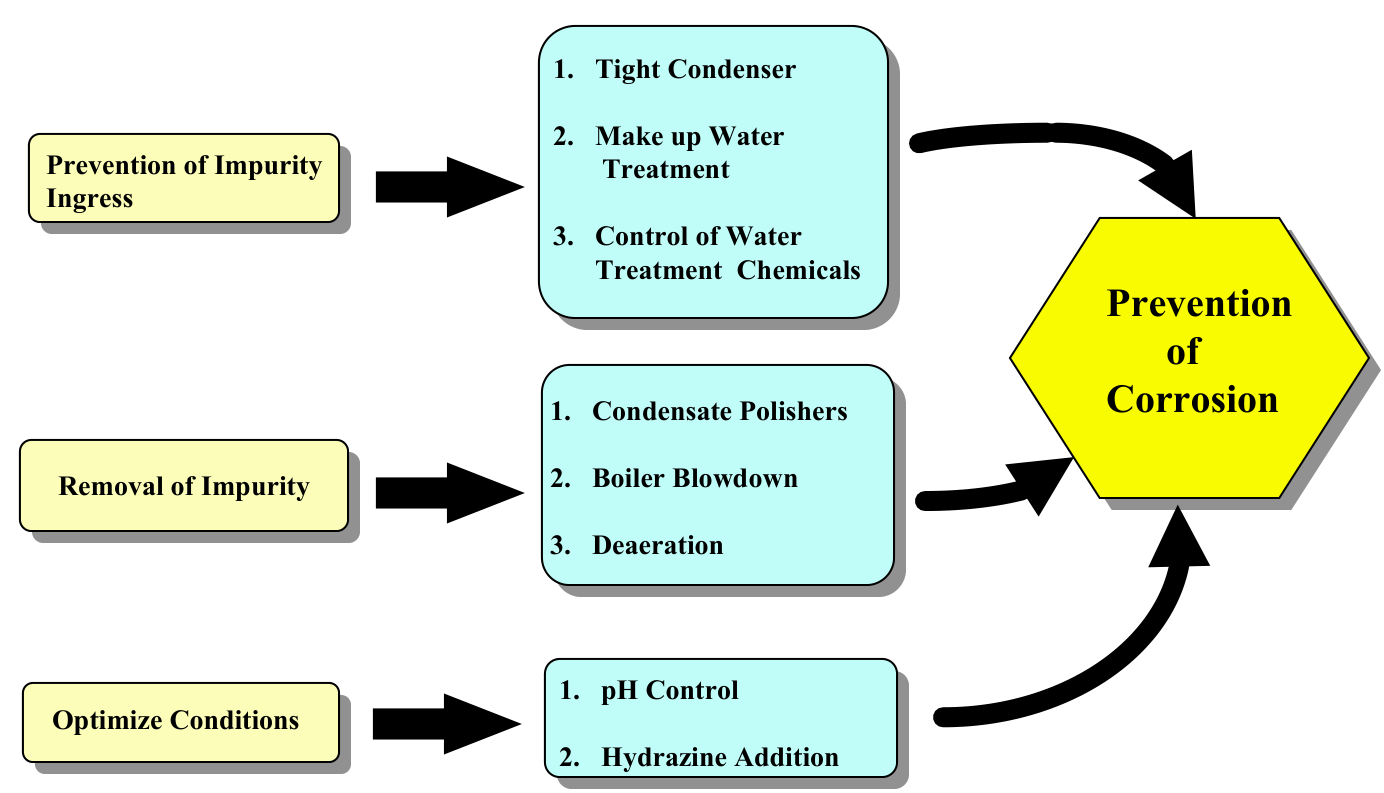
Every activity in this topic sits under one of those five aims. Dosing, testing, and blowdown are not separate rituals — they are the three controls that hold the chemistry inside its limits.
2. What is dissolved in the water
2.1 Classification of salts
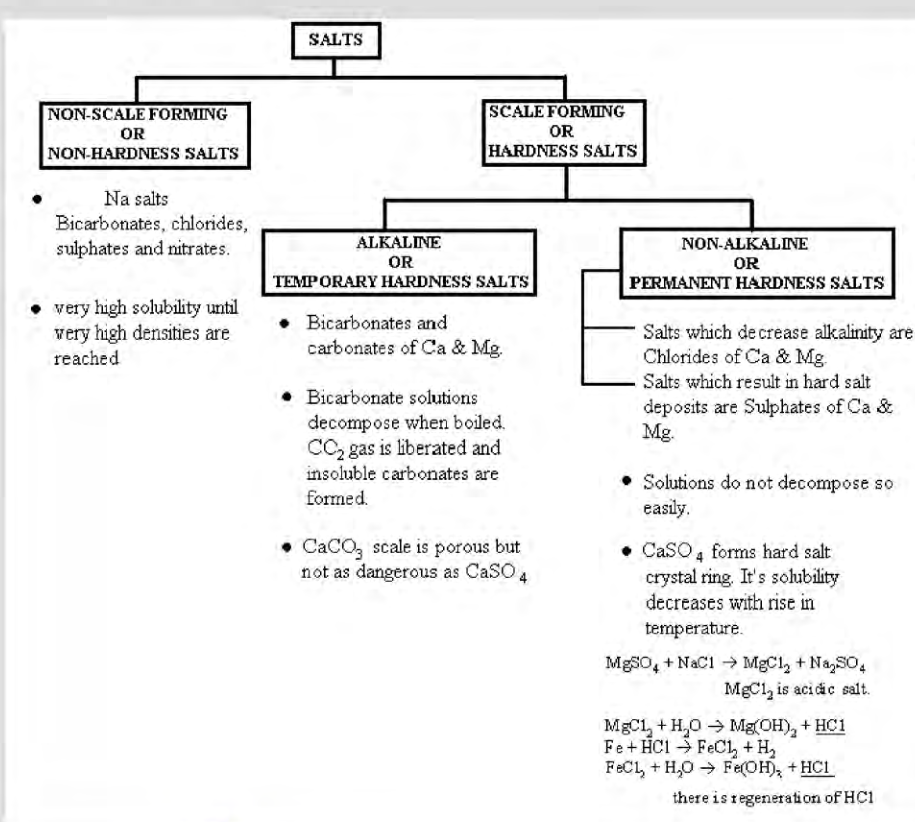
Non-scale-forming or non-hardness salts
- Sodium bicarbonates, chlorides, sulphates, and nitrates.
- Very high solubility; they remain dissolved until very high density is reached.
- They do not form scale, but they raise total dissolved solids, promote foaming, and carry chloride that accelerates corrosion.
- Sodium salts can also concentrate under deposits and in crevices and produce alkaline conditions that crack steel.
Scale-forming or hardness salts
Alkaline or temporary hardness salts — bicarbonates and carbonates of calcium and magnesium:
- Bicarbonate solutions decompose when boiled. Carbon dioxide is driven off and insoluble carbonate is left behind.
- Calcium carbonate scale is porous, and less dangerous than calcium sulphate scale, but it still insulates the tube.
Non-alkaline or permanent hardness salts — chlorides and sulphates of calcium and magnesium:
- These solutions do not decompose readily on boiling.
- Calcium sulphate forms a hard crystalline ring. Its solubility falls as temperature rises, so it deposits preferentially on the hottest surface — exactly where cooling is most critical.
- Magnesium chloride is thermally unstable at boiler pressure and temperature. It breaks down to hydrochloric acid, and that acid attacks the metal. The reaction regenerates itself:
The acid is regenerated each cycle, so a small quantity of magnesium chloride can do a great deal of damage. This is why chloride control is treated as a hard limit, not a target.
2.2 Dissolved gases
Oxygen enters with cold feedwater and through any point in the system below atmospheric pressure. It causes pitting — local, deep, and able to perforate a tube while the rest of the surface looks healthy.
Carbon dioxide dissolves to form carbonic acid. It comes from bicarbonate decomposition in the boiler and from air ingress. It lowers pH and attacks both boiler metal and condensate lines.
Removing oxygen is easier before it reaches the boiler, so deaeration and scavenger dosing are both used. The mechanical deaerator removes the bulk; the chemical scavenger mops up the remainder.
2.3 Other sources of trouble
Oil and grease — from fuel heating coils, lubricating systems, or contaminated returns. Oil coats tube surfaces, prevents the water from wetting the metal, promotes overheating and foaming, and resists blowdown.
Treatment: the immediate response is dosing a coagulant such as sodium aluminate or a liquid coagulant, which breaks the oil out into a removable form, followed by blowdown. Find the source — usually a leaking fuel oil heater coil or an overflowing lubricating oil point.
Iron and copper oxides — corrosion products carried in from the feed and condensate system. They settle on tube plates, support plates, and in low-flow regions.
Suspended matter — sand, dirt, and debris from make-up water or from poor tank condition.
3. What each problem does to the boiler
3.1 Scale and deposits
Scale is a poorer conductor of heat than steel. A thin layer raises the metal temperature well above the water temperature, and the tube loses its design margin.
Consequences:
- Tube metal temperature rises; strength falls.
- Bulging, cracking, and eventually rupture.
- Reduced heat transfer, so more fuel for the same steam.
- Narrowed passages and reduced circulation, which makes the deposit grow faster.
- Deposits hide crevices where corrosion concentrates.
Because deposits collect most heavily where heat flux is highest, failure happens first at the hottest tubes, not uniformly.
3.2 Foaming, priming, and carryover
Foaming is the build-up of a stable froth on the water surface. Priming is the entrainment of water droplets with the steam. Carryover is the general name for anything leaving the drum that should not — water, salt, or both.
Causes:
- High total dissolved solids, especially chlorides and sodium salts.
- High alkalinity.
- Oil or organic contamination.
- Sudden, large load change.
- Insufficient blowdown.
- Water level too high.
- Damaged or displaced steam separating equipment.
Effect: dissolved salts are carried in the steam, concentrate as the steam is used, and deposit on superheater tubes, valve seats, and turbine blades. Deposits on turbine blades change balance and reduce efficiency; deposits in superheater tubes cause overheating. Silica in particular can deposit in turbine blading and is very difficult to remove.
3.3 Corrosion mechanisms
Pitting — localised attack. Breaks through the protective oxide film in one small spot and eats downward. Oxygen and chloride drive it.
General and acidic corrosion — the whole surface thins. Low pH, carbon dioxide, and chloride are the usual causes.
Caustic attack (caustic embrittlement) — high caustic alkalinity concentrates in a crevice or under a deposit, dissolves the protective film, and causes intercrystalline cracking. The metal itself becomes brittle. Sodium carbonate in the water breaks down under heat and pressure into sodium hydroxide, which is why caustic alkalinity is measured separately from total alkalinity and limited more tightly.
At the surface the sodium hydroxide attacks the steel to form sodium ferrate, and the metal loses ductility.
Corrosion fatigue — a cyclic stress applied to an already-corroded surface. Cracks start at pits or at the base of corrosion grooves.
Crevice and deposit corrosion — oxygen cannot reach the area under a deposit while the surrounding water stays oxygenated. The difference in oxygen concentration sets up a corrosive cell, and the attack continues unseen under the scale.
Dezincification — selective removal of zinc from brass fittings and tube plates, leaving a weak copper sponge.
4. Treatment chemicals and what they actually do
4.1 Alkalinity control chemicals
Sodium hydroxide (NaOH) — strongly alkaline, reacts readily with corrosive magnesium chloride, and absorbs carbon dioxide to become sodium carbonate. It produces heat when mixed with water. It does not readily react with calcium sulphate. Because it is so strongly alkaline it is unsuitable for standard mixed treatments at low pressure, and at high pressure it attacks the magnetite layer.
Sodium carbonate (Na₂CO₃, soda ash) — alkaline, cheaper, and part of the standard mix. Above about 14 bar a proportion of it decomposes to sodium hydroxide and carbon dioxide, and the proportion rises with pressure. This decomposition is why caustic alkalinity has to be checked separately in higher-pressure boilers.
Sodium hexametaphosphate (NaPO₃, calgon) — safe, soluble, slightly acidic. It does not react until it is inside the boiler, which means it can be injected at any convenient point. Suited to low-pressure boilers that need lower alkalinity.
Disodium phosphate (Na₂HPO₄) — neutral, used with an alkaline additive. Combines with sodium hydroxide to form trisodium phosphate.
Trisodium phosphate (Na₃PO₄) — alkaline. In water it decomposes into sodium hydroxide and disodium phosphate; as the water evaporates and density rises, the two recombine. Phosphates can form a protective coating on the metal, but with excessive phosphate the coating becomes thick on highly rated boilers, and it behaves as a deposit in its own right.
4.2 How the chemicals are dosed
Chemicals are normally added as a dilute solution fed by a proportioning pump, or injected from a pressure pot.
Two rules matter in practice:
- Keep the chemical usage to the minimum that holds the test results in range.
- Inject over a long period rather than in one large dose. A long, slow injection distributes the chemical evenly and avoids the local high concentration that causes foaming.
Excessive phosphate without adequate blowdown produces phosphide deposits as bad as scale. Where that risk exists, sludge conditioners such as polyelectrolytes are added as well.
4.3 Oxygen scavengers
Hydrazine (N₂H₄) — continuously injected to maintain a reserve in the boiler of 0.02 to 0.1 ppm, with feedwater oxygen below 10 ppb.
Properties that matter:
- It is steam-volatile, so it follows the steam and neutralises carbon dioxide in the steam lines.
- Its own alkalinity helps hold feedwater pH in the region of 8.6 to 9.0.
- Above about 350 °C it decomposes into ammonia and nitrogen. The ammonia protects ferrous metal but attacks copper alloys, so on a plant with copper components the breakdown products are a real concern.
- It does not react readily with oxygen below about 50 °C, so it is a boiler-side scavenger, not a cold-side one.
- It is supplied as a 35% solution and is toxic and carcinogenic — handle with the correct PPE and never let it contact the skin or eyes.
Carbohydrazide ((N₂H₃)₂CO) — a combined form of hydrazine, better in performance and designed to reduce vapour release during handling. It and its reaction products add no dissolved solids. It acts as an oxygen scavenger and metal passivator at both high (around 230 °C) and low (around 65 °C) temperature, and can be used up to about 170 bar.
Diethylhydroxylamine (DEHA) — like hydrazine, it forms a passive magnetite film on the metal. It contributes to pH neutralisation, to the extent that separate condensate treatment may not be needed, and it protects feedwater, boiler, and condensate.
Sodium sulphite (Na₂SO₃) — soft white powder, slightly alkaline. It reacts with oxygen to form sodium sulphate, at roughly 8 ppm sulphite per 1 ppm oxygen. It is used only in low-pressure boilers because it raises total dissolved solids and reduces alkalinity as it works.
Tannins — alkaline tannin solutions absorb oxygen, roughly 6 ppm tannin per 1 ppm oxygen. The reaction is complex and unreliable, and no official reserve level exists for a tannin-treated system, so it is not a dependable primary scavenger.
Erythorbic acid — an effective scavenger and metal passivator, and the only non-volatile scavenger that can be used with spray attemperation. It adds no measurable solids and can be used up to about 122 bar. A small amount of ammonia is produced, so it is not recommended for lay-up.
4.4 Polymer, sludge, and anti-foam treatment
Polymers are large molecules built by linking simple units — polyelectrolytes, polyacrylates, polyamides. Polymer treatment prevents scale formation and minimises sludge. It can also loosen existing scale, which is a mixed blessing: a boiler converted to polymer treatment after years on phosphate can begin to leak at expanded joints that were previously sealed by scale. Polymers also absorb trace oil.
Polymer treatment suits low-pressure boilers that have no phosphate to suppress caustic alkalinity.
Sludge conditioners and coagulants — mainly polyelectrolytes. They stop precipitated particles from forming soft scale and keep oil in emulsion so it can be blown out. The water must be kept alkaline for them to work.
Anti-foams — usually polyamide-based. They lower the stability of the film around a steam bubble so the bubble collapses instead of building foam. Where contamination is severe, a separate antifoam injection point is used so the antifoam does not have to be mixed into the main treatment.
Dispersing agents — starch or tannin. They stop solid precipitates joining into large crystals.
4.5 Neutralising and filming amines
Neutralising amines are nitrogen-hydrogen compounds that raise the pH of the condensate. The condensate leaving a condenser is very pure and slightly acidic — often called "hungry water" — and will dissolve trace metals to satisfy that acidity. Distilled make-up aggravates this because it carries dissolved carbon dioxide.
- Cyclohexylamine (bramine) — used with hydrazine to hold feedwater alkalinity. It is stable at high temperature, so it controls steam-line alkalinity better than hydrazine, with less risk of ammonia attacking copper. It travels with the steam and condenses with the condensate, so it acts on the condensate system, and it has a gradual cleaning effect that removes the copper and iron oxide film from tube surfaces.
- Hydrazine — as a neutralising agent it breaks down to ammonia, which protects ferrous metal but attacks copper.
Filming amines — coat the pipe bore with a molecular water-repellent film. Their main job is a barrier, not neutralisation.
Where amines are injected matters:
- In the cross-over pipe between HP and LP turbines — reduces corrosion of copper alloys, but the deaerator then only works as a feed heater.
- After the deaerator — the deaerator performs correctly as both deaerator and feed heater.
- The best arrangement is a changeover: inject into the cross-over at sea, and after the deaerator when the turbine is shut down.
5. Treatment schemes by pressure
The treatment has to suit the boiler. The higher the pressure, the more sodium carbonate breaks down and the more aggressive the water becomes.
Low-pressure tank boilers, below about 14 bar
- Sodium carbonate to precipitate salts and provide alkalinity.
- Magnesium sulphate as a sludge conditioner.
- Sodium carbonate breaks down to caustic in higher-rated boilers, so the initial dose is made with sodium sulphate.
Medium-pressure tank boilers, below about 17.5 bar
- Sodium carbonate, sodium phosphate, and a sludge conditioner.
- An oxygen scavenger to allow the magnetite (Fe₃O₄) layer to form and stay intact.
Medium- to high-pressure water-tube boilers, below about 60 bar
- Sodium carbonate, disodium phosphate, and sludge conditioners.
- Oxygen scavenger in use.
Above about 42 bar
- A deaerator is required.
High-pressure boilers, about 42 to 80 bar
- Sodium carbonate decomposition becomes significant, so sodium hydroxide is preferred for controllability, together with disodium phosphate.
- Above roughly 42 bar, sodium hydroxide attacks the magnetite layer, so congruent phosphate treatment is used instead of straight caustic addition.
Congruent phosphate treatment holds the phosphate and pH in a relationship that keeps the protective magnetite layer intact. It works by keeping the sodium-to-phosphate ratio in a range where the water does not become either caustic or acidic at the tube surface.
All-volatile treatment is used where adding solids is unacceptable — the chemicals are volatile, travel with the steam, and leave no dissolved solids in the boiler.
Chelant (EDTA) treatment keeps hardness in solution so it can be removed by blowdown. It has to be fed into the feedwater, upstream of the boiler, so the hardness is complexed before it reaches the hot surfaces. Correct feed gives a chelant residual in the boiler water, but a boiler-water residual alone is not proof of correct control: the residual that matters is in the feedwater, and it has to be maintained at all times. The treatment must be fed downstream of the boiler feed pump, using a high-pressure chemical feed pump and a stainless steel injection quill. Feeding to the deaerator storage is not recommended because copper alloys in the feed pump may be attacked.
6. How to take a boiler water sample
Everything downstream depends on the sample being representative. A bad sample produces a meaningless test result, and a meaningless result produces the wrong dose.
Open the cooling water to the sample cooler first.
Open the sampling cock and drain the first portion to waste. This clears the condensate and stagnant water in the line. If you do not do this, flash-off in the line will change the concentration and the reading will be wrong.
Collect the sample in the container supplied with the test kit, at about 25 to 30 °C after the cooler.
Notes that matter:
- Do not take the sample from a rusty or stagnant line.
- The sample cooler is there for a reason: a hot, flashing sample gives a false, usually higher, reading and is dangerous to handle.
- Take the sample from the correct point for the test you are doing. The boiler-water sample comes from the boiler-water connection; the condensate and feed-water samples come from their own points.
7. How to perform each test
Where possible, use the ship's test kit. The methods below are the standard titration and comparator procedures. The kits supplied on board may use different reagent concentrations and different multipliers, so always read the kit instructions and use the multiplier printed on the kit.
7.1 Alkalinity to phenolphthalein (P-alkalinity)
What it measures: the alkalinity due to hydroxides and half the carbonates. It is the warning against excessive caustic concentration and the risk of caustic embrittlement.
Method:
- Take 100 ml of cooled boiler water sample.
- Add 1 ml (about 10 drops) of phenolphthalein indicator.
- The sample turns pink. Phenolphthalein is a weaker alkali than hydroxide or carbonate, so a pink colour means those are present.
- Titrate with N/50 sulphuric acid until the pink colour just disappears and the sample is clear.
- Record the millilitres of acid used.
Calculation:
Why it works: the acid first neutralises the hydroxides, forming salts, then reacts with the carbonate to form bicarbonate. Bicarbonate is less alkaline than phenolphthalein, so when all the hydroxide and carbonate has been dealt with, the pink colour is gone. Two carbonate molecules produce one bicarbonate molecule, so the acid used represents the hydroxides plus half the carbonates.
7.2 Total alkalinity (T-alkalinity)
What it measures: hydroxides, carbonates, and bicarbonates together.
Method:
- Continue directly from the P-alkalinity sample — do not start again.
- Add 10 drops of methyl orange; the sample turns yellow.
- Titrate with N/50 sulphuric acid until the colour changes to pink.
- Record the total acid used for both stages.
Calculation:
Interpretation: methyl orange is less alkaline than phenolphthalein and less alkaline than bicarbonate, so it only changes when the bicarbonates have also been neutralised.
Two practical conclusions come out of the relationship between the two results:
- If no yellow colour appears when methyl orange is added, there are no bicarbonates — so there were no carbonates either — and the whole of the P-alkalinity was due to hydroxides.
- Hydroxides and carbonates can exist together in solution, but hydroxides and bicarbonates cannot. Getting both in a single result means a sampling or titration error.
7.3 Caustic alkalinity
What it measures: the hydroxide (caustic) content alone, with the carbonates removed from the equation first. This test exists because caustic concentration, not total alkalinity, is what causes caustic embrittlement.
Method:
- Take 100 ml of boiler water sample.
- Add 10 ml of barium chloride. The barium chloride precipitates all the carbonates present.
- Add 10 drops of phenolphthalein; the sample turns pink.
- Titrate with N/50 sulphuric acid until the sample clears.
- Record the millilitres of acid used.
Calculation:
Why it works: with the carbonates precipitated out as barium carbonate, only the hydroxides remain to react with the acid, so the acid used measures caustic alkalinity alone. This is the test that tells you whether the caustic level is approaching the point where intercrystalline cracking becomes a risk.
7.4 Chloride test
What it measures: the chloride content, expressed as sodium chloride or as calcium carbonate depending on the reagent strength used. Chloride is the primary indicator of seawater ingress, and the primary hard limit on boiler water quality.
Method:
- Take the P-alkalinity sample — this is deliberate, because the hydroxides and carbonates have already been dealt with and will not interfere.
- Add 2 ml of sulphuric acid to make the sample definitely acidic and speed up the reaction.
- Add 20 drops of potassium chromate indicator.
- Titrate with N/35.5 silver nitrate solution until a brown (reddish-brown) colouration appears and persists.
- Record the millilitres (or drops) used.
Calculations:
Why it works: silver nitrate has an affinity for both potassium chromate and chloride, but it prefers chloride. While chloride remains, the silver reacts with it. Once all the chloride has been consumed, the silver is free to react with the potassium chromate, and that reaction produces the reddish-brown colour.
One trap: as each drop of silver nitrate strikes the sample, a reddish-brown colour flashes and then disappears, as long as chloride is still present. Ignore that transient colour. Only the persistent colour marks the end point.
What the result means: a rising chloride result is a direct indication of salt-water leakage into the feed system — a leaking condenser, a priming evaporator, or untreated water used as make-up. It is not a chemistry problem to be solved by dosing; it is a leak to be found.
7.5 Phosphate test
What it measures: the phosphate reserve. Phosphate must be present to deal with any hardness that reaches the boiler, but too much phosphate causes foaming and priming and, on highly rated boilers, thick phosphide coating.
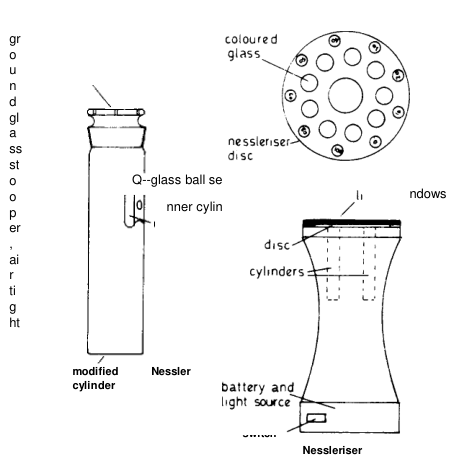
Method using a comparator:
- Take 25 ml of filtered boiler water sample.
- Add 25 ml of vanadomolybdate reagent.
- Fill the comparator tube with this solution and place it in the right-hand compartment of the comparator.
- In the left-hand compartment place a blank made by mixing equal volumes of vanadomolybdate reagent and de-ionised water.
- Allow the colour to develop for at least three minutes.
- Compare with the disc and read the phosphate reserve.
Calculation:
Method using the drop-count technique (some kits):
- Take the sample. Do not cool it. Filter it.
- Add 4 crystals of potassium.
- Cool it.
- Add 5 ml of ammonium molybdate, which makes the sample cloudy.
- Time how long the cloudiness takes to appear.
Reading the drop-count result:
- Cloudy within about 2 minutes → approximately 70 ppm phosphate.
- Cloudy within about 5 minutes → approximately 20 ppm phosphate.
Filtering matters: suspended matter produces a false cloud or a false colour.
7.6 Hardness test
What it measures: the calcium and magnesium hardness remaining in the water, expressed as ppm calcium carbonate. It is the direct check that the treatment is coping with hardness ingress.
Method:
- Take 100 ml of filtered boiler water sample and cool it.
- Add 2 ml (about 20 drops) of ammonia buffer solution. This holds the sample at the pH at which the indicator works correctly.
- Add 0.2 g of mordant black 11 indicator (also supplied as Eriochrome Black T) and stir until dissolved.
- If hardness salts are present, the solution turns wine red.
- Titrate with EDTA solution until the colour changes to purple, and then to blue.
- Record the millilitres or drops of EDTA used.
Calculation:
or, for drop-count kits:
Why the colour changes: the indicator combines with the hardness ions to give the wine-red colour. EDTA has a stronger affinity for those ions than the indicator does, so as it is added it strips the ions away from the indicator. When all the hardness has been taken up by the EDTA, the indicator returns to its free blue colour. The purple stage is the transition.
Note that some waters give a greyish end point rather than a clean blue. Read the end point consistently, and use the same judgement each time so the trend remains meaningful.
7.7 Sulphite test
What it measures: the sulphite reserve, used where sodium sulphite is the oxygen scavenger.
Method:
- Take 100 ml of boiler water sample.
- Add 2 ml of sulphuric acid.
- Add 1 ml of starch solution.
- Add potassium iodide-iodate solution until the sample turns blue.
- Record the millilitres used.
Calculation:
Why it works: the acid speeds up the reaction. The iodide-iodate reacts preferentially with sulphite if any is present; only when all the sulphite has been consumed does it react with the starch, giving the blue colour.
Two cautions:
- Exclude the atmosphere as far as possible. Air contact will oxidise the sulphite and give an incorrect, low result.
- If the test shows an adequate sulphite reserve, there is no need to carry out a separate test for dissolved oxygen, because the reserve proves the scavenger is present in excess.
7.8 pH value
pH can be obtained by three methods:
- Litmus paper — quick, but only tells you whether the water is acidic or alkaline, and rough at that. Blue means alkaline, red means acidic.
- Colourimetric — comparator with indicator, reasonably accurate.
- Electrolytic — a pH meter with glass electrode, the most accurate of the three.
For routine watchkeeping the colourimetric method is normal; the pH meter is used where accuracy matters or where results are being disputed.
7.9 Salinometer and hydrometer
On low-pressure boilers such as the multitubular Scotch, vertical Cochran, and thimble-tube types, a salinometer is still used as a quick check on density.
- The scale normally runs from 0 to 1/32nd.
- Floating in pure water at 93 °C, with relative density of unity, the reading is zero.
- Floating in common salt solution at 93 °C with a relative density of approximately 1.025, the reading is about 1/32nd, representing roughly 32,000 ppm.
For low-pressure boilers using sea water as make-up, the boiler density is held as close as possible to about 1/32nd, which is approximately 125,000 ppm, by blowdown. Using sea water as make-up should be avoided; where it cannot be avoided, soda ash provides some protection.
The salinometer is a rough indicator only. For accurate work it is inadequate, and the titration tests in the sections above must be used.
8. What the test results tell you
8.1 Reading the trends, not the numbers
A single result tells you what the boiler water is doing right now. A trend tells you where it is going.
| Observation | What it usually means | What to do |
|---|---|---|
| Chloride rising steadily | Seawater ingress — condenser leak, primed evaporator, or untreated make-up | Find and stop the source; increase monitoring; follow the contamination procedure |
| Chloride high but stable | Dosing or blowdown not matched to the leak rate | Increase blowdown; keep looking for the source |
| P-alkalinity low, chloride normal | Insufficient alkaline treatment | Check dosing pump and stroke; increase dose slowly |
| P-alkalinity high, T-alkalinity much higher | High carbonate content | Check for sodium carbonate decomposition; check pressure against treatment scheme |
| Caustic alkalinity approaching the limit | Caustic concentration building | Increase blowdown; check phosphate/caustic balance; watch for embrittlement risk |
| Phosphate falling with steady dosing | Hardness ingress consuming the phosphate, or dosing fault | Check dosing pump; test for hardness; check make-up water |
| Phosphate high | Overdosing | Reduce dose; increase blowdown; watch for foaming |
| Hardness present | Treatment not coping | Check dosing; check for ingress; increase sludge removal |
| Sulphite reserve absent | Scavenger demand not met, or air ingress | Check dose; check deaerator; check for air in-leakage |
| pH falling | Carbon dioxide or acidic contamination | Check condensate treatment; check for organic ingress |
| Foaming with normal solids | Oil contamination, high level, or sudden load change | Check for oil; correct level; dose antifoam |
8.2 Why you treat the cause, not the reading
If chloride is rising, the answer is not more blowdown forever. The answer is to find the seawater leak. If phosphate is falling, the answer is not an unlimited dose — the answer is to find what is consuming it. The test results are evidence, and the evidence points at a physical fault somewhere in the plant.
9. Blowdown
Blowdown is how concentrated water and settled solids leave the boiler.
9.1 Surface or continuous blowdown
Taken from the water surface, where dissolved solids are most concentrated after the steam has left.
- Controls conductivity, total dissolved solids, chloride, and silica.
- Limits the potential for foaming, priming, and carryover.
- Usually run continuously, or for long enough to keep concentrations below the limits.
9.2 Bottom blowdown
Taken from the lowest point of the boiler or water drum.
- Removes sludge and settled solids that surface blowdown cannot reach.
- Carried out as short, frequent blows of about 5 to 10 seconds, not one long blow.
- Short frequent blows keep the sludge moving out; a single long blow stirs up the whole boiler and loses a large amount of water and heat.
9.3 Doing blowdown correctly
Confirm the water level is normal and the feedwater supply is available.
Confirm the correct valve — surface or bottom — before opening anything.
Open the valve fully and closed quickly for a bottom blow; do not crack it open and leave it partly open, because a partly open valve erodes its own seat.
Watch the water level immediately afterwards and allow the feed control to recover it.
Confirm normal operation of the blowdown valve after closing — a passing valve wastes water, upsets the chemistry, and can be mistaken for a tube leak.
Record the operation and check the chemistry response.
Never blow down:
- To correct a low water level.
- With the burner at high fire and the level already low.
- Without checking that the valve closes properly afterwards.
Blowdown is a continuous running cost, not a free action: every kilogram blown down is a kilogram of treated water and heat thrown overboard. Too little blowdown creates deposits and carryover; too much wastes fuel and water and stresses the feed system. The correct amount is the amount that holds the tests in range.
10. Protecting the boiler when it is not steaming
10.1 Short periods out of service
Water-tube boilers, about two days: either fire the boiler at intervals to hold pressure above about 3.5 bar with the water maintained at its normal steaming composition, or fill the boiler while hot with hot deaerated alkaline feed water with about 0.5 kg of anhydrous sodium sulphite per tonne of water. If the second method is used, top up periodically and remove all air from the system.
Fire-tube boilers, short periods: ensure the alkalinity to phenolphthalein is not below the recommended value, or fill the boiler completely with alkaline water.
The logic in both cases is the same: exclude oxygen and keep the water alkaline. A boiler sitting partly full of aerated water corrodes faster than one that is steaming.
10.2 Long periods out of service
Drain the boiler completely.
Dry it out with heater units.
Place trays of quicklime internally at suitable positions throughout the boiler.
Seal the boiler up.
Fit blanks to pipe connections where steam is being maintained in other boilers. Blank the blowdown in every case.
Renew the lime at least once every two months.
10.3 Chemical cleaning of a new boiler
Before a new boiler is commissioned, it carries surface rust, mill scale from manufacture and erection, dirt, and traces of oil. Pre-commission cleaning is carried out in this order:
- Boil out at atmospheric pressure with an alkaline solution to remove oil and dirt.
- Wash out with a heated acid solution to remove rust and mill scale.
- Rinse with a weak acid solution.
- Flush repeatedly to remove debris.
- Passivate under pressure with hydrazine. The feed system is treated the same way, except that the alkaline boil-out is omitted and the passivation is done at atmospheric pressure.
11. The routine
EVERY ROUND
- Read and record water level, and check both gauge glasses
- Confirm dosing pump running at the correct stroke
- Look at the sample for colour, oil, or suspended matter

DAILY
- Take samples correctly: cool the line, drain first, collect at 25-30 C
- Run the tests required by the ship's programme
- Record results and compare against the previous readings, not just the limits
- Adjust dosing and blowdown in small steps
- Carry out surface blowdown as required and bottom blowdown at the scheduled interval

WHEN A RESULT IS OUT OF RANGE
- Repeat the test before acting: confirm sample and reagents are correct
- Compare against the trend to see how fast it is moving
- Look for a physical cause: condenser leak, dosing fault, level problem, oil ingress
- Correct the cause; use dosing and blowdown only to hold the situation until the cause is fixed
- Record what you found and what you did
12. Handling the chemicals safely
The treatment chemicals are hazardous and the test reagents are worse.
- Hydrazine is toxic and a suspected carcinogen. Use gloves, eye protection, and avoid vapour. Never pipette by mouth.
- Sodium hydroxide and strong alkalis burn skin and eyes severely. Flush with copious water and get medical help.
- Sulphuric acid and other acids burn and splatter. Add acid to water, never water to acid.
- Silver nitrate stains skin and clothing and is an oxidiser. Keep it away from organic material.
- Store all chemicals in their labelled containers, in the correct compartment, with the safety data sheets available.
- Use the correct PPE and the correct eye-wash and emergency shower arrangements.
- Never mix chemicals unless the procedure requires it.
- Dispose of test samples and waste reagents according to the ship's procedures, not down the sink.