
LSA Chapter 2: Pyrotechnics, VHF, SART, EPIRB & GMDSS
Distress signalling equipment — rocket flares, hand flares, buoyant smoke, two-way VHF, SART, EPIRB and GMDSS — with every SOLAS number the surveyor will ask for.
Key Principles at a Glance 6 points
- Rocket parachute flares reach at least 300 m, burn red at not less than 30,000 cd for at least 40 seconds with a descent rate not more than 5 m/s, and are carried 4 per boat and raft with a 3-year expiry.
- Hand flares burn red at not less than 15,000 cd for at least 1 minute and keep burning after 10 seconds immersion under 100 mm of water; 6 per boat and raft on foreign-going ships, 3 on short voyages.
- Two-way VHF sets: 2 sets on ships of 300–500 GT and 3 sets above 500 GT, with 8 hours transmitting plus 24 hours standby; channel 16 ship-to-ship and channel 06 ship-to-aircraft over 5–8 nautical miles.
- The SART works on 9 GHz (9.2–9.5 GHz) against the 3-cm X-band radar, showing a 12-dot line at 0.6 nm spacing, with 96 hours standby plus 8 hours transmission from a minimum of 2 units on board.
- The EPIRB transmits on 406.5 MHz to Cospas-Sarsat with 121.5 MHz homing and GPS accuracy within 50 m, floats free automatically by HRU, and transmits for at least 48 hours.
- GMDSS falls under SOLAS Chapter 5 (Safety of Navigation), is kept on the bridge, operated by the master or navigating officer, and covers mail and satellite calls through 3 fitted sets.
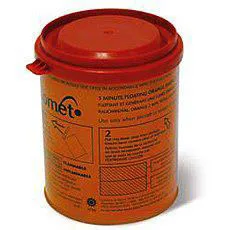
1. Pyrotechnics: Rocket Flares, Hand Flares & Buoyant Smoke
When the surveyor asks "tell me about pyrotechnics?", name the three families first — rocket parachute flares, hand flares and buoyant smoke signals — then give the numbers for each.
Rocket parachute flares (4 per lifeboat & liferaft):
- Packed in a water-resistant casing with brief instructions or diagrams clearly illustrating the use, printed on the casing.
- Fitted with integral means of ignition and so designed as not to cause discomfort to the person holding the casing when used in accordance with the manufacturer's operating instructions.
- The rocket shall, when fired vertically, reach an altitude of not less than 300 m; at or near the top of its trajectory it ejects a parachute flare, which burns with a bright RED colour.
- Burns uniformly with an average luminous intensity of not less than 30,000 cd with a burning period of not less than 40 seconds.
- Rate of descent of not more than 5 m/s, and the flare must not damage its parachute or attachments while burning.
- Carrying: 4 per boat and 4 per raft; expiry 3 years from the date of manufacture — check the date before every inspection.
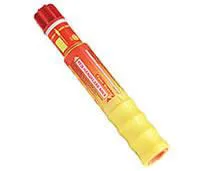
Hand flares (6 per lifeboat & liferaft on F.G. vessels, 3 on short voyages):
- Packed in a water-resistant casing with brief instructions or diagrams clearly illustrating the use, printed on the casing, and fitted with a self-contained means of ignition.
- So designed as not to cause discomfort to the person holding the casing and not to endanger the survival craft by burning or glowing residues when used in accordance with the manufacturer's operating instructions.
- Burns with a bright RED colour, visible from 5–8 nautical miles, burning uniformly with an average luminous intensity of not less than 15,000 cd.
- Burning period of not less than 1 minute; continues to burn after having been immersed for 10 seconds under 100 mm of water.
Buoyant smoke signals:
- Packed in a water-resistant casing with brief instructions or diagrams clearly illustrating the use, printed on the casing; must not ignite explosively when used in accordance with the manufacturer's operating instructions.
- Emits smoke of a highly visible colour at a uniform rate for not less than 3 minutes when floating in calm water; does not emit any flame during the entire smoke emission time.
- Is not swamped in a seaway; continues to emit smoke when submerged for 10 seconds under 100 mm of water.
| Feature | Rocket Parachute Flare | Hand Flare | Buoyant Smoke |
|---|---|---|---|
| Colour | Red | Red | Orange smoke |
| Intensity | ≥ 30,000 cd | ≥ 15,000 cd | — |
| Duration | ≥ 40 s | ≥ 1 min | ≥ 3 min floating |
| Special figure | ≥ 300 m altitude, ≤ 5 m/s descent | Visible 5–8 nm | No flame, not swamped |
| Water test | Water-resistant casing | Burns / emits after 10 s under 100 mm water | |
| Carrying | 4 per boat / raft, 3-yr expiry | 6 F.G. / 3 short voyage | As per muster list |
Answering Q7 in the oral:
Open with the three families and their craft numbers — rocket 4 per boat and raft, hand flare 6 (3 on short voyages) — then give one distinguishing number per family: rocket 300 m / 30,000 cd / 40 s / 5 m/s with a 3-year expiry, hand flare 15,000 cd / 1 min, visible 5–8 nm, smoke 3 min floating, no flame, not swamped. Close every family with its casing line: water-resistant casing with instructions on the casing, fired per the manufacturer's operating instructions.
Stowage, expiry and inspection:
The rocket's 3-year expiry from the date of manufacture is the surveyor's favourite inspection trap: open the lifeboat and liferaft equipment lockers, read every rocket casing date, and replace expired stock before the inspection — an expired rocket is a deficiency even if everything else is perfect. Check the water-resistant casings are dry and undamaged, confirm the firing instructions or diagrams are legible on each casing, and verify the hand-flare and smoke-signal counts against the muster list: 4 rockets per boat and raft, 6 hand flares (3 on short voyages).
Rocket Parachute Flare
- Altitude & Burn: Reaches ≥ 300 m; burns with bright red star ≥ 30,000 cd for ≥ 40 seconds
- Descent rate: Parachute descent ≤ 5 m/s without damaging canopy
- Casing & Firing: Integral igniter in water-resistant casing with instructions
- Carriage: 4 per lifeboat & liferaft; 12 on bridge; 3-year expiry date
Hand Flare
- Luminosity: Burns with bright red light ≥ 15,000 cd for ≥ 1 minute
- Visibility: Visible 5–8 nautical miles at night
- Water test: Continues burning after 10 seconds immersion under 100 mm of water
- Carriage: 6 per boat / raft on foreign-going; 3 on short voyages
Buoyant Smoke Signal
- Duration: Emits highly visible orange smoke for ≥ 3 minutes floating in water
- Safety: Emits no flame; cannot ignite floating oil; not swamped by sea waves
- Water test: Continues emitting smoke after 10 s under 100 mm water
- Carriage: 2 per lifeboat and liferaft; daytime visual spotting
2. Two-Way VHF & SART
For "how many two-way VHFs and SARTs on board?" the surveyor expects the carriage numbers first, then the operating figures.
Two-way VHF radiotelephone apparatus (walkie-talkie) — Q8:
- Carrying per SOLAS: vessels between 300 and 500 GT carry 2 nos., vessels above 500 GT carry 3 nos.
- Battery endurance: capable of continuously transmitting for 8 hours and standing by for 24 hours.
- Channels: channel 16 for ship-to-ship communication and channel 06 for ship-to-aircraft communication.
- Range of communication: 5–8 nautical miles; the set is finished in a highly visible colour and carries a clear ON / OFF visual indication.
- The set is waterproof and buoyant and is capable of single-hand operation — pick it up, switch on and talk with one hand while holding on with the other.
Oral tip — VHF in one breath:
Give carriage first — "2 sets between 300 and 500 GT, 3 sets above 500 GT" — then endurance "8 hours transmitting, 24 hours standby", then use "channel 16 ship-to-ship, channel 06 ship-to-aircraft, 5 to 8 miles", and finish with handling: visible colour, ON/OFF indication, waterproof and buoyant, single-hand operation.
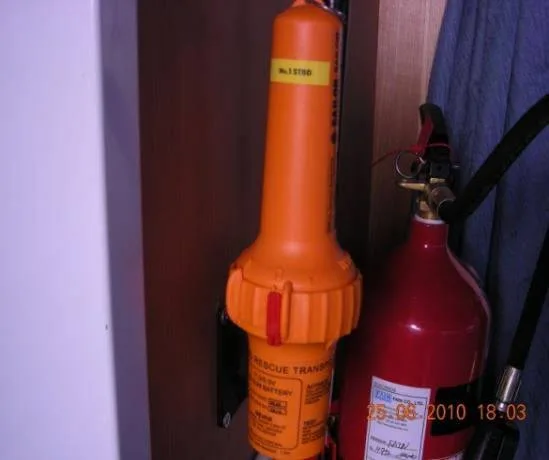
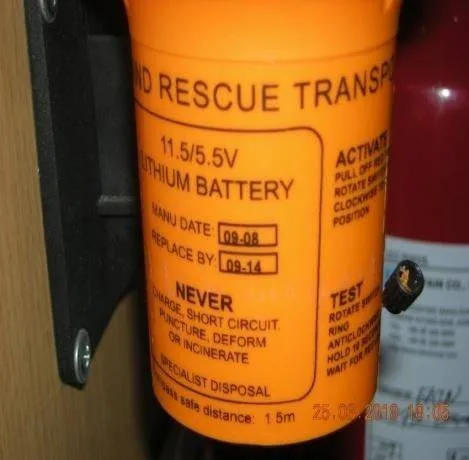
SART (Search And Rescue Transponder) — the main means of locating ships in distress or their survival craft:
- Minimum 2 nos. on board; body of fibre-reinforced plastic (F.R.P.) which bears prolonged sunlight and stays unaffected by seawater or oil.
- Capable of self-floating free of the survival craft; coloured international orange and stowed in a mounting bracket fixed to the bulkhead of the ship.
- Works in the 9 GHz band (9.2–9.5 GHz): on being interrogated by any ordinary 9 GHz shipborne 3-cm X-band radar (or suitable airborne radar) it transmits a series of response signals.
- SARTs are either portable (carried from ship to survival craft) or permanently installed in the survival craft; the unit is activated manually so that it responds when interrogated thereafter.
- Radar picture (PPI): the response generates a line of 12 blips (dots) extending outward from the SART's position along its line of bearing, with 0.6 nm spacing between each pair of dots.
- As the search craft closes to within about 1 nm, the dots change into wide arcs and then complete circles as the SART is continually triggered — a useful warning to slow down, with the centre marking the casualty.
- This distinctive signal is easily recognised and much easier to spot than a mere echo such as from a radar reflector.
- Gives a visual or audible indication of correct operation and informs survivors when interrogated: an audible beep every 2 seconds when interrogated by radar, every 12 seconds when no radar is in sight.
- Battery: standby for 96 hours followed by a minimum 8 hours of transmission while being interrogated.
Two-Way VHF Apparatus
- Carriage: 2 sets for 300–500 GT; 3 sets for vessels > 500 GT
- Endurance: 8 hours transmission + 24 hours standby
- Channels: Channel 16 (ship-to-ship/distress) & Channel 06 (ship-to-aircraft)
- Range: 5–8 nautical miles; waterproof, buoyant, single-hand operation
SART Electronics
- Frequency: 9.2–9.5 GHz band (interrogated by 3-cm X-band ship/aircraft radar)
- Display: 12 blips spaced 0.6 nm apart; concentric rings when within 1 nm
- Battery life: 96 hours standby + 8 hours continuous interrogation transmission
- Carriage: Minimum 2 sets stowed on bridge / survival craft
3. EPIRB
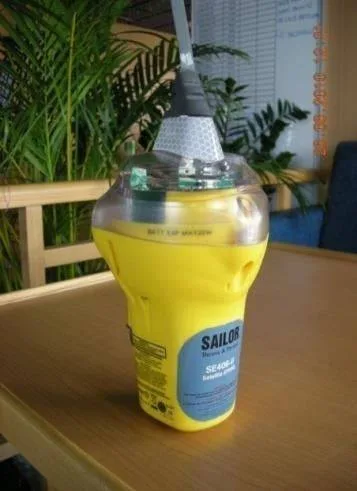
EPIRB = Emergency Position Indicating Radio Beacon — a compact, buoyant, self-contained radio transmitter used to alert search and rescue services in the event of an emergency. For "tell me about your EPIRB?" give the carriage, the float-free arrangement and the frequencies.
- Carrying: minimum 1 under SOLAS, minimum 2 on Indian vessels under D.G. Shipping requirements.
- Battery storage life 5 years; unit weight about 2 kg.
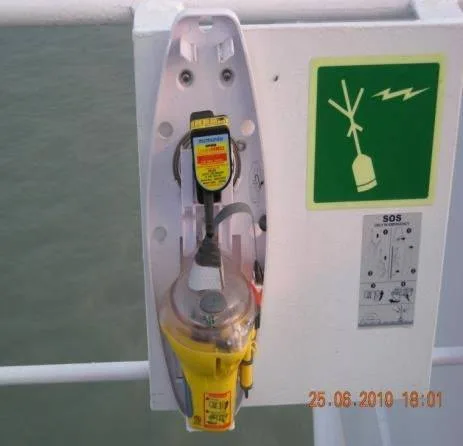
- Kept on the bridge wing attached with an H.R.U. (hydrostatic release unit); it is capable of floating free and is automatically activated in the event of the ship sinking.
- Once activated, it continuously emits a distinctive radio signal for a minimum of 48 hours.
- Transmits a coded message on the 406.5 MHz distress frequency via satellite and earth stations to the nearest rescue co-ordination centre (RCC).
- 406 MHz EPIRBs work with the Cospas-Sarsat polar-orbiting satellite system, giving true global coverage; there is an alert delay of about 45 minutes, depending on when the satellites come into view on the horizon.
- The satellite fixes the position by Doppler effect to within about 5 km (3 miles); the coded message identifies the exact vessel to which the EPIRB is registered, letting rescue services eliminate false alerts and launch an appropriate rescue.
- GPS-enabled units carry a built-in GPS transmitter: they typically alert rescue services within 3 minutes to ± 50 m accuracy (position updated every 20 minutes) given a clear view skywards.
- Many units also carry a secondary 121.5 MHz distress transmitter for homing — rescue craft direction-find on it when close — plus a high-brightness flashing LED that aids final visual location.
How it activates and how the HRU works — the Q10 follow-ups:
When the surveyor adds "how does it activate? what is HRU? how does it operate?", answer the sinking sequence: the EPIRB sits on the bridge wing attached with the H.R.U. (hydrostatic release unit); when the ship sinks, the unit floats free and activates automatically, then emits its distinctive signal continuously for at least 48 hours. The coded 406.5 MHz message travels via satellite and earth stations to the nearest rescue co-ordination centre, the GPS narrows the fix to ± 50 m, and the 121.5 MHz tone plus the flashing LED walk the rescuers onto the final position.
EPIRB inspection — what the surveyor checks on the bridge wing:
On the bridge wing the surveyor reads the unit like a pyro casing: confirm the 5-year battery storage life date is in date, the unit is compact, buoyant and self-contained at about 2 kg, it sits attached with its H.R.U. so it can float free, and the casing, release and mounting are unobstructed so nothing stops the automatic activation if the ship sinks. An expired battery or a lashed-down EPIRB that cannot float free is a deficiency — the whole alert chain in the figure above depends on that one release.
Surveyors test endurance as a set, so answer the register in one pass — one set at a time:
- Two-way VHF — 8 hours transmitting plus 24 hours standby.
- SART — 96 hours standby followed by 8 hours transmitting while interrogated.
- EPIRB — 5-year battery storage life on the shelf, then a minimum 48 hours transmitting once activated.
Transmitting first for the VHF, standby first for the SART, shelf-life then transmitting for the EPIRB — that order is the whole trap.
4. GMDSS & Surveyor Asks
GMDSS (Global Maritime Distress and Safety System):
- Comes under SOLAS Chapter 5 — Safety of Navigation and is kept on the bridge.
- It is the main communication system of the ship — all external communication with the world is done through GMDSS (distress alerting, mail, satellite calls).
- It can be operated by the master and the officer in charge; 3 sets are fitted on board.
SART vs EPIRB — answer them as a pair:
| Feature | SART | EPIRB |
|---|---|---|
| Carriage | Minimum 2 on board | SOLAS minimum 1; 2 on Indian vessels |
| Frequency | 9 GHz (9.2–9.5 GHz) vs 3-cm X-band radar | 406.5 MHz alert + 121.5 MHz homing |
| What the rescuer sees | 12 dots at 0.6 nm, arcs then circles inside ~1 nm | Coded vessel ID at the RCC; GPS to ± 50 m |
| Endurance | 96 h standby + 8 h transmitting | Minimum 48 h transmitting; 5-yr battery |
| Stowage | Bulkhead bracket; orange FRP, self-floating | Bridge wing with HRU; floats free |
Oral flow (Q8–Q11):
- Q8 two-way VHF: carriage first — 2 sets (300–500 GT), 3 sets (above 500 GT) — then endurance 8 h transmitting + 24 h standby, channels 16 ship-to-ship and 06 ship-to-aircraft, range 5–8 nm, visible colour with ON/OFF, waterproof and buoyant, single-hand operation.
- Q9 SART: the main locating means, minimum 2; orange FRP proof against sun, seawater and oil, self-floating, bulkhead bracket; 9.2–9.5 GHz against the 3-cm X-band radar, portable or permanently installed, manually activated; 12 blips at 0.6 nm opening into arcs and circles inside 1 nm as the slow-down warning; easier to spot than a reflector echo; visual/audible indication with a 2-second beep when interrogated and 12 seconds when not; 96 h + 8 h battery.
- Q10 EPIRB + HRU: compact, buoyant, self-contained; SOLAS 1, D.G. Indian 2; 5-year battery, ~2 kg; bridge wing on the HRU, floating free and auto-activating on sinking, 48 h minimum transmission; coded 406.5 MHz message via satellite to the RCC; Cospas-Sarsat global cover with ~45 min alert delay; Doppler fix ~5 km, coded ID kills false alerts; GPS units alert in ~3 min to ± 50 m with 20-minute updates given a clear sky; 121.5 MHz homing plus LED for the final run-in.
- Q11 GMDSS: Global Maritime Distress and Safety System under SOLAS Chapter 5, on the bridge, operated by the master and the officer in charge; 3 sets fitted; the ship's main external link — distress alerting, mail and satellite calls.
3 GMDSS Sets Fitted
Bridge Console Configuration:
- 3 complete sets installed at the bridge navigation workstation
- Connected to main, emergency, and dedicated reserve radio batteries
- Continuous automatic watch on distress alerting frequencies
Qualified Operators
Master & Deck Officers:
- Operated strictly by the Master and certified Deck Officers (GOC holders)
- Immediate transmission of distress alert upon Master's order
- Daily & weekly test calls logged in the GMDSS Radio Log
World Communication Link
Primary Shipborne Communications:
- Carries all external distress alerting (VHF/MF/HF DSC & Inmarsat C)
- Routine commercial traffic, weather warnings, and safety messages (NAVTEX)
- Crew mail, maritime safety information (MSI), and satellite telephone
Answering Q11 — and the Chapter 5 trap:
When the surveyor asks "what is GMDSS — and in which SOLAS chapter does it come?", answer the name first — Global Maritime Distress and Safety System — then the trap: it comes under SOLAS Chapter 5, Safety of Navigation, not Chapter 3 with the rest of the life-saving appliances. Examiners set this trap deliberately, so say the chapter number before anything else. Then place it — on the bridge — name the operators — the master and the officer in charge — give the fit — 3 sets — and finish with what it carries: distress alerting first, then mail and satellite calls, because it is the main communication system of the ship and all external communication with the world goes through it.
Everything else in this chapter — flares, VHF, SART, EPIRB — is distress signalling equipment under the LSA umbrella, but GMDSS itself is a navigation-chapter system (SOLAS Chapter 5). If the surveyor asks "in which SOLAS chapter does GMDSS come?" and you say Chapter 3, the follow-up questions get harder. Say Chapter 5 — Safety of Navigation crisply, and the oral moves on.
The distress chain — how the pieces fit in the oral:
Surveyors often close this chapter with "your ship is sinking — walk me through your distress signalling, step by step." Answer in alert order, using only the numbers already given above. First the EPIRB floats free on its HRU and alerts the RCC on 406.5 MHz via Cospas-Sarsat — the long-range, coded, vessel-identified call for help with its ~45-minute satellite delay and ~5 km Doppler fix, tightened to ± 50 m with GPS. Then the SART answers the rescuers' 9 GHz radar with its 12-dot line at 0.6 nm, opening into arcs and circles inside 1 nm as the slow-down warning, with the 2-second beep confirming interrogation. Alongside, the two-way VHF carries on-scene voice traffic on channel 16 ship-to-ship and channel 06 ship-to-aircraft over 5–8 nm, with 8 hours transmitting and 24 hours standby. And at close range the pyrotechnics take over the visual job — rockets to 300 m at 30,000 cd for 40 s, hand flares at 15,000 cd for 1 min, smoke floating 3 min with no flame. Finish by naming the umbrella: all of it is coordinated through the GMDSS bridge station under SOLAS Chapter 5.
| Leg | Equipment | Frequency / signal | Range / picture |
|---|---|---|---|
| Long-range alert | EPIRB | 406.5 MHz coded + 121.5 MHz homing | Global via Cospas-Sarsat; GPS ± 50 m |
| Locating | SART | 9.2–9.5 GHz vs 3-cm radar | 12 dots at 0.6 nm; circles inside ~1 nm |
| On-scene voice | Two-way VHF | Ch 16 ship-ship, ch 06 ship-aircraft | 5–8 nm; 8 h + 24 h |
| Visual fix | Rocket / hand / smoke | Red star / red hand / visible smoke | 300 m; 5–8 nm; 3 min floating |
Closing the chapter in the oral:
To close this block in the oral: name the four distress legs — EPIRB alert, SART locate, VHF voice, pyrotechnic visual — and land on the umbrella, GMDSS on the bridge under SOLAS Chapter 5 with its 3 sets. Said in that order, with the carriage numbers and the frequencies attached, it answers Q7 through Q11 in under two minutes and leaves the surveyor nothing left to chase.
Numbers first, story second — carriage, frequency, endurance — and the surveyor hears a seagoing answer, not a memorised list.
Surveyors commonly ask: "tell me about the SART / EPIRB / two-way VHF including numbers?" Answer in threes — carriage, frequencies and endurance, one system at a time:
- VHF: 2 sets (300–500 GT) / 3 sets (above 500 GT), ch 16 ship-ship and ch 06 ship-aircraft, 8 h + 24 h, 5–8 nm.
- SART: min 2, 9 GHz (9.2–9.5 GHz) vs 3-cm radar, 12 dots at 0.6 nm, 96 h + 8 h.
- EPIRB: SOLAS 1 / D.G. 2, 406.5 + 121.5 MHz with GPS ± 50 m, HRU float-free, 48 h TX, 5-yr battery.
- Pyrotechnics: rocket 300 m / 30,000 cd / 40 s / 5 m/s with 3-yr expiry, hand 15,000 cd / 1 min, smoke 3 min.
- GMDSS: SOLAS Ch 5, bridge, master- or officer-operated, 3 sets.
Distress signalling sits between personal LSA and the wider SOLAS framework — see LSA Chapter 1: Categories of LSA & Personal Life-Saving Appliances and SOLAS Chapter III — Life-Saving Appliances & Arrangements.