
LSA Chapter 4: Life Rafts — Capacity, Equipment & Launching
Inflatable and rigid life rafts: CO2 inflation, 25 items of equipment, painter strengths, manual, auto-HRU and davit launching — with the SOLAS numbers surveyors ask for.
Key Principles at a Glance 8 points
- Life rafts are inflatable or rigid; buoyancy comes from non-flammable CO2 with nitrogen as anti-freeze, freezing at −78 °C yet still inflating at −15 °C by one person.
- Minimum capacity is 6 persons; the packed raft with container must not exceed 180 kg, inflates within 1 minute at 18–20 °C and within 3 minutes at −30 °C, and stays afloat for 30 days.
- The raft withstands an 18 m packed drop, jumps equal to its complement from 4.5 m, tows at 3 knots loaded with one sea anchor streamed, and carries 2-layer insulation, a 1 m SART mount, a 15 m painter and a 4.3 cd / 50–70 per minute / 12-hour canopy lamp.
- The painter is at least 15 m long with breaking strengths of 15 kN above 25 persons, 10 kN for 9–24 persons and 7.5 kN below that; the weak link in auto release is 2.2 ± 0.4 kN.
- Each raft carries 25 items of equipment including 6 hand flares, 4 rockets, 2 smoke signals, EPIRB, SART, 500 g food and 500 ml water per person per day for 3 days, 3 tin openers, 50 seasickness tablets, 2 sponges, paddles, bailers and sea anchors, and 2 thermal protective aids.
- Container markings list 10 entries (maker, serial, service date, painter length, stowage height, pack type, manufacture date, capacity, launching instructions, SOLAS) and the raft itself 5 (maker, serial, service date, manufacture date, approving authority).
- Manual launching means paying out 80% of the painter, making it fast, throwing the container, a hard pull to fire the gas, embarking by ladder or 4.5 m jump seated face-by-face with SART and EPIRB, headcount, then knife-cut and paddle clear; a capsized raft is righted from the windward side using the righting strap over the CO2 cylinder end.
- Davit-launched embarkation rafts (16-person example) are boarded at the deck, lowered to about 1 m above the water for hook release, then cleared; forward 6-person rafts are manual-only while embarkation rafts carry davit plus HRU.
1. Regulation, Capacity & Construction
When the surveyor asks "what are the types of life raft and what is inside the bottle?", answer in two halves — types first, gas second:
- Types: there are mainly two types — inflatable life raft and rigid life raft.
- Inflation cylinder: the inflatable raft contains an inflation cylinder with CO2 gas.
- Buoyancy gas: CO2 plus a small percentage of nitrogen — carbon dioxide provides the buoyancy and is non-flammable; nitrogen acts as the anti-freeze.
- CO2 is heavier than air, hence adds buoyancy to the raft.
- Freezing point of CO2 is −78 °C, yet the raft must still inflate at −15 °C.
- One person alone must be able to complete the inflation.
Capacity, weight and inflation numbers:
- Minimum capacity: 6 persons — no approved raft carries fewer.
- Weight with container and equipment: not more than 180 kg so it remains manhandleable.
- Inflation time: completed within 1 minute at 18–20 °C, and within 3 minutes at −30 °C.
- Afloat endurance: constructed to withstand exposure for 30 days afloat in any sea condition.
- Drop test packed: when packed in its container it withstands being dropped into the water from 18 m without damage to raft or equipment.
- Jump test: when afloat it withstands jumps onto it equal to the number of its complement, from at least 4.5 m above its floor.
- Towing: with its towing patch it can be towed at 3 knots in calm water when loaded with its full complement and equipment and one of its sea anchors streamed.
Insulation, SART, painter and lamp:
- Insulation: provided against heat and cold by two layers of material separated by an air gap, with means to prevent accumulation of water in the air gap.
- SART mounting: provided with means to mount a survival-craft radar transponder at a height of at least 1 m above the sea.
- Painter: an efficient painter of length not less than 15 m.
- Painter breaking strength: 15 kN for rafts permitted above 25 persons, 10 kN for 9–24 persons, 7.5 kN for any smaller raft.
- Canopy lamp: a manually controlled lamp fitted to the top of the canopy — white, capable of operating continuously for at least 12 hours with luminous intensity not less than 4.3 cd in all directions of the upper hemisphere, flashing at not less than 50 and not more than 70 per minute.
Carrying capacity and location — the worked example:
- Minimum carrying capacity = 6 persons.
- Forward: 6-person raft for the forward party.
- At the embarkation station, port and starboard: 16-person rafts — the example to quote when asked "give numbers from your ship".
- Always confirm exact numbers and positions from the Fire Control and Safety Plan.
"What gas inflates the raft and why nitrogen?" — CO2 gives non-flammable buoyancy heavier than air, N2 is the anti-freeze; the raft inflates at −15 °C even though CO2 freezes at −78 °C.
Gas & Inflation
CO2 provides non-flammable buoyancy; N2 acts as anti-freeze preventing CO2 solidifying at −78 °C. Inflates in 1 min at 18–20 °C and 3 min at −30 °C.
Capacity & Mass
Approved capacity minimum 6 persons, capable of floating 30 days. Total mass of container, raft and equipment cannot exceed 180 kg. Designed for one-person inflation.
Painter Line & Weak Link
Painter length ≥ 15 m (or 2× stowage height). Breaking strength: 15 kN (>25 persons), 10 kN (9–24 persons), 7.5 kN (6–8 persons). Weak link breaks at 2.2 ± 0.4 kN.
Strength & Drop Tests
Withstands packed drop from 18 m into water. Accommodates jumps from 4.5 m without damage. Towed at 3 knots fully laden with sea anchor streamed.
Canopy & SART Mount
Double-skinned insulated canopy. Exterior dome lamp flashes white 4.3 cd (50–70 flashes/min) for 12 h. Internal light provided. SART mount extends ≥ 1 m above waterline.
2. Equipment (25 Items), Markings & Safety Features
For "what is carried in the life raft?" the surveyor expects all 25 items with exact quantities counted out confidently:
- 1 — Mirror / heliograph: 1 signalling mirror.
- 2 — Sponges: 2.
- 3 — Buoyant paddles: 2.
- 4 — Hand flares: 6.
- 5 — Rocket parachutes: 4.
- 6 — Smoke signals: 2.
- 7 — EPIRB: 1.
- 8 — SART: 1.
- 9 — Food ration: 500 g per person per day up to 3 days, not less than 10000 kJ each person.
- 10 — Water: 500 ml per person per day up to 3 days.
- 11 — Knife: 1 buoyant safety knife (for cutting the painter).
- 12 — Survival instruction booklet: 1.
- 13 — Topping-up pump and bellows: 1 set.
- 14 — First aid outfit: 1 watertight kit.
- 15 — Anti-seasickness medicine: 50 doses (at least 6 doses per person) + 1 seasick bag per person.
- 16 — Thermal protective aids (TPAs): 2 (or 10% of capacity, whichever is greater).
- 17 — Whistle: 1 buoyant signalling whistle.
- 18 — Waterproof electric torch: 1 with spare batteries and bulb in watertight container.
- 19 — Radar reflector: 1 efficient radar reflector.
- 20 — Fishing tackle: 1 set.
- 21 — Sea anchors (drogues): 2 (one permanently attached, one spare with hawser).
- 22 — Tin openers: 3 safety tin openers.
- 23 — Graduated drinking vessel: 1 rustproof graduated cup.
- 24 — Repair kit: 1 kit for puncturing and leaks (plugs, clamps, adhesive).
- 25 — Buoyant rescue quoit: 1 quoit with at least 30 m buoyant line.
Marking on the life raft container — 10 items:
- 1 — Maker name or trademark.
- 2 — Serial number.
- 3 — Date when last serviced.
- 4 — Length of painter.
- 5 — Maximum permitted height of stowage above the waterline.
- 6 — Type of emergency pack enclosed.
- 7 — Date of manufacture (month and year).
- 8 — Capacity of the life raft.
- 9 — Launching instructions.
- 10 — SOLAS marking.
Marking on the life raft itself — 5 items:
- 1 — Maker name or trademark.
- 2 — Serial number.
- 3 — Date when last serviced.
- 4 — Date of manufacture (month and year).
- 5 — Name of the approving authority.
Built-in safety features:
- Pressure relief valve — vents excess gas so chambers never burst on over-inflation or heat.
- Stabilising pockets — flood on launching to lower the centre of gravity and resist capsize.
- Insulated canopy with two layers — retains heat, sheds water, and carries the lamp and SART mount.
| Item group | What to quote |
|---|---|
| Pyrotechnics (6-4-2) | 6 hand flares, 4 rockets, 2 smoke signals |
| Locating aids | 1 EPIRB, 1 SART, mirror, whistle, radar reflector, lamp, torch |
| Sustenance | Food 500 g/pp/day × 3 days (≥10000 kJ); water 500 ml/pp/day × 3 days; 3 tin openers |
| Boat handling | 2 paddles, 2 sea anchors, 2 bailers, 2 sponges, pump/bellows, knife, compass, fishing kit |
| Care | First aid, 50 seasick tablets, instructions, 2 thermal protective aids |
Pyro 6-4-2, water tools 2-2-2 (paddles, bailers, sponges), food and water 500 × 3 days, and one each of mirror, EPIRB, SART, compass, whistle, knife and torch — with 3 tin openers, 50 tablets and 2 TPAs closing the 25.
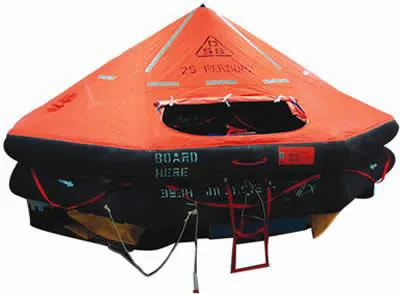
Container Markings (10 Items)
Maker name/trademark • Serial number • Approving authority + persons capacity • SOLAS emergency pack (Pack A/B) • Date last serviced • Painter length • Max stowage height • Launch instructions • Mass with pack (≤180 kg) • Next service due date.
Raft Markings (5 Items)
Maker name/trademark • Serial number • Date of manufacture (month/year) • Approving authority • Number of persons permitted over each entrance (not less than 100 mm character height).
3. Manual Launch, Righting & Automatic HRU Release
For "launch the raft manually", give the deck sequence step by step — during a drill or in a real emergency:
- Take the painter out of the raft to almost 80% of its total length.
- Fasten it to the ship side on deck and make sure it is not loose.
- Remove the railing and clear the way for launching; check overside clear.
- Unfasten the ship hook (securing gripes) from the cradle.
- Two persons lift the container from its cradle and throw it overboard — painter end on the ship side.
- Pull out the remaining painter and give a sharp pull to fire the gas — the raft inflates within 1–3 minutes depending on ambient temperature.
- Pull the raft to the ship side with the same painter.
- Lower the embarkation ladder — or if the height is low, jump direct into the raft (permitted up to 4.5 m from the waterline), or go down the ladder, swim a short distance and climb in. In cold weather keep as dry as possible.
- Sit in order — face by face — so the raft stays balanced.
- Carry the SART and EPIRB into the raft with you.
- After all persons are inside, take a headcount.
Pull out approximately 80% of the painter line and lash it firmly to a strong deck fitting (cleat or pad-eye). Verify it is secure and not loose.
Remove portable ship rails or open gates. Check overside is clear of wreckage, flotsam, or propellers. Unfasten Senhouse slip hooks and lashing gripes from the cradle.
Two crew members lift the cylindrical container overboard and drop it into the water with painter end attached inboard. Pull the remaining painter out until taut, then give a sharp pull to actuate the gas cylinder firing head.
Raft fully inflates in 1–3 minutes. Pull to ship side, lower embarkation ladder (or jump from ≤4.5 m). Board quickly, carry SART & EPIRB inside, sit face-to-face to balance, take headcount, and cut painter with buoyant safety knife.
If wind or sea flips the raft during inflation: climb onto the inverted floor at the CO2 cylinder side. Grasp the heavy-duty righting strap. Stand on the gas cylinder and lean backward, pulling in the same direction as the wind with your face opposite the wind — wind catching under the canopy will easily right the raft over you.
Righting a capsized raft — wind technique:
- If the raft inflates upside down, use the fitted righting strap.
- Climb up on the CO2 cylinder end and pull the strap in the same direction as the wind — your face opposite to the wind — so the wind helps flip the raft upright and stable.
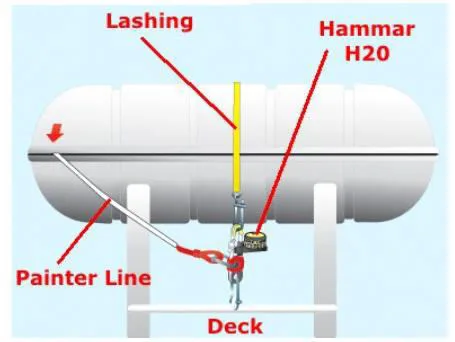
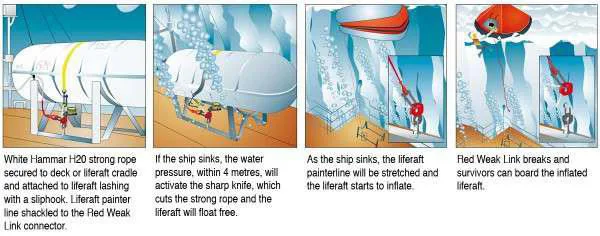
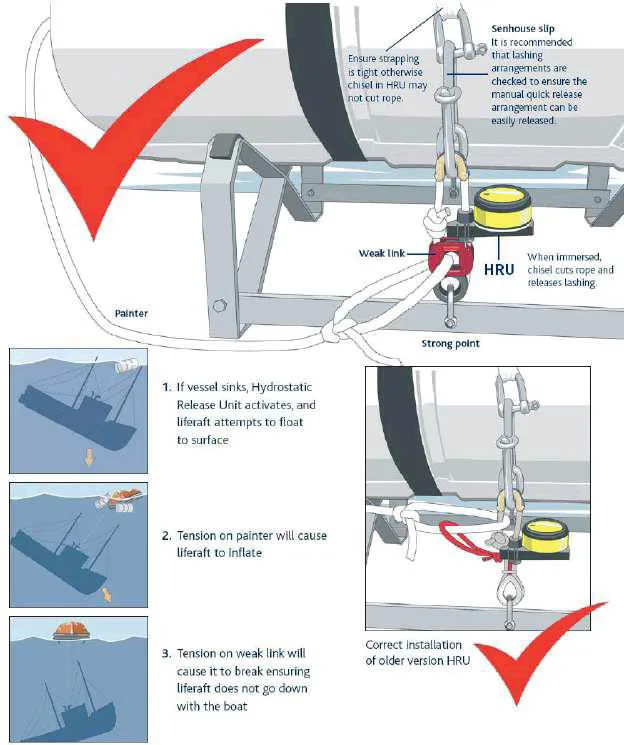
Automatic release — the HRU:
- Once the ship starts to sink and reaches about 4 m depth, water pressure activates the sharp knife in the HRU.
- It cuts the securing rope around the canister so the raft floats free.
- As the ship sinks further, the painter line stretches and fires the gas, inflating the raft.
- Increased buoyancy then breaks the red weak link at about 2.2 kN ± 0.4, leaving the raft floating free on the surface.
The painter holds at 7.5–15 kN during manual launching, but the 2.2 ± 0.4 kN weak link guarantees the inflated raft breaks free automatically instead of being dragged down.
4. Davit Launch & Oral-Exam Rapid Fire
For "how do you launch a raft by davit?", walk through the davit drill keeping the mechanism maintained:
- Keep the davit mechanism maintained at all times.
- Open the ship handrail or gate at the launching position.
- Unlash the container — the INBOARD mark stays on the ship side.
- Lower the davit hook and lock it with the lifting shackle.
- Secure the canister lines outboard and secure the bowsing line.
- Pull out about 5–6 m of painter; check the hook and brake lanyard are inboard.
- Secure the painter line, then pull out its full length.
- Lift the canister to some height, then pull the painter with a sharp pull to inflate the raft.
- Check the canopy access opening faces the ship side, then secure the raft.
- One person goes inside for checks — no sharp-edged shoes or heels.
- Collect the SART and EPIRB, then board and sit evenly.
- Release the bowsing line and pass it to the raft.
- Check the launching area is clear, then lower the raft using the brake release.
- Operate the hook release about 1 m above the water, or let the raft touch the water so the load comes off the hook and it releases itself.
- Cut the painter and use the sea anchor or paddle to clear the area immediately.
Forward versus aft — the difference to state:
- Forward raft: typically a 6-person unit — manual inflation only, no HRU.
- Midship / embarkation raft: maximum-capacity unit (the 16-person example) that can be launched manually, by davit and by HRU.
- Forward rafts prioritise quick throw-overboard release; embarkation rafts prioritise controlled boarding and lowering of large numbers.
Maintenance and servicing (Q15e):
- Rafts are serviced at approved stations at the due interval — the container carries the date last serviced and the raft adds the approving authority; at service the raft is inflated and inspected, the gas cylinder weighed, and pyrotechnics, food, water, first aid and batteries renewed to expiry.
- On board, keep the painter and HRU/weak-link rigging correct per the launching instructions, stow below the marked maximum stowage height, and keep the embarkation ladder, SART and EPIRB ready for the drill.
Oral-exam rapid fire:
- "Inflation time?" — 1 minute at 18–20 °C, 3 minutes at −30 °C.
- "Painter length and strength?" — ≥ 15 m; 15 kN above 25 persons, 10 kN for 9–24, 7.5 kN small rafts.
- "Container versus raft markings?" — 10 items on the container (maker through SOLAS) and 5 items on the raft itself (maker, serial, service date, manufacture date, authority).
- "Built-in safeties?" — pressure relief valve, stabilising pockets, 2-layer insulated canopy.
- "Forward versus aft?" — forward 6-person manual-only; embarkation 16-person manual + davit + HRU.
- "Tow speed?" — 3 knots loaded with sea anchor streamed.
- "Weak link?" — 2.2 ± 0.4 kN; HRU knife fires at 4 m; painter ≥ 15 m.
- "25 equipment items?" — pyro 6-4-2, EPIRB + SART, food and water 500 × 3 days, 3 tin openers, 50 tablets, 2 TPAs.
- "Hook release height on davit?" — release at 1 m above water; confirm the INBOARD mark ship-side and 5–6 m painter paid out before lifting.
- "Lamp?" — white 4.3 cd, 50–70 per minute, 12 hours; SART mount ≥ 1 m.
- "Minimum capacity and weight?" — 6 persons minimum; packed raft with container and equipment ≤ 180 kg.
Quote the chain: 15 m painter → hard pull → 1-minute inflation → 30 days afloat → 4 m HRU knife → 2.2 kN weak link → 1 m davit hook release — every number in one breath.