
LSA Chapter 1: Categories of LSA & Personal Life-Saving Appliances
The LSA categories, lifebuoys, life jackets, immersion suits, anti-exposure suits and thermal protective aids — with the SOLAS numbers surveyors ask for.
Key Principles at a Glance 6 points
- Life-saving appliances are grouped into survival craft (life raft, life boat), personal LSA (life buoy, life jacket, immersion suit, anti-exposure suit, thermal protective aid), distress signalling equipment (EPIRB, SART, GMDSS, pyrotechnics) and general LSA (line throwing apparatus, breathing apparatus, EEBD).
- A life buoy is inherently buoyant and internationally orange: inner diameter not less than 400 mm, outer diameter not more than 800 mm, mass 2.5–6 kg, supports 14.5 kg of iron in fresh water for 24 hours, and is marked with the port of registry.
- Each person on board must have a personal life jacket plus one for the watchkeeper plus 5% extra at the muster station; it must be donned within 1 minute by at least 75% of persons without assistance and allow a jump from 4.5 m.
- H.E.L.P. = Heat Escape Lessening Posture — the posture assumed after wearing a life jacket.
- Each person must have a personal immersion suit plus one for the watchkeeper; it is internationally red, donned within 2 minutes, allows a 4.5 m jump, covers the whole body except the face, and limits body-temperature fall to 2°C over 6 hours immersion at 0–2°C.
- The anti-exposure suit is orange with a pocket for a portable VHF and at least 120° lateral field of vision; the thermal protective aid functions from −30°C to +20°C and must be removable in the water in not more than 2 minutes.
1. Categories of LSA & Abbreviations
When the surveyor asks "which are the categories in L.S.A?", group the appliances into four families:
- Survival craft: Life raft, Life boat.
- Personal LSA: Life buoy, Life jacket, Immersion suit, Anti-exposure suit, Thermal Protective Aid (T.P.A).
- Distress signalling equipment: EPIRB, SART, GMDSS, Pyrotechnics.
- General LSA: Line throwing apparatus, Breathing apparatus (SCABA), EEBD, and the general alarm and P.A system.
Abbreviations to give fluently:
- T.P.A — Thermal Protective Aid.
- EEBD — Emergency Escape Breathing Device.
- SCABA — Self-Contained Air Breathing Apparatus.
- EPIRB — Emergency Position Indicating Radio Beacon.
- SART — Search And Rescue Transponder.
- GMDSS — Global Maritime Distress and Safety System.
For "how many on your ship and where are they?", the answer is always the Fire Control and Safety Plan — check your own vessel's plan for the number and location of buoys, jackets and suits.
1. Survival Craft
Primary evacuation appliances:
- Life Raft (inflatable / rigid)
- Life Boat (open / enclosed / freefall)
- Rescue Boat
2. Personal LSA
Individual lifesaving equipment:
- Life Buoy (400/800 mm, 2.5–6 kg)
- Life Jacket (1 min donning, 4.5 m jump)
- Immersion Suit (Red, 6 h @ 0–2°C)
- Anti-Exposure Suit (Orange, 120° vision)
- Thermal Protective Aid (TPA)
3. Distress Signalling
Search and locating systems:
- EPIRB (406.5 MHz satellite beacon)
- SART (9 GHz radar transponder)
- Pyrotechnics (rockets, hand flares, smoke)
- Two-way portable VHF (ch 16 & 06)
4. General LSA
Shipboard emergency gear:
- Line Throwing Apparatus (4 × 230 m)
- SCABA / BA Sets (200 bar, 1240 L)
- EEBD (Emergency Escape, 2.5 L, ≥10 min)
- General Alarm & Public Address system
2. Life Buoys (SOLAS Regulation)
The life buoy is a personal LSA. For "how many and where on your ship?", check the Fire Control and Safety Plan. The SOLAS regulation numbers are:
- Carrying (minimum): ship length under 100 m = 8; 100–150 m = 10; 150–200 m = 12; above 200 m = 14.
- Size: inner diameter not less than 400 mm (16 in); outer diameter not more than 800 mm (32 in).
- Weight: total mass not less than 2.5 kg and not more than 6 kg.
- Made of inherently buoyant material; colour internationally orange, highly visible.
- Capable of supporting not less than 14.5 kg of iron in fresh water for 24 hours.
- Shall not sustain burning or continued melting after being totally enveloped in a fire for 2 seconds.
- Constructed to withstand a drop into the water from the stowed height above the waterline in the lightest seagoing condition or 30 m, whichever is the greater — without impairing either its operating capability or that of its attached components.
- Marking: the port of registry of the ship.
Accessories:
- Retro-reflective tape — reflects a beam of light back in the opposite direction.
- Grab line — diameter not less than 9.5 mm, length not less than 4 times the outer diameter of the body, secured at 4 equidistant points.
- Self-igniting light — white, burning continuously with luminous intensity not less than 2 cd, 50–70 flashes per minute for 2 hours, battery operated.
- Buoyant life line — non-kinking, diameter not less than 8 mm, breaking strength not less than 5 kN.
- Self-activating smoke signal — quick release from 30 m, burning period at least 15 minutes, orange smoke.
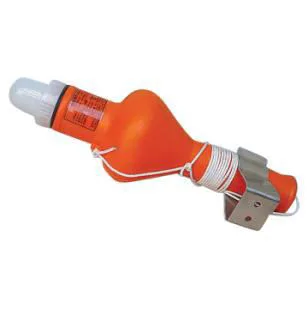
Size, Mass & Fire Rule
- Inner diameter: ≥ 400 mm (16 in)
- Outer diameter: ≤ 800 mm (32 in)
- Total mass: 2.5 kg to 6.0 kg
- Fire envelopment: Shall not sustain burning/melting after 2 seconds in fire
Buoyancy & Drop Tests
- Iron test: Supports ≥ 14.5 kg of iron in fresh water for 24 hours
- Drop height: Withstands drop from stowed height or 30 m (whichever is greater) into water without damage
- Marking: Clearly marked with ship's name and port of registry in Roman block capitals
Fittings & Accessories
- Light: White, ≥ 2 cd, 50–70 flashes/min for ≥ 2 hours
- Smoke signal: Orange smoke for ≥ 15 minutes, operable after 30 m drop
- Buoyant lifeline: Non-kinking, ≥ 8 mm diameter, breaking strength ≥ 5 kN
- Grab line: ≥ 9.5 mm diameter, secured at 4 equidistant points
SOLAS Carriage Scale
- Ship length < 100 m: 8 lifebuoys minimum
- 100 m – 150 m: 10 lifebuoys minimum
- 150 m – 200 m: 12 lifebuoys minimum
- > 200 m: 14 lifebuoys minimum
3. Life Jackets & H.E.L.P.
The life jacket is a personal LSA. For "how many, what type and where on your ship?", check the Fire Control and Safety Plan.
- Carrying (minimum): each person on board must have a personal life jacket, plus an extra jacket for the watchkeeper, plus 5% extra at the muster (embarkation) station.
- Types: (1) inflatable, (2) rigid.
- Made of non-flammable or synthetic buoyant material; colour internationally orange, highly visible.
- Worn: must be donned within 1 minute without assistance (by at least 75% of persons) and be comfortable to wear.
- Jump: allows a jump from a height of at least 4.5 m into the water without injury to the jacket or the person.
- Buoyancy: reduced by not more than 5% after 24-hour submersion in fresh water.
- Shall not sustain burning or continued melting after being totally enveloped in a fire for 2 seconds.
Accessories:
- Retro-reflective tape.
- Non-conducting whistle secured with a lanyard.
- Manual igniting light — white, burning continuously with luminous intensity not less than 0.75 cd, 50–70 flashes per minute for 8 hours.
Marking:
- Manufacturer's name, serial number, date of manufacture, weight capacity — and FRONT printed on the front.
After wearing the life jacket, H.E.L.P. = Heat Escape Lessening Posture — the posture that slows heat loss while waiting in the water.
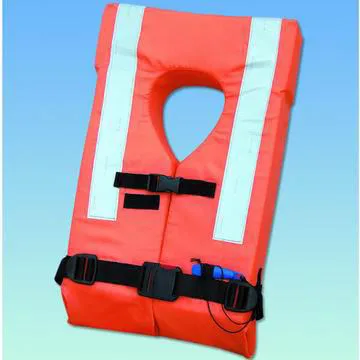
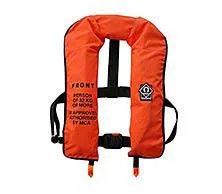
Donning & Jump Rules
- Donning time: ≤ 1 minute without assistance by ≥ 75% of persons
- Jump test: Withstands a jump from at least 4.5 m into water without injury or dislodging
- In-water performance: Turns an unconscious person face-up in ≤ 5 seconds with mouth ≥ 120 mm clear of water
Fittings & Light Specs
- Light intensity: ≥ 0.75 candela in all directions of upper hemisphere
- Light duration: Flashes 50–70 times/min for ≥ 8 hours continuously
- Whistle: Non-metallic, non-conducting, attached securely by lanyard
- Buoyancy loss: ≤ 5% loss after 24-hour immersion in fresh water
Ship Carriage Scale
- Base scale: 1 personal lifejacket for every person on board
- Watchkeepers: +1 extra lifejacket for bridge and engine room watchkeepers
- Muster stations: +5% extra lifejackets stowed at muster / embarkation stations
- Child lifejackets: ≥ 10% of total passengers or 1 per child on passenger vessels
4. Immersion Suits & Anti-Exposure Suits
Immersion Suit:
- Carrying (minimum): each person on board must have a personal immersion suit, plus an extra suit for the watchkeeper. Check the Fire Control and Safety Plan for numbers and locations on your ship.
- Types: (1) insulated, (2) un-insulated, (3) worn with a life jacket, (4) having sufficient buoyancy.
- Made of non-flammable, waterproof material; colour internationally red, highly visible.
- Worn: unpacked and donned within 2 minutes without assistance.
- Jump: allows a jump from at least 4.5 m into the water without injury.
- Covers the whole body except the face (hands covered unless permanently attached gloves are provided); fitted with retro-reflective tape.
- Shall not sustain burning or continued melting after being totally enveloped in a fire for 2 seconds — the same 2-second fire rule applies to every personal LSA (buoy, jacket, immersion suit and anti-exposure suit).
- After wearing, the person must be able to work normally, climb up and down a vertical ladder of at least 5 m, swim a short distance and board a survival craft.
- Used in cold weather below freezing point: body temperature must not fall more than 2°C over 6 hours immersion in calm circulating water at 0–2°C.
- A person in fresh water wearing the suit (with or without a life jacket) must turn from face-down to face-up in not more than 5 seconds.
Hypothermia is the dangerous fall of the body core temperature when a person is immersed in cold water — the body loses heat faster than it can produce it, leading to loss of muscle control, unconsciousness and eventually death if rescue is delayed. That is exactly what the immersion suit guards against: it limits the fall to 2°C over 6 hours at 0–2°C, buying time for rescue.
Anti-Exposure Suit:
- Made of non-flammable, waterproof material; colour internationally orange, highly visible.
- Worn: unpacked and donned within 2 minutes without assistance; jump from at least 4.5 m without injury.
- Covers the whole body except head and hands (gloves and hood provided; feet too where the Administration permits).
- Equipped with a pocket for a portable VHF telephone and a lateral field of vision of at least 120°.
- Shall not sustain burning or continued melting after being totally enveloped in a fire for 2 seconds — the same 2-second fire rule as every other personal LSA.
- After wearing: normal work, climb up and down a 5 m vertical ladder, swim at least 25 m through the water and board a survival craft.
- So constructed that, when worn as marked, the suit continues to provide sufficient thermal protection following one jump into the water which totally submerges the wearer: in calm circulating water at 5°C, the wearer's body core temperature must not fall at a rate of more than 1.5°C per hour, after the first 0.5 hour.
- A person in fresh water wearing an immersion suit — or an immersion suit with a life jacket — must turn from face-down to face-up in not more than 5 seconds and stay stable face-up.
| Feature | Immersion Suit | Anti-Exposure Suit |
|---|---|---|
| Colour | Red | Orange |
| Donning | Within 2 minutes, unassisted | |
| Jump | At least 4.5 m without injury | |
| Coverage | Whole body except face | Whole body except head and hands |
| Special fittings | Retro-reflective tape | VHF pocket, 120° vision |
| Thermal standard | −2°C / 6 h at 0–2°C | −1.5°C per hour at 5°C |
Oral tip — pair the suits, don't mix them:
Surveyors love asking the immersion suit and the anti-exposure suit back to back because the numbers rhyme. Anchor on the differences: red vs orange, whole body except face vs except head and hands, retro tape vs VHF pocket + 120° vision, short swim vs 25 m swim, and −2°C / 6 h at 0–2°C vs −1.5°C per hour at 5°C after the first half hour. Everything else — 2-minute donning, 4.5 m jump, 2-second fire rule, 5 m ladder, boarding the craft, 5-second face-up turn — is common to both, so say it once and move on.
Immersion Suit (Red)
Primary hypothermia protection:
- Coverage: Whole body except face; fitted with retro-reflective tape
- Donning: ≤ 2 minutes unassisted
- Jump: ≥ 4.5 m into water without injury
- Thermal standard: Body temp fall ≤ 2°C over 6 hours in calm water at 0–2°C
- Mobility: 5 m vertical ladder, short swim, board craft
- Righting: Turn face-down to face-up in ≤ 5 seconds
Anti-Exposure Suit (Orange)
Rescue boat crew protection:
- Coverage: Whole body except head and hands (hood and gloves provided)
- Fittings: Pocket for portable VHF; lateral vision ≥ 120°
- Donning & Jump: ≤ 2 minutes unassisted; jump ≥ 4.5 m
- Thermal standard: Core fall ≤ 1.5°C/h at 5°C (after first 0.5 h, even after full immersion)
- Mobility: 5 m vertical ladder, swim ≥ 25 m, board craft
- Righting: Stable face-up after 5-second turn
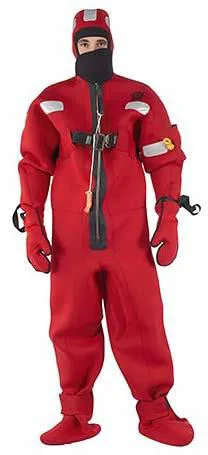
5. Thermal Protective Aids & Surveyor Asks
Thermal Protective Aid (T.P.A):
- Made of non-flammable, waterproof material; colour internationally orange, highly visible.
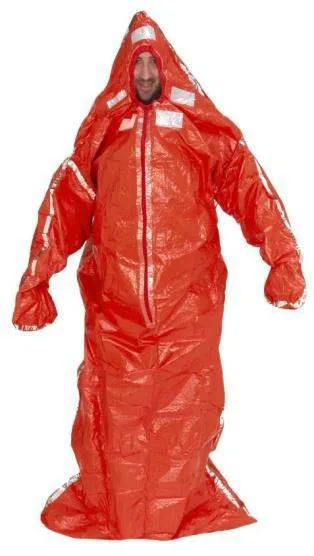
- Thermal conductance not more than 7800 W/(m²·K); reduces both convective and evaporative heat loss from the wearer.
- Functions properly over an air temperature range of −30°C to +20°C.
- Must permit the wearer to remove it in the water in not more than 2 minutes if it impairs the ability to swim.
- Covers the whole body of all sizes wearing a life jacket, except the face (hands covered unless permanently attached gloves are provided).
- Capable of being unpacked and easily donned without assistance in a survival craft or rescue boat.
- When used to enclose a person, it is so constructed that it reduces both the convective and evaporative heat loss from the wearer's body — the aid wraps the survivor, not the other way round.
Thermal Conductance
- Conductance: ≤ 7800 W/(m²·K)
- Action: Cuts convective & evaporative heat loss from survivor's body
- Operating Range: Functions from −30°C to +20°C air temperature
Fit & Donning
- Sizing: Encloses all body sizes wearing a life jacket, except the face
- Hands: Covered unless permanently attached gloves provided
- Donning: Easily unpacked and donned without assistance in craft
In-Water Removal
- Quick Release: Must permit removal in water in ≤ 2 minutes if it impairs swimming
- Colour: International orange, highly visible
- Material: Non-flammable, waterproof fabric
Oral-exam flow (Q1–Q6):
- Q1 categories: open with the four families — survival craft, personal LSA, distress signalling, general LSA — then the abbreviations T.P.A, EEBD, SCABA, EPIRB, SART and GMDSS.
- Q2 lifebuoys: personal LSA; size 400/800 mm, mass 2.5–6 kg, 14.5 kg iron for 24 h, 2-second fire rule, drop from stowed height or 30 m without impairing the buoy or its attachments, accessories (tape, 9.5 mm grab line × 4 diameters at 4 points, 2 cd / 2 h light, 8 mm / 5 kN life line, 30 m / 15 min orange smoke), marked with the port of registry; numbers from the Fire Control and Safety Plan.
- Q3 jackets: one per person + watchkeeper + 5% at muster; inflatable or rigid; donned within 1 minute by 75% unassisted; 4.5 m jump; buoyancy loss ≤ 5% / 24 h; whistle, tape, 0.75 cd / 8 h light; FRONT marking with maker, serial, date and weight capacity; then H.E.L.P.
- Q4 immersion suits + hypothermia: one per person + watchkeeper; red; 2-minute donning; 4.5 m jump; whole body except face; normal work, 5 m ladder, short swim, board craft; below-freezing use, −2°C / 6 h at 0–2°C; 5-second turn-over; define hypothermia as the cold-water core-temperature fall the suit delays.
- Q5 anti-exposure suits: orange; 2-minute donning; 4.5 m jump; body except head and hands with hood, gloves and VHF pocket; 120° vision; 5 m ladder, 25 m swim, board craft; thermal cover after one full dunk, −1.5°C per hour at 5°C after the first half hour; stable face-up.
- Q6 TPA: conductance ≤ 7800 W/(m²·K), cutting convective and evaporative loss; −30°C to +20°C; removable in ≤ 2 min; all sizes over a life jacket except the face; donned unassisted in the craft.
Read this table across when the surveyor jumps between appliances — every number below is the exact convention figure, nothing added.
Personal LSA numbers at a glance:
| Feature | Lifebuoy | Life Jacket | Immersion Suit | Anti-Exposure Suit | T.P.A |
|---|---|---|---|---|---|
| Colour | Orange | Orange | Red | Orange | Orange |
| Donning | — | ≤ 1 min, 75% unassisted | ≤ 2 min unassisted | Unassisted in craft | |
| Jump / drop | Drop stowed height or 30 m | Jump ≥ 4.5 m without injury | Remove ≤ 2 min in water | ||
| Key survival number | 14.5 kg iron / 24 h | Buoyancy loss ≤ 5% / 24 h | Fall ≤ 2°C / 6 h at 0–2°C | Fall ≤ 1.5°C/h at 5°C after 0.5 h | ≤ 7800 W/(m²·K); −30°C to +20°C |
| Marking / fit | Port of registry | FRONT + maker, serial, date, capacity | Whole body except face | VHF pocket, 120° vision | All sizes over life jacket |
Surveyors commonly ask: "Tell me about life buoys / life jackets / immersion suits including SOLAS regulation?" Open with the category (personal LSA), give the carrying rule, then the numbers — one appliance at a time:
- Buoy: 400/800 mm, 2.5–6 kg, 14.5 kg/24 h, port of registry.
- Jacket: +1 watchkeeper +5%, 1-minute donning, 4.5 m jump, H.E.L.P.
- Suit: red, 2-minute donning, −2°C/6 h.
Close every quantity question with "as per the Fire Control and Safety Plan" for your own ship.
Personal LSA sits inside the wider SOLAS framework — see SOLAS Chapter III — Life-Saving Appliances & Arrangements and Maritime Codes & Conventions for the LSA Code.