
Starting & Reversing the Two-Stroke
How 30 bar becomes rotation, the interlocks that guard it, and the three ways to run astern.
Key Principles at a Glance 5 points
- Air at 15–30 bar pushes pistons to firing speed, then fuel takes over — distributor sequences cylinders, interlocks guard direction and gear.
- Two receivers hold 12 alternating starts (6 unidirectional) with relief capped at 10% over design — flame traps and bursting discs guard each line.
- Astern comes four ways: reverse the engine, gear it, pitch it (CPP), or motor it electrically — fixed-pitch direct drive reverses the engine itself.
- Reversing re-times fuel and air-start (and mechanical exhaust valves); ports and constant-pressure exhaust need no change.
- Class demands 70% revolutions astern for 30 minutes with 60% power proven on trials; SOLAS demands crash-stop capability demonstrated and recorded.
1. Air Start — Sequenced, Interlocked, Protected
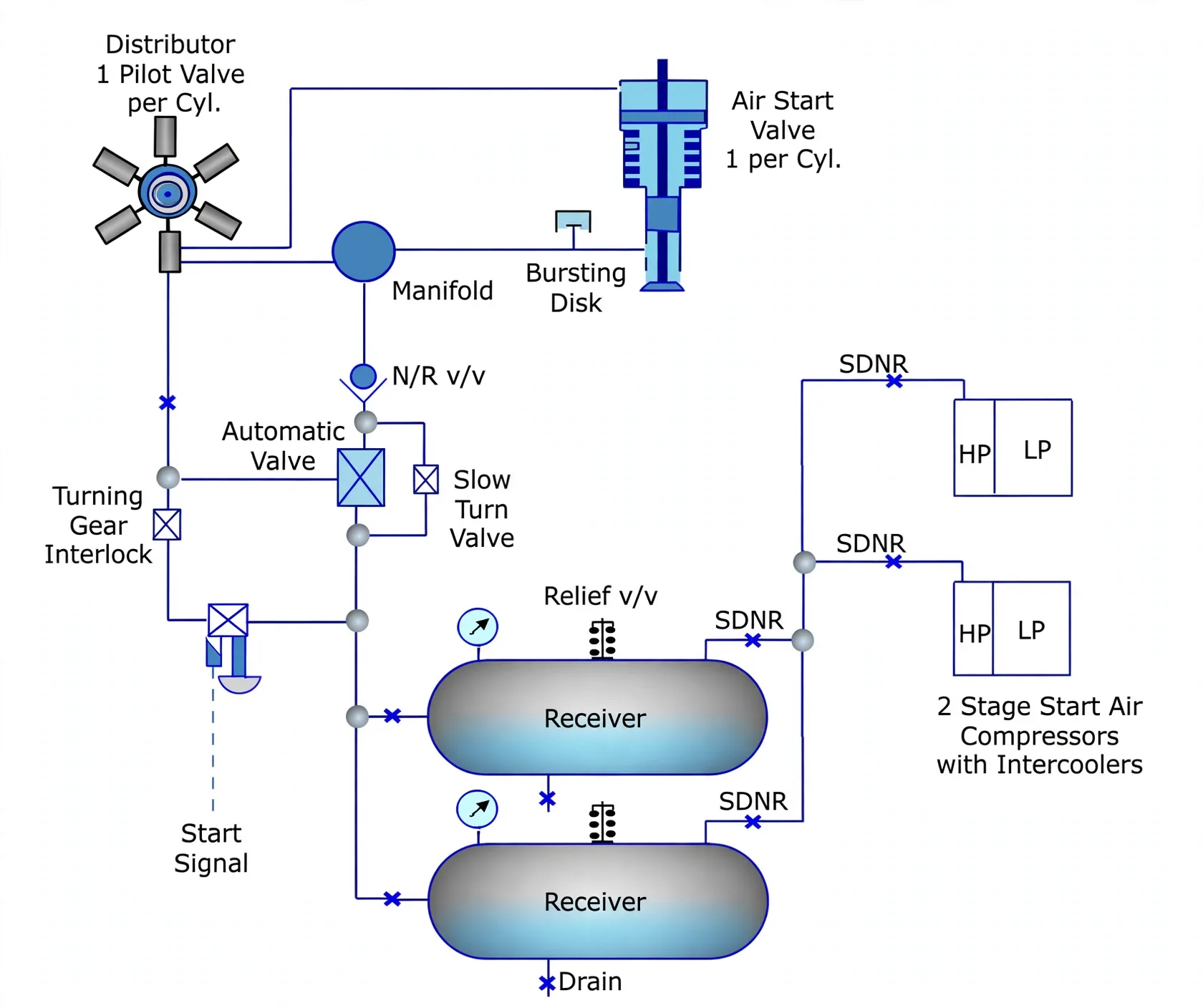
Distributor pilot valves, cam-timed per cylinder, open each head start valve in firing order. At 30 bar the piston is slammed down until firing speed lets fuel take over and air cut out.
Five guards stand over every start:
- Turning-gear interlock — bars air with gear engaged.
- Direction logic — verifies the set rotation.
- Flame traps — stop cylinder fire reaching the manifold.
- Bursting discs — cap pressure spikes.
- Receivers — carry gauges, drains and manholes.
2. Four Ways Astern
| Method | How | Price paid |
|---|---|---|
| Direct reverse | Re-time the engine to fire backwards | Full reversing gear; critical manoeuvring drill |
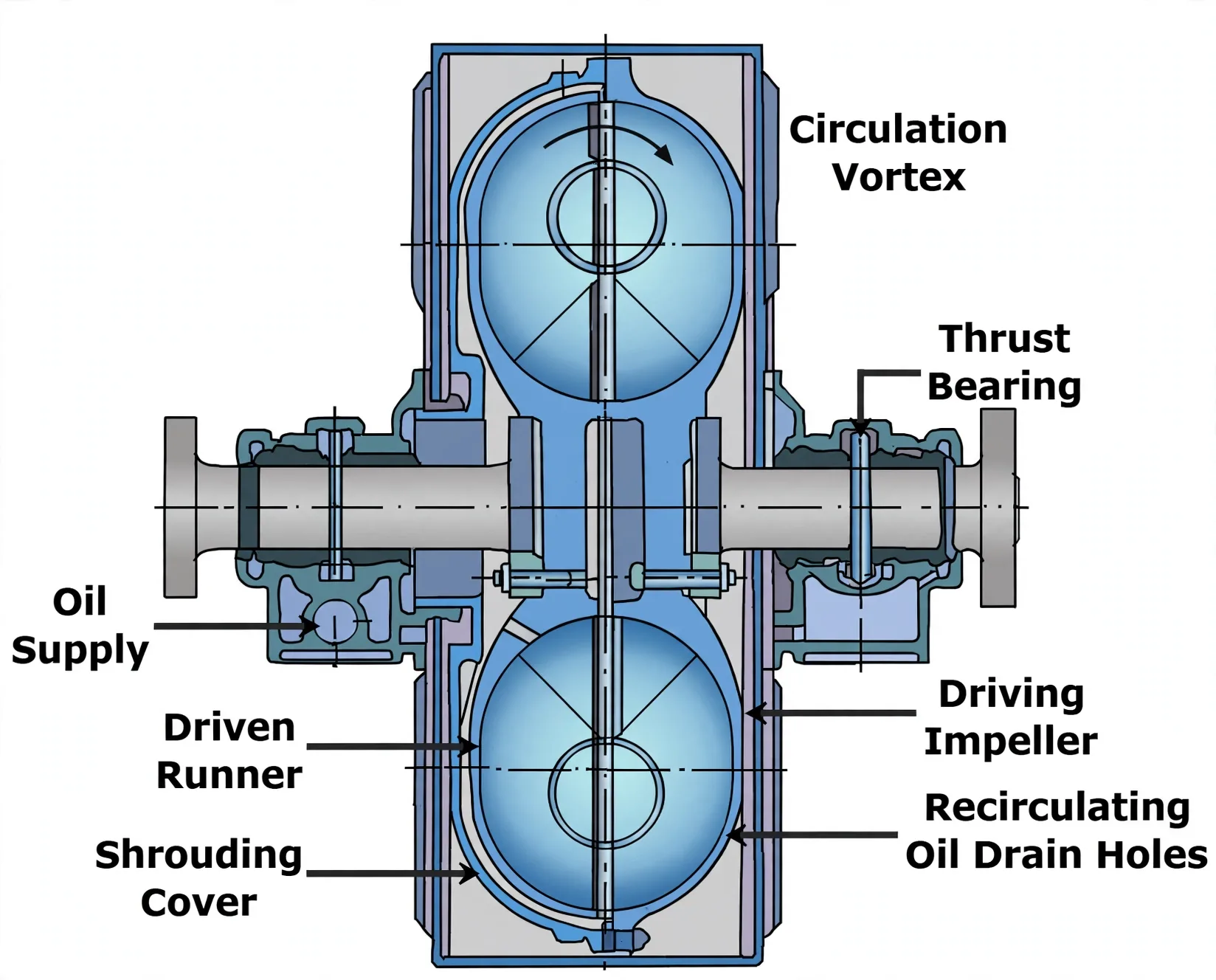
| Gearbox + clutch | Unidirectional engine, reverse gear engaged after clutching out | Gearbox weight; small air plant (no restarts needed) |
| CPP | Blades pivot to reverse thrust, engine never stops | Hub mechanism complexity |
| Electric | Reversible motor turns the shaft | Full electric transmission chain |
3. Re-Timing a Direct-Reversible
Reversing keeps some timings and moves the rest. The rule is simple: anything the piston itself governs stays put; anything a cam governs must shift.
| Stays put | Why |
|---|---|
| Scavenge ports | Opened and closed by piston position alone, symmetric about BDC — direction changes nothing. |
| Constant-pressure exhaust timing | Symmetric valve events need no shift for reverse running. |
| Must shift | How |
|---|---|
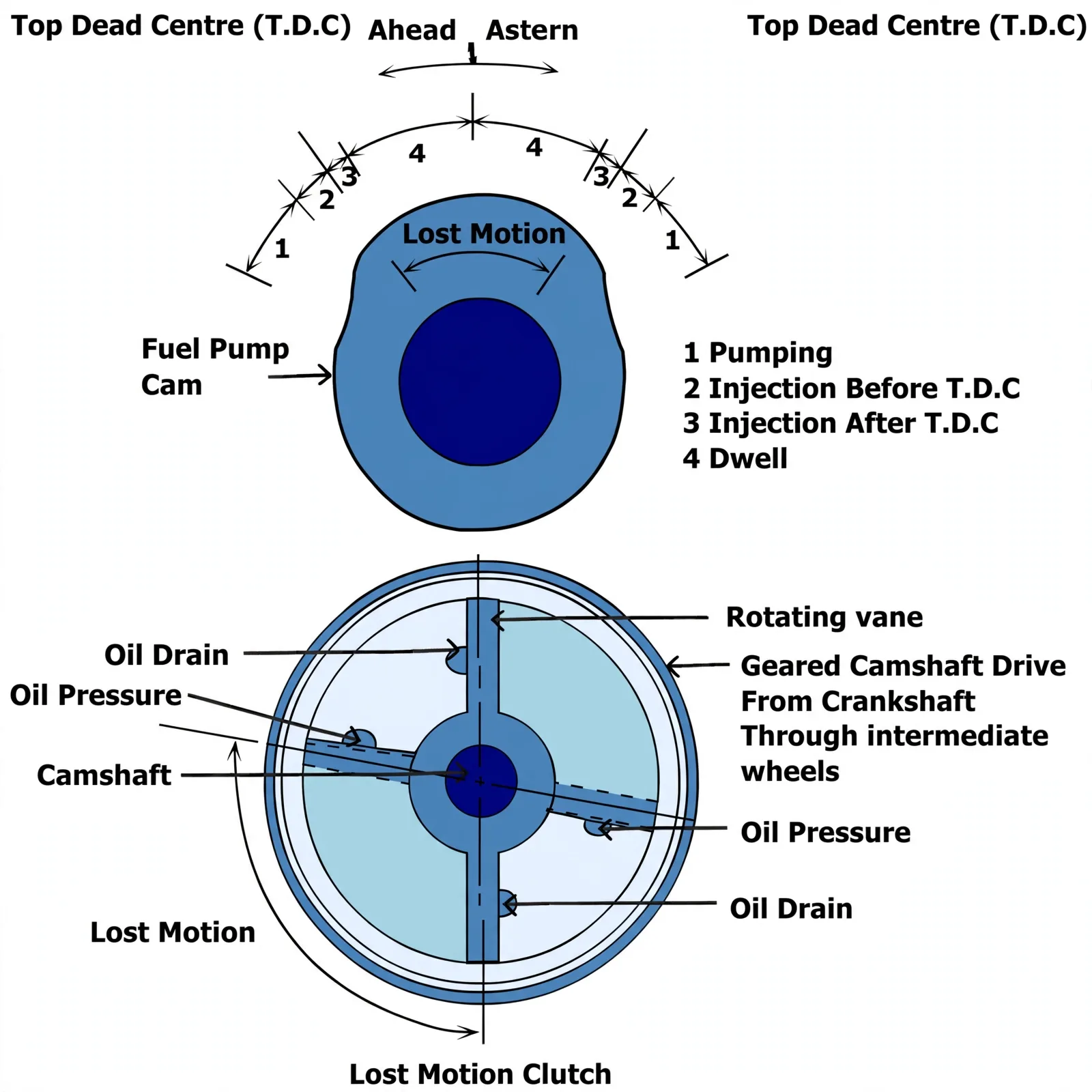
| Fuel cams | Axial shaft sliding between ahead and astern cam pairs; or per-unit roller shifting locked in the new position; or lost-motion vane servomotor rotating the camshaft ~98° on LO pressure. |
| Distributor cams | Shift with the fuel cams through shared gearing so air admission follows the new firing order. |
| Mechanical exhaust valves | Re-timed with the camshaft like fuel cams. |
| Hydraulic exhaust valves | Re-timed electronically — no mechanical shifting needed. |
Lost-motion shifting runs under interlock discipline: a blocking device holds the start lever at stop until the vanes seat, and a rotation-direction check cuts fuel if the shaft turns the wrong way. Camless engines skip all of it — PLC-driven solenoids re-time injection, air admission and exhaust purely from crank-angle input.
4. Rules & Electronics
Astern law: 70% revolutions for 30 minutes free-route, 60% power on trials, 12 alternating starts in the bottles, one-hour refill, crash stop demonstrated and recorded. Electronic engines replace cams with code: per-cylinder controllers firing fuel, exhaust, start-air and lube off speed-plus-angle inputs (standby controller covers any single failure), engine controller binding plant, safety and alarms together, servo-oil accumulators guaranteeing injection energy with pattern libraries from dead-slow to crash astern.