
Manoeuvring, Port Ops & Engine Vigilance
Stop/start/run signals, full-away and finished-with-engines drills, fuel changeover, and reading every abnormality.
Key Principles at a Glance 5 points
- Three signals run the engine: stop kills fuel via puncture valve, start sequences air through every interlock, run meters fuel by handle angle.
- Full-away is a plant state change: start air shut, HFO confirmed past SECA, economiser and FWG loaded, second generator off.
- Finished-with-engines parks hot steel safely: cocks open, LO half an hour on, jackets preheating, economiser cooled off-load.
- Every abnormality has a signature table — one hot unit vs all hot, pressure vs temperature, loss vs fluctuation — each pointing at its system.
- Alarms advise, trips act: independent power-backed monitoring with auto/manual/lock-in/delay/recorder/first-up behaviour, colour-coded and tone-distinct.
1. Signals & Interlocks
Three coloured signals run the engine. Each does one job, and each guards the next.
Stop — black
Holds the puncture valve down. No fuel reaches the cylinders whatever else happens.
Start — blue
Overrides stop only with every interlock clear and reversal complete. Opens the automatic start valve to the air distributor.
Run — green/red
Ends air admission through the fuel-air interlock. Meters governor fuel by lever angle from here on.
Reversing drives the fuel-pump cams and the air distributor together. The reversing-completed interlock releases the start path only at full travel — a cylinder stuck mid-travel bars the start entirely.
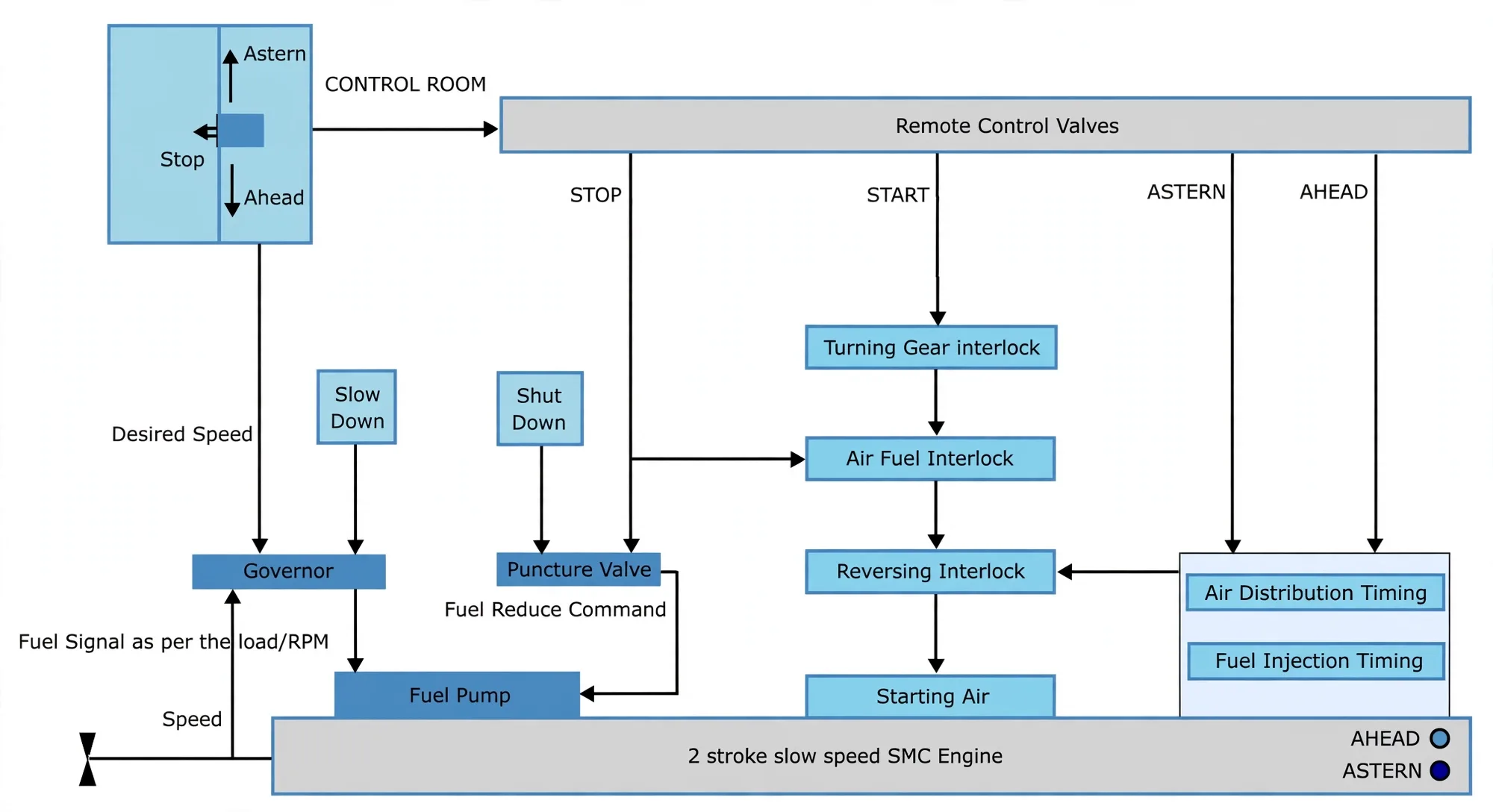
Bridge control adds its own layer on top:
- Programmed starts — three attempts, then lockout with alarm.
- Critical-speed jump-through, direction verification, and an independent emergency stop.
- Propeller area sensed clear, turbocharger lubrication confirmed, pressures correct.
- Starting-air pipe checked for heat, all cylinders confirmed firing.
- Full temperature watch on, loading raised gradually under program control.
- Running-in observed after renewed liners, rings or bearings.
2. Full-Away & Finished-With-Engines
Leaving and entering port are plant state changes, not single actions. Three checklists cover them.
Full-away
- Starting air shut; HFO service and settling tanks confirmed.
- Jacket preheating off; second generator stopped.
- Sea suction matched to draft; SECA-exit fuel changeover logged.
- FWG and shaft generator loaded.
- Economiser warmed through on steady gas before its pump starts — cold circulation invites acid condensation. Standby pump to auto.
Port approach
- Standby generator on, shaft generator off; auxiliaries and boiler to auto.
- FWG secured with the jacket water watched; distillate tanks pressed full.
- Fuel changeover run one hour out; air chests and bottles managed.
- Steering tested with the bridge; ahead and astern trials at manoeuvring revs.
Finished-with-engines
- Pumps set per fuel mode; starting air shut; blowers off; indicator cocks open.
- Lube oil kept running 30 minutes; jackets on preheating.
- Economiser cooled off-load; generators to port load.
- Full engine-room rounds to close out.
3. Fuel Changeover Without Casualties
Heavy fuel for economy outside restricted zones. Distillate for SECAs, manoeuvring and flushing. Change over on falling load, with tracing steam secured:
Set the viscotherm and trim heater steam to hold outlet temperature.
Open the distillate valve and turn the three-way valve while watching pressure.
Shut the heavy-oil feed and service outlets.
Swing the return to the distillate tank only after full flushing.
Bunkering discipline sits behind every changeover:
- Segregate sources — mixing invites asphaltene sludge.
- Drip-sample the manifold continuously through every delivery.
Samples stay labelled, cool and tracked.
4. Reading Abnormalities
| Signature | Points at |
|---|---|
| One unit hot exhaust | Its pyrometer, nozzle, ports, valve, cam, timing, rings, fire — or afterburning fuel valve |
| All units hot | Starved air (turbo, silencer, cooler), dirty ports, fuel grade, overload |
| One unit cold | Starved fuel (pump, valves, pipes, relief) or dead exhaust valve — cut both pumps at once |
| Jacket hot all / one | All: controller, cooler, pump pressure, overload. One: shut valves, air locks, choked passages, hot piston, gas leaking into water |
| Pressure swinging | Air trapped, expansion-tank drain-down, or combustion gas entering water spaces |
| LO pressure down / cylinder oil dead | Crosshead pump failed; sensor, empty daily tank, shut valves, choked filter |
| Scavenge low / hot / cooler ΔP high | Fouled turbo path, cooler, separator, nozzle ring, EGB back-pressure; heat also whispers early scavenge fire |
Noise, vibration and leaks get the same signature treatment. Sound localises rotating defects before instruments do. Pipe colours speed tracing:
| Colour | Service |
|---|---|
| Red | Fire main |
| Green | Sea water |
| Blue | Fresh water |
| Yellow | Lube oil |
| Black / brown | Fuel oil |
Every leak is repaired regardless of size:
- Oil absorbed, steam spaces evacuated, electrics dried dead.
- Superheated-steam jets found with a fluttering rag on a stick.
- Vibrating lines re-clamped; flange gaskets renewed.
5. Alarms Advise, Trips Act
Alarms advise, trips act. The monitoring system stands independent of control and safety:
- Standby power supply and self-watch — a broken wire alarms too.
- Unrectified faults stay displayed; UMS relays to cabins with timed general escalation.
- Bridge always notified; colour-coded lamps that silence-buttons never kill; distinct tones per system.
Auto-reset
Clears by itself once healthy after acknowledge.
Manual-reset
Stays until deliberately reset by hand.
Lock-in
Fleeting faults stay displayed for diagnosis.
Delay
Spurious flickers suppressed before alarming.
Recorder
Alarm sequence and time printed for the log.
First-up
The trigger isolated from the alarm flood — the only way to read a blackout's first second.