

Permits to Work: Enclosed Space Entry Criteria & Precautions
Master enclosed space entry on ships: atmospheric gas testing criteria (O2, LFL, H2S, CO), Wheatstone bridge explosimeters, Draeger stain tubes, ventilation, and rescue standby protocols.
1. What Constitutes an Enclosed Space Onboard Ship
In maritime operations under IMO Resolution A.1050(27) (Revised Recommendations for Entering Enclosed Spaces Aboard Ships), an enclosed space is legally defined as any space that possesses any of the following characteristics:
- Limited openings for entry and exit;
- Unfavourable or inadequate natural ventilation; and
- Is not designed or intended for continuous worker occupancy.
Aboard commercial vessels, the scope of enclosed spaces extends far beyond cargo and ballast tanks. Every marine engineer must recognize that all of the following compartments are enclosed spaces subject to mandatory permit control:
| Machinery Space Enclosed Zones | Hull & Cargo Structural Spaces | Utility & Auxiliary Compartments |
|---|---|---|
| Main engine crankcases & bedplate sumps | Double bottom ballast tanks & duct keels | Sewage vacuum collection & holding tanks |
| Scavenge air trunks & under-piston spaces | Cargo oil, chemical & product cargo tanks | Oily bilge water holding & sludge tanks |
| Boiler steam drums & water mud drums | Fuel oil bunker, settling & service tanks | Fresh water double bottom & peak tanks |
| Exhaust gas economizer (EGE) gas uptakes | Cofferdams, void spaces & pipe tunnels | Anchor chain lockers & bow thruster rooms |
Warning: The Hidden Hazard of Rust (Oxidation)
A completely empty, clean, and unpainted steel compartment (such as a void space, cofferdam, or water ballast tank) that has remained sealed can become completely devoid of oxygen simply through the natural chemical process of steel rusting (ferrous oxidation: 4Fe + 3O2 → 2Fe2O3). Entering such a compartment without testing has caused numerous maritime fatalities from instantaneous hypoxia.
2. Atmospheric Testing Criteria & Legal Thresholds
Before any person crosses the threshold of an enclosed space, the atmosphere must be rigorously tested using calibrated, intrinsically safe portable instruments. Testing must strictly follow a three-stage sequence:
- Step 1: Oxygen (O2) Content — Tested first because other electronic and catalytic detectors require oxygen to function accurately.
- Step 2: Hydrocarbon & Flammable Gases — Tested second to ensure the atmosphere is well clear of flammable or explosive envelopes.
- Step 3: Toxic Gases & Chemical Vapours — Tested third using specialized sensors or chemical stain tubes tailored to the previous cargo or compartment history.
| Atmospheric Parameter | Statutory Entry Threshold | Instrumentation & Mechanism | Hazardous Manifestation |
|---|---|---|---|
| Oxygen (O2) | Strictly ≥ 20.9% by volume | Electrochemical sensor cell (Lead-acid micro-fuel cell) | At <16%: impaired judgment; at <10%: mental confusion; at <6%: immediate unconsciousness and fatal brain hypoxia within 3 minutes. |
| Flammable Hydrocarbons | Strictly < 1% LFL (Lower Flammable Limit) | Catalytic bead pellistor / Infrared optical sensor | Flash fire or bulk vapour explosion ignited by static electricity, non-spark-proof footwear, or tools. |
| Hydrogen Sulfide (H2S) | Strictly < 5 ppm (TLV-TWA) | Electrochemical sensor or Draeger stain tube | Rotten egg odor at 0.1 ppm; at >50 ppm paralyzes the olfactory nerve (loss of smell); at >300 ppm causes instant respiratory arrest. |
| Carbon Monoxide (CO) | Strictly < 25 ppm (TLV-TWA) | Electrochemical cell or chemical stain tube | Colorless, odorless asphyxiant with 250× higher affinity for blood hemoglobin than oxygen, forming carboxyhemoglobin. |
| Sulfur Dioxide (SO2) | Strictly < 2 ppm (TLV-TWA) | Chemical stain tube / electrochemical cell | Present in boiler uptakes and inert gas residues; highly corrosive acid vapor destroying lung tissue. |
| Benzene (C6H6) | Strictly < 0.5 ppm (TLV-TWA) | Photoionization detector (PID) or selective stain tube | Carcinogen and marrow toxin found in refined gasolines and reformate cargoes. |
Warning: If any atmospheric parameter drifts outside these limits, entry is prohibited or the space must be immediately evacuated.
3. Testing Instruments & Physical Principles
Marine engineers must thoroughly understand the internal operation and critical failure modes of both primary types of detection equipment documented in engineering practice:
A. The Combustible Gas Indicator (Explosimeter)
The standard combustible gas indicator measures flammable vapors in concentrations below the Lower Flammable Limit (LFL). Its measuring core consists of a balanced Wheatstone bridge electrical circuit with four resistive arms:
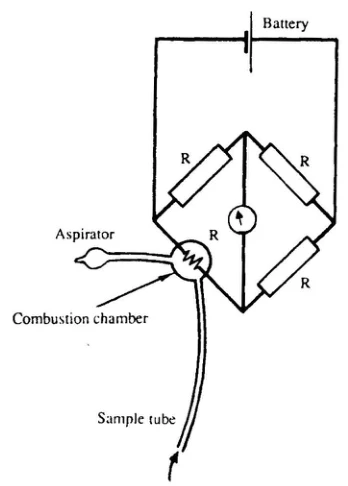
Operating Principle:
- An aspirator bulb draws a sample through an internal sintered-metal flashback arrestor into a combustion chamber containing a platinum-catalyst coated filament heated to dull red by a stable battery current.
- When flammable hydrocarbon vapor enters the chamber, it burns catalytically on the filament surface, releasing heat.
- This combustion raises the filament's temperature, increasing its electrical resistance proportionally to the hydrocarbon concentration:
ΔR = α × R0 × ΔT
- The unbalance of the Wheatstone bridge causes a proportional current flow through the galvanometer, which is directly calibrated to read 0% to 100% of LFL.
Danger: Fatal Failure Mode in Inert or Low-Oxygen Atmospheres
Because the explosimeter relies on combustion of the sample gas on the platinum filament, it cannot burn gas if oxygen is deficient! If you draw a sample from an inerted tank (where hydrocarbon gas is 15% and O2 is 2%), the gas will fail to burn on the filament. The meter will indicate 0% LFL! An unsuspecting engineer might conclude the space is gas-free when it is actually full of lethal, explosive gas. Always verify O2 ≥ 20.9% before trusting an explosimeter reading.
B. Chemical Stain Tube Detectors (Draeger Type)
Where specialized electrochemical sensors are unavailable or where a wide variety of volatile chemical toxins may exist, chemical stain tubes provide foolproof, substance-specific detection:
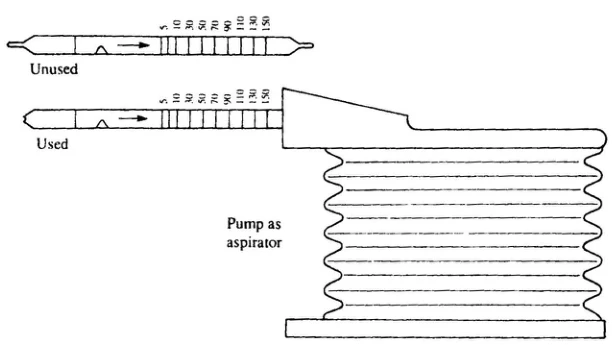
Operating Principle:
- Each sealed glass tube contains inert silica or ceramic granules impregnated with a specific chemical reagent that undergoes an irreversible color change upon reacting with the target gas.
- Both glass tip ends are snapped off using the integral tube cutter immediately prior to testing.
- The tube is inserted into the aspirator pump with the directional arrow pointing toward the pump suction.
- The calibrated spring bellows pump draws an exact volume (typically 100 cm3 per stroke) of sample gas through the tube.
- The length of the resulting color stain along the printed graduation scale indicates the exact concentration in parts per million (ppm). Unused tubes maintain a shelf life of approximately two years when stored away from direct light and excessive heat.
4. Step-by-Step Enclosed Space Entry Protocol
Every enclosed space entry must adhere to an uncompromised procedural sequence:
-
Risk Assessment & Tool-Box Meeting
Conducted by the Chief Engineer / Chief Officer with all participants. Review tank history, adjacent compartments, hazards, emergency signals, and individual assignments.
-
Positive Mechanical & Electrical Isolation
Close and lock all cargo, ballast, fuel, steam, and inert gas lines connected to the compartment. Where practicable, insert line spectacle blanks (spades) or physically disconnect spool pieces. De-energize and lock out all submerged pump motors, level transmitters, and cathodic protection systems (LOTO).
-
Forced Mechanical Ventilation
Ventilate thoroughly using dedicated pneumatic fans, water-driven blowers, or central ventilation trunking for at least 24 hours. Mechanical ventilation must remain continuous for the entire duration of the permit.
-
Pre-Entry Atmospheric Testing (Stratified Sampling)
Ventilation must be stopped at least 10 minutes prior to atmospheric testing to prevent measuring fresh inlet air streams. Lower sample hoses to sample top, middle, and bottom platforms:
- Light gases (Methane, Carbon Monoxide) rise and accumulate under the deckhead.
- Heavy vapors (Hydrocarbon gas, Gasoline, H2S, Carbon Dioxide, Freon) settle in the bottom bilges and sump pockets.
-
Permit Issuance & Sign-off
The Master or Designated Officer inspects the checklist, verifies instrument readings, and signs the Enclosed Space Entry Permit. The permit is valid for a maximum of one watch / shift (typically 8–12 hours). If work ceases or ventilation trips, the space is evacuated and re-tested before re-entry.
-
Continuous Ventilation & Personal Multi-Gas Monitors
Re-start forced ventilation. Every entering team member must carry an activated, calibrated personal 4-gas monitor (O2, LEL, CO, H2S) worn in the breathing zone.
5. The Standby Person & Emergency Rescue Equipment
A fatal pattern in maritime casualties occurs when workers collapse in an enclosed space and crew members rush in to help without breathing protection, immediately collapsing themselves. Under SOLAS and STCW regulations, the duties of the Standby Person are strict and non-negotiable:
Danger: The Golden Rule of the Standby Person
The Standby Person must NEVER enter the space under any circumstances, even if they observe their crewmates collapsed or calling for help. Their sole immediate duty is to RAISE THE ALARM, summon the designated shipboard rescue team, maintain continuous ventilation, and prepare the entrance hoist gear.
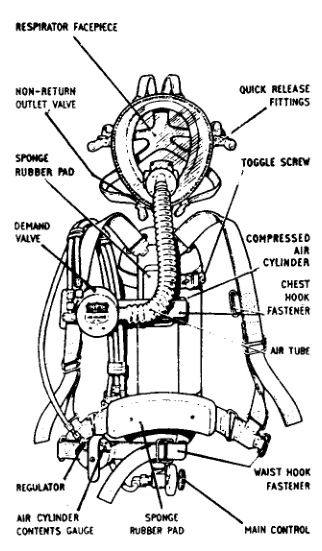
Mandatory Rescue Equipment Staged at the Tank Entrance
Before any person enters the hatch, the following equipment must be fully assembled and tested directly beside the access opening:
- Two Complete SCBA Sets: Charged to working pressure (typically 200–300 bar, providing ~30–45 minutes of air) with positive-pressure full-face masks.
- Emergency Resuscitator / Reviver: Medical oxygen resuscitator bag-valve-mask assembly for immediate unconscious casualty treatment.
- Tripod & Mechanical Winch: Erected directly above the manhole coaming with stainless steel cable or synthetic rescue line.
- Neil Robertson or Paraguard Stretcher: Specifically designed to immobilize casualties and pass vertically through narrow 400×600 mm shipboard manholes.
- Explosion-Proof Communication & Lighting: ATEX/IECEx approved intrinsically safe two-way UHF radios and certified portable torches.
- Lifeline & Full Body Recovery Harness: Tested and secured outside the entrance.
Standards & sources referenced
- SOLAS: International standards for the safety of life at sea.
- STCW: International standards for seafarer training, certification and watchkeeping.
- Conventions index
Practise this in the question bank
- Enclosed Space Entry — 16 questions
Found a mistake, or something unclear?
Report it in a few seconds — it goes straight to the editors.