
Gear & Screw Pumps — Rotary Overhaul, Backlash & Alignment
How trapped pockets move oil without valves, why shims go back in order, and the backlash numbers that condemn a gear set.
Key Principles at a Glance 6 points
- Rotary pumps trap liquid in moving pockets — gear teeth or screw threads carry it from suction to discharge with no valves at all.
- Alignment decides their life: a well-aligned gear or screw pump hardly breaks down; misalignment eats bushings, seals and gears.
- Shims are measured positions, not packing — every shim under motor and pump returns in its original order under its original foot.
- Backlash standard is 0.02–0.15 mm, absolute maximum 0.20 mm — beyond that, renew gears as a matched set and log every reading.
- A screw pump always works with its relief valve bypassing discharge to suction — never defeat, blank or raise it.
- On any planned opening, renew the seal as routine — it is the cheapest part in the pump and the most common comeback failure.
1. How a Gear Pump Moves Oil
Idea in one line: two meshing gears are a conveyor belt of tooth-sized buckets — liquid rides around the outside and gets squeezed out where teeth re-mesh.
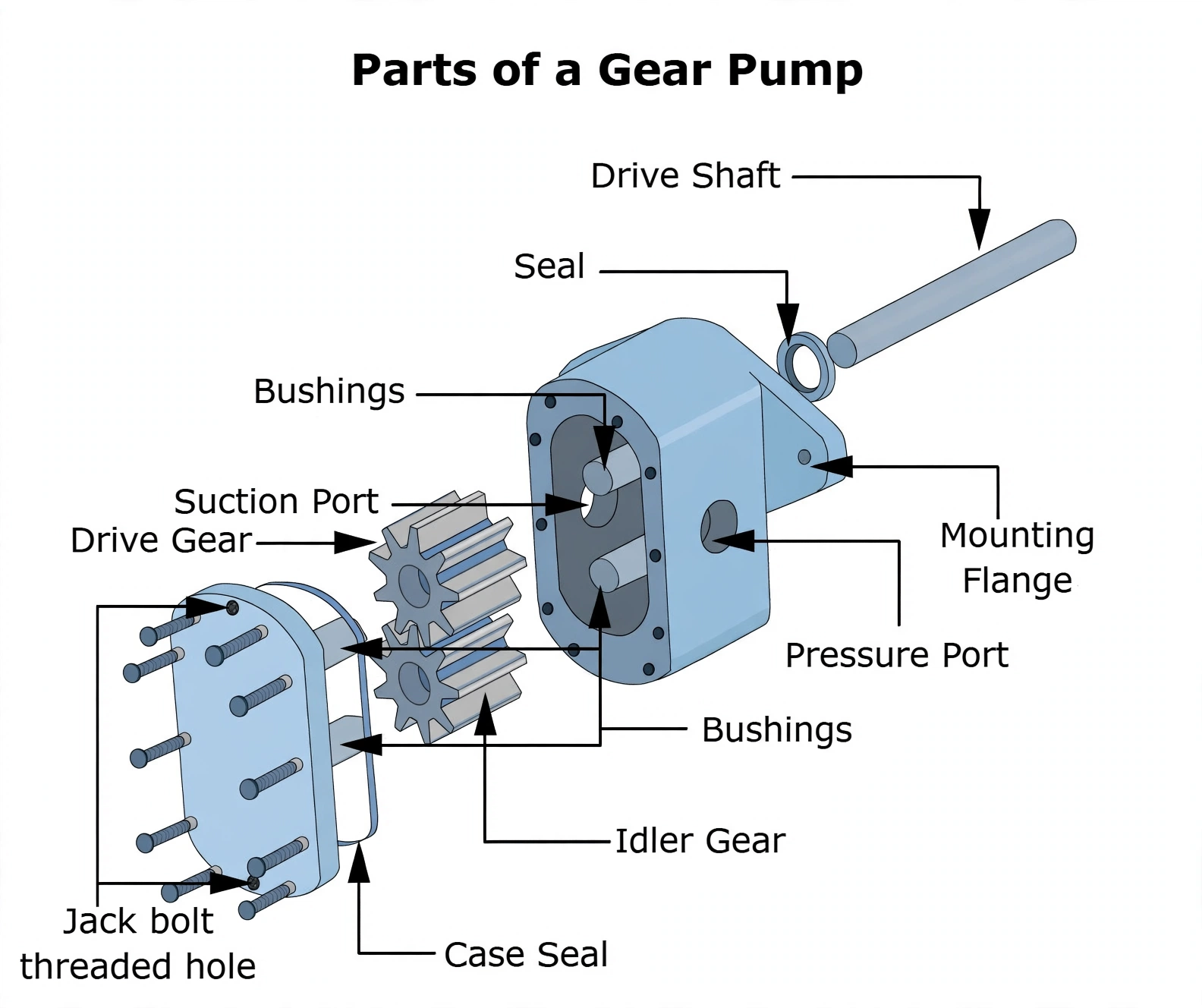
The drive gear, coupled to the motor, turns the idler on its own shaft — the two rotate in opposite directions inside a close-fitting casing, horizontal or vertical mounted. Liquid entering the suction port is trapped in the tooth spaces, carried around the outside of each gear — never through the mesh — and squeezed out the pressure port as teeth re-engage. No valves, no pulses worth naming: just pockets in continuous procession. Driven shaft rides on bearings or bushings at both ends; the drive shaft carries a mechanical seal where it leaves the casing.
2. Preparation — Spares, Power, Shims in Order
Idea in one line: the overhaul is won before the first bolt moves — spares on the bench, power truly dead, and every shim captured in order.
Rotary pumps punish improvisation: a missing seal or a shuffled shim set stalls the whole job. Work the preparation in this order, and treat alignment shims as measured positions — each set stored separately for reuse under its own foot:
Stage spares: confirm oil seal, bushings or bearings, and joint material on hand — discovering a missing seal with the pump open wastes a tide.
Kill the drive: switch off power, remove the fuse, hang the warning sign — the motor must have no path back to life.
Close the system: shut inlet and outlet valves to and from the pump.
Free the motor: coupling bolts out, motor foundation bolts out, ease the motor back — lifting every shim from under the motor feet and keeping each set in order.
Free the pump: flange bolts out of suction and delivery lines (inspect every joint face as it parts) — then foundation bolts out and lift the pump with its pipe stubs to a clean strip-down spot.
Capture the rest: note and store pump-foundation shims in order, clean the empty foundation while parts are cleaned, unbolt remaining pipework and drain leftover oil to a tray.
3. Strip, Three Checks & Backlash Verdict
Idea in one line: the cover comes off square, the shafts lift out in order — then three measurements decide what gets renewed.
Drain: drain plug out, oil to the tray.
Open square: back-cover bolts out, then drive the cover off with the maker's jacking threads — left and right bolts tightened evenly so the cover breaks free without cocking. That is what the spare threaded holes are for.
Lift shafts in order: idler out of its two bushings first, then drive gear and shaft. Mind the layout — one bushing per shaft sits in the back cover, two more (one per shaft) sit in the front shell. Some makers cut gear and shaft as one piece; handle it as one. Clean everything.
The three checks that decide renewal:
- Backlash — dial indicator between meshing teeth (feeler gauge on small pumps): 0.02–0.15 mm standard, 0.20 mm absolute maximum. Past maximum, change both gears as a matched set. Record every reading for the history file.
- Bushings or bearings — two per shaft. Rough turning by hand or audible rumble condemns ball bearings (high-capacity pumps use them to cut friction); visible wear condemns bushings.
- Oil seal — worn or nicked lips are renewed. Standing rule: on any planned or condition-based opening, fit a new seal regardless — it is the cheapest part in the pump.
4. Rebuild Square & Realign on Shims
Idea in one line: shafts must enter their bushings dead square — one cocked entry scores the new bushings you just fitted.
Dress the faces: clean joint seatings on shell and back cover, renew damaged joints — clamped faces must seal without distorting the casing.
Box up square: hold the back cover true while both gear shafts find their bushings; hand-turn the drive and prove smooth rotation with zero wobble.
Close: torque the back cover with its new joint, drain plug home, pipework refitted with sound thread seals so no air leaks into the suction side.
Realign on shims: set the pump on its cleaned foundation with its own shims in order, then draw the motor up with its shims in order until flanges meet with no visible misalignment.
5. How the Screw Pump Differs
Idea in one line: same rotary family, different pockets — intermeshing screws carry oil axially, and a timing gear keeps metal off metal.
Two or three screws carry liquid along their threads instead of around gears. The idler screws are not dragged by the pumped liquid — a dedicated timing gear couples drive to driven shafts so the screw flanks never touch. Both shafts ride on bearings at both ends (a pair per shaft plus the front-shell pair), mechanical seal on the drive end, horizontal or vertical mounted — and alignment is just as decisive as on gears.
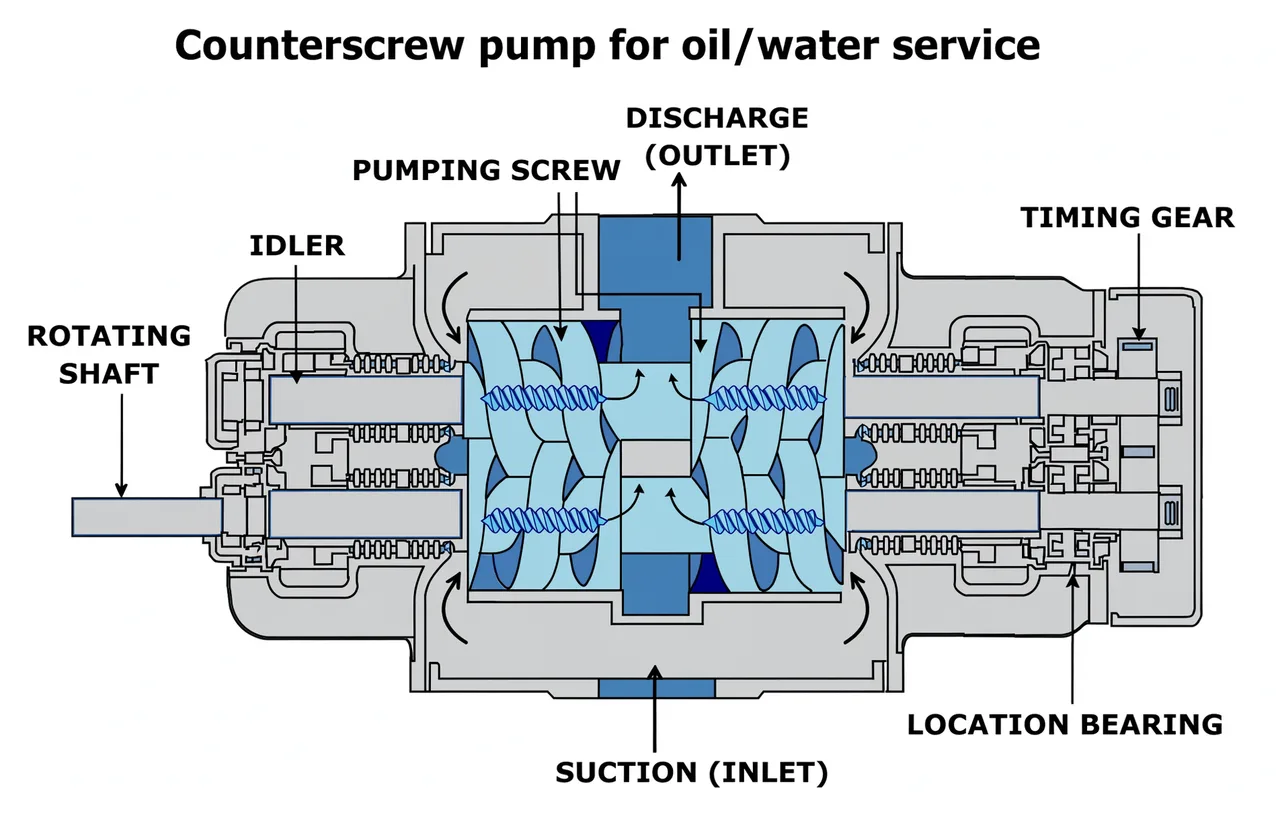
Every screw pump carries a relief valve bypassing discharge back to suction, because trapped-liquid pressure against a closed outlet has nowhere else to go. It is protection, not an accessory — never blank it, never raise it.
6. Screw Overhaul Specifics
Idea in one line: preparation mirrors the gear pump exactly — the differences begin at the timing gear.
Spares, power off with fuse removed, valves shut, warning sign, motor back with shims kept in order, flanges parted with joints inspected, unit lifted to a clean bench, foundation shims kept in order, foundation cleaned, pipework off with oil drained — identical. Then:
- Timing-gear backlash is the condemning measurement — same 0.02–0.15 mm band, 0.20 mm ceiling, renew as a set past it, log the readings. Dial indicator on large sets, feeler gauge on small ones. Some makers integrate timing gear with shaft — handle the assembly as one.
- Four bearings, two shafts — a pair per shaft plus the front-shell pair; rumble or roughness on hand-turning condemns. High-capacity sets run ball bearings to cut friction.
- Mechanical seals, not lip seals — renew on worn or nicked lips; on planned openings renew as routine regardless.
- Box up square: hold the back cover true while both screw shafts find their bearings; hand-turn for wobble-free rotation; new joint, torqued cover, drain plug home; pipes with sound thread seals; foundation shims then motor shims, flanges meeting with no visible misalignment.