
Reciprocating Pumps — Strokes, Air Vessels & Fault-Finding
How piston strokes become steady pressure, why trapped air smooths the blows, and where to look when delivery fails.
Key Principles at a Glance 6 points
- The piston retreats to fill (inlet opens) then advances to deliver (delivery opens at set pressure) — each valve opens only when its side wins the pressure contest.
- Pulsed flow is smoothed by air vessels on suction and discharge: compressed air stores each peak and returns it in each trough.
- A relief valve between suction and discharge is mandatory — a positive-displacement pump against a closed valve breaks something.
- NPSH is the suction-side energy margin; starve it and vapour cavities form and collapse inside the pump — that collapse damage is cavitation.
- Wear concentrates on rings, liners, valves, gland packing and crosshead alignment — and the condensed fault table traces every symptom back to these.
- Duplex vertical bilge and stripping pumps trade smooth bulk flow for pressure, lift and dirty-suction tolerance — up to about 225 m³/hr and 18 bar.
1. How a Stroke Becomes Pressure
Idea in one line: the piston makes vacuum to fill the cylinder, then makes pressure to empty it — valves just obey whichever side pushes harder.
On the suction stroke the piston retreats, cylinder pressure falls below suction pressure, the inlet valve lifts and liquid fills the space. On the delivery stroke it advances, pressure rises, the inlet slams shut, the delivery valve lifts at its set pressure and liquid is forced out. Single-acting sucks and delivers on one face only; double-acting admits liquid on both faces, so one side sucks while the other delivers — output per revolution roughly doubles.
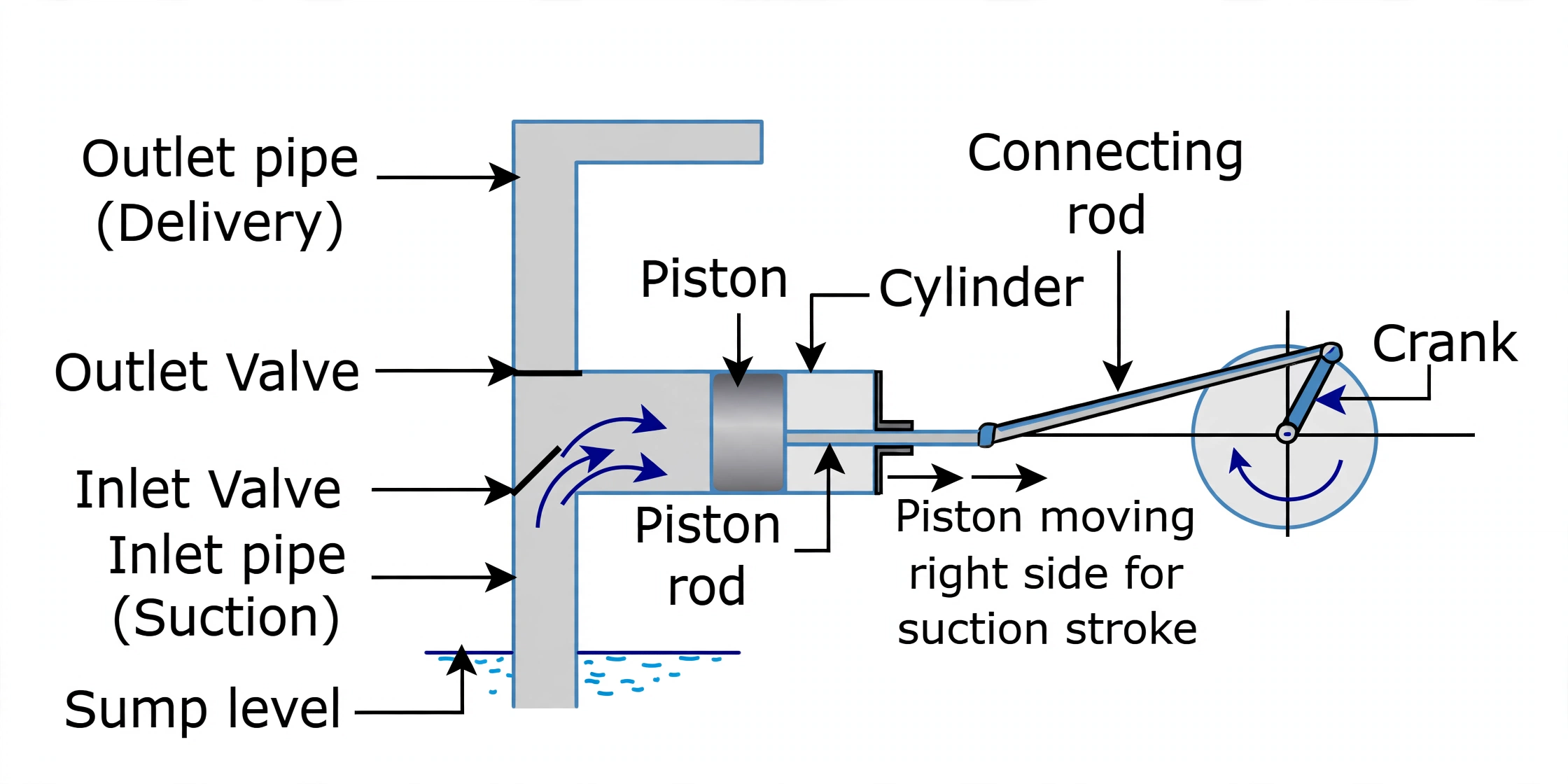
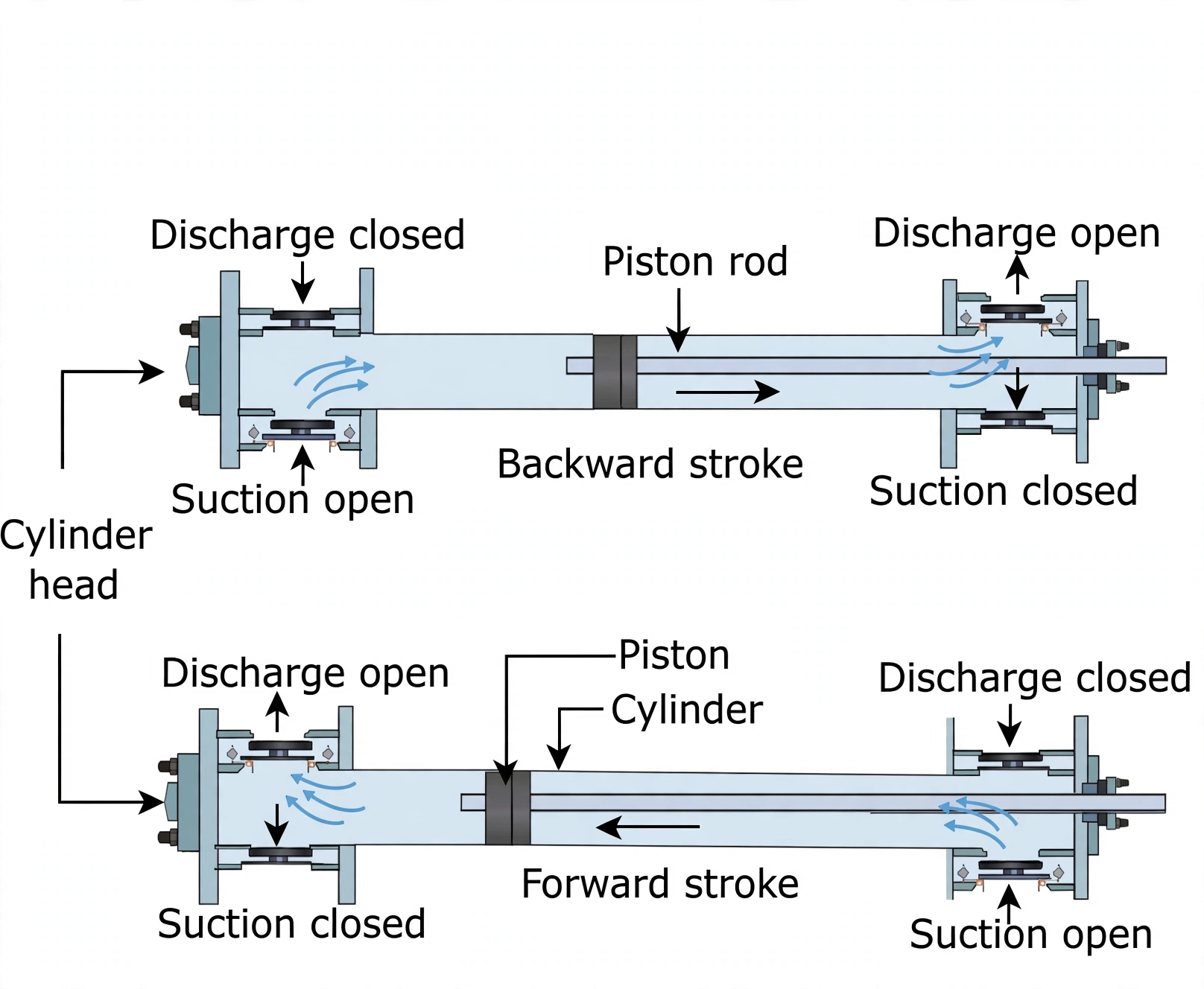
A positive-displacement pump keeps pushing regardless of downstream resistance. Against a closed discharge valve, pressure climbs until pump, piping or driver breaks — so a relief valve between suction and discharge chambers must always be fitted and free.
2. Why Pulses Need an Air Vessel
Idea in one line: piston flow arrives in blows, not steadily — trapped air swallows each blow and breathes it back out between strokes.
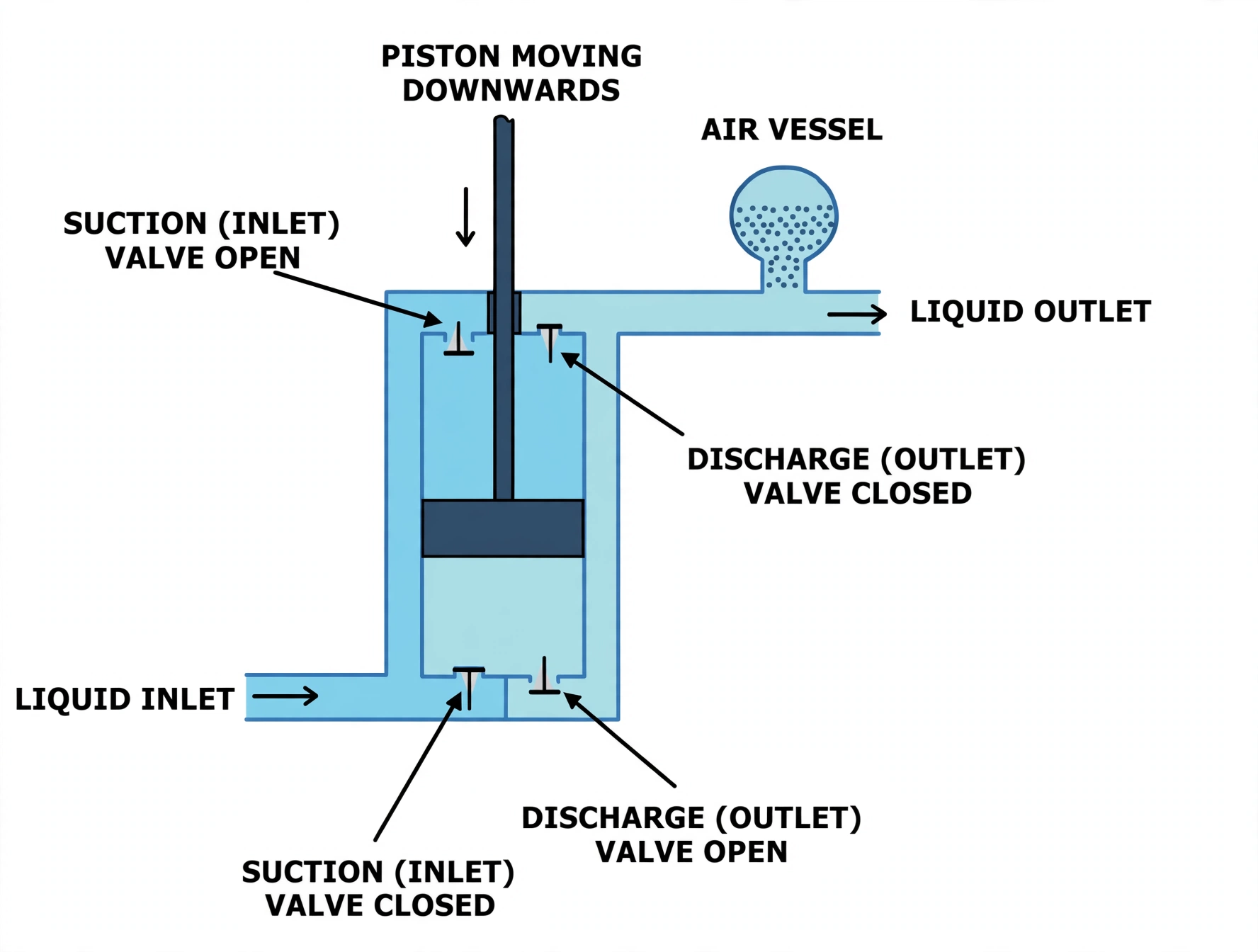
Vessels sit on discharge and suction lines alike, buffering pressure swings both ways. As discharge pressure rises the trapped air compresses — storing that peak energy — and as pressure falls the air expands, returning it. Peaks shaved, troughs filled: near-steady discharge and quiet pipelines instead of hammering joints loose.
Direct-acting
Power piston drives the liquid plunger on one straight rod — no mechanism between them.
Indirect-acting
Levers, cams or a crankshaft sit between them to change stroke length or speed ratio.
- A larger steam piston driving a smaller plunger multiplies pressure (force over smaller area) — high pressure at small volume.
- Reverse the sizes for bulk flow at low pressure.
3. Types, Duties & Trade-offs
Idea in one line: these pumps win where pressure and suction lift matter more than smooth bulk flow — and lose everywhere else.
Classified by action (direct or indirect, simplex or duplex, single or double acting, high or low pressure, vertical or horizontal). On board they survive as main-engine lube-oil supply and main bilge suction:
| Why it wins | What it costs | |
|---|---|---|
| Pressure & lift | High discharge pressure, high suction lift, no priming needed | Heavy, bulky, expensive to buy |
| Flow character | Positive, metered delivery per stroke | Pulsed and low-volume — needs vessels both ends, unfit for bulk transfer |
| Upkeep | Simple parts, crew-serviceable | Many sliding faces wear fast — heavy routine load |
Duplex bilge and stripping pumps (twin vertical pistons, motor or steam driven, up to about 225 m³/hr and 18 bar) are built for dirty suction: compact and robust, gas pockets designed out, large quick-seating valves with minimum lift, air vessels on discharge, and big valve-chest doors for fast access. They handle everything from light grades to viscous liquids under difficult suction conditions.
4. Where Wear Lives — the Maintenance Shortlist
Idea in one line: every sliding face is a wear face — check the shortlist first, every time.
Many moving parts means concentrated wear, which is why these pumps are confined to duties that truly need them. Check these first:
- Piston rings and liner (corrosion-resistant materials) — constant sliding contact; renew rings on schedule before they score the liner.
- Inlet and delivery valves — leaking valves show as lost capacity; reseat or renew promptly, and keep spare valve gear ready.
- Gland packing where the rod leaves the pump — adjusted to control leakage, never overtightened (overtight glands overload the driver).
- Crosshead, coupling and crank gear — misalignment here multiplies wear everywhere else; check pins, bushings, bearings and end play.
- Power-end oil — level, grade, temperature and crankcase seals; water in the crankcase or a clogged breather cooks bearings.
5. NPSH & Cavitation — Starve the Suction, Eat the Pump
Idea in one line: NPSH is the margin keeping liquid liquid at the inlet — spend it all and vapour bubbles form, then implode on metal.
Static head, atmospheric pressure and inlet-line losses all feed the margin; long or narrow suction lines, clogged strainers and inlet filters, excess fittings, hot liquid near vapour pressure, low static head, or vortices in the supply tank all drain it. Fall below the margin and liquid vaporises at the inlet — then those vapour cavities ride into high pressure and collapse violently. The micro-jets pit liners, seats and pistons, shake the machine and destroy performance: noisy operation, vibration, falling capacity with a healthy-looking discharge line.
Liquid knock (cavitation, air entrainment, valve slamming, hydraulic noise, shocks in piping) changes with suction conditions and flow; mechanical knock (loose piston or plunger, worn crosshead pins and bushings, slack rod bearings, excessive main-bearing end play, worn or misaligned gears and chains) follows speed and load. Diagnose the wrong one and you overhaul the wrong half of the pump.
6. Condensed Fault-Finder
Idea in one line: every symptom on this pump traces back to air, valves, wear, suction margin, or drive — work the table in that order.
| Symptom | Most likely causes |
|---|---|
| Low volumetric efficiency | Air or vapour pocket in inlet line, manifold or above valves; air leak in supply piping, loose inlet-manifold bolts; gases entrained in liquid; vortex in supply tank; foreign object holding inlet or discharge valves open; worn valves and seats; relief or bypass valve passing; worn liners, rings or plungers; blown liner gasket; internal bypassing; blocked liquid passage; NPSH insufficient; charge-pump capacity below power-pump capacity; wrong drive ratio, loose belts, wrong speed; loose valve covers or cylinder head; motor underpowered. |
| Liquid not delivered | Not primed; air or vapour pocket or clog in inlet line; all inlet or all discharge valves propped open; loose inlet-manifold bolts; valve velocities too high, slamming valves shut. |
| Cavitation noise | NPSH too low; no liquid reaching the inlet connection; excessive stuffing-box leakage drawing air. |
| Overloads the driver | Speed too high; discharge blocked, throttled or over-pressured; wrong plunger size; over-tightened glands; improper bypass conditions; poor cooling or electrics (low voltage, engine or gear trouble). |
| Stuffing-box leakage | Worn packing, rods, plungers, boxes or O-rings; wrong packing size; discharge valve stuck open raising box pressure. |
| Leak at head / valve cover | Over-pressure operation; loose head or cover; damaged gasket or O-ring. |
| Stud failure | Excessive discharge pressure; wrong nut torque; shock overload from cavitation. |
| Valve noise / line vibration | Broken or weak valve springs; obstruction under valves; worn packing; cavitation or trapped air above inlet valve; inlet air leaks or loose manifold bolts; over-pressure or over-speed running; low NPSH; unsupported, undersized, over-long or over-bent inlet piping; multiple pumps running in phase. |
| Noisy operation | Liquid knock (cavitation, air leak, partial loss of prime, hydraulic noise, piping shocks, poor supports, abrupt turns, misalignment, undersized pipe) vs mechanical knock (loose piston, worn crosshead, rod bearings, main-bearing end play, gears or chains worn or out of line, running backward, valve noise through the power end, water in crankcase). |
| Hot power end / oil troubles | Wrong oil level (too much or too little), grade or temperature; running backward or too slowly; tight main bearings, misaligned drive, tight belts; glands over-tightened; poor ventilation or over-pressure running; water condensation, worn seals or packing, clogged breathers, loose crankcase covers — leaking or watered oil. |