
Marine Propulsion & Diesel Engines
Diesel Engine Types — 2-Stroke Crosshead vs 4-Stroke Trunk
Five ways to classify any diesel, then the full head-to-head that decides propulsion vs power generation.
Key Principles at a Glance 5 points
- Every diesel sorts five ways: speed, usage, operation, cylinder arrangement and cycle — the chart below answers "what engine is that?" in seconds.
- Slow speed means 100–150 rpm direct-drive propulsion; medium 300–1000 and high above 1000 need gears and governors with faster reflexes.
- The crosshead fires every revolution with slow-speed visibility into faults; the trunk fires every other with compact power at hotter, dirtier cost.
- Two-stroke weaknesses cluster around breathing (scavenging, air hunger, fire risk) and bulk (weight, space, overhaul hours).
- Four-stroke weaknesses cluster around heat and complexity (higher temperatures, contamination, reversing gear, governor care).
1. Five Questions Classify Any Diesel
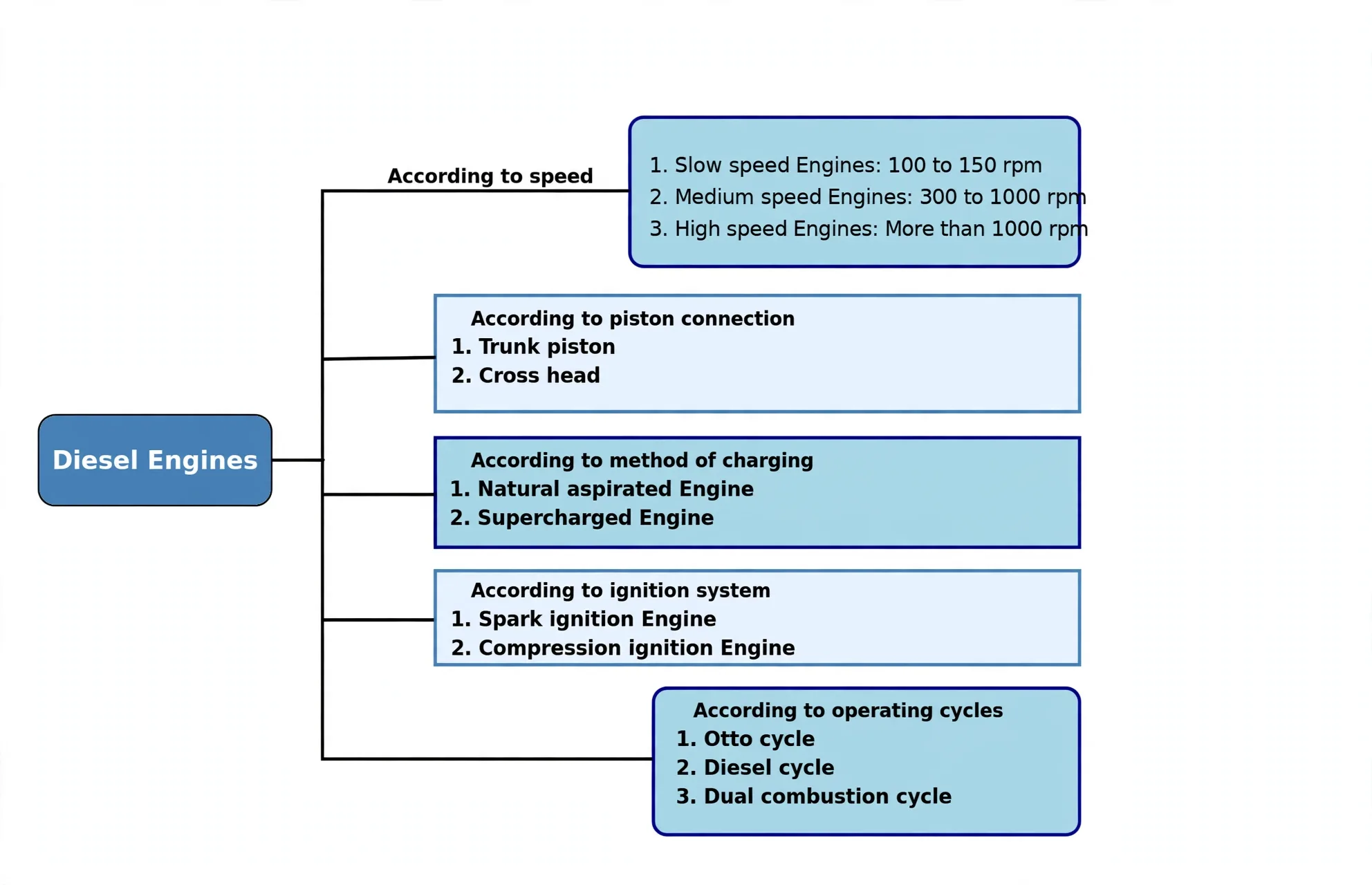
Speed bands fix the application: slow (100–150 rpm) couples straight to the propeller; medium (300–1000) and high (above 1000) drive through gears. Connection splits the marine world in two — trunk piston vs crosshead — which the rest of this lesson compares.
2. Power, Starting & Control
| 2-stroke crosshead | 4-stroke trunk | |
|---|---|---|
| Power per swept volume | More — every revolution fires | Less — one power stroke per two revolutions |
| Starting | Efficient, every revolution a chance | Inefficient by comparison |
| Fault visibility | Slow running exposes abnormalities early | Faults hide at medium-high speed |
| Governor | No special care at slow speed | Demands attention at 300–800 rpm |
| Reversing | Simple mechanism | Complex — two valves plus pump to reverse |
| Gears | Direct drive, none needed | Reduction gear required |
3. Heat, Dirt & Breathing
| 2-stroke crosshead | 4-stroke trunk | |
|---|---|---|
| Working temperatures | Lower mean temperatures | Higher mean and exhaust temperatures |
| Crankcase oil | Clean — sealed crankcase, separate cylinder lube | Contaminated — open trunk shares blow-by |
| Scavenging | Poorer (no dedicated stroke), fire-prone, air-hungry with long compressor hours | Cleaner (own stroke), almost no scavenge fires |
| Efficiency note | Lower MEP for same fuel rate | Higher MEP for same fuel rate |
4. Bulk, Space & Upkeep
| 2-stroke crosshead | 4-stroke trunk | |
|---|---|---|
| Size & weight | Heavy, long stroke vibrates, eats cargo space, high power-to-weight | Compact, smooth, shorter overhauls, more cargo space |
| Wear parts | Flywheel light, LO consumption low, liner spared by crosshead side-thrust take-up | Flywheel heavy, LO thirsty, head maintenance complicated |
| Upkeep | Longer overhauls, separate cylinder lubrication to tend | Faster turnarounds for the same power |
The pattern to carry forward: two-strokes pay in breathing and bulk, four-strokes pay in heat and complexity — every later chapter is a consequence of this trade.