
Theoretical Cycles — Otto, Diesel & Dual Combustion
Three ideal heat-addition stories on one p-V plot — and why real marine diesels follow the dual one.
Key Principles at a Glance 5 points
- All three cycles assume air as an unchanging working fluid with no induction or exhaust strokes — heat simply appears and disappears.
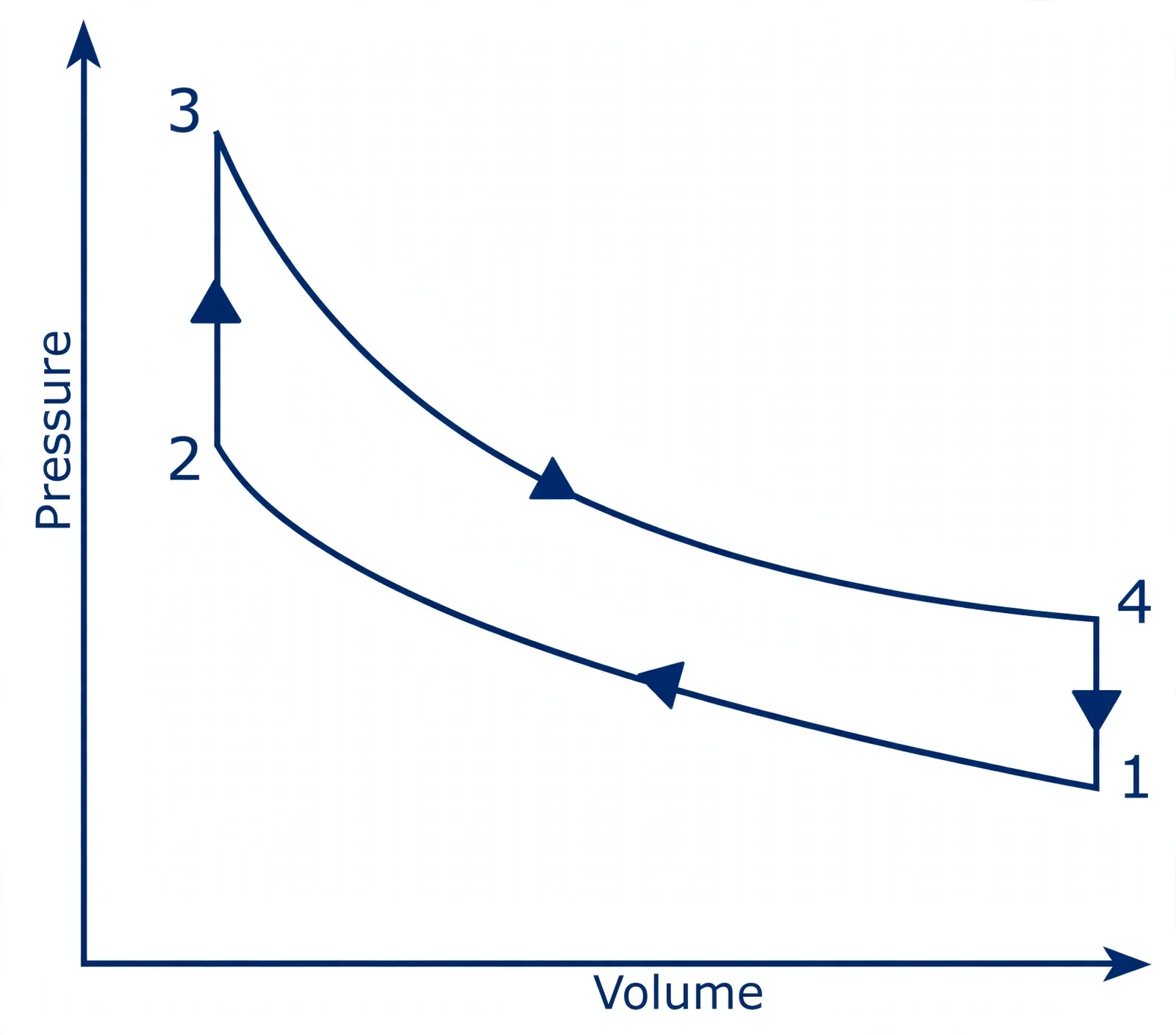
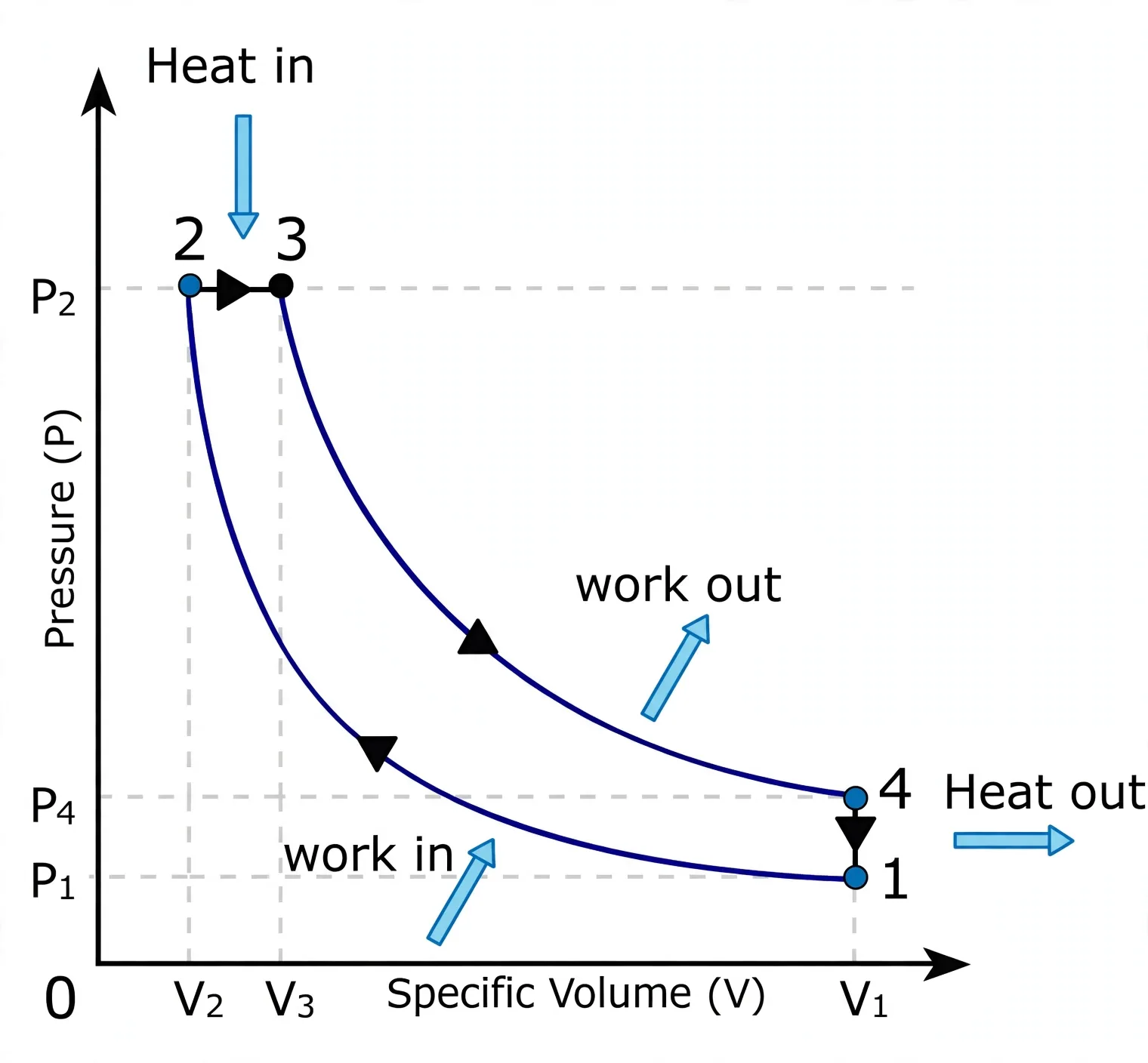
- Otto adds all heat at constant volume (2–3 vertical); Diesel adds all heat at constant pressure (2–3 horizontal).
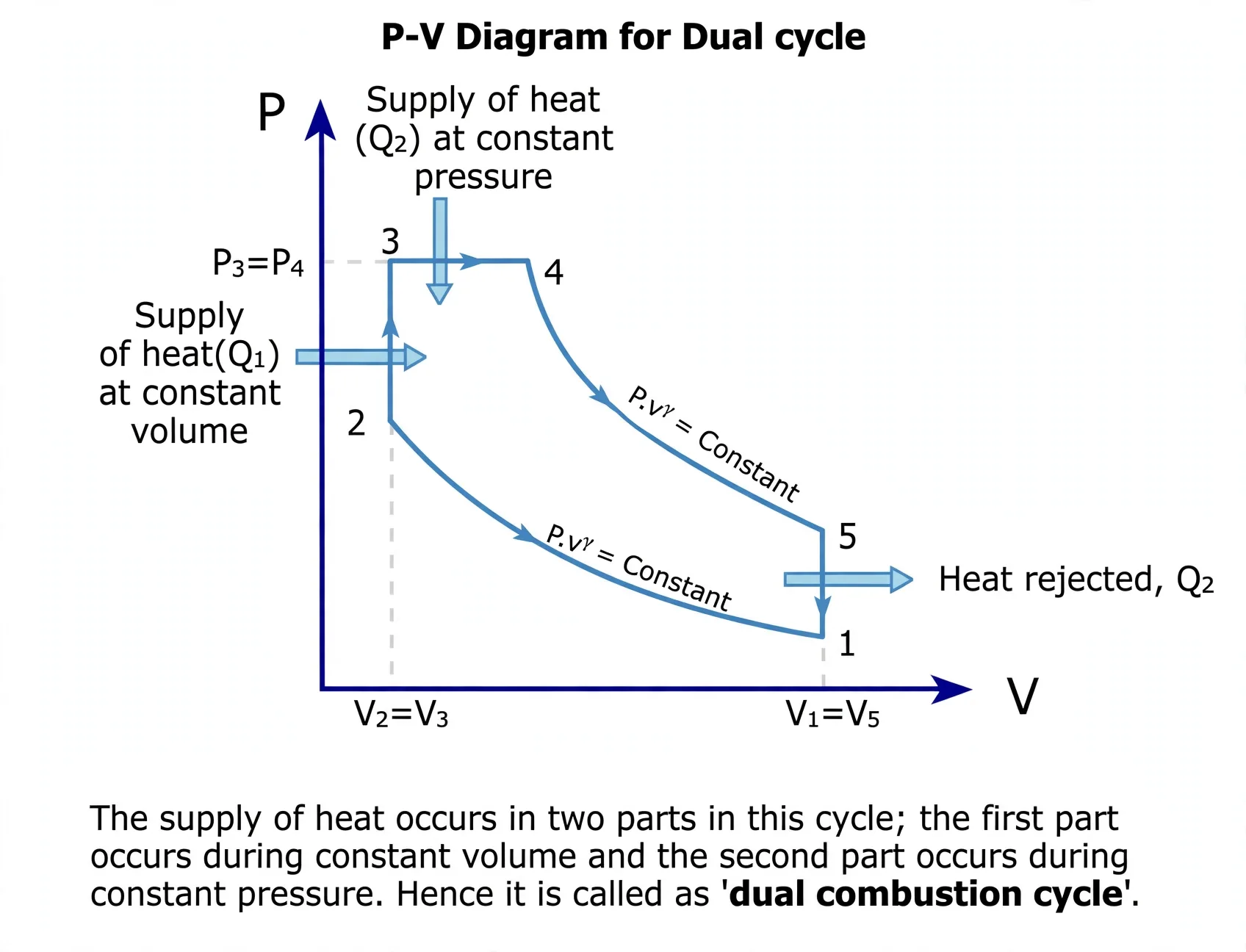
- Dual splits the difference: part of the heat at constant volume, the rest at constant pressure — closest to real diesel burning.
- Every cycle closes the same way: isentropic expansion for work, then constant-volume heat rejection back to the start.
- No real engine follows any of them strictly — valve events, finite burn time and heat losses reshape every corner.
1. The Ground Rules All Three Share
Theory strips the engine to its thermodynamic skeleton: a fixed mass of air, compressed and expanded isentropically, with heat added at one stage and rejected at another. Induction and exhaust strokes do not exist in this world — the cycle is a closed loop, and efficiency depends only on how the heat is added and how far the air expands.
2. Otto — All Heat at Constant Volume
Compress air isentropically (1–2), dump all heat in with the piston parked (2–3, vertical line — volume frozen, pressure leaping), expand isentropically (3–4), reject heat at constant volume (4–1). Instantaneous burning at top dead centre is the idealisation — and the petrol engine's theoretical home.
3. Diesel — All Heat at Constant Pressure
Same isentropic compression (1–2), but heat enters while the piston retreats just fast enough to hold pressure steady (2–3, horizontal line) — slow, controlled burning as in early air-blast diesels. Then isentropic expansion (3–4) and constant-volume rejection (4–1) exactly as before.
4. Dual — the Marine Diesel Compromise
Real fuel burns in two phases: a rapid premixed spike near constant volume, then a drawn-out diffusion burn near constant pressure. The dual cycle writes exactly that — heat partly at constant volume (2–3), partly at constant pressure (3–4) — followed by adiabatic expansion to point 5 and constant-volume rejection home. This is the cycle modern marine diesels are analysed against.
| Cycle | Heat added | Describes |
|---|---|---|
| Otto | Constant volume | Petrol / gas engines |
| Diesel | Constant pressure | Early slow-burn oil engines |
| Dual | Volume then pressure | Modern marine diesels |