
Transformers, Diodes & Thyristors
How shared flux trades volts for amps, why DC cannot cross, and the one-way valves of electronics.
Key Principles at a Glance 5 points
- A transformer moves power between isolated windings through shared changing flux — same frequency, different voltage, power conserved.
- Step up trades volts up for amps down (and reverse) — ratings quote kVA because current, not power factor, heats windings.
- DC cannot transform: no flux change means no induction — unidirectional supply gives no output.
- A diode is a one-way valve; a Zener adds controlled reverse breakdown for references and stabilizers; an SCR adds a gate for full power switching.
- Auto shares winding (small, cheap, no isolation); isolation separates it (shock and noise protection); welding steps down to high-current arc volts.
1. Shared Flux Trades Volts for Amps
AC through the primary breathes alternating flux around the core. Any nearby secondary linked by that flux feels an EMF by Faraday's law — power crosses with no wire touching.
- Same frequency always.
- Turns ratio sets voltage ratio.
- Current ratios invert it because power in equals power out (minus small losses).
Step up: volts rise, amps fall. Step down: the reverse.
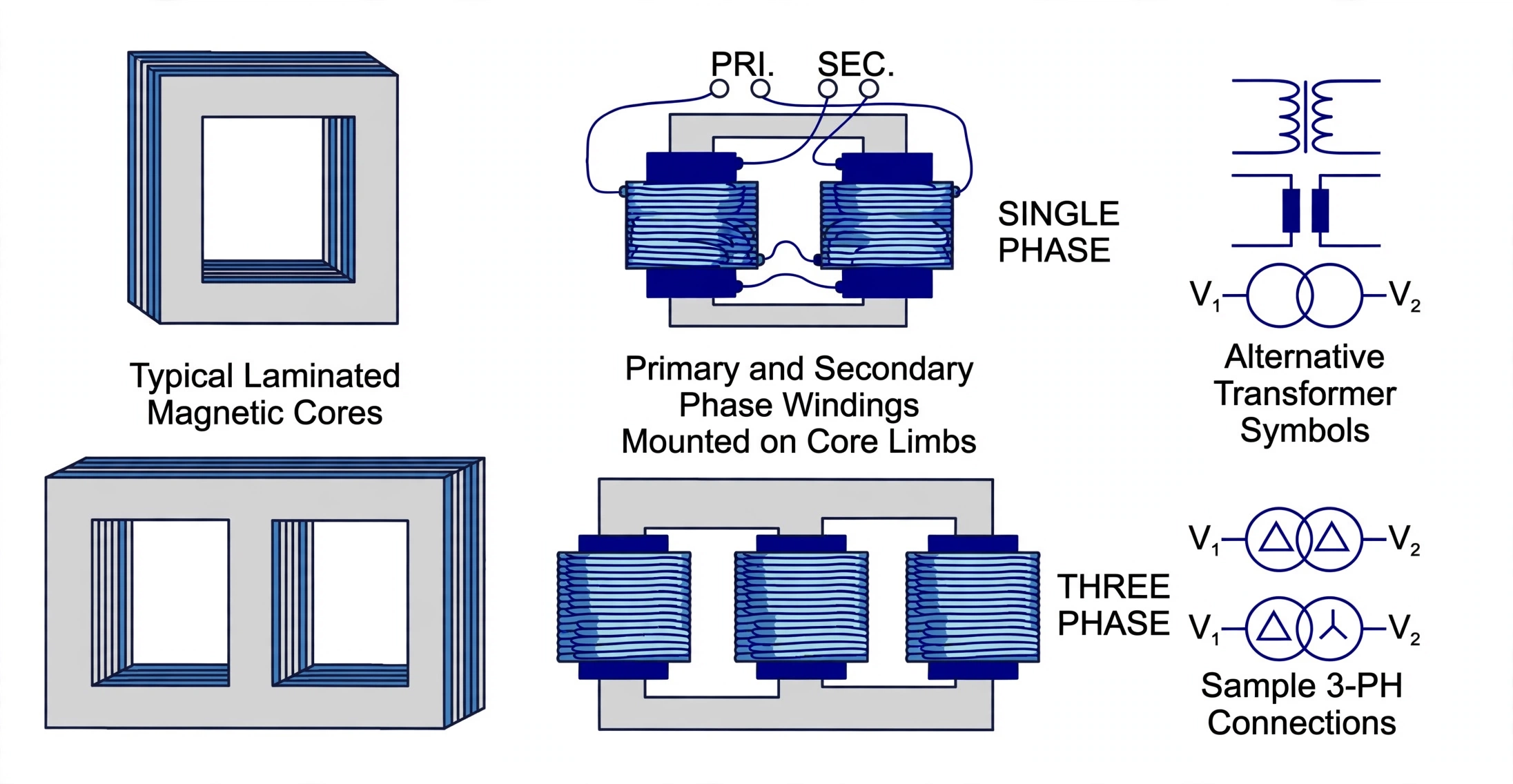
Rated in kVA because copper loss follows current while iron loss follows voltage — power factor belongs to the load, not the machine, so apparent power is the honest nameplate. No DC for the same reason in reverse: steady current means steady flux, zero rate of change, zero induced EMF, zero output.
2. Core, Cooling and Special Cousins
| Family | Built how | Used where |
|---|---|---|
| Core-type | Windings hug separate core limbs | High-voltage power work |
| Shell-type | Core hugs windings both sides | Compact low-voltage duty |
| Oil self / water-cooled | Bath carries heat out, water assists | Shipboard power transformers |
| Air-blast | Forced air over dry windings | Fire-safe spaces |
| Auto | One tapped winding shared by both sides | Small ratio steps, starters — never where isolation matters |
| Isolation | Extra inter-winding insulation, high withstand | Shock protection, noise breaking, DC blocking between circuits |
| Welding | Step-down to 15–45 V at 200–600 A+ with taps, high impedance for arc stability | Welding sets (rectifier plus choke for DC) |
3. One-Way Valves With Ambition
A diode passes forward, blocks reverse — rectifier duty in every power supply, protection duty everywhere else. Variants earn their names: LED and laser emit (incoherent vs coherent light), Schottky drops 0.15–0.4 V for efficiency, photodiode sees (or solar-generates), varicap tunes with bias, TVS clamps spikes, Gunn oscillates on negative resistance. The Zener differs by design: engineered low breakdown (knee voltage) lets it conduct in reverse on purpose — the classic low-current reference and stabilizer. The SCR/thyristor adds a gate to the rectifier: off until triggered, on until current zeroes — AC power control, crowbar overvoltage dumps, phase-angle controllers, flash-tube switches.
4. Lambda Sensor — Sniffing the Burn
A zirconia (or galvanic, infrared, ultrasonic, laser) cell reports exhaust oxygen fraction; rich-vs-lean inferred against other engine data trims fuelling. Divers read the same physics as breathing-gas partial pressure — one device, two life-support duties.