
Retention, Holding and Zero-Discharge Systems — Holding Tanks, Vacuum Toilets and Elsan
The arrangements that keep sewage on board rather than treating it.
Key Principles at a Glance 6 points
- Retention systems are simple in operation with virtually no maintenance, but they comply only within the limit of their storage capacity — and nothing may be discharged in port.
- A vacuum toilet uses about 1 litre of water per flush against about 12 for a conventional type, cutting the volume the tank has to hold roughly twelve-fold.
- A comminutor plus chlorine contact tank macerates the solids and holds the mix for at least 20 minutes before discharge — the comminuting and disinfecting arrangement the regulations allow between 4 and 12 miles.
- Holding tanks need a vent with the outlet safely positioned and a flame trap fitted, internal coating against corrosion, and a fresh water connection for washing through after discharge at sea.
- The Elsan zero-discharge system separates the waste, chemically inerting the solids and recycling the treated liquid as flushing fluid, and holds only 2 litres per person per day — about 1 % of a conventional retention system.
- A plain holding tank is not a neutral solution: it is an anaerobic digester that happens to be located in the accommodation block.
1. Retention systems
The ISPP Certificate and its supplement, the SMS and the Chief Engineer's orders override. In port, nothing goes overboard. The holding tank is pumped to a shore reception facility.
Their main advantage is simplicity in operation and virtually no maintenance. There is no bacterial colony to keep alive, no aeration to maintain, and no chemical dosing. They comply with present regulations within the limit of their storage capacity.
That qualification is the whole problem. Since no sewage can be discharged in port, prolonged stays create a problem. A ship that spends three days alongside is fine; a ship that spends three weeks alongside has a tank that filled up in the first few days.
The vacuum toilet — the fix for volume
The problem is reduced by a vacuum transportation system for toilets, where only about 1 litre of water per flush is used, compared with about 12 litres for conventional types.
That is roughly a twelve-fold reduction in the volume the tank has to hold, achieved by a change to the toilet rather than to the tank. The other consequences are worth knowing:
- Vacuum systems use smooth, small-bore plastic pipes, except in fire hazard areas, which are relatively inexpensive to install.
- Because of the small amount of water used, they are usually supplied with fresh water — which keeps salt water out of the accommodation spaces.
The fresh water point is a habitability benefit as well as a corrosion one. Sea water flushing produces salt deposits and odours in the accommodation; a vacuum system avoids both.
The comminutor route
Some retention systems pass the sewage first through a comminutor, which macerates the solids and gives them a greater surface area. The mix then passes into a chlorine contact tank, where it must remain for at least 20 minutes before discharge overboard.
The comminutor plus chlorine contact tank is effectively a comminuting and disinfecting system of the kind the discharge regulations allow between 4 and 12 miles. The 20 minute retention is a specific requirement and worth memorising.
2. Holding tank construction
Simple holding tanks may be acceptable for ships that are in port only briefly. Beyond that, capacity would need to be excessively large for long stays, because of the flushing water.
The construction requirements are few but each has a reason:
- A vent, with the outlet suitably and safely positioned because of the gas emissions. A flame trap reduces the risk. The vent is not merely for smell. A holding tank contains sewage breaking down anaerobically, which produces methane and hydrogen sulphide.
- Internal corrosion is inhibited by coating.
- A fresh water connection is required for washing through the tank and pump after discharge at sea.
The flame trap on the vent is the item people forget, and it is the one that matters most — a tank venting methane needs a flame trap in the same way any fuel tank does.
3. The Elsan zero-discharge system
A retention or holding tank is required where no discharge of treated or untreated sewage is allowed in a port area. The sewage is pumped out to shore reception facilities, or overboard when the vessel is proceeding on passage at sea, usually beyond the 12 nautical mile limit.
The Elsan system is the classic zero-discharge arrangement, and it is more than a holding tank — it separates, chemically treats and recycles.
The flow
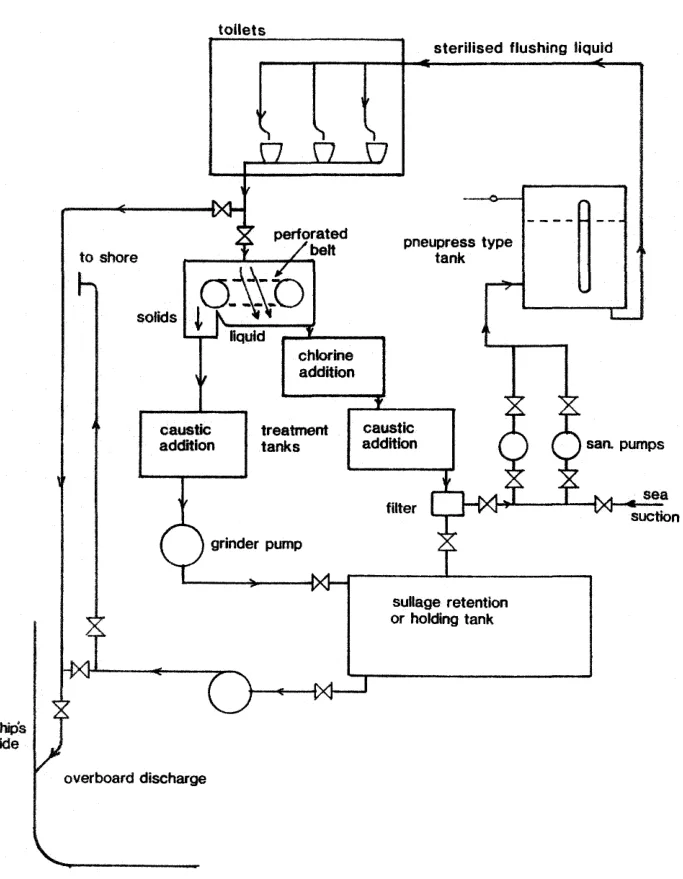
- An initial reception chamber, where liquid and solid separate.
- Wastes drop onto a moving perforated rubber belt, driven by an electric motor. The liquid passes through the belt; the solids travel with it into a caustic treatment tank.
- The solids are chemically inerted by a caustic compound and transferred by a grinder pump to the sullage or holding tank.
- The liquid passes via the perforated belt to treatment tanks containing chlorine and caustic based compounds, which makes the effluent acceptable for use as a flushing fluid.
- The Pneupress arrangement supplying the flushing liquid can deliver recirculated fluid, or sea water when the vessel is on passage.
The capacity figures
Holding tank capacity is 2 litres per person per day. The tank is pumped out at sea, or to shore if the ship is in port for a long period. Tank size is small because the liquid effluent passes mainly to the flushing system, with the excess overflowing to the sullage tanks.
Compare that with the 70 to 114 litres per person per day that a conventional system produces. Recycled effluent flushing is claimed to require only about 1 % of the retaining capacity of a conventional retention system.
That is the whole argument for the Elsan arrangement: by recycling the liquid as flushing water and inerting the solids, the volume that must be retained falls from tens of litres per person per day to two.
Why the system exists at all
The Elsan system is not merely a convenience. A plain retention tank has no oxygen in it, so anaerobic breakdown is inevitable — putrefaction, corrosion of the tank, and toxic and flammable gas. The mechanism is set out in Aerobic and Anaerobic Breakdown, section 1; what matters here is the conclusion. A plain holding tank is not a neutral solution. It is an anaerobic digester that happens to be located in the accommodation block. The Elsan system answers that by treating the liquid chemically and inerting the solids, so that what is stored is stable.
4. Choosing between the options
| Arrangement | Best suited to | Main limitation |
|---|---|---|
| Plain holding tank | Ships in port only briefly | Capacity becomes excessive for long stays; anaerobic breakdown in the tank |
| Vacuum toilets plus holding tank | Ships wanting to reduce retention volume | Still finite capacity; needs the vacuum system |
| Comminutor plus chlorine contact tank | Ships able to discharge between 4 and 12 miles | 20 minute retention required; discharge still prohibited inside 4 miles |
| Elsan zero-discharge | Ships required to discharge nothing at all | More complex; chemical treatment and grinder pump to maintain |
| Sewage treatment plant | Ships wanting to discharge anywhere | Needs continuous operation; bacteria die on shutdown |
The pattern is that each option trades capacity against complexity. A holding tank is simple and large. A sewage plant is complex and small. The Elsan system is complex and very small.