
Steam Boilers — Heat, Circulation, Types & EGB Fire
How flame becomes steam through three heat paths, why circulation decides survival, which boiler fits which duty — and why wet soot burns at 200 °C.
Key Principles at a Glance 6 points
- Steam heats fuel, tanks, accommodation and drives turbines, pumps, evaporators and deck machinery — the boiler is a floating utility plant.
- Flame heats by radiation (∝T⁴), gas-to-metal by conduction and convection together, water-side mixing finishes the job — all three at once.
- Circulation is survival: rising steam-water mixture must pull cool feed down continuously, or bubbles blanket tubes into blisters and burn-out.
- Fire-tube (gas in tubes, ≤7 bar, tolerant, sluggish) vs water-tube (water in tubes, to 100+ bar, fast, feed-fussy) is the master split.
- Scotch robustness, Cochran compactness with spheroid furnace fix, Sunrod low-temperature extraction, D-type 60 bar 510 °C 52 t/h performance.
- EGB tubes foul with wet carbon that ignites at 200 °C: stop the engine, keep the water circulating, starve the air, cool the boundary — burst tube shows as a climbing hot-well.
1. Duties & the Three Heat Paths
One auxiliary boiler heats fuel systems and tanks, feeds purifiers and calorifiers, warms accommodation, drives cargo-pump and generator turbines, deck winches, feed pumps, evaporators, soot blowers, atomising burners, smothering steam, incinerators and tank washing. Flame reaches water by radiation (flame-to-tube, fourth-power law, colour-sensitive), conduction (molecule-to-molecule through metal, thickness- and material-set) and convection (moving gas scrubbing tubes, coefficient-set) — furnace radiates, passes convect, water circulates the gain home.
2. Circulation Decides Survival
Hot water lightens and rises while cool water sinks to replace it. Boiling adds steam bubbles that burst free at the surface — and their turbulence is the pump.
Staggered tubes and arranged gas passes amplify the churn. Feed must enter where it joins the loop, never where it fights it.
Starve the flow and bubbles cling, merge and blanket — blistered, burnt-out tubes follow.
Water-tube geometry circulates almost instantly on steaming. Big fire-tube shells need coaxing until the loop establishes.
3. The Type Catalogue
| Type | Duty |
|---|---|
| Main | Propulsion steam past 100 bar, 513 °C — high-pressure water-tube |
| Auxiliary | Propulsion support (fuel heating and the like) |
| Donkey / Tank | Hotel loads and big water capacity at low pressure |
| Vertical / Horizontal | Shell orientation to fit the space available |
| Exhaust-gas / Composite | Waste-heat recovery, sometimes oil-fired combined |
| Package | Boxed automatics, coil or fire-tube, fast steam anywhere |
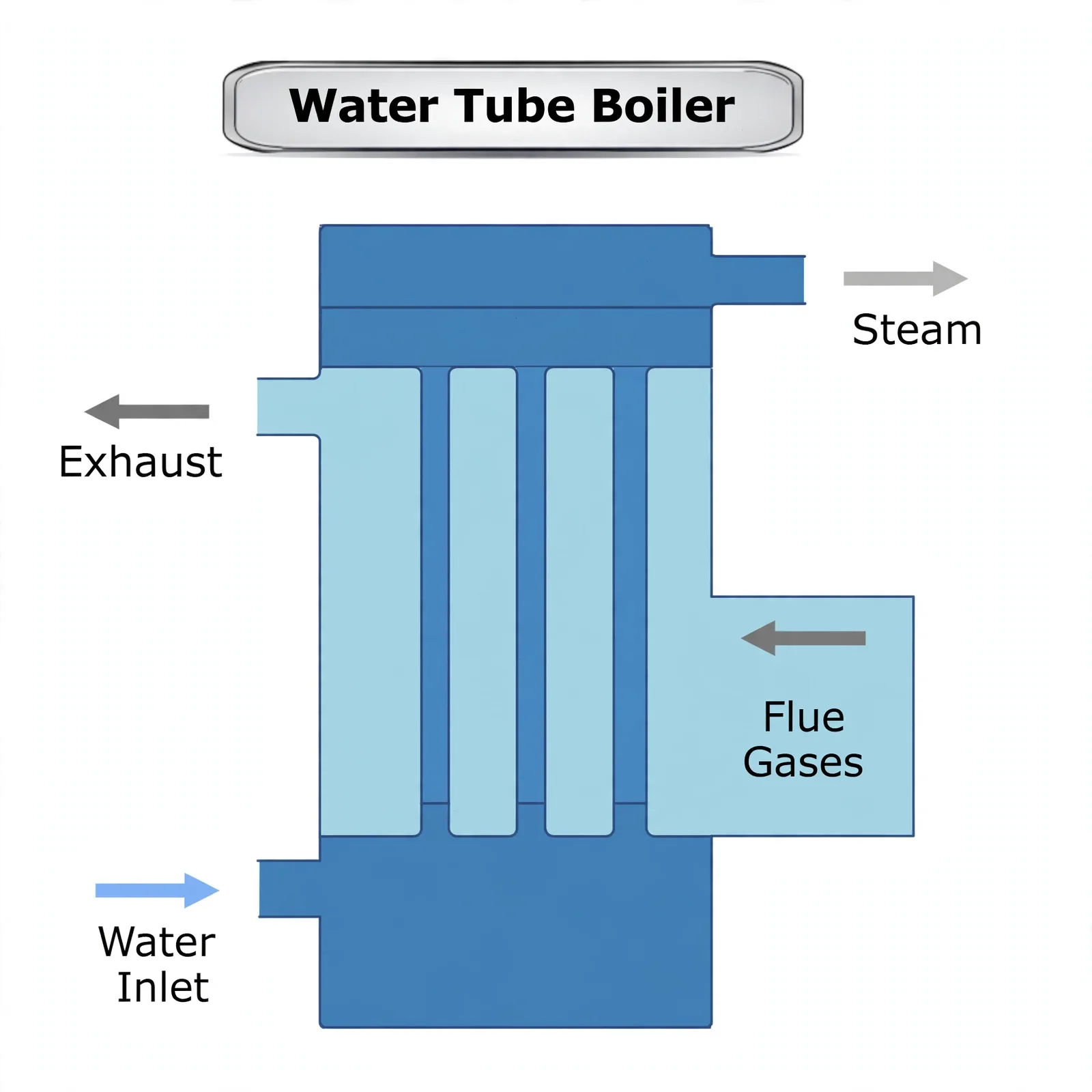
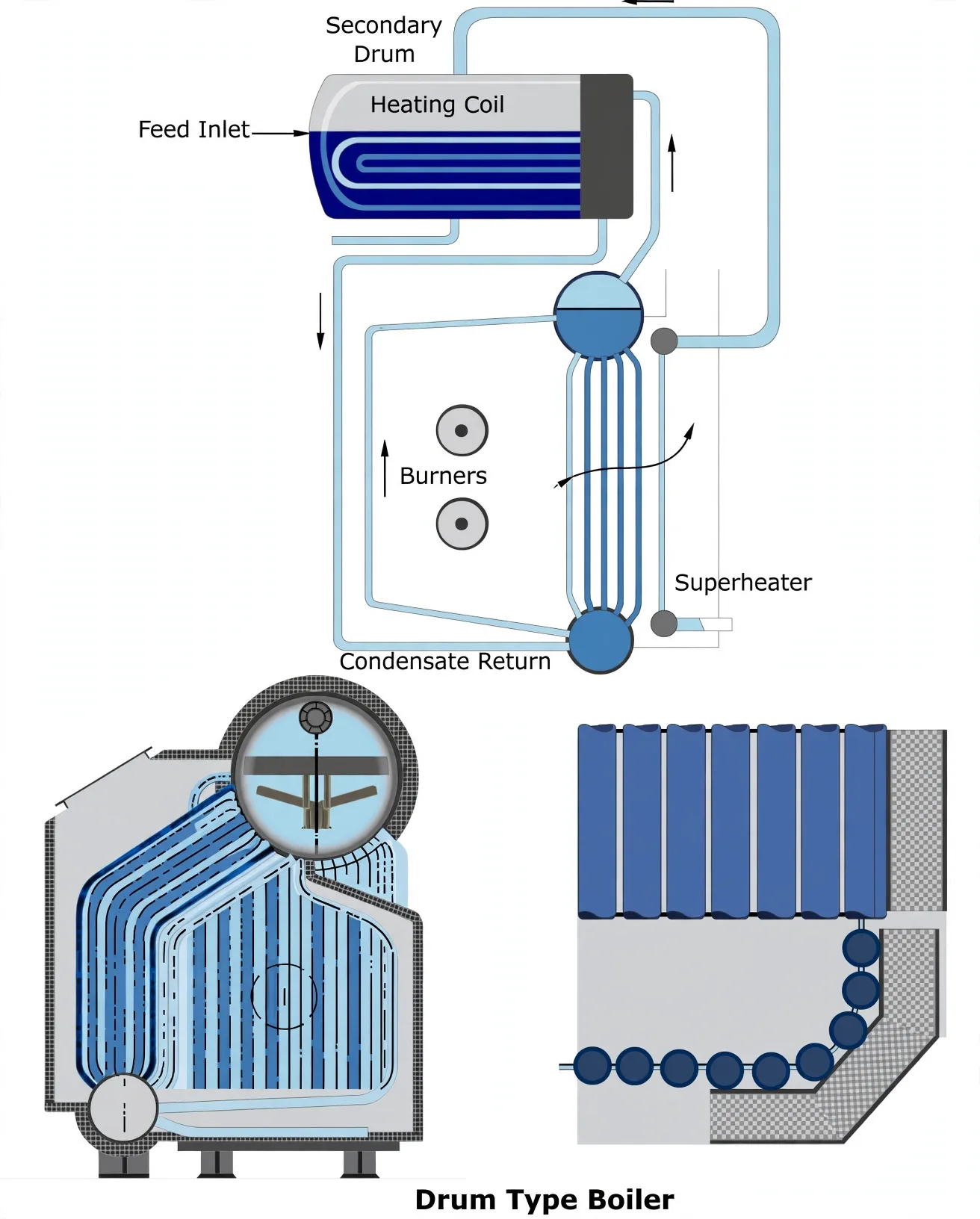
4. Scotch Fire-Tube — the Survivor
Two centuries old and still auxiliary-standard: corrugated furnace (collapse-proof, flexible, extra area) firing into a combustion chamber, smoke tubes carrying gas to the uptake through surrounding water, shell/end-plates/stays/refractory holding pressure. Wet-back vs dry-back variants; tolerant of indifferent feed, welded modern builds, capped near 7 bar.
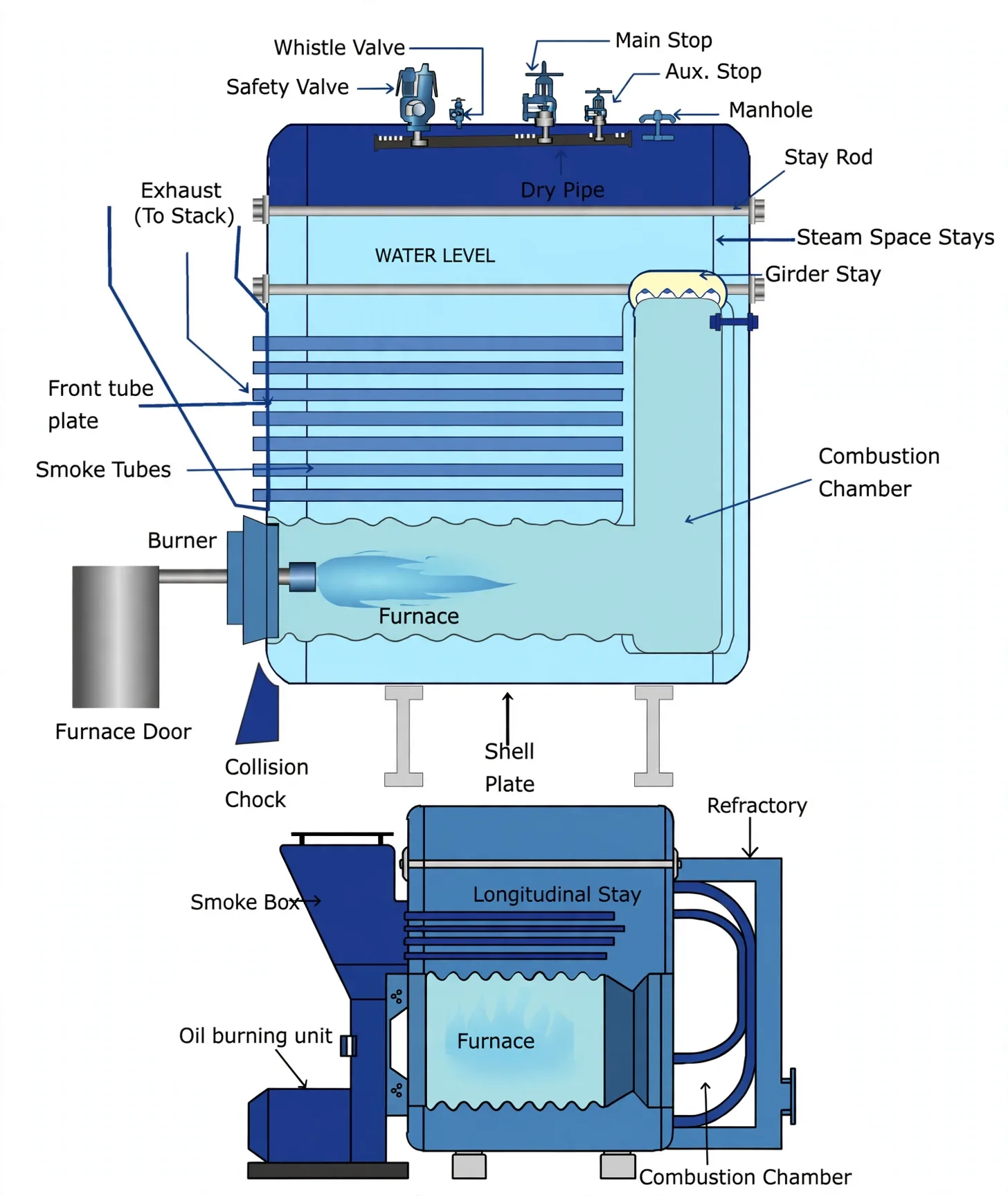
5. Water-Tube Designs — Pressure & Speed
Two drums (steam over water) with water-walled furnace alongside: 50 mm wall tubes on rectangular headers fed by underfloor tubes and 130 mm downcomers, eight screen-tube rows, multi-loop superheater (mild steel to alloy past its limit) on heat-proof beams, baffled gas path, economiser preheating feed, refractory where flame bites, air-cooled attemperator trimming superheat between stages. Variants: Cochran vertical (compact composite with exhaust recovery), spheroid (water all round the neck, killing the classic heat-stress failure), Sunrod (studded tubes milking low-temperature uptake gas on header-riser circulation), D-type (60 bar, 510 °C, 52,000 kg/h with full drum/header/tube discipline).
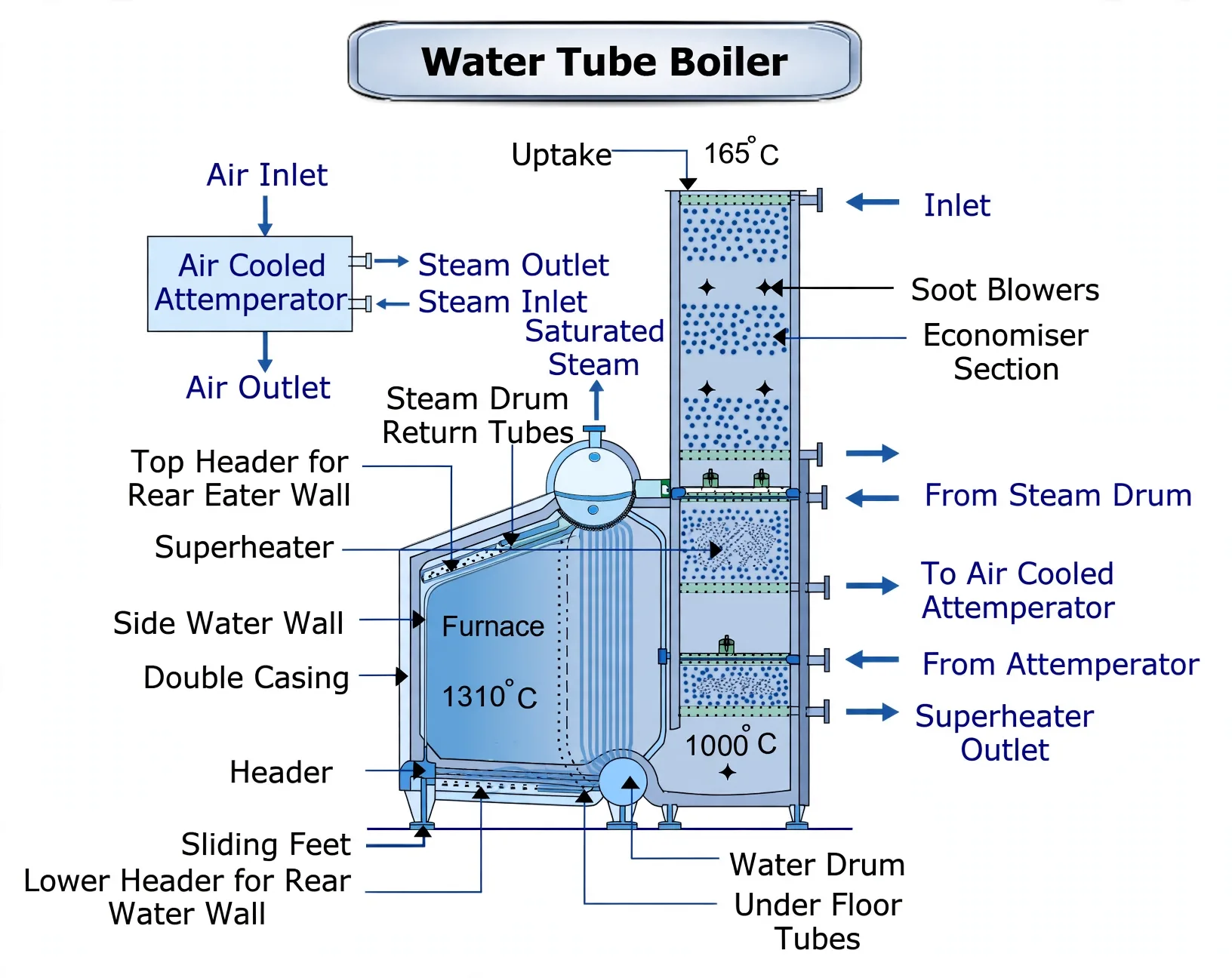
6. EGB Fire — Wet Carbon Burns at 200 °C
Idea in one line: dry soot is harmless at 1000 °C ignition — wet it with unburnt fuel or lube oil and it catches at 200 °C, inside a gas path you cannot see into.
The exhaust-gas boiler lives on main-engine exhaust: uptake gas crosses tube nests (plain, studded or spiral — studs and spirals grab more heat per metre) and heats circulating boiler water on its way to the funnel. Every deposit below starts as that bargain's price:
| Stage | What happens | What you see |
|---|---|---|
| Dry carbon | Self-ignition near 1000 °C — safe in normal gas temperatures | Normal uptake temperature, routine soot-blowing handles it |
| Wet carbon | Unburnt fuel/lube oil wets the deposit — ignition crashes to 200 °C | Sudden uptake-temperature rise, smoky smell, sparks from funnel, hot economiser body, flame in smoke indicator |
| Minor fire | Local deposit burning, heat transfer still partly alive | Sparks in exhaust, excess funnel smoke, outlet gas hotter than inlet |
| Major → metal fire | Heavy deposits insulate tubes red-hot and become the ignition source; water-washing dissociates to hydrogen (2H2O → 2H2 + O2) and oxidising metal burns | Steam pressure surging, 400 °C-class metal temperatures against a 180 °C norm, black smoke |
Slow the engine, never the water. Inform bridge, stop the main engine; keep the boiler circulating pump running — dry red-hot tubes plus water later means hydrogen fire.
Starve the air. Stop the auxiliary blower, shut turbocharger drains, canvas over the blower side, shut scavenge drains, stop the oil-fired boiler if running. No soot blowing, no load lowering (soot feeds it worse).
Fixed system or boundary cooling. Release the permanent EGB firefighting fit where provided; otherwise cool boundaries from outside and hold the watch.
If the hot-well level keeps climbing while you fight the fire, a tube has burst — stop the circulating pump at once or the inrushing water becomes the next hydrogen charge. Prevention between fires: clean tubes on schedule, burn good fuel, avoid long low-load steaming, soot-blow as routine.