
Boiler Water, Combustion, Draft & Economiser Leaks
How level is proved, how oil becomes a suspended flame, how fans divide the draught — and which way a leak pushes.
Key Principles at a Glance 6 points
- Tubular glasses serve below 17.5 bar, reflex below 34 — mica guards plain glass, ribs forbid it on reflex.
- Blow-through proves passages in a fixed order (drain, steam, water, refill, steam) with 45° respect for ball checks and full respect for shattering glass.
- Low level kills tubes: alarm, auto trip, and a drill that never bypasses the trip and restarts reserve feed first.
- Oil burns in four stages — heat, atomise, hollow cone, suspended flame — shaped by registers and two burner families.
- Furnace pressure is a design choice: pressure-fired membrane-tight with FD only, or balanced slightly negative with FD plus ID sharing the load.
- Leaks obey the pressure gradient: running shows oil in the funnel and a falling sump, stopped shows a rising sump and weeping aft seal — smoke-tube leaks are easy, water-tube leaks take a standby man.
1. Gauge Glasses — Seeing Truly
Twin gunmetal bodies grip the glass on tapered seals with steam, water and drain cocks — tubular for low pressure (ball check slams shut on fracture, cage guards the crew), reflex ribbed plate for higher duty (steam glares silver, water reads black, mica shields plain glass where ribs allow none).
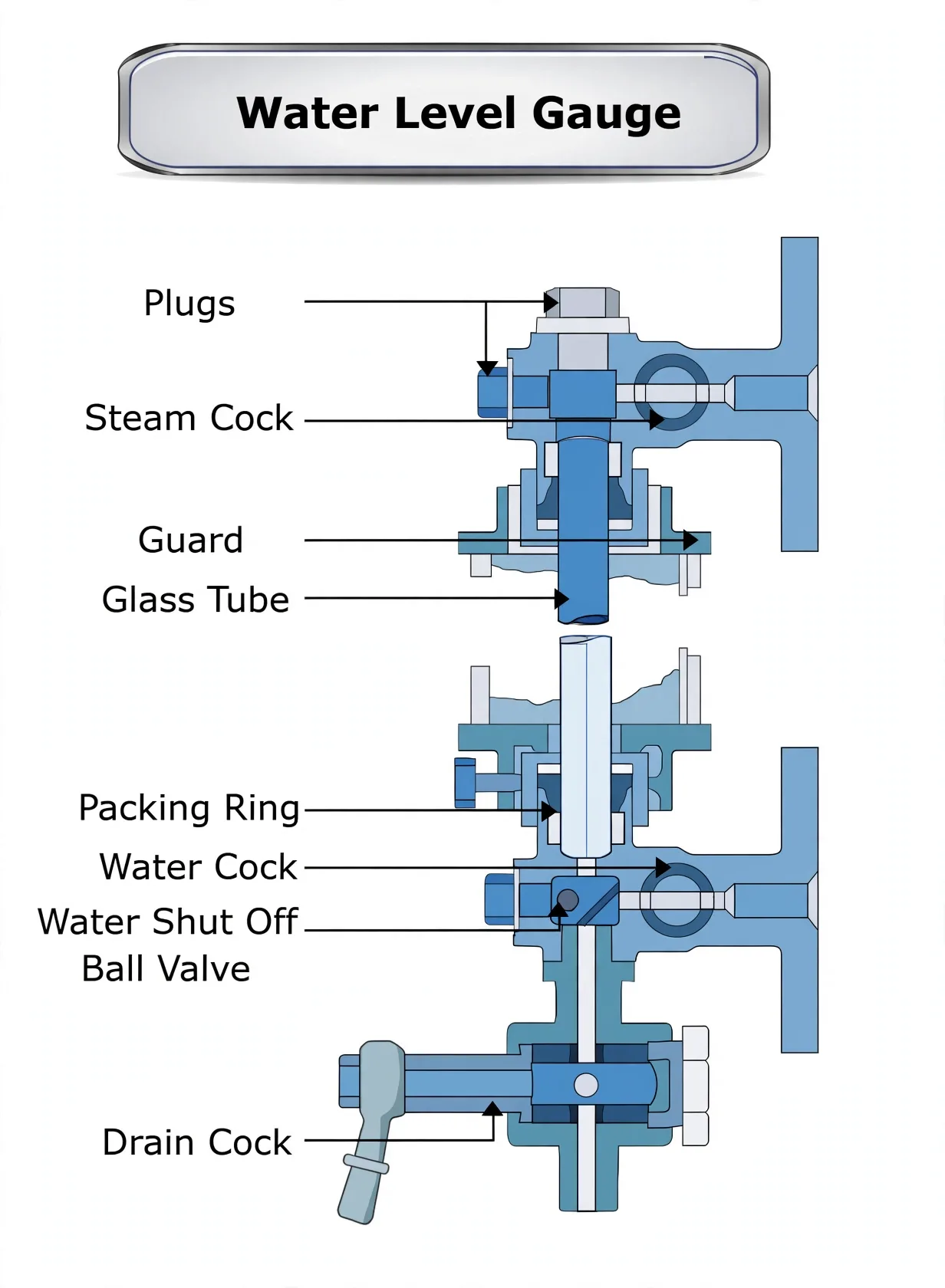
Blow-through order:
PPE on, both cocks shut, drain open and emptied (any continued flow indicts a cock).
Steam side 5 seconds, then water side 5 seconds.
Drain shut.
Water cock refills the glass against a holding drain.
Steam cock returns true drum level.
- Ball-check fittings get 45° turns only.
- Diverging glasses get blown immediately.
- Choked passages.
- Leaking drains.
- Foaming.
- Load swings.
- Overlong round glass.
2. Alarms, Cut-Outs & the Low-Level Drill
Level devices need their own discipline:
- Scale-prone float chambers earn weekly blows and checks.
- Magnetic snap-action floats drive feed pumps, high/low alarms and burner cut-out with tertiary-magnet latching.
- Igema U-tubes read red fluid against a condensing constant head at a distance, with diaphragm-pneumatic and bellows variants for control rooms.
Low-level drill:
Alarm answered instantly.
Trip never bypassed.
Reserve feed started.
Control to manual if needed.
Trip even without automation if the glass empties.
While the drill runs, local hands find the dead pump, the burst wall tube, the open drain or the failed controller link.
High level merely carries salt to superheaters. Low level kills tubes.
3. Combustion in Four Stages
Pressure holds steady only if fuel-air tracks load, and level only if feed tracks steam — the control system's twin loops. Oil burns as: heated (viscosity down for pumping and spraying), atomised (surface area exploded), hollow coned (rotation spreads a thin rotating sheet), suspended (inflow matching outflow freezes the flame front in space). Registers split primary from secondary air, swirl-mix it into the spray and meter the total; pressure-jet burners spin oil through swirl-and-orifice plates while rotary cups fling a gravity-fed film off a 5000 rpm cup — no HP supply needed.
4. Draft — Push, Pull or Both
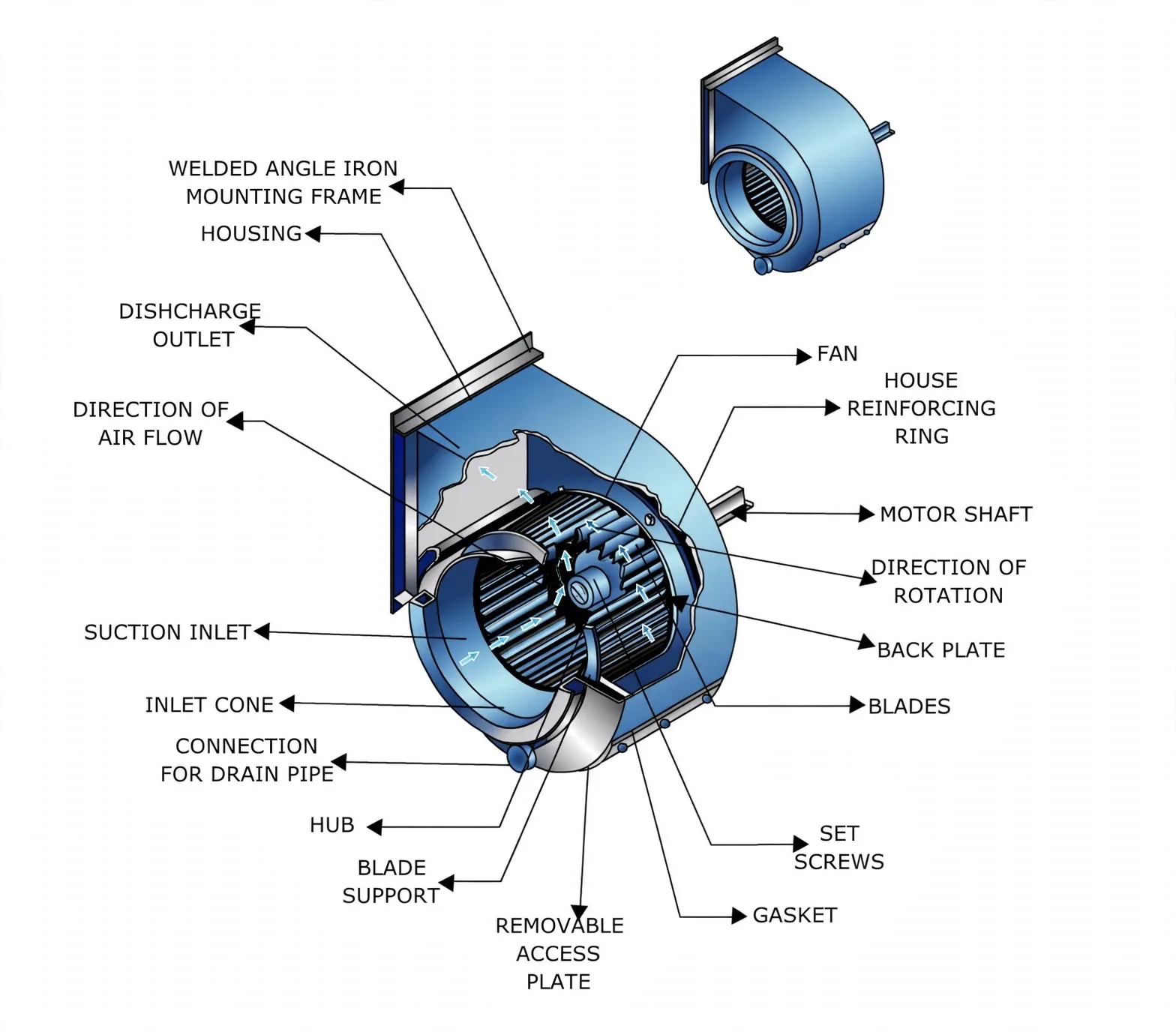
Fourteen cubic metres of air per kilo of oil (sixteen installed) must be pushed through every resistance in the gas path — each exacting its draft loss. Pressure-fired (FD only, membrane-tight furnace running positive, leaks forbidden as wall-eating blowtorches) is the marine norm; balanced (FD plus ID sharing load around a slightly negative set point) suits leaky solid-fuel practice where inward cool leakage beats outward hot. Stack effect alone stays a supplement. Centrifugal (radial/forward/backward, single/double inlet) and multi-stage axial families move the air, inlet vanes trimming flow cheaper than outlet dampers ever could.
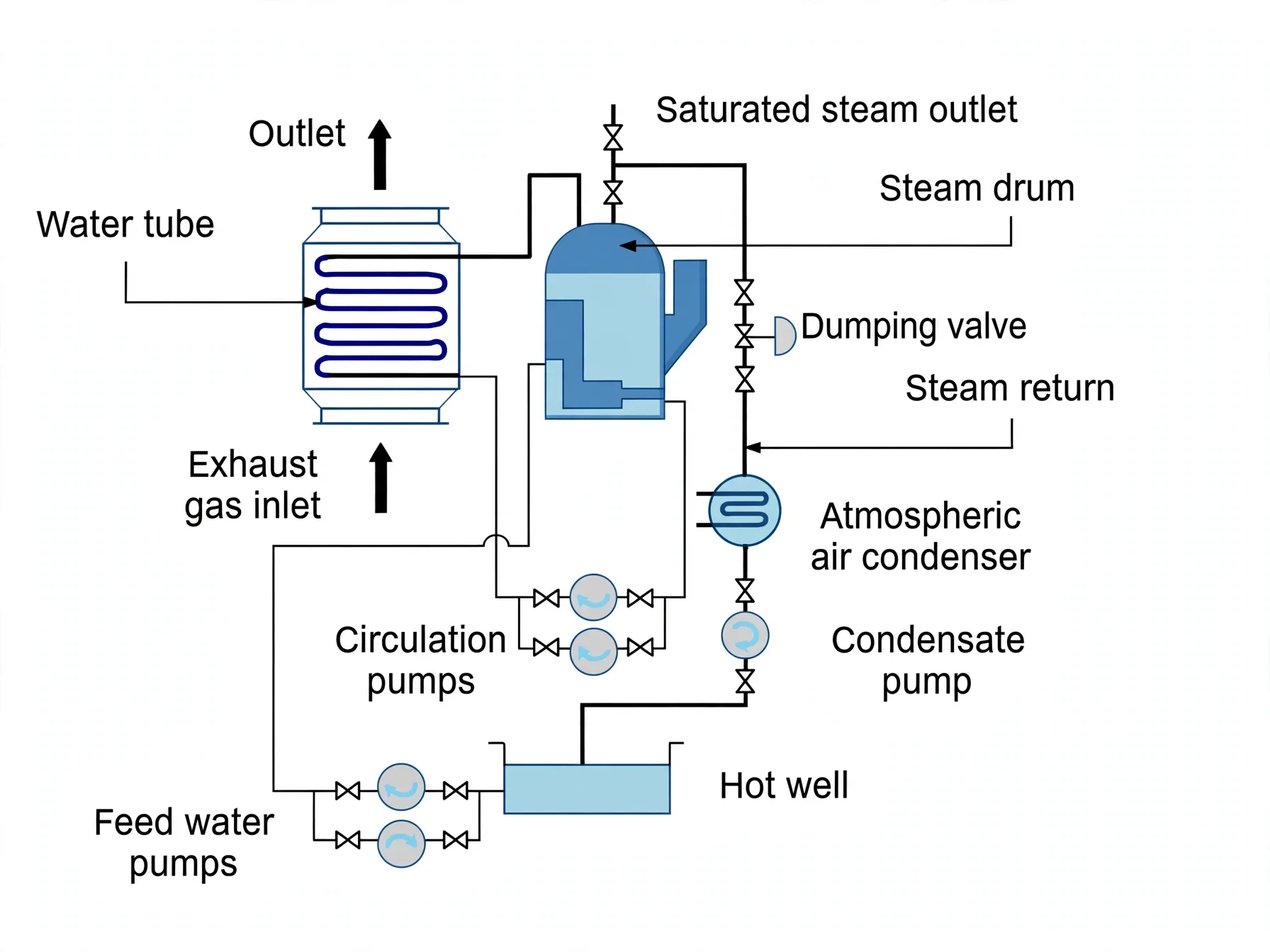
Waste-heat tail: uptakes grow WHR tube nests, composite change valves and economisers (forced-circulation loops feeding the aux drum, turbo-alternators on big exhaust flows, steam dumped or bypassed to regulate) — circulated two hours before the engine turns, never dry except emergency, soot-blown running and water-washed in port against soot fires.
5. Economiser Leaks & Fire Response — Read the Gradient
Idea in one line: while running, oil pressure beats seawater pressure and leaks show in the funnel; stopped, the gradient reverses and leaks show in the sump — read the direction before touching a valve.
Tube-leak indications (Prashant): hot-well level falling, white funnel smoke, economiser temperature dropping, manometer and boiler pressures sagging, feed-pump pressure sagging, turbocharger surging only when damage is heavy. Economiser-tube leak specifically: soot-collecting (shoot) tank wet, white funnel smoke, hot-well level dropping fast.
Finding it (BOILER-1): smoke-tube boiler — stop firing below about 5 bar, open tube-side doors, look for the weeper, plug wood. Water-tube boiler — stop firing, open the furnace door, go in at once with heat protection and ice, a standby man outside; when dehydrated, come out and send the next man. Never send one man alone into a hot drum.
Economiser-fire response (BOILER-1): circulation-pipe leak means stop the main engine — inform bridge first. Never use soot blowers on the fire (they feed hydrogen fire). Cover the turbocharger suction filter so no air feeds in. Fixed spray nozzles at the economiser drench it on command. Boundary-cool throughout. Economiser safety valve rides the outlet pipe, set 10–15% above the boiler valve by the Chief, proved en route with the circulating pump running and the outlet throttled against the gauge.
Deposit ignition, minor-vs-major escalation and the keep-pumping rule sit in Steam Boilers §6 — read both halves before the viva.