
Globe & Gate Valves — Overhaul, Seats & Testing
How a globe throttles and a gate isolates, how to rebuild either without wrecking the seat, and the two tests that prove it.
Key Principles at a Glance 5 points
- Globes throttle (disc moves into the flow path); gates isolate (wedge lifts fully clear) — throttling with a gate wire-draws the wedge to ruin.
- Stem truth is measured, not guessed: roll for a quick check, lathe plus dial gauge for the verdict; scratches kill packing, so stone them out.
- Seats heal by lapping together, renew by screwing in, shrink-fitting with liquid-nitrogen cold, or cutting true — matched to the damage.
- Globe reassembly lives or dies on disc-to-seat centering, proved with the bonnet loose before final torque.
- Proof is two-stage: water above the closed disc for weeps, then air at or above service pressure for bubbles — or a 5-minute zero-drop hold.
1. Two Valves, Two Duties
Idea in one line: a globe meters flow by choking it; a gate passes flow by getting out of the way — use each for its own duty or destroy it.
Globe — throttles
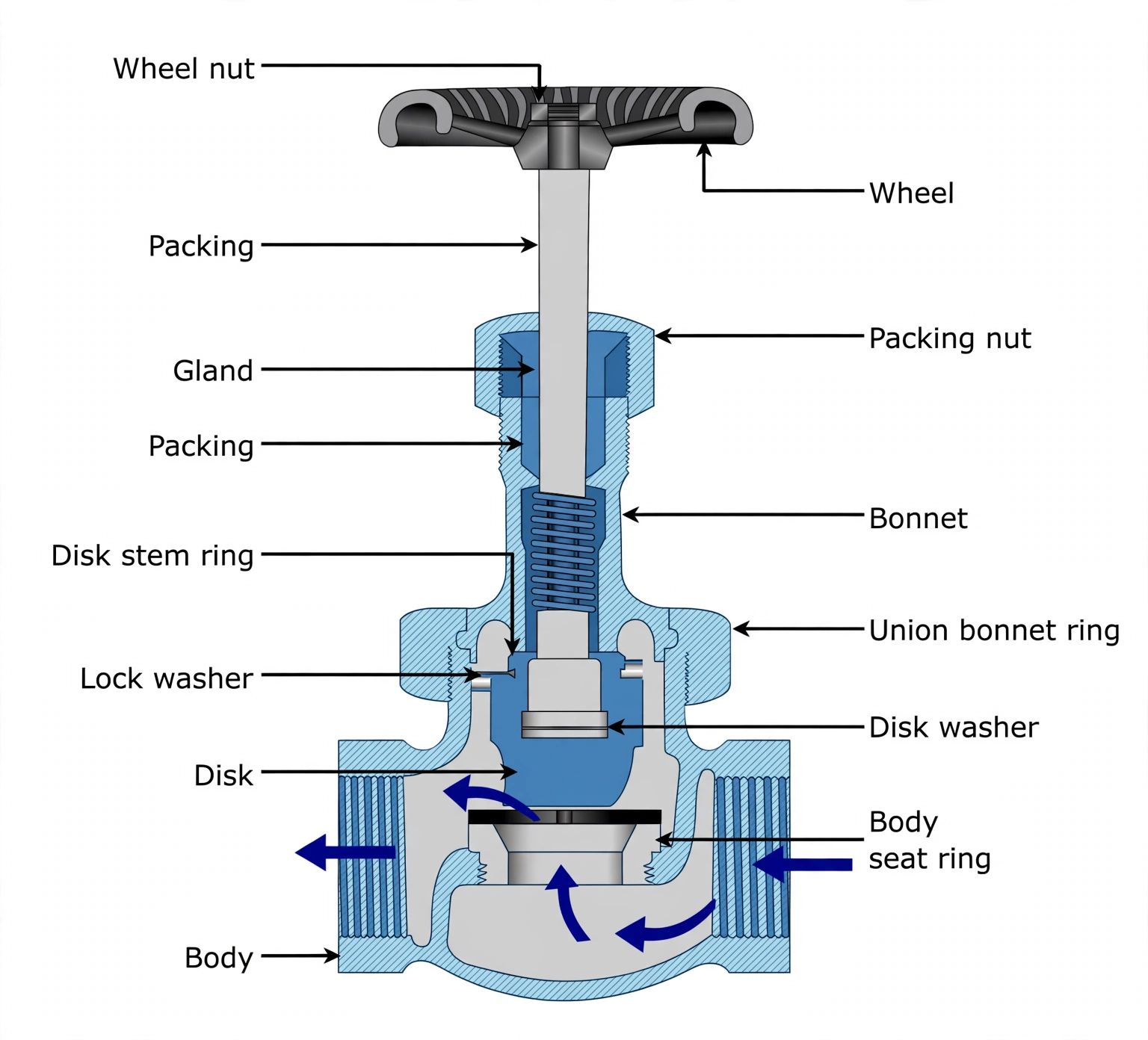
Disc descends onto a seat ring square across the flow. Partial lift meters flow precisely — and the seat takes the beating, which is why globes are built to be re-lapped.
Gate — isolates
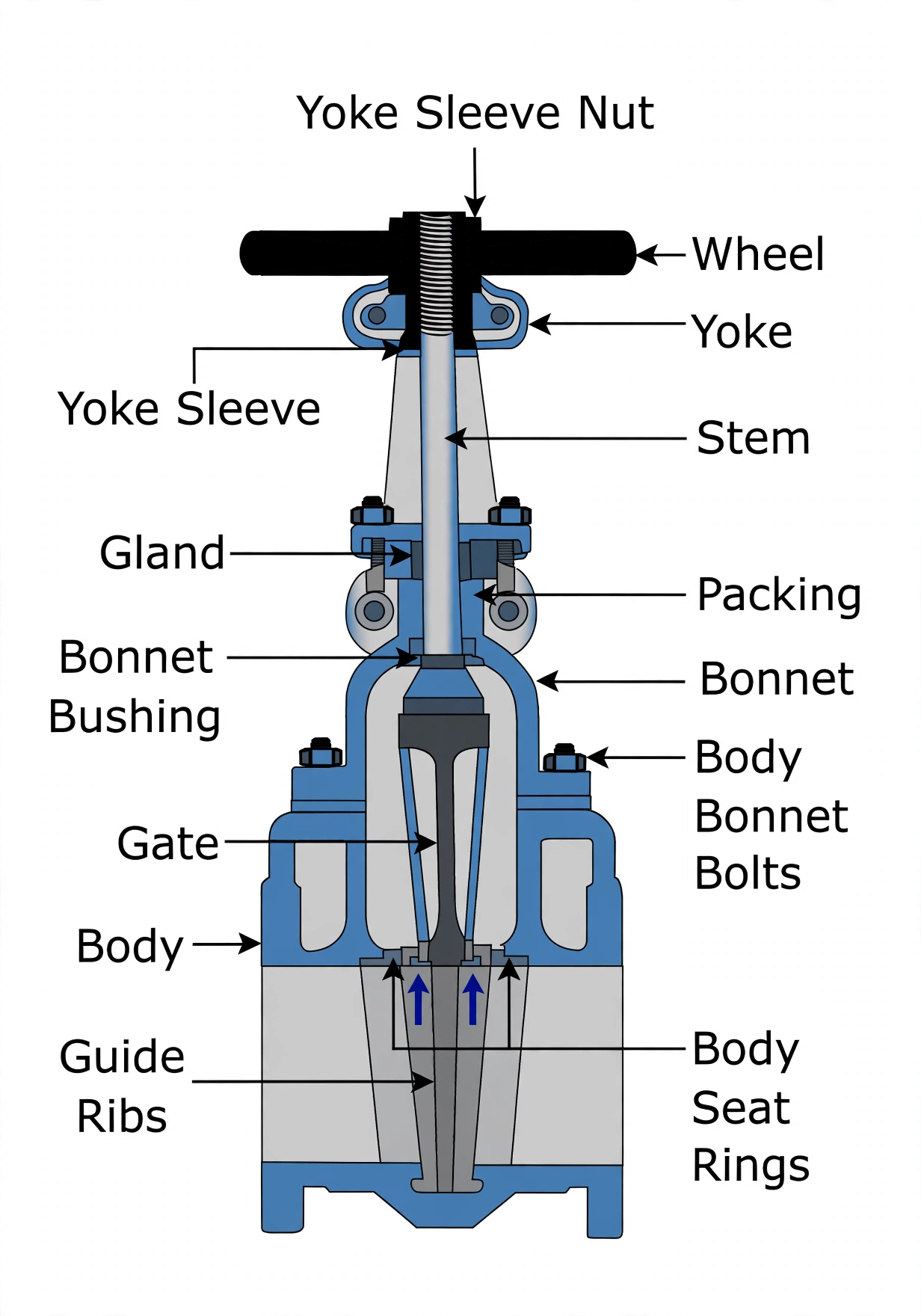
Wedge rises fully out of the bore for straight-through flow. Used half-open, high-velocity jets cut erosion channels (wire drawing) across wedge and seats — a ruined valve, not a regulated flow.
2. Globe Strip-Down & Inspection
Idea in one line: dismantle from the top down, inspect stem truth and faces, and let lapping — not force — make the seal.
Open the top. Wheel nut and handle off; bonnet bolts out — the top assembly (seat, stem and all) lifts clear of the body. Never lay parts on the floor — clean surface only.
Free the stem and disc. Bonnet in the vice; gland bolts, flange and bush off; screw the stem clockwise out from below with its disc; free the disc set screw.
Pull packing properly. Every gland packing out with an extractor — dug-out packing scores the stuffing box and the new rings will leak from day one.
Clean and measure. Buff and polish; dress thread damage with a needle file. Stem straightness: roll on a flat surface for a quick check, lathe plus dial gauge on a magnetic stand for the verdict. Scratches stone out with emery or oil-stone — they would chew new packing.
Lap the pair. Sound disc and seat ground together with a centring guide and correct paste grade until both faces mate fully — the faces marry each other, not a specification.
3. When Lapping Is Not Enough — Seat Surgery
Idea in one line: lapping heals faces; destroyed seats need surgery — and the seat's mounting decides the operation.
| Seat type | Damage | Cure |
|---|---|---|
| Screwed-in replaceable | Worn beyond lapping, or lapping would take forever | Unscrew and renew — fastest fix |
| Shrink-fitted | Same, in a plain bore | Knock the old out; chill the new in liquid nitrogen or a refrigeration compartment — it drops in small, then expands into a grip-tight fit |
| Built-in | Cannot be removed at all | Machine true in place with a valve-seat cutter (sized cutters, centring guide); badly worn discs go to the lathe first, then lap together |
4. Rebuild Centred, Prove Twice
Idea in one line: lapped faces seal only when they land dead-centre — guideless valves punish any offset, so centering is proved loose before torque.
Build the stem. Disc on the stem with its set screw; greased threads through the yoke nut with gland nut and flange in correct order.
Wheel on, wound shut. Fit the handle and nut, close fully so the disc sits at maximum reach.
Gasket down. Correct-size new gasket on the body, stuck with grease (moly slip for hot duty).
Lower loose, prove centre. Bonnet on with bolts loose — a gap stays between body and bonnet. Sight through it: disc dead on seat. Re-centre now; after torque it is too late.
Draw together square. Crack the valve open — the gap closes evenly and bonnet meets body square. Fully open, torque bonnet bolts in sequence.
Pack and stroke. Correctly cut greased rings in the box; gland bolts only nipped — final nip at installation. Stroke repeatedly, sight through the flanges that it seats true. Prime outside, set aside to dry.
Two tests, then a tag
| Test | Method | Pass |
|---|---|---|
| 1 · Water weep | Flood water above the shut disc | No weep to the other side — weep means re-lap and retest |
| 2a · Air bubble | Flange below, air at or above service pressure under the seat | Zero bubbles on the water above |
| 2b · Pressure hold | Charge one side through a regulating valve and gauge, shut the valve | Zero drop in five minutes |
Tag the valve tested with the date before it returns to store.
5. Gate Faults — Silt and Wire Drawing
Idea in one line: gates fail two ways — dirt jams them (cleanable), misuse cuts them (fatal).
Silted guides — clean it
The common complaint: silt on the guideways makes the valve go tight. Open, scrape the grooves between wedge seats without touching the seats, reassemble reversed. Testing copies the globe water-plus-air method.
Wire-drawn wedge — renew it
Throttling misuse jets erode-cut the wedge. No lapping fixes it — renew the gate (a donor gate from a scrapped valve works) and retrain the operator who throttled an isolating valve.
Gate overhaul mirrors the globe sequence — wheel, gland, bonnet with wedge, stem out from below, buff, dress threads, inspect seats, build reversed. Gate testing is the same water-plus-air proof: bubbles mean bad sealing, no exceptions.