
MARPOL Annex V — Prevention of Pollution by Garbage from Ships
Universal plastics ban, 25 mm food comminution, 3 NM / 12 NM distance matrix, color-coded stations, and GRB Parts I & II.
Key Principles at a Glance 6 points
- MARPOL Annex V applies universally to all ships; it issues no statutory certificate, relying on mandatory Placards, the Garbage Management Plan (GMP), and the Garbage Record Book (GRB) for proof of compliance.
- There is an absolute, non-negotiable global ban on the discharge of all plastics, synthetic ropes, fishing gear, and plastic incinerator ash into the sea anywhere on earth.
- Food waste may be discharged outside Special Areas if comminuted to pass through a 25 mm screen at ≥3 NM from land, or uncomminuted at ≥12 NM en route; inside Special Areas, only comminuted food waste at ≥12 NM is permitted.
- Ships of 12 m or more LOA must display multilingual placards; ships ≥400 GT or certified to carry ≥15 persons must maintain an approved GMP and GRB (preserved for 2 years).
- Under IMO MEPC.277(70), the Garbage Record Book is split into Part I (All ships: Categories A to I) and Part II (Ships carrying solid bulk cargo: Categories J and K cargo residues).
- Cooking oil, domestic wastes, incinerator ash, operational waste, and e-waste must be retained on board and discharged exclusively to authorized port reception facilities.
1. Annex V Scope & Shipboard Waste Processing Station Architecture
MARPOL Annex V: Regulations for the Prevention of Pollution by Garbage from Ships governs all domestic, operational, and cargo-related solid wastes generated during normal ship operations. Floating plastics and operational trash choke marine mammals, ruin propellers and sea chest suctions, and transport toxic invasive species across oceans.
Annex V applies to all ships of any size, from small tugs to ultra-large container ships. Unlike Annexes I, II, IV, and VI, no statutory certificate is issued under Annex V. Environmental compliance is verified solely through physical equipment, crew operational adherence, and statutory paper logs (Placards, Garbage Management Plan, and Garbage Record Book).
Under the revised Annex V regime, modern commercial vessels operate a centralized Garbage Processing Station equipped with mechanical volume-reduction machinery and standardized color-coded receptacles:
2. Marine Food Waste Comminuter & 25 mm Screen Engineering
Under MARPOL Annex V Regulation 4, the only domestic solid waste legally permitted to be discharged overboard is food waste. Discharge permissions depend on whether the food has been mechanically ground to pass through a standardized screen:
The mechanical engineering of a marine food waste macerator pulper illustrates the statutory 25 mm sizing screen plate:
3. Permissible Discharge Distance Matrix & The Eight Special Areas
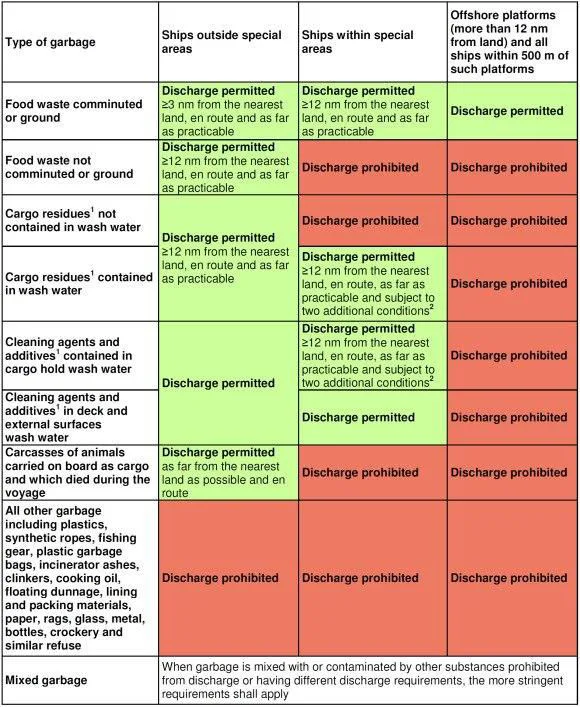
MARPOL Annex V establishes a comprehensive matrix balancing garbage category, comminution status, and vessel position. Under the 2013 revised Annex V regime, the historic default presumption was inverted: discharge of all garbage is prohibited unless explicitly permitted by a specific regulation.
| Garbage Category | Discharge Outside Special Areas | Discharge Inside Special Areas | Offshore Platforms (>12 NM) |
|---|---|---|---|
| Plastics (Category A) | PROHIBITED (Discharge ashore only) | PROHIBITED (Discharge ashore only) | PROHIBITED |
| Food Waste (Comminuted ≤25 mm) | Permitted at ≥ 3 NM en route | Permitted at ≥ 12 NM en route | Permitted at ≥ 12 NM (screen ≤25 mm) |
| Food Waste (Uncomminuted) | Permitted at ≥ 12 NM en route | PROHIBITED | PROHIBITED |
| Cargo Residues (Non-HME) | Permitted at ≥ 12 NM en route | Permitted at ≥ 12 NM (only if no reception) | PROHIBITED |
| Cargo Residues (Harmful - HME) | PROHIBITED | PROHIBITED | PROHIBITED |
| Domestic Wastes & Cooking Oil | PROHIBITED (Categories C & D) | PROHIBITED (Categories C & D) | PROHIBITED |
| Incinerator Ashes (Category E) | PROHIBITED (Retain for shore) | PROHIBITED (Retain for shore) | PROHIBITED |
| Operational & E-Waste | PROHIBITED (Categories F & I) | PROHIBITED (Categories F & I) | PROHIBITED |
The Eight Special Areas Under Annex V:
In oral exams, surveyors frequently expect candidates to rattle off the eight Special Areas designated under Annex V Regulation 1:
1. Mediterranean Sea
Enclosed coastal basin with immense tourist traffic; zero operational dumping except comminuted food at ≥12 NM.
2. Baltic Sea Area
Brackish water with high ecological vulnerability; strict shore reception mandated for all operational residues.
3. Black Sea Area
Anoxic bottom layers; zero cargo residue discharge permitted without certified non-HME wash water certificates.
4. Red Sea Area
Vulnerable coral reef biomes flanking high-density transit routes; food waste restricted to ≥12 NM.
5. "Gulfs" Area
Persian/Arabian Gulf shallow basin; intensive petroleum extraction and desalination plants demand strict protection.
6. North Sea Area
Heavy merchant shipping, offshore oil rigs, and commercial fishing grounds; plastics and ashes completely banned.
7. Antarctic Area
South of 60°S latitude; pristine wildlife sanctuary with total prohibition on all discharges, including food waste.
8. Wider Caribbean Region
Includes Gulf of Mexico and Caribbean Sea; protects coral atolls and island nation economies from cruise ship debris.
4. Placards, Garbage Management Plan & GRB Parts I & II
Annex V compliance is enforced through an escalating hierarchy of documentation and evidentiary records based on vessel size and crew complement:
Placards (Ships ≥ 12 m LOA)
Durable notices posted in the galley, mess rooms, bridge, and ECR notifying crew and passengers of discharge rules. Must be in the working language of the crew, and in English, French, or Spanish for international trade.
Garbage Management Plan (GMP)
Mandatory for ships ≥400 GT or ≥15 persons. Provides written ship-specific procedures for collecting, storing, processing, and disposing of garbage, designating the Chief Officer as the officer in charge.
Garbage Record Book (GRB)
Mandatory for ships ≥400 GT or ≥15 persons. Each discharge into the sea, delivery to shore reception, completed incineration, or accidental loss must be logged immediately and signed by the officer in charge; Master signs each page.
GRB Structure: Part I vs Part II (Resolution MEPC.277(70)):
Effective from 1 March 2018, the Garbage Record Book is formally split into two separate statutory books:
| Record Book | Target Vessel Scope | Statutory Categories Recorded |
|---|---|---|
| GRB Part I | All ships ≥400 GT or ≥15 persons |
Category A: Plastics Category B: Food waste Category C: Domestic wastes (paper, cardboard, rags, bottles, crockery) Category D: Cooking oil Category E: Incinerator ashes Category F: Operational wastes (cargo dunnage, rags, sweepings) Category G: Animal carcasses Category H: Fishing gear Category I: E-waste (computers, circuit boards, batteries) |
| GRB Part II | Solid Bulk Cargo Carriers ≥400 GT |
Category J: Cargo residues (Non-Harmful to the Marine Environment - Non-HME) Category K: Cargo residues (Harmful to the Marine Environment - HME) |