
Lube Oil & Fuel Systems — Properties, Treatment & Changeover
Four jobs one oil does, the fuel enemies written in the bunker analysis, and why heavy oil never sleeps.
Key Principles at a Glance 6 points
- One oil lubricates, cleans, cools and works hydraulics — failure in any role cascades into the others.
- High-sulphur combustion breeds sulphuric acid on liners, so cylinder oil is a separate alkaline system with mechanical lubricators per unit.
- Continuous purification runs sump-to-sump at sea (system volume three times daily at 40% throughput); water past 0.5% triggers extraordinary measures.
- Batch rescue means settle 24 hours at 60 °C with periodic draining, purify at optimum to a cleaned sump, and let the lab rule on reuse.
- Heavy oil circulates hot even with the engine stopped; diesel waits for lay-ups, repairs, drydock and disciplined changeover.
- Fuel enemies are named in analysis: cat fines grind, sulphur corrodes, asphaltenes block, vanadium-sodium ash burns valves — microbes grow only where water settles.
1. Four Jobs, Two Oils
Idea in one line: one oil films, flushes, cools and pushes hydraulics — while a second, alkaline oil fights acid on the liner wall alone.
Lubrication
Films every moving part against friction and wear — mains, crossheads, guides, rods, thrust, chain drive.
Cleaning
Carries dirt and debris away from running surfaces to filters and separator.
Cooling
Holds pistons and bearings inside tolerable temperature, including piston-cooling spaces.
Hydraulics
Works hydraulically actuated exhaust valves as the pressure medium.
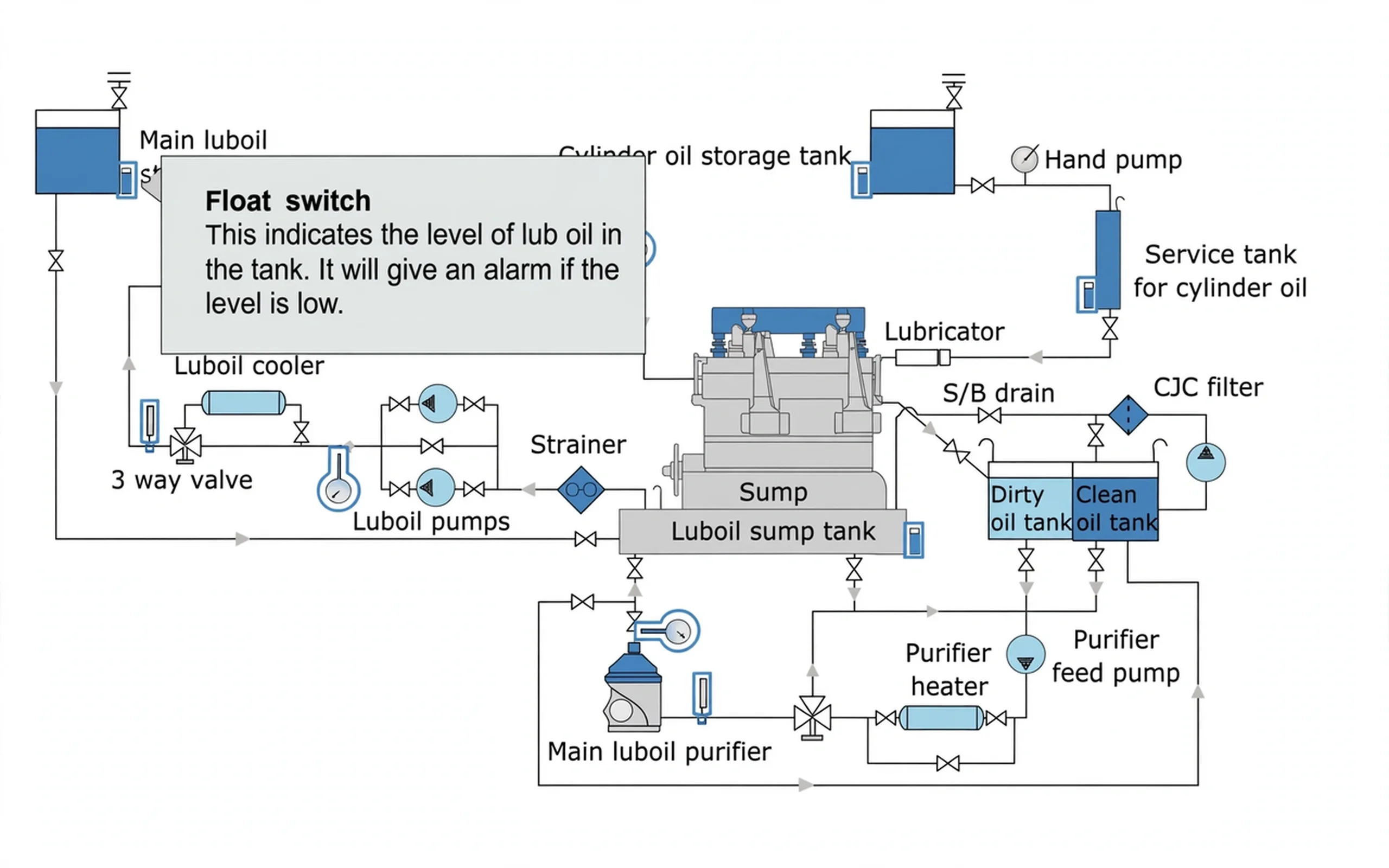
Main supply pump draws from the sump and feeds mains, crosshead bearings and guides, connecting-rod bearings, thrust, chain drive and piston cooling. A self-cleaning centrifugal separator works in bypass, drawing sump oil and returning it to the sump after stripping water and solids.
Slow-speed cylinder liners get their own system: high-sulphur fuel makes dilute sulphuric acid on the wall, so special alkaline cylinder oil — dosed to neutralise acid and keep liners clean — is metered by mechanical lubricators to each cylinder and injected between liner and rings on the upstroke.
2. Watch the Sump, Rescue by the Book
Idea in one line: a steady sump is a healthy engine — any move beyond consumption and refills is a leak talking, and water past half a percent is an order to act.
Sump quantity holds one safe litres-figure allowing only consumption, losses and refills — any other rise or fall means trouble. Routine health is onboard testing plus sea-going purification, with purifier and filter dirt load telling when intensity must rise.
Batch rescue:
Find and kill the seawater entry first — purifying into an open leak is bailing a holed boat.
Shift the whole charge to the settling tank and hold around 60 °C.
Settle about 24 hours, draining water and sludge on schedule.
Scrub and inspect the empty sump.
Re-purify at optimum temperature and minimum throughput back into the cleaned sump.
Shore-test before reuse — the lab rules whether the oil returns to service or needs water-washing treatment.
3. Fuel That Never Sleeps
Idea in one line: heavy oil is kept hot and moving even at standstill so it is injectable on demand — diesel waits in reserve for the days the engine goes cold.
| Circuit | Path |
|---|---|
| Heavy oil | Bunkers → settling → service → transfer, supply and circulating pumps → purifiers → heaters → mixing column → engine — circulating preheated oil continuously, stopped or running, so pumps, pipes and valves stay at service temperature. |
| Diesel | Bunkers → settling → service → transfer pumps → strainers → full-flow filters → viscosity regulator → engine, with its own purifier — held ready for emergencies, heating failures and changeovers. |
Change to diesel for a prolonged cold inactive period, major fuel-system repair, drydock or long lay-up — never casually. Reduce load per procedures, secure tracing steam, set viscosity control for the lighter fuel, ease the changeover valve across while watching line pressure, then secure heavy-oil feed and swing returns to the diesel service tank once flushed. Reverse the discipline coming back.
Gravity-disc selection, start-up proofs and desludge intervals belong to Purifier Operation — Separation, Start-Up & Oil Limits; fuel-ready bunkering practice to the fuel-preparation routine.
4. Fuel Properties — What the Lab Reads Before the Engine Burns It
Idea in one line: every fuel fault the engine ever shows — smoke, trumpet nozzles, choked filters, corroded valves, surging turbocharger — was already written in the bunker analysis.
Characteristics that matter (MOT): viscosity sets heating and injection temperature; CCAI grades ignition quality (high CCAI means lazy ignition — shorten the delay with hotter fuel and correct timing); catalytic fines (aluminium + silicon from refinery cracking) grind pumps, valves, liners and rings; sulphur feeds cold corrosion and steals calorific value (~0.7% per 1% S); asphaltenes block filters, upset purifiers and grow trumpet/petal nozzle deposits (dispersant-dosed); Conradson carbon above ~10% fouls chambers and smokes; ash metals (vanadium, sodium) melt at 480–560 °C into hot corrosion on exhaust valves, while nickel, aluminium, silicon and sand abrade everything they touch:
Representative sampling — the analysis is only as honest as the sample
Sample at six points: before the filter, cooler inlet, engine inlet, LO pump inlet, and the two points the book adds for the system under test. One bottle per point, labelled, sealed, dispatched — a single bunker-manifold drip tells you about the manifold, not the engine.
Microbial degradation — the sump grows its own enemies
Anaerobic sulphate-reducing bacteria live without oxygen in sump-bottom water, eating hydrocarbons and additives into acids, stable sludge, corrosion cells and H2S. Signs: rotten-egg smell, choking filters, discoloured oil, crankcase sludge, mud on the sounding tape, yellow crankcase patches, pitted purifier bowl, rust film on the oil, dead additive performance. Prevention: keep LO and purifier running so water never settles, heat the crankcase if the pump stops, test oil on schedule, dose stored oil with biocide.